
Garage Ramp Slope Calculator: Ensure Safe & Code Compliant Parking
Designing a functional, safe, and code-compliant ramp for a parking structure or residential driveway is one of the most critical aspects of architectural planning. A miscalculation in your parking garage ramp slope can lead to disastrous consequences—ranging from minor bumper scrapes to severe structural undercarriage damage to vehicles. It can also result in failed building inspections and costly concrete tear-outs.
Whether you are a structural engineer mapping out a multi-level commercial facility, a contractor pouring a new concrete driveway, or a homeowner trying to figure out how to prevent cars from scraping on a driveway ramp, getting the math right is non-negotiable.
- Rise: This is the total vertical distance your ramp needs to cover. For a multi-level parking garage, this would be the floor-to-floor height. For a residential driveway, it is the height difference between the street level and the garage floor.
- Run: This is the total horizontal distance available for the ramp. It is crucial to remember that the “run” is the flat footprint on the ground, not the actual diagonal length of the ramp surface itself.
- The Gradient Percentage: The most common metric used in building codes to define slope.
- The Angle in Degrees: The exact pitch of the ramp.
- The Hypotenuse (Ramp Length): The actual linear distance of the driving surface.
Find Garage Door Seo Hub on Instagram
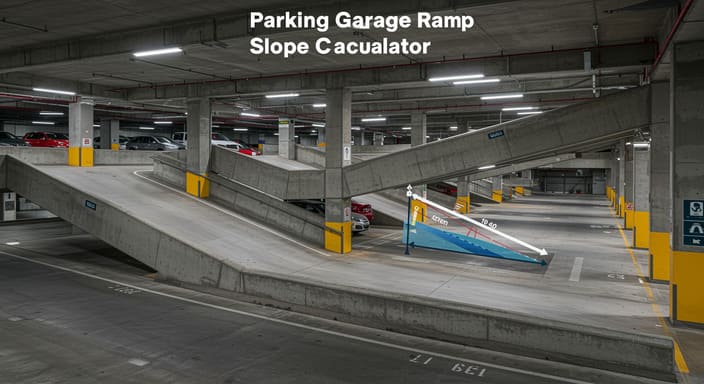
Parking Garage Ramp Slope Calculator
Calculate ramp dimensions for ADA compliance and safety with our advanced calculator
Ramp Parameters
Calculation Results
Ramp Length
Slope
Angle
Run
Ramp Visualization
How It Works
Ramp Slope Calculations
The calculator uses the following formulas based on your input:
Ramp Length (ft) = Rise (in) × Safety Factor
Example: 24″ rise × 1.2 (safety) = 28.8 ft
Run = √(Length² – Rise²)
Ramp Length (ft) = Rise (in) ÷ 2 × Safety Factor
Example: 24″ rise ÷ 2 × 1.2 = 14.4 ft
Ramp Length (ft) = Rise (in) ÷ 3 × Safety Factor
Example: 24″ rise ÷ 3 × 1.2 = 9.6 ft
Ramp Length = √(Rise² + Run²)
Slope Ratio = 1 : (Run / Rise)
Slope Percentage = (Rise / Run) × 100%
Angle = arctan(Rise / Run)
Safety & Compliance
ADA Requirements
- Maximum slope: 1:12 (8.33% gradient)
- Minimum width: 36 inches
- Maximum rise: 30 inches per ramp run
- Landings required for ramps longer than 30 feet
- Edge protection required on both sides
By having these precise numbers, you can immediately compare your planned design against local building codes and standard vehicle clearance requirements, allowing you to make necessary adjustments to the run or rise before construction begins.
You Might Like : Cost to Remodel Garage Calculator
What Is a Parking Garage Ramp Slope Calculator?
A parking garage ramp slope calculator is a smart tool that helps designers, builders, and homeowners figure out the correct slope or incline for vehicle ramps. It ensures that cars can move smoothly and safely between different levels of a parking structure. By entering simple values like the height difference, ramp length, and space available, the calculator provides the slope measurement in both degrees and percentage.
This tool is especially helpful for architects, civil engineers, and contractors. It makes sure that ramps are built according to safety standards, ADA compliance, and building codes. Whether it’s for a residential garage or a multi-level parking garage, the calculator helps prevent design mistakes and vehicle clearance issues.
Get in Touch With Us if You want Seo For your garage door company
Why Is Ramp Slope Important for Parking Garages?
Ramp slope is one of the most critical factors in parking garage design. A ramp that is too steep can cause vehicle scraping, slippage, or engine strain, while a ramp that is too flat can waste valuable space. Finding the right balance improves safety, efficiency, and usability for all vehicles.
Key Benefits of Correct Ramp Slope:
- Ensures smooth and safe access for vehicles.
- Avoids damage to bumpers or low-clearance cars.
- Meets ADA slope standards and local building codes.
- Optimizes space in compact parking areas.
- Improves safety in rainy, snowy, or icy weather.
With a ramp incline calculator, you can quickly check the ideal slope ratio and make adjustments to prevent future problems. It helps plan the garage layout so that ramps are both comfortable to drive on and space-efficient.
How the Parking Garage Ramp Slope Calculator Works
The calculator uses simple geometry and engineering formulas to find the correct slope or gradient. It works by dividing the vertical rise (height difference) by the horizontal run (length of the ramp). The result is expressed as a percentage or ratio, such as 1:12, which means one unit of rise for every 12 units of run.
Input Fields:
- Vertical rise (level difference between floors).
- Horizontal run (ramp length or space available).
- Slope ratio or percentage target (e.g., 8% slope).
- Vehicle clearance (low cars or SUVs).
- Surface type (concrete, asphalt, or coated ramps).
Output:
- Exact ramp slope in degrees and percentage.
- Minimum ramp length required for safe slope.
- Transition or landing suggestions to improve driving comfort.
- Compliance alerts if the slope exceeds ADA or local code limits.
In some cases, the calculator also recommends design adjustments like adding intermediate flat sections or using textured surfaces to improve traction.
Use our Garage Door Repair Cost Calculator
Understanding the Basics: Rise, Run, and Gradient Explained
Before diving into complex architectural standards and vehicle geometry, it is essential to understand the fundamental vocabulary of ramp design. The terminology can sometimes be confusing, especially when translating architectural plans to real-world construction.
What is the Rise?
The rise is the absolute vertical elevation change. If you are building a parking garage and the second floor is 10 feet above the ground floor, your rise is 10 feet. It is a strict vertical measurement, perpendicular to the horizon.
What is the Run?
The run is the horizontal distance over which the elevation change occurs. A common mistake among novice builders is confusing the run with the actual length of the ramp. If you view the ramp from a perfect profile (side view), the run forms the bottom horizontal base of a right-angled triangle.
What is the Gradient Percentage?
The vehicle ramp gradient is most frequently expressed as a percentage rather than an angle in degrees. The gradient percentage represents the ratio of the vertical rise to the horizontal run. For example, a 10% slope means that for every 100 feet of horizontal run, the ramp rises by 10 feet. Expressing the slope as a percentage is the industry standard for civil engineers, architects, and building code inspectors.
Why Ramp Slope Matters: Preventing Vehicle Damage
A parking garage is only as good as its accessibility. If vehicles cannot safely navigate the transition from a flat surface to an incline, the infrastructure fails its primary purpose. The design of a parking garage ramp slope must account for the diverse geometries of modern vehicles, from low-clearance sports cars to long-wheelbase pickup trucks.
The Threat of Bottoming Out (Breakover Angles)
The breakover angle is the maximum angle a vehicle can drive over without the apex (the peak of the ramp) striking the undercarriage of the car. This usually occurs at the very top of a ramp where the incline meets the flat upper parking deck.
If a garage ramp slope is too steep, or if it lacks a proper transition zone, the center of the vehicle will high-center or “bottom out.” Long-wheelbase vehicles, such as crew-cab trucks or luxury sedans, are particularly vulnerable to this because the distance between their front and rear tires spans a wider gap, effectively lowering their breakover threshold.
Scraping Bumpers (Approach and Departure Angles)
While bottoming out happens at the peak, bumper scraping happens at the base of the ramp.
- Approach Angle: This is the maximum angle of a ramp that a vehicle can drive up without the front bumper scraping the incline.
- Departure Angle: This is the maximum angle a vehicle can drive down and off the ramp without the rear bumper scraping the ground as the rear tires hit the flat surface.
A sudden, sharp incline will destroy front splitters, exhaust pipes, and bumpers. Understanding these angles is the key to answering the common question: how to prevent cars from scraping on a driveway ramp. The solution relies almost entirely on calculating a gentle gradient and utilizing proper transition slopes at the base.
Standard Building Codes and Maximum Slopes for Garage Ramps
While local municipalities may have their own specific variations, most building codes rely on universally accepted architectural standards for parking structures to ensure safety, navigability, and proper water drainage.
If you are wondering what is the maximum allowable slope for a garage ramp, the answer depends on the type of ramp and its intended use.
Maximum Slopes for Straight vs. Curved Ramps
Straight ramps and curved (helical) ramps operate under different physical constraints.
- Straight Ramps: For most commercial parking garages, the absolute maximum slope for a straight ramp is typically 15%. However, for optimal user comfort and to accommodate a wider variety of vehicles, a slope of 10% to 12% is highly recommended. For residential driveways, some local codes may permit up to a 20% slope, but this is extremely steep and requires aggressive transition zones.
- Curved (Helical) Ramps: Curved ramps are significantly more difficult for drivers to navigate. Because the inner radius of a curved ramp is shorter than the outer radius, the slope on the inside curve is naturally steeper. Therefore, building codes strictly regulate curved ramps. The maximum slope on the centerline of the driving lane should not exceed 10%, and the cross-slope (the side-to-side tilt for drainage and centrifugal force) should generally be kept between 2% and 4%.
The Critical Role of Transition Slopes (Blend Ramps)
You cannot simply run a 15% slope directly into a flat concrete floor. The abrupt change in angle will guarantee bumper scraping and bottoming out. This is where transition slopes (also known as blend ramps) become mandatory.
A transition slope is a section of the ramp at both the very top and the very bottom that acts as a buffer between the flat ground and the primary steep ramp.
- The Rule of Thumb: The gradient of the transition slope should be exactly half the gradient of the primary ramp. (e.g., If your main ramp is 12%, your transition slopes must be 6%).
- Standard Length: Industry standards dictate that a transition slope should be at least 10 feet (approx. 3 meters) long at both the base and the crest of the ramp.
Standard Maximum Slopes Quick Reference Guide
| Ramp Type / Zone | Recommended Slope | Maximum Allowable Slope |
| Straight Commercial Ramp | 10% – 12% | 15% |
| Residential Driveway Ramp | 10% – 15% | 20% (Code dependent) |
| Curved (Helical) Ramp | 8% – 10% | 12% (At centerline) |
| Transition Slope (Blend) | Half of primary slope | N/A (Minimum 10 ft length) |
| Parking Deck Surface | 1% – 2% | 5% (For ADA compliance) |
How to Calculate Garage Ramp Slope Manually
While our garage ramp slope calculator handles the heavy lifting instantly, it is always beneficial for contractors and DIYers to understand the math behind the tool. Knowing how to calculate the slope of a parking garage ramp manually allows you to verify architectural plans on the fly.
The formula for calculating the slope percentage is straightforward geometry:
$$\text{Slope Percentage} = \left( \frac{\text{Rise}}{\text{Run}} \right) \times 100$$
Step-by-Step Calculation Example:
Let’s assume you are building a commercial parking structure. You have a floor-to-floor vertical elevation change (Rise) of 12 feet. You have a horizontal distance (Run) of 100 feet available to build the ramp.
- Identify the variables: Rise = 12 ft, Run = 100 ft.
- Divide the Rise by the Run: $12 \div 100 = 0.12$
- Multiply by 100 to get the percentage: $0.12 \times 100 = 12$
Your ramp will have a 12% slope percentage.
Note on Transitions: Because this ramp is 12%, you will need 10-foot transition slopes at the top and bottom graded at 6%. You must deduct these 20 feet of horizontal run from your total available footprint, which will slightly increase the slope of the primary center section of your ramp. This is exactly why utilizing an automated calculator saves hours of complex recalculations!
[Insert diagram showing a step-by-step mathematical breakdown of the rise over run calculation with transitions included]
5 Common Mistakes in Parking Garage Ramp Design
Even seasoned architects occasionally fall into traps when designing vehicular ramps. Avoiding these five common pitfalls will save you from structural failures and poor user experiences.
1. Ignoring the Transition Slopes
This is the number one cause of vehicular damage. Builders will calculate a perfect 12% slope from point A to point B, pour the concrete, and then wonder why every sedan scrapes its front bumper. You must factor the horizontal distance required for your 10-foot top and bottom blend ramps into your initial measurements.
2. Confusing “Run” with “Ramp Length”
As mentioned earlier, the run is the flat ground beneath the ramp, not the hypotenuse. If you measure 50 feet of concrete surface and use that as your “run” in your calculations, your final slope will be much steeper than anticipated. Always measure straight out horizontally.
3. Failing to Account for Water Drainage
A flat ramp is a dangerous ramp. While we focus heavily on the longitudinal slope (up and down), the cross-slope (side to side) is vital for shedding water. If a ramp lacks a 1% to 2% cross-slope, water will pool, freeze in winter, and turn the steep incline into an impassable, dangerous slip-and-slide.
4. Making the Inside Edge of Curved Ramps Too Steep
Because the inner circle of a helical ramp has less distance to travel to achieve the same vertical rise as the outer circle, the inner lane is always steeper. If the centerline is at the maximum 12% slope, the inside edge might jump to an illegal and dangerous 16% or 18%. Planners must calculate the slope based on the inner turning radius, not just the center.
5. Using the Wrong Surface Finish
A steep slope requires immense traction. Finishing a 15% concrete driveway ramp with a smooth trowel finish is a recipe for disaster. Ramps require heavy broom finishes, grooved surfaces, or specialized epoxy traction coatings to ensure vehicle tires can grip the surface, especially in wet or snowy conditions.
Frequently Asked Questions (FAQs)
Q: How do I calculate the slope of a parking garage ramp?
A: To calculate the slope, measure the total vertical height change (the rise) and divide it by the total horizontal footprint available (the run). Multiply that number by 100 to get your slope percentage. Alternatively, you can use our free Garage Ramp Slope Calculator at the top of this page to instantly compute the gradient and required transition zones.
Q: What is the maximum allowable slope for a garage ramp?
A: For commercial parking garages, the standard maximum slope is 15% for a straight ramp, though 10% to 12% is highly preferred for user comfort. Curved ramps should not exceed a 10% to 12% slope on their centerline. Residential driveways are sometimes permitted to reach up to 20% depending on local building codes, but this requires significant transition blending.
Q: How long should a transition slope be?
A: Industry standard building codes dictate that a transition slope (or blend ramp) should be at least 10 feet (approximately 3 meters) long at both the base and the crest of the ramp. The slope of this transition area should be exactly half of the slope of the primary ramp.
Q: What is the difference between slope percentage and degrees?
A: Slope percentage is the ratio of vertical rise to horizontal run, multiplied by 100 (e.g., a 10-foot rise over a 100-foot run is a 10% slope). Degrees refer to the actual geometric angle of the incline measured from the flat horizon. A 100% slope (where rise equals run) is equal to a 45-degree angle. Building codes almost exclusively use slope percentage.
Q: Can I fix an existing steep driveway ramp that causes cars to scrape?
A: Yes, but it requires concrete modification. The most effective way to prevent cars from scraping on a driveway ramp that is already built is to add or extend the transition slopes at the base and the crest. This involves cutting out the bottom and top sections of the concrete and pouring new, longer blend ramps at half the gradient of the main driveway to smooth out the sharp angles.