
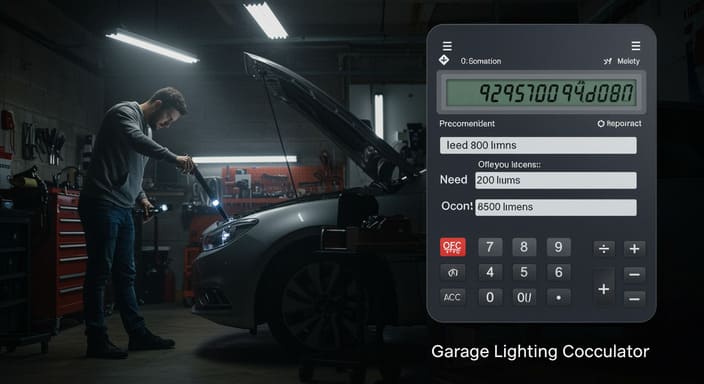
What is a Garage Lighting Calculator?
A garage lighting calculator is an advanced, automated digital tool designed to take the complex mathematical equations used by professional lighting architects and make them accessible to the everyday homeowner.
By inputting specific parameters about your physical space and how you intend to use it, the calculator generates a highly accurate lighting blueprint.
Find Us on Linkedin : Garage Door Seo Hub
Bright Garage Lighting Calculator
Calculate optimal LED lighting requirements for your garage with lumen specifications, task lighting, and fixture recommendations
Lumen Calculator
Fixture Calculator
Recommended LED Fixtures
SkyLux High Bay
15,000-20,000 lumens
150W
50,000 hours lifespan
Crystal Panel
3,500 lumens
40W
IP65 rated
Color temp adjustable
Lumino Strip Lights
4,000 lumens per 4ft
45W
Dimmable
Easy installation
BeamPro Flood Lights
2,000 lumens
25W
120° beam angle
Weatherproof
Lighting Information & Tips
Requirements
- Ambient Lighting: 50-75 lumens/sq ft for general illumination
- Task Lighting: 300 lumens/sq ft for detailed work areas
- Accent Lighting: 75 lumens/sq ft for specific features
- Color Temperature: 4000K-5000K for workspaces
- CRI (Color Rendering Index): 85+ for accurate color representation
Installation Tips
- Position fixtures directly above work areas
- Use multiple light sources to eliminate shadows
- Install lighting at 8-10 ft height for optimal coverage
- Include separate switches for different lighting zones
- Consider motion sensors for energy savings
Energy Saving
- LEDs use 75% less energy than incandescent bulbs
- Dimmable fixtures provide flexibility and savings
- Use occupancy sensors in less-frequented areas
- Regularly clean fixtures to maintain light output
- Consider daylight harvesting where possible
Purpose and Core Benefits
- Eliminates Guesswork: Instantly translates your square footage into the exact total lumens required.
- Fixture Recommendations: Tells you exactly how many LED shop lights or fluorescent tubes you need to buy.
- Customized to Your Needs: A storage garage requires vastly different lighting than a woodworking shop. The calculator adapts to these needs.
- Budget Management: Provides a baseline garage lighting cost estimator so you can plan your upgrades without financial surprises.
Who Should Use This Tool?
- DIY Homeowners: Looking to upgrade from old bulbs to modern, daisy-chained LED strip lights.
- Woodworkers and Mechanics: Who require high-intensity, shadow-free lighting for precision safety.
- Fitness Enthusiasts: Designing a home gym that is bright and motivating, but free from blinding overhead glare when lying on a bench.
- Contractors and Builders: Needing quick, accurate estimates to provide quotes for clients.
The Ultimate Free Garage Lighting Calculator & Design Guide (2026 Edition)
If you are reading this, you are probably tired of squinting in the dark. For decades, the standard for garage lighting was a single, dim, 60-watt incandescent bulb hanging pathetically in the center of the ceiling. It left the corners in pitch blackness, cast terrible shadows over the workbench, and made parking safely feel like a guessing game.
Today, your garage is more than just a place to park the car. It is a home gym, a DIY workshop, an auto detailing bay, and an essential storage hub. To maximize the utility of this space, you need proper, scientifically calculated illumination.
That is exactly where our free garage lighting calculator comes in.
In this comprehensive, extensively updated guide for 2026, we will show you exactly how to calculate garage lighting, break down the science of lumens and foot-candles, and provide you with the blueprint to transform your dark cavern into a brilliantly lit, functional workspace.
What is Garage Lighting Design?
Garage lighting design is the strategic process of calculating, selecting, and placing light fixtures to achieve optimal visibility, safety, and energy efficiency in a garage space.
Proper lighting design moves away from the outdated concept of measuring light by "watts" (which simply measures energy consumption) and focuses entirely on lumens (which measures actual brightness).
A well-designed garage utilizes a concept known as layered lighting, which includes:
- Ambient Lighting: The general, overhead illumination that allows you to walk around safely.
- Task Lighting: Focused, high-intensity light directed at specific areas like workbenches, tool chests, or under vehicle hoods.
- Accent Lighting: Softer lighting used to highlight architectural features or specific display areas (like a custom car or trophy wall).
Why Does It Matter?
Relying on guesswork for your garage lighting leads to two common scenarios: an under-lit garage that causes eye strain and safety hazards, or a drastically over-lit garage that wastes electricity and causes blinding glare. Taking the time to properly calculate your needs ensures a perfect balance of comfort, utility, and cost-efficiency.
How Does the Garage Lighting Calculator Work?
Using our garage lighting calculator online is incredibly straightforward. Behind its simple interface is a robust algorithm that factors in industry-standard lighting metrics. Here is a step-by-step breakdown of how it works.
Step 1: Input Your Dimensions
You start by entering the Length, Width, and Height of your garage. Length and width give us the total square footage, which is the foundational metric for lighting. The height is equally critical; lights placed on a 12-foot ceiling require much more output to reach the floor than lights on an 8-foot ceiling.
Step 2: Select Your Garage Usage
How you use the space dictates the brightness you need. The calculator asks you to choose between:
- Basic Storage & Parking
- Home Gym / Casual Workspace
- Active Workshop / Carpentry
- Auto Detailing / Painting
Step 3: Account for the Environment
Are your walls painted bright white, or are they unfinished dark gray concrete? Light colors reflect illumination, while dark colors absorb it. The calculator allows you to input your wall color to adjust the final lumen count appropriately.
The Output
Once you enter your data, the calculator instantly provides:
- Total Target Lumens: The aggregate amount of light your space needs.
- Recommended Fixtures: How many standard 4-foot LED shop lights (typically ~4,000 lumens each) you should purchase.
- Estimated Cost & Wattage: A quick look at what this setup will cost to buy and run.
The Formula Behind the Calculator Explained
For those who want to know how to calculate garage lighting manually, it helps to understand the underlying math. The lighting industry uses a measurement called a "Foot-Candle" (FC) or "Lux". One foot-candle is equal to one lumen of light distributed over one square foot of area.
The Core Formula
$$\text{Total Lumens Required} = \text{Garage Area (Sq. Ft.)} \times \text{Target Lumens per Sq. Ft.}$$
Breaking Down the Variables
- Garage Area: If your garage is 20 feet wide and 20 feet long, your area is 400 square feet.
- Target Lumens per Sq. Ft.: This is dictated by the Illuminating Engineering Society (IES) guidelines based on activity type (e.g., 50 lumens/sq ft for a gym).
If we want a home gym in our 400 sq. ft. garage: $$400 \text{ sq. ft.} \times 50 \text{ lumens/sq. ft.} = 20,000 \text{ Total Lumens}$$
If you are buying standard 4,000-lumen LED shop lights, you simply divide the total: $$20,000 / 4,000 = 5 \text{ Fixtures Needed}$$
Note: Our calculator automatically adds mathematical adjustments for high ceilings and dark walls, saving you from complex inverse-square law calculations!
Factors That Affect Your Lighting Results
To get truly accurate results from any garage lighting formula explained, you must realize that raw square footage isn't the only variable in the room.
1. Ceiling Height (The Inverse Square Law)
Light intensity drops dramatically the further it travels from the source. A 4,000-lumen fixture mounted at 8 feet will feel incredibly bright. That same fixture mounted at 14 feet will feel dim at floor level. Rule of thumb: For every foot of ceiling height over 10 feet, you generally need to increase your total lumens by 10% to 15%.
2. Light Reflectance Value (LRV)
The color of your walls, ceiling, and even your epoxy floor coating drastically impacts lighting. Glossy white walls bounce light back into the room (high LRV). Unfinished drywall or dark paint absorbs light (low LRV). If your garage is dark, you must compensate with higher lumen output.
3. Natural Light Sources
Does your garage have skylights or large windows? While natural light is fantastic during the day, your lighting design must be calculated based on nighttime usage to ensure you aren't left in the dark when the sun goes down.
4. Beam Angle
Some fixtures focus light straight down in a narrow 60-degree beam, while others cast light wide at 120 degrees. Wider beam angles provide better ambient coverage and reduce harsh shadows between cars.
Example Calculations for Common Scenarios
Let’s look at how the calculator adapts to different real-world situations.
Example 1: The Standard 2-Car Parking Garage
- Dimensions: 20x20 (400 sq. ft.) with 9ft ceilings.
- Usage: Just parking cars and basic storage (Target: 30 lumens/sq ft).
- Calculation: 400 x 30 = 12,000 Total Lumens.
- Result: You need three 4,000-lumen LED fixtures.
Example 2: The Serious Woodworker
- Dimensions: 24x24 (576 sq. ft.) with 10ft ceilings.
- Usage: Power tools, measuring, and precision cutting (Target: 75 lumens/sq ft).
- Calculation: 576 x 75 = 43,200 Total Lumens.
- Result: You need roughly eleven 4,000-lumen LED fixtures, distributed evenly to prevent shadows over table saws.
Example 3: The High-Ceiling RV Detailing Bay
- Dimensions: 16x40 (640 sq. ft.) with 14ft ceilings.
- Usage: Auto detailing, paint correction (Target: 100 lumens/sq ft).
- Base Calculation: 640 x 100 = 64,000 Lumens.
- Height Adjustment: Add 40% for the 14ft ceiling = 89,600 Lumens.
- Result: You need twenty-two 4,000-lumen fixtures, or you should upgrade to high-bay UFO LED lights that output 15,000+ lumens each.
Benefits of Using This Calculator
Why should you rely on a free garage lighting calculator instead of just buying a multi-pack of lights from the hardware store and hoping for the best?
- Pinpoint Accuracy: Prevent the "cave effect" of too little light, and avoid the sterile, blinding "operating room" effect of too much light.
- Massive Time Savings: Skip the complex manual math. Plan your layout in under 30 seconds.
- Cost Efficiency: By knowing exactly how many fixtures you need, you won't overspend on unnecessary hardware or waste money on electrical bills by over-lighting.
- Confident Decision-Making: Walk into the hardware store or order online knowing exactly what lumen count and fixture quantity to look for.
Real-World Applications
Proper lighting transforms a garage. Here is how specialized lighting calculations apply in the real world:
- Auto Detailing & Paint Correction: Detailers need to see swirl marks, scratches, and exact paint matching. This requires high lumens (80-100/sq ft) and high CRI (Color Rendering Index) lights.
- The Home Gym: The best lighting for garage gym setups uses diffusers to soften the light. When you are lying on your back doing bench presses, you don't want a bare LED diode burning your retinas.
- Crafting & Hobby Zones: Requires intense, shadow-free task lighting immediately over the workbench, while the rest of the room can remain at standard ambient levels.
Common Mistakes to Avoid
Even with the correct number of lumens, poor execution can ruin a lighting design. Avoid these frequent user errors:
1. Ignoring Color Temperature (Kelvin)
Brightness is measured in lumens, but the color of the light is measured in Kelvin (K).
- Warm White (2700K - 3000K): Looks yellow/orange. Great for cozy living rooms, terrible for garages.
- Cool White (4000K): A crisp white. Good for basic garages.
- Daylight (5000K - 6000K): Mimics the midday sun. This is the gold standard for garages and workspaces. It provides maximum contrast and alertness.
2. Forgetting About CRI (Color Rendering Index)
CRI measures how accurately a light source reveals true colors compared to natural sunlight. If you are painting cars, doing woodwork, or sorting colored wires, you need a CRI of 85 or higher. Cheap LEDs often have a CRI in the 70s, making reds and blues look muddy.
3. Relying on a Single Light Source
Never put all your lumens in the center of the room. A single 20,000-lumen light will cast massive, dark shadows on the walls when you park a car under it. Always distribute multiple, lower-lumen fixtures evenly across the ceiling.
Tips for Getting Accurate Results & Best Practices
To maximize the output of your garage lighting cost estimator and design tool, follow these 2026 best practices:
- Daisy-Chaining: Look for LED shop lights that are "linkable" or "daisy-chainable." This allows you to plug one light into the next, requiring only a single wall outlet for up to 6 or 8 fixtures.
- Paint Your Walls First: Before buying extra lights to combat a dark garage, consider painting the drywall with high-gloss white paint. This simple step can increase perceived brightness by up to 30%.
- Use Motion Sensors: Garages are high-traffic transition zones. Installing a smart motion sensor switch ensures you never walk into a dark garage carrying groceries, and lights never accidentally stay on all night.
- Task Lighting is Supplemental: Use the calculator to determine your overhead ambient light, but always add separate, dedicated under-cabinet or clamp lights directly over your workbench.
Comparison: Manual Math vs. The Calculator vs. Professionals
| Method | Speed | Accuracy Level | Cost | Best For |
|---|---|---|---|---|
| Manual Calculation | 15-20 Minutes | Moderate (Prone to math errors) | Free | People who love formulas. |
| Online Calculator | < 1 Minute | High (Accounts for height & usage) | Free | 95% of Homeowners & DIYers. |
| Lighting Architect | Days / Weeks | Perfect (Includes 3D rendering) | $300 - $1,000+ | High-end custom luxury garages. |
Summary: For almost every residential and light commercial application, the calculator provides professional-grade estimates instantly, at zero cost.
Frequently Asked Questions (FAQs)
Q1: How many lumens do I need for my garage? For general parking and storage, you need 20 to 30 lumens per square foot. For a home gym or basic workspace, aim for 50 lumens per square foot. For intricate mechanical work or auto detailing, you will need 75 to 100 lumens per square foot.
Q2: Are LED shop lights better than fluorescent tubes? Yes, overwhelmingly. By 2026 standards, LEDs are the only logical choice. They use 70% less energy, operate perfectly in freezing temperatures (unlike fluorescents which flicker in the cold), do not contain hazardous mercury, and last up to 50,000 hours.
Q3: Can I include natural light in my calculator estimate? It is generally not recommended. While windows provide great daytime light, your garage lighting system must be designed to safely illuminate the space at night or during dark winter storms. Always calculate for zero natural light.
Q4: What is the best color temperature (Kelvin) for a garage? The ideal color temperature for a garage is 5000K (Daylight). This crisp, bright white light provides high contrast, which reduces eye strain when working with tools, reading labels, or navigating around vehicles.
Q5: How many LED fixtures can I string together? This depends on the manufacturer and the amperage of your electrical circuit. Typically, you can safely "daisy-chain" 4 to 8 standard LED shop lights together on a standard 15-amp residential circuit. Always check the manufacturer's specific instructions.
Q6: Are smart lights worth the investment for a garage? Yes, especially if your garage is a multi-use space. Smart lights allow you to dim the brightness for gym workouts, turn them up to 100% for woodworking, and set automated timers or motion detection, saving significant energy costs over time.
Conclusion: Take the Guesswork Out of Your Garage
Good lighting is not a luxury; it is a fundamental requirement for a safe, usable, and enjoyable garage. Operating power tools in the shadows or tripping over clutter in the dark are hazards of the past.
By using our free garage lighting calculator, you take the guesswork out of home improvement. You now have the knowledge to calculate exactly how many lumens you need, the best color temperature to select, and how to distribute those fixtures for maximum efficiency.
Ready to brighten up your workspace? Scroll back to the top of the page, input your garage dimensions, and let the calculator build your custom lighting blueprint in seconds. Get your instant results, grab your fixtures, and transform your garage today!