
A garage door spring calculator finds the right torsion spring for your door in 2026. Enter your door size, weight and material, and it gives the spring size, wire size, turns and number of springs. A standard 8×7 steel door weighs 83 lbs and needs one 207x2x22 spring. Use the result below, then book a pro to fit it today.
Garage Door Hub connects you with a trusted local pro. Need a repair? Need a replacement? Start here. First, find out what it should cost.
Garage Door Spring Calculator
Find the right torsion spring for your door, convert an old spring to a new size, or estimate what a spring replacement costs. All four tools use the same door-weight table, so one door gives one answer everywhere. Estimates only — a pro must confirm the spring before it is fitted.
A. Spring Size by Door
Pick your door size and material. The weight comes from the spring table — or enter your door’s known weight if you have it.
If you leave this blank, the table weight is used. If you enter one, it is shown as “your entered weight”.
Call a pro — springs are dangerous, don’t DIY.
B. Torsion Spring by Measurements
Two ways to size a spring. Use your door’s measurements, or measure the old spring itself. The old “Tension Calculator” is not a separate tool here: its turns output is included in “By door specs” below, and its torque figures were static text with no formula behind them, so no torque figure is shown.
B1. By door specs
Leave blank and the table weight is used for your door size. Enter a weight only if you have weighed the door.
Call a pro — springs are dangerous, don’t DIY.
B2. By spring measurements (measure the old spring)
Call a pro — springs are dangerous, don’t DIY.
C. Spring Conversion
Convert an existing spring to a different wire size. The current spring specification below updates as you type; the converted results update only when you press Calculate Conversion.
Call a pro — springs are dangerous, don’t DIY.
D. Spring Replacement Cost
Estimate what a spring replacement costs. Prices are the original page’s market ranges (page id 1568, which redirects to this page). The location adjustment is a rough guide from the first digit of the zip code — get an exact price from the pro.
Call a pro — springs are dangerous, don’t DIY.
How much does garage door spring replacement cost in 2026?
One torsion spring costs $150 to $350 installed, average $250 (Angi, 30 Oct 2026). A matched pair costs $250 to $550 (CostInspector, 2026). That range covers most standard doors in a weekday visit, not a heavy custom door or an extension-to-torsion conversion.
Watch: What Garage Door Repairs Cost in 2026 (Springs, Openers, Panels, New Doors) — American Garage Door, 5 Nov 2026. YouTube labels this video as content made with AI.
| Job | Typical cost in 2026, installed | What it usually covers |
|---|---|---|
| One torsion spring | $150–$350 | 1 spring, parts and labour |
| Matched pair of torsion springs | $250–$550 | Both springs, matched to your door weight |
| Pair of extension springs | $120–$200 | Both springs, with safety cables |
| High-cycle upgrade (per pair) | +$40–$80 | Springs rated 20,000+ cycles instead of 10,000 |
| Extension-to-torsion conversion | $400–$800 | New torsion shaft, drums and springs |
| After-hours or emergency visit | +$100–$300 | Same repair, out-of-hours call-out |
Sources: Angi, 30 Oct 2026; HomeGuide, 2026, via Garage Playbook, 2 Oct 2026; CostInspector, 2026; This Old House, Mar 2026. See also the Angi spring replacement cost guide, 30 Oct 2026. Prices include parts and labour unless the row says otherwise. Your area moves the total by 10% to 40%.
One number to watch: Angi prices $150 to $350 per spring, while HomeGuide prices $150 to $350 for a pair. Both are right — they price different things. This Old House puts an installed job at $300 to $540, average $420 (Mar 2026). That is a pair, with labour, in a higher-cost market. Before you compare two quotes, ask each one: is that one spring or a pair, parts only or parts and labour? If the door has a dented panel as well as a broken spring, price the panel first with the garage door panel replacement cost calculator — one panel costs $250 to $900 (HomeGuide, Oct 2026).
What size torsion spring do I need?
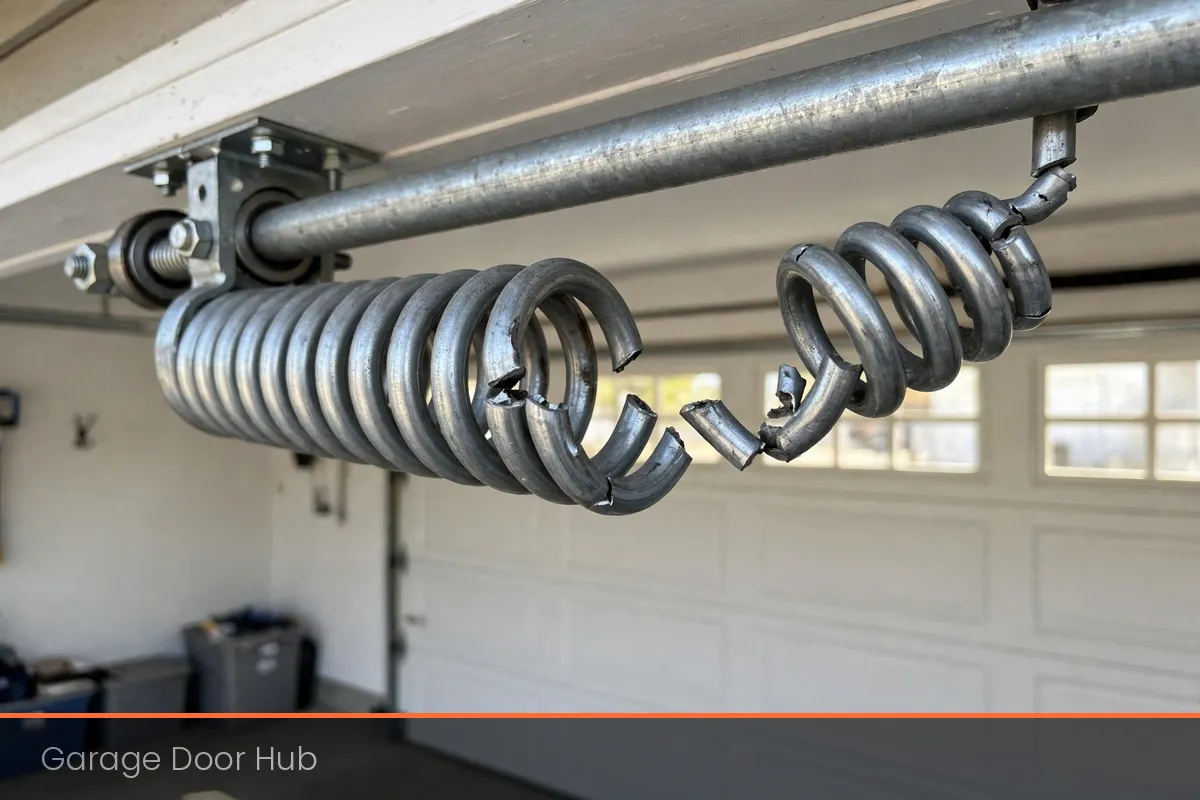
Start with the door, not the spring. The spring must lift the door’s weight. A spring that is too weak leaves the door heavy. A spring that is too strong slams the door up and wears out the opener.
Use Section A above: pick your door width, height and material. The weight comes from the site’s spring table — or enter your door’s known weight if you have it. On the live test, an 8×7 steel single-layer door weighs 83 lbs and needs one 207x2x22 spring. That means 0.207-inch wire, 2-inch inside diameter, 22 inches long. One spring, not two.
If you are not sure of the weight, use the garage door weight calculator. An 8×7 steel door weighs 83 lbs. A double door weighs more and usually needs 2 springs. A heavy insulated door needs heavier wire than a light single-layer door of the same size — price the insulation first with the garage door R-value calculator.
| Door | Turns needed | Typical wire size |
|---|---|---|
| 7 ft high | 7.5 turns | 0.207–0.225 in |
| 8 ft high | 8.5 turns | 0.207–0.225 in |
| 9 ft high | 9.5 turns | 0.225–0.243 in |
| 10 ft high | 10.5 turns | 0.225–0.250 in |
Turns come from the door height and the drum: a 7 ft door needs 7.5 turns, an 8 ft door needs 8.5 turns (CDCalculators, Oct 2026). The rule is simple: add 1 turn for each extra foot of height. Section B1 gives the exact turns for your drum diameter.
Wire size is the thickness of the steel wire. Common residential sizes run from 0.192 to 0.312 inches. The most common are 0.218, 0.225, 0.234, 0.243, 0.250 and 0.262 inches. Thicker wire lifts more weight per turn. A 0.207-inch wire with a yellow colour code lifts about 83 lbs on an 8 ft door (ServiceAgent.ai, 2026).
How to measure a garage door torsion spring
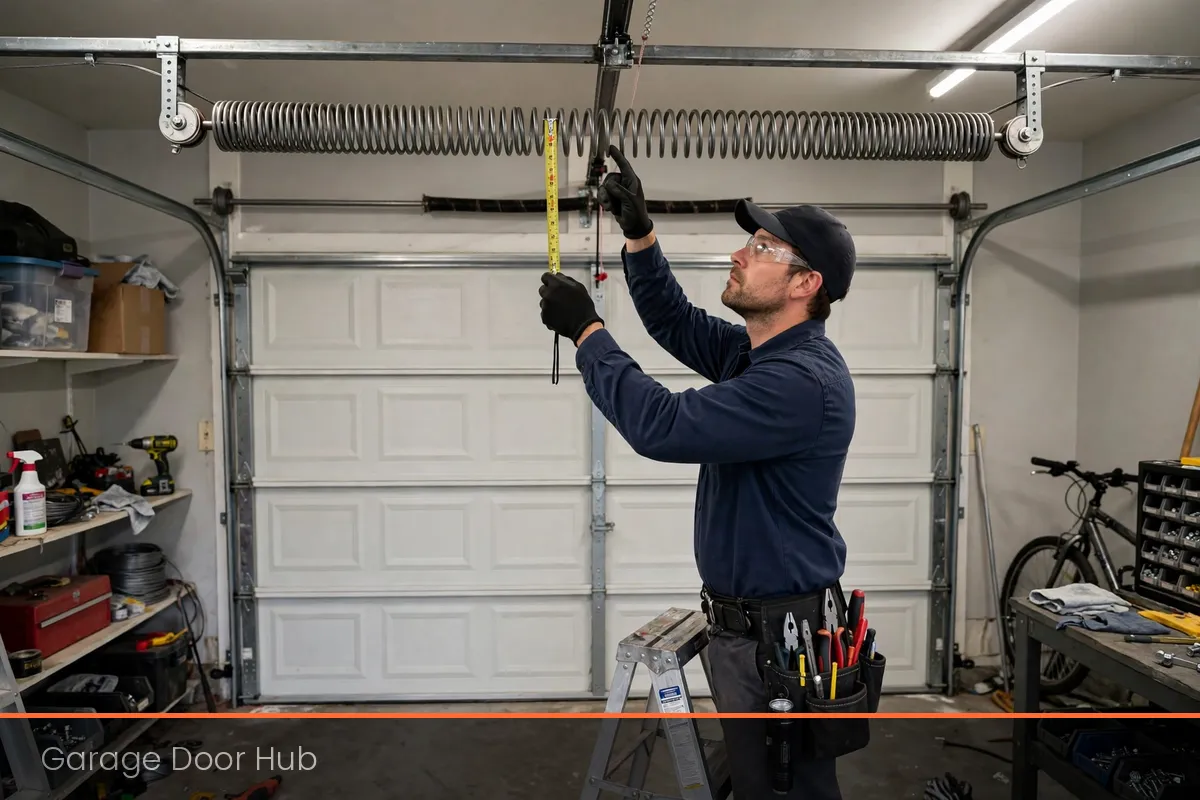
If the door worked well before the spring broke, measure the old spring. That is what Section B2 of the calculator does. You need 4 numbers. Do not measure a spring that is still wound. If any tension is left, a pro must release it first.
Inside diameter (ID). Measure across the open centre of the coil. Most homes use 1.75 or 2 inches. The cone is often stamped with the size — 175 means 1.75 inches, 200 means 2 inches.
Wind direction. Look at the winding cone. A left-wound spring (LHW) coils counter-clockwise from the cone. A right-wound spring (RHW) coils clockwise. A left-wound spring sits on the right side of the centre bracket. A right-wound spring sits on the left side. Match the old spring’s wind exactly — a spring wound the wrong way will not fit or work.
Wire size. Count 20 coils and measure them end to end, then divide by 20. If 20 coils measure 4 1/8 inches, the wire is 0.207 inches. Do not use calipers alone — they are not reliable on spring wire. See the DDM Garage Doors measuring guide. Measure 10 coils too and check both numbers against the chart.
Length. Measure the relaxed spring end to end, not counting the cones. Include both broken pieces. Round to the nearest inch. Most 7 ft doors use a 25-inch spring. Most 8 ft doors use a 27-inch spring.
Watch: How To Measure Garage Door Torsion Springs — DDM Garage Doors. Title confirmed on the YouTube watch page 12 Nov 2026. The upload date was not shown in the fetched page text, so no date is given here — check it before publishing.
Torsion spring by measurements
Section B of the calculator works two ways: B1 starts from your door, B2 from your old spring.
B1 asks for door width, height, construction (single, double or triple layer), door weight and drum diameter. Most residential drums are 4 inches. Leave the weight blank and the table weight is used. The maths is a torque balance: the door weight pulling on the drums must be matched by the springs over the turns they carry. Torque is door weight times drum radius, shared by the springs. Turns come from the door height divided by pi times the drum diameter, plus 0.75 turn of preload (ServiceAgent.ai, 2026). See also the ServiceAgent.ai spring calculator, which shows the same torque-balance method.
A healthy spring sits within 90 to 110% of the IPPT your door needs. IPPT means inch-pounds per turn — how much torque the spring adds for each turn of wind. It depends on wire size, inside diameter and spring length together. If the spring on your door is far outside that band, the door wears out its hardware faster or risks a sudden failure (Garage Door Fix Canada, cycle-life guide).
Do not use this section to wind a spring yourself. It tells you what to order and what a fair quote looks like. It is not a winding guide.
Converting a spring to a different size
Section C converts an existing spring to a different wire size. Say your old spring is out of stock, or you want a longer-life spring. Enter the current wire length, wire diameter, coil diameter and turns, then the target wire and coil diameter. The calculator gives the equivalent spring, the turns it needs, and how its torque and cycle life compare with the original.
A thicker wire lifts more weight per turn but needs more turns to give the same total torque. A thinner wire lifts less per turn. The conversion keeps the total lift the same. That is why the wire size, the length and the turns must change together — change one alone and the door will not balance.
Check the converted spec the same way: wire size, inside diameter, length and wind. If any of those 4 is wrong, the spring is wrong.
How long do garage door springs last?
Springs are rated in cycles, not years. One cycle is one open and one close. A standard torsion spring is rated for 10,000 to 20,000 cycles (HomeGuide, 2026). At 2 cycles a day, 10,000 cycles last 13.7 years. At 4 cycles a day, they last 6.8 years. A family that opens the door 8 times a day wears out a standard spring in about 3.5 years.
| Cycle rating | Life at 2 cycles a day | Life at 4 cycles a day | Best for |
|---|---|---|---|
| 10,000 cycles (standard) | 13.7 years | 6.8 years | Light use, most new homes |
| 20,000 cycles | 27.4 years | 13.7 years | Busy households |
| 25,000 cycles (high-cycle) | 34.2 years | 17.1 years | Heavy daily use |
A high-cycle spring costs $40 to $80 more per spring (Garage Door Service Florida, 13 Oct 2026) and lasts about twice as long. At 4 cycles a day, that is 13.7 years instead of 6.8. Ask for the cycle rating before you approve a spring job. Most quotes list a 10,000-cycle spring by default because it is cheaper to stock.
Extension springs last less: 5,000 to 15,000 cycles, about 4 to 10 years (HomeGuide, 2026). This Old House puts extension springs at 7 to 12 years and about 10,000 cycles (Mar 2026). Torsion springs last 8 to 15 years and up to 20,000 cycles on the same measure. Cold weather makes springs break more often — the wire gets brittle in winter (Clopay, via Call the Local, Nov 2026).
Torsion vs extension springs
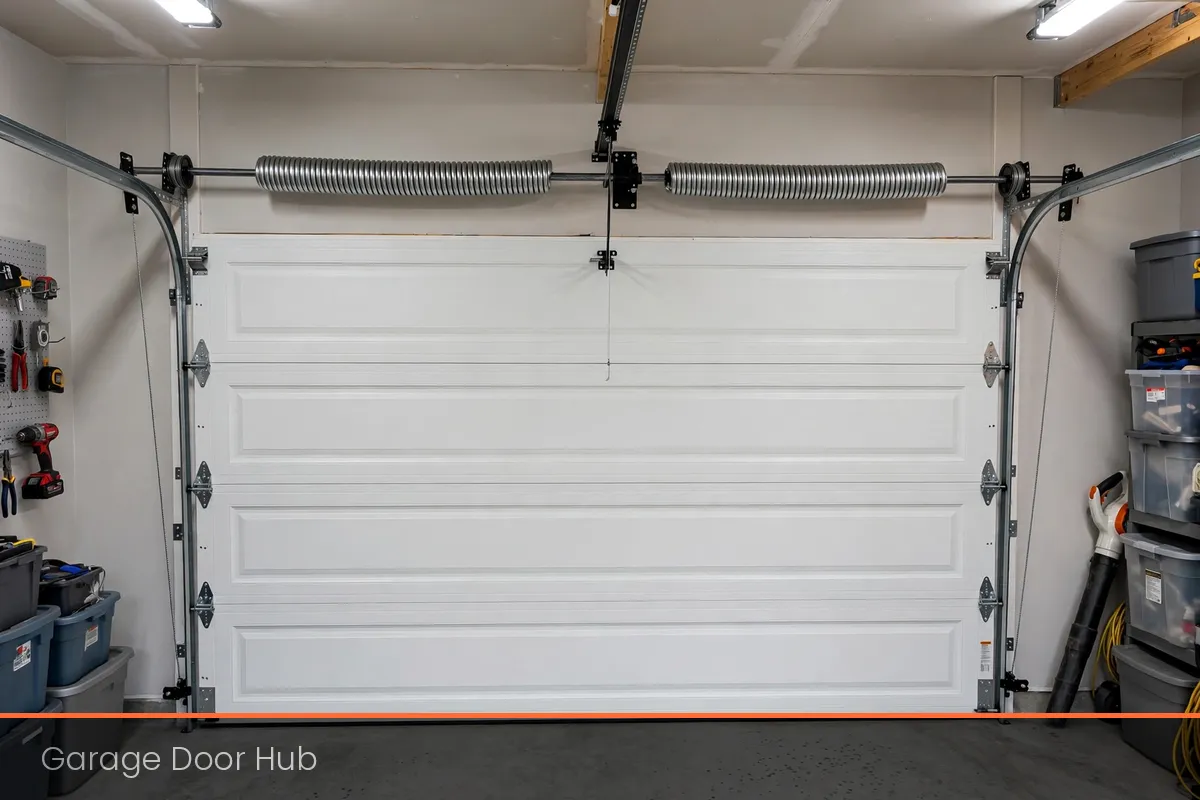
Torsion springs sit on a steel shaft above the door and twist to store energy. Extension springs sit along the sides and stretch. Torsion springs are the modern standard. They are smoother, safer and last longer.
| Torsion spring | Extension spring | |
|---|---|---|
| Where it sits | Above the door, on a shaft | Along the sides, by the tracks |
| Cycle life | 10,000–20,000 cycles | 5,000–15,000 cycles |
| Typical life | 7–14 years | 4–10 years |
| Pair replacement cost | $150–$350 | $120–$200 |
| Safety if it breaks | Stays on the shaft | Needs a safety cable to contain it |
Extension springs cost less to buy; torsion springs cost less over 15 years because they last about twice as long. Converting an extension system to torsion costs $400 to $800 (HomeGuide, 2026). One installer guide puts it at $600 to $1,100 (Garage Door Pros WA, Nov 2026) — the higher figure covers a new shaft and drums on a heavy door. Ask what the conversion price includes before you compare.
Signs your spring is about to break — and the safety rule
Watch for 5 signs. A loud bang from the garage, and then the door will not open. A visible gap of 2 to 3 inches in the coil. A door that feels 2 to 3 times heavier than normal when you lift it by hand. A door that opens a few inches and stops. Cables that look loose or off the drum.
If you see a gap in the coil, do not run the opener — it will strain the motor and can strip the drive gear. Pull the red emergency release only with the door closed, and do not force the door open.
The safety rule is not negotiable: do not replace, wind or adjust a torsion spring yourself. A wound spring holds 150 to 200 foot-pounds of torque. It can break bones or blind you. DASMA, the door industry trade group, advises having springs inspected and replaced by trained door systems technicians. A pro job takes 60 to 90 minutes. That is the whole job — measure, fit, wind, balance and test.
Watch: Garage Door Broken Spring Replacement | OC Garage Door Guys LLC — OC Garage Door Guys LLC, 29 Mar 2024. Title re-confirmed on the YouTube watch page 12 Nov 2026; date from the Repair Cost v5 verification the same day. This video shows a replacement step by step. It is for information only — if you are not comfortable with the work, book a pro.
5 questions to ask before you book
- What is the spring size — wire, inside diameter, length and wind? Get all 4 numbers in writing.
- Is the price for one spring or a matched pair? A pair costs $250 to $550 installed.
- What is the cycle rating — 10,000 or 20,000+? A high-cycle pair adds $40 to $80 per spring.
- What is the warranty on parts and on labour? A spring job should carry at least 1 year on labour.
- What is the emergency fee tonight, separate from the spring price? Get 2 numbers, not 1.
For a second opinion, use the Garage Door Hub calculator hub. To reach a pro, use the contact page. If the door is stuck open, price the repair first with the garage door repair cost calculator, and price a new door with the garage door cost calculator — or the full job with the garage door replacement cost calculator — before you decide. If the cables are worn too, check the length with the garage door cable length calculator, and the opener with the garage door opener cost calculator.
Garage Door Hub connects homeowners with trusted local garage door pros. Need a repair? Need a replacement? Start here. First, find out what it should cost. Then, price your exact job with our free calculator. Next, find a pro near you. Fast. No jargon. No guesswork. No surprise bills. Just clear prices, honest guides, and a local pro you can call today.
Frequently asked questions
How much does it cost to replace a garage door spring? One torsion spring costs $150 to $350 installed, average $250 (Angi, 30 Oct 2026). A matched pair costs $250 to $550 (CostInspector, 2026).
What size torsion spring do I need? An 8×7 steel door weighs 83 lbs and needs one 207x2x22 spring — 0.207-inch wire, 2-inch inside diameter, 22 inches long. A 7 ft door needs 7.5 turns and an 8 ft door needs 8.5 turns.
How do I measure a garage door spring? Measure 4 things from the old spring: inside diameter, wind direction (LHW or RHW), length end to end, and wire size by measuring 20 coils and dividing by 20. Only measure a spring that is unwound.
How long do garage door springs last? Torsion springs last 10,000 to 20,000 cycles, or 7 to 14 years at normal use (HomeGuide, 2026). At 4 cycles a day, a 10,000-cycle spring lasts 6.8 years and a 20,000-cycle spring lasts 13.7 years.
Can I replace a garage door spring myself? No. A wound torsion spring holds 150 to 200 foot-pounds of torque and can cause serious injury. Book a trained technician. A pro job takes 60 to 90 minutes.