
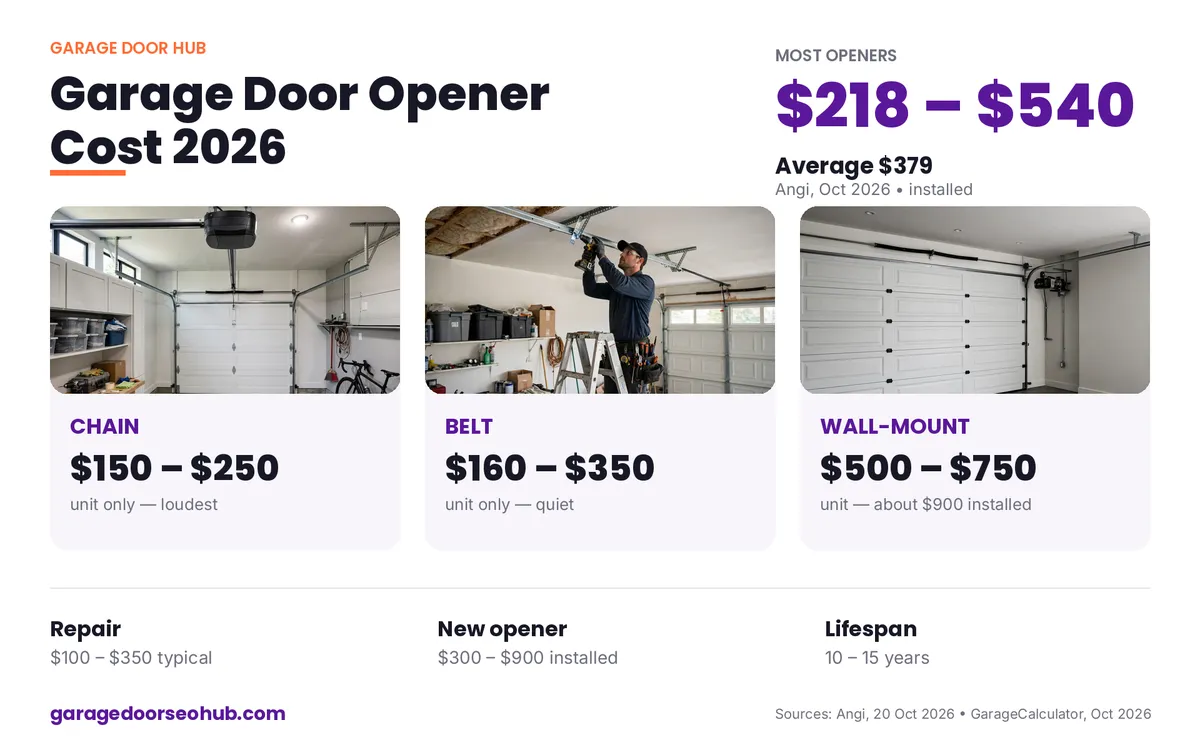
A new garage door opener costs $218 to $540 installed in 2026, and most homeowners pay about $379. A chain-drive opener costs about $405 installed. A belt-drive opener costs about $505. A wall-mount opener costs about $900. Use the free garage door opener cost calculator below. Pick your opener type, labor and extras. You get your total in 30 seconds.
Garage Door Hub connects you with a trusted local pro. Need a repair? Need a replacement? Start here. First, find out what it should cost.
Price your opener
Installed prices for 2026. Pick the opener type and the job — the total always falls inside the range shown.
| What you pay for | Amount |
|---|---|
| Opener unit | |
| Labor | |
| Add-ons |
Prices: Angi, 20 Oct 2026 (unit prices, labor rate, battery backup); HomeGuide, 10 Jul 2025 (labor $150–$400); GarageCalculator, Oct 2026 (installed point figures); Firstline, 23 Apr 2026 (LiftMaster surcharge). Region multipliers are a model (EstimatorSuite, Jul 2026), not a published price index.
How much does a garage door opener cost in 2026?
Most openers land between $218 and $540 installed. That range covers the standard job: a chain or belt opener, fitted in place of an old one, with the sensors and 2 remotes included. It does not cover a wall-mount opener, or a first-time install that needs new wiring.
Angi puts the average at $379, from 11,399 verified projects (20 Oct 2026). GarageCalculator puts most jobs at $400 to $500 installed (Oct 2026). HomeGuide puts the range higher, at $300 to $900, average $600 (10 Jul 2025). The HomeGuide figure is older and includes more premium jobs — that is why it sits above Angi. Fixr lands in the middle, at $300 to $600 installed, with a 3/4 HP belt drive averaging $480.
The calculator default is a belt drive at moderate labor: $530, range $435 to $625. That is above Angi's $379 average on purpose — the average mixes simple chain swaps with belt jobs, and a belt drive at moderate labor is a bigger job than the average. The default is a stated configuration, not the national average.
Watch: Best Garage Door Openers 2026 — Top 5 Tested & Reviewed — Tools Informer. Title confirmed on the watch page 12 Nov 2026; upload date was not shown in the watch-page text I could read, so re-check it before publishing.
| Opener | Unit only, 2026 | Installed, 2026 (moderate labor) | Noise |
|---|---|---|---|
| Chain drive | $150–$250 | $425–$525 | Loudest |
| Belt drive | $160–$350 | $435–$625 | Quiet |
| Screw drive | $150–$300 | $425–$575 | Moderate |
| Direct drive | $280–$500 | $555–$775 | Near-silent |
| Wall-mount (jackshaft) | $500–$750 | $775–$1,025 | Quietest |
Sources: Angi, 20 Oct 2026 (unit prices); GarageCalculator, Oct 2026 (installed point figures: chain about $405, belt about $505, screw about $445, wall-mount about $900 — each sits inside or within $5 of its installed range at the matching labor level). See also the GarageCalculator opener installation cost guide, Oct 2026 and the Angi opener installation cost guide, 20 Oct 2026. Installed ranges in this table are unit + $275 moderate labor, Midwest, no add-ons — the same numbers the calculator above gives. Prices vary by brand, door weight and region. Your area moves the total by 10% to 40%.
What your bill is made of
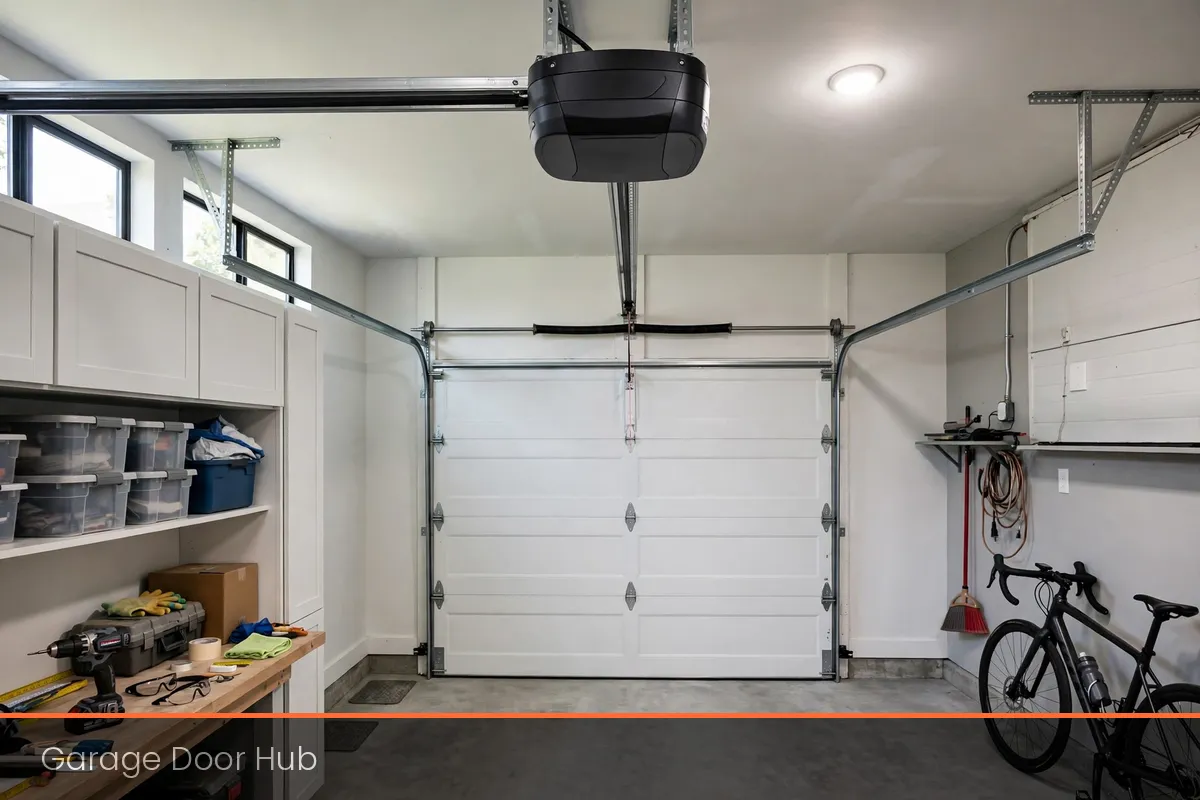
An opener bill has 3 parts. Most quotes show only 1 number.
The unit. The motor and rail cost $150 to $750, before labor, depending on the type (Angi, 20 Oct 2026). Chain is cheapest. A smart belt drive with a camera costs the most of the ceiling-mounted types. A wall-mount unit costs $500 to $750 before labor.
Labor. Labor runs $65 to $85 per hour, and most jobs take 2 to 6 hours (Angi, 20 Oct 2026). HomeGuide puts the job total at $150 to $400 (10 Jul 2025). This calculator prices labor as a flat $150 for a simple swap, $275 for moderate work, $400 for a complex job. A simple swap takes 2 to 3 hours. A complex job takes 4 to 6 hours.
Extras. Removal of the old opener adds $50. New wiring adds $100. A permit and inspection adds $75. A keyless pad adds $30. An extra remote adds $20. Smart home integration adds $100. A battery backup adds $50 to $150 (Angi, 20 Oct 2026) — the calculator uses the $100 midpoint. A rail extension for a door taller than 8 feet adds $45 to $85. Those are this calculator's own add-on prices — check them against your written quote before you sign.
The LiftMaster surcharge: what changed in April 2026
In April 2026 the Chamberlain Group — LiftMaster's parent company — told dealers the surcharge on residential door operators and rails was rising from 6% to 12.5%, a 6.5-point rise, after the Section 232 tariff expansion of 6 April 2026. On a $600 job that is about $39 extra, and about $75 once the earlier 6% is counted too (Firstline, 23 Apr 2026, reporting the dealer letter signed by Jackie Lorenty, Chief Revenue Officer).
Two things to know. First, the surcharge applies to operators and rails, not just the motor. Second, Angi's October 2026 unit prices came after the surcharge, so a quote built from those prices may already include it. That is why the calculator has a separate checkbox: tick it only if your quote itemises the surcharge on its own line. Tick it on a quote that already includes it and you will double-count the tariff. See also the Firstline report on the LiftMaster surcharge, 23 Apr 2026.
Garage door opener cost by type
The drive type sets the price, the noise and the upkeep. Pick the type for your garage first, then for the price.
Chain drive. A chain pulls the trolley along the rail. It is the cheapest and the toughest type, and the loudest. The unit costs $150 to $250 (Angi, 20 Oct 2026). Installed at moderate labor, it costs $425 to $525. Pick it for a detached garage, or where noise does not matter. It needs oil on the chain once a year.
Belt drive. A rubber belt replaces the chain. It is much quieter — 60 to 70% quieter than a chain, by one installer's measure — and it is the best all-rounder for most homes. The unit costs $160 to $350 (Angi, 20 Oct 2026). Installed at moderate labor, it costs $435 to $625. Pick it if a bedroom sits above or beside the garage. The belt needs almost no upkeep.
Screw drive. A threaded rod moves the trolley. It has few moving parts and little to wear out. The unit costs $150 to $300 (Angi, 20 Oct 2026). Installed at moderate labor, it costs $425 to $575. It dislikes big temperature swings, so it suits mild climates best. It is rare in 2026 — most shops stock chain and belt first.
Direct drive. The motor itself travels along the rail, so there is no chain, belt or screw to wear out. The unit costs $280 to $500 (Angi, 20 Oct 2026). Installed at moderate labor, it costs $555 to $775. It is near-silent and lasts 12 to 20 years. Pick it if you want the quietest ceiling-mounted opener and plan to stay in the house.
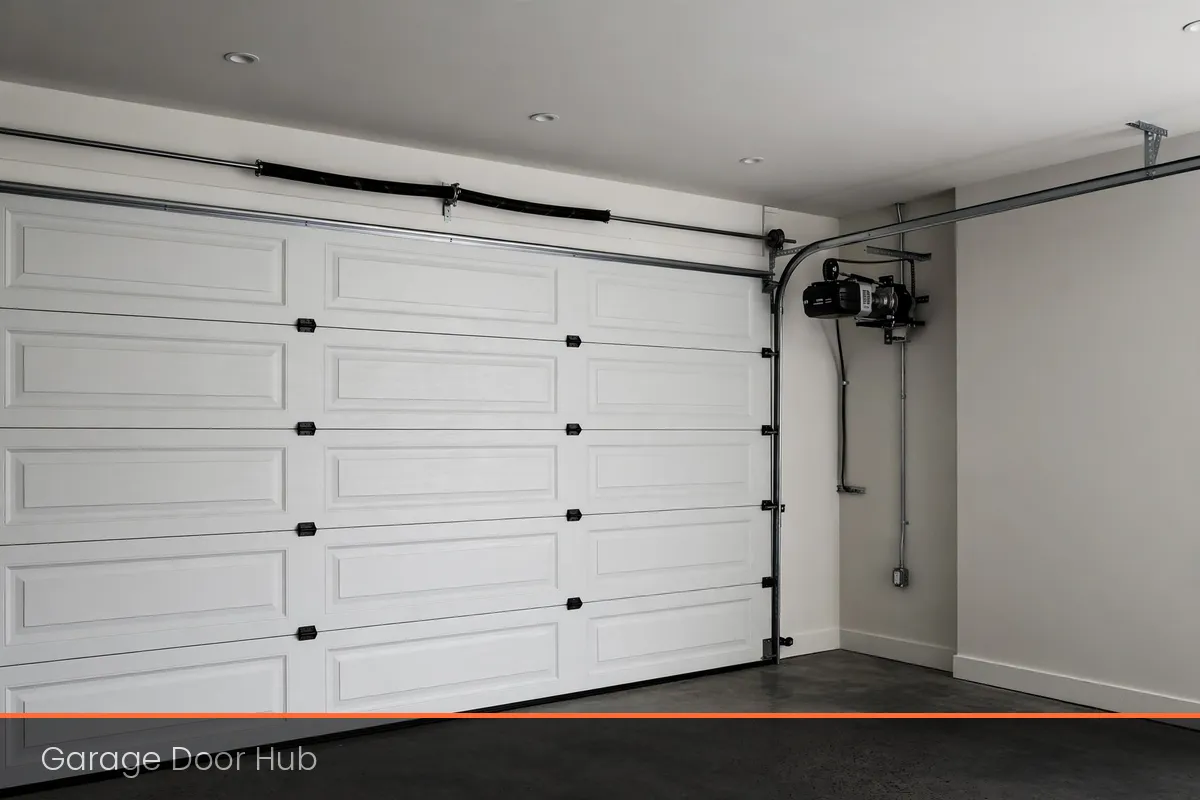
Wall-mount (jackshaft). The motor sits on the wall beside the door, on the torsion spring bar. It frees the whole ceiling for storage. The unit costs $500 to $750 (Angi, 20 Oct 2026). Installed at moderate labor, it costs $775 to $1,025, and GarageCalculator puts it at about $900 (Oct 2026). The LiftMaster 8500W is the best-known model, at $450 to $580 for the unit alone. Pick it for a low ceiling, a tall vehicle, or a garage where the ceiling is already full. It only works with a torsion-spring door — not with extension springs.
What size opener do I need? Horsepower explained
Match the power to the door's weight, not to the size of your garage. The springs carry most of the weight. The opener only moves a balanced door along its tracks. A door that is hard to lift by hand needs its springs checked first — no motor stays healthy fighting an unbalanced door.
1/3 HP. This is enough for a light single steel door up to about 125 lbs — an 8x7 at 83 lbs, or a 9x7 at 88 lbs. It is the minimum size; most singles are sold with 1/2 HP, which also fits and leaves headroom.
1/2 HP. This fits single doors from about 125 to 150 lbs, and is the usual baseline for a standard single door. It also fits a light, non-insulated double door. If your door is balanced and used a few times a day, 1/2 HP is plenty.
3/4 HP. This is the sweet spot for most homes. It fits a standard 16x7 double door, an insulated steel door up to about 250 lbs, and a light wood door. It runs below its limit on most jobs, so it stays cooler and quieter and lasts longer. When in doubt between 1/2 and 3/4 HP, pick 3/4 HP for a double door. Stepping up from 1/2 to 3/4 HP adds $50 to $150 to the unit price.
1 HP or more. This fits heavy wood doors, carriage-house doors, oversized doors taller than 8 feet, and any door over 250 lbs by the conservative sizing rule this site uses. A 1/2 HP opener is rated to about 300 lbs by LiftMaster and a 3/4 HP to about 500 lbs, so the makers would allow a smaller motor — but the conservative rule sizes up for longer motor life, and the article says so.
Newer DC openers are sometimes rated in newtons, not horsepower. A 500N DC motor lines up with about 1/2 HP, and a 700N motor with about 3/4 HP. Compare within one brand, not across brands. Size your exact door with the garage door opener size calculator, and check your door's real weight with the garage door weight calculator. An 8x7 steel door weighs 83 lbs.
| Door | Weight | Opener |
|---|---|---|
| Single steel, 9x7, non-insulated | 85–95 lbs | 1/3 HP |
| Double steel, 16x7, non-insulated | 150–170 lbs | 1/2–3/4 HP |
| Double steel, 16x7, insulated | 180–220 lbs | 3/4 HP |
| Double wood, 16x7 | 200–300 lbs | 3/4–1 HP |
| Oversized or heavy wood, over 8 ft tall | 250–500+ lbs | 1 HP or more |
Watch: 5 Garage Door Openers You Should (Or Probably Shouldn't) Buy Right Now! — SOS Garage Door Service. Title confirmed on the watch page 12 Nov 2026; upload date was not shown in the watch-page text I could read, so re-check it before publishing.
Smart features, battery backup and accessories
Smart features are the add-ons that move the price most after the drive type. Buy them for how you use the door, not for the box.
Wi-Fi and app control. A Wi-Fi opener opens, closes and checks the door from your phone. Most new belt and wall-mount models include it. The premium over a non-Wi-Fi version is often only $30 to $50. If your opener is under 10 years old and still works, a $50 to $90 smart controller (Chamberlain, Meross or Tailwind) adds phone control for about a tenth of a new Wi-Fi opener, installed.
Battery backup. A battery lets the door open 1 or 2 times in a power cut. It adds $50 to $150 to a belt-drive unit (Angi, 20 Oct 2026). It is required by law in California since 2019, and it is worth having anywhere storms cut the power.
Camera and auto-close. A built-in camera adds $100 to $200 to the unit. Auto-close shuts the door after a set time, and the opener must beep and flash before it moves — that is part of the UL 325 safety rule for unattended closing. Some app services add up to about $300 over 10 years in subscription fees (Angi, 20 Oct 2026) — check before you buy, and note that some controllers charge no subscription at all.
Keypad, remotes and sensors. A wireless keypad adds $30. An extra remote adds $20. New safety sensors cost $25 to $50 if your old ones do not work with the new opener (Angi, 20 Oct 2026) — a new opener may not work with your existing sensors, so budget for a pair.
Professional installation vs DIY
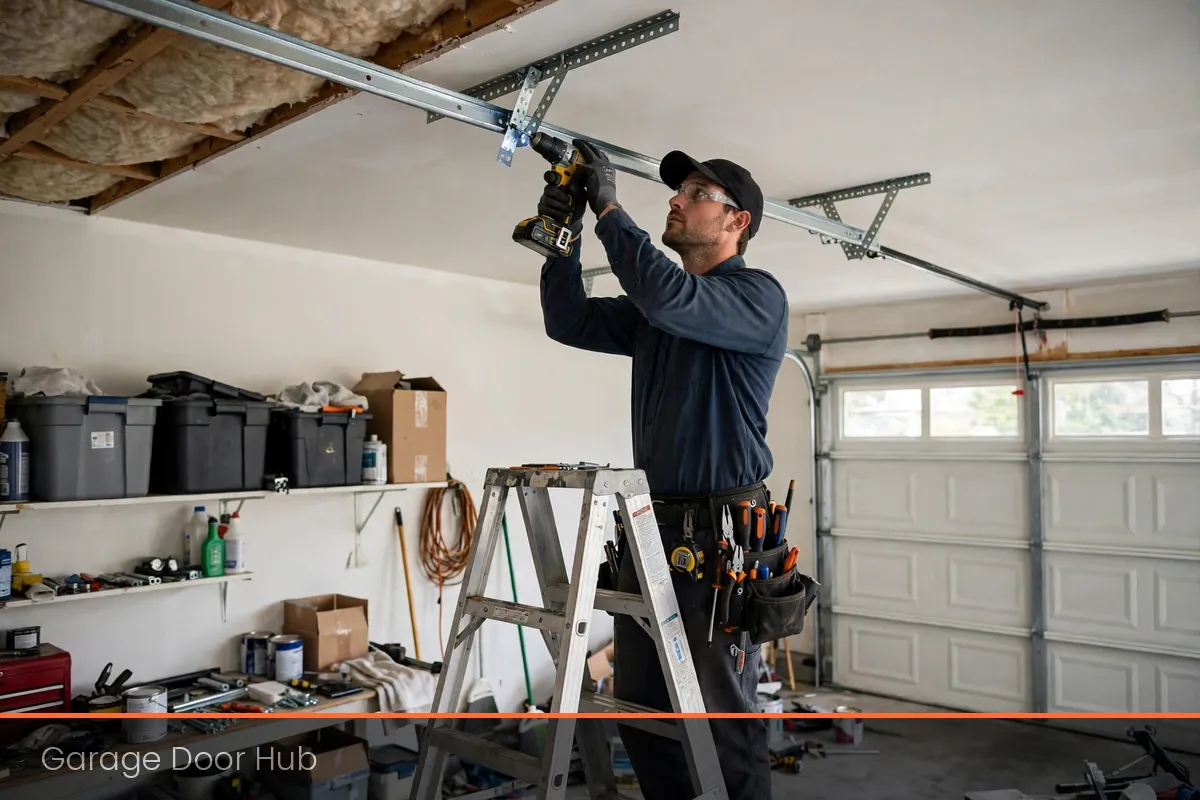
A pro swap takes 2 to 3 hours. A first-time DIY install takes 3 to 4 hours, and a first-timer should plan a full afternoon.
A pro job includes the unit, rail, sensors, remotes, wall control, safety tests, and haul-away of the old opener. Labor alone runs $150 to $400 (HomeGuide, 10 Jul 2025). Home Depot lists installation from $178 when you buy the opener there.
A DIY install saves $150 to $400 in labor. It risks 3 things. First, the rail and motor must hang from joists, not from drywall — an opener hung on drywall can fall. Second, the sensors must sit no higher than 6 inches off the floor and face each other exactly, or the door will not close. Third, the travel limits and force settings must be set right, or the door will slam or reverse for no reason.
Do the safety tests after any install, pro or DIY. They are in the next section. If the door is heavy, unbalanced, or off its tracks, fix the door first — a new opener will not fix a door that binds, and it will wear out faster carrying weight it should not have to. Price the door itself with the garage door cost calculator, and the full job with the garage door replacement cost calculator.
Watch: How to Install a Garage Door Opener | A Step-by-Step Guide — Lowe's. Title confirmed on the watch page 12 Nov 2026; upload date was not shown in the watch-page text I could read, so re-check it before publishing.
Safety: UL 325, photo eyes and auto-reverse
Every residential opener sold in the US since 1 Jan 1993 must meet the UL 325 safety standard. It is federal law, not a brand feature. An opener made before 1993 has no photo-eye sensors, and no adjustment brings it up to the modern standard — replace it.
UL 325 needs 2 systems, working together.
Photo eyes. Two small sensors sit on each side of the opening, no higher than 6 inches off the floor. One sends an invisible beam across the doorway. The other receives it. If anything breaks the beam while the door is closing — a child, a pet, a car bumper — the door stops and reverses before it touches it. That 6-inch height is low enough to catch a crawling toddler.
Auto-reverse. If the door touches something the beam missed, the motor must feel the resistance and reverse within 2 seconds. That is the backup system.
Test both systems once a month. First, the photo eyes: start the door closing, then wave a broom handle through the beam near the floor. The door should stop and reverse at once. Second, the contact reverse: lay a 2x4 flat on the floor in the middle of the opening and close the door onto it. The door should touch the board and reverse within about 2 seconds. If it keeps pushing, stop using the opener and call a pro. Never tape the sensors together, and never bypass them — a door with no sensors can close on a person or a pet.
If your sensors are the fault, price them first with the garage door repair cost calculator. Most sensor calls are a dirty lens or a knocked bracket, not a broken sensor. Wipe both lenses first. That fix costs $0 and takes 2 minutes.
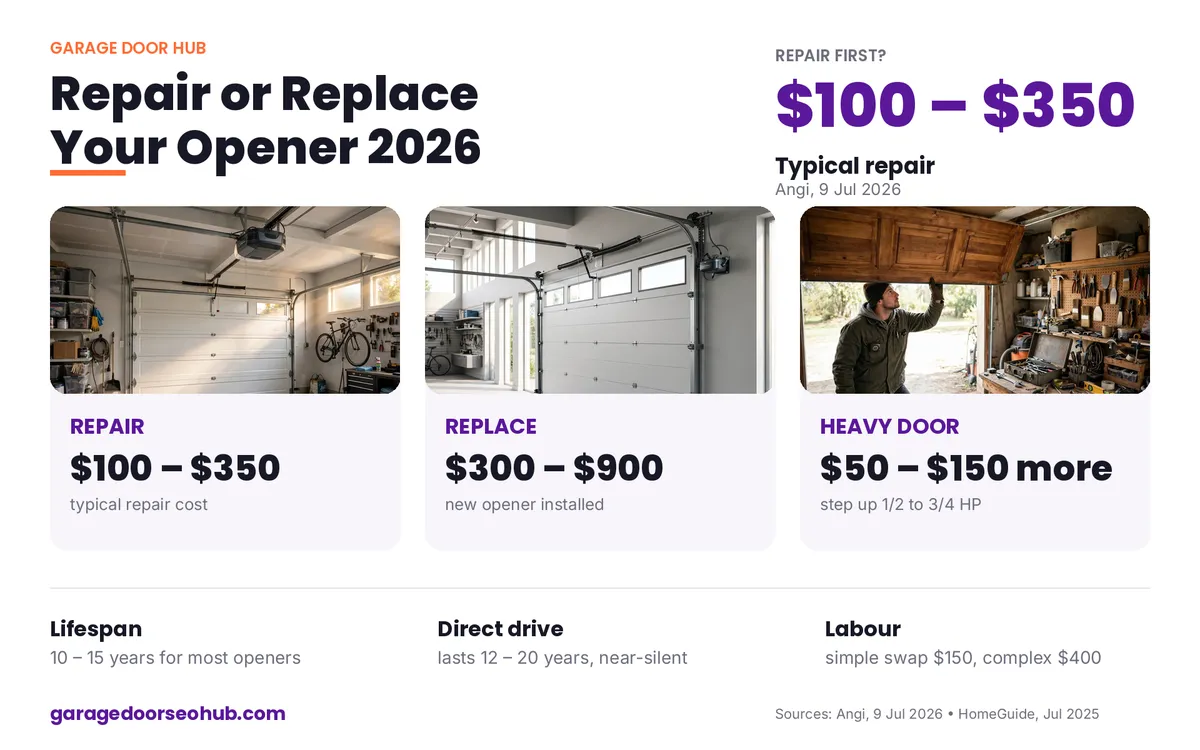
Repair or replace your opener
Most openers last 10 to 15 years (Angi, 9 Jul 2026). Belt-drive and wall-mount units reach the top of that range. Chain-drive units in hot, uninsulated garages land closer to 10 to 12 years. A household opening the door 4 times a day puts about 1,460 cycles a year on the opener.
Repair it when the unit is under 10 years old and one part failed — a gear, a capacitor, a sensor, or a remote. A typical repair costs $100 to $350, and a logic board costs $180 to $320. A gear or trolley fix lands at $100 to $200. If the motor still runs, repair is usually the better call.
Replace it when the unit is 12 years or older, the motor is dead, or the repair quote tops half the price of a new opener installed. A new opener installed costs $300 to $900 (Angi, 9 Jul 2026), and $218 to $540 for the mainstream chain/belt job (Angi, 20 Oct 2026). A 12-year-old opener with a $280 logic-board fault is a coin flip — price the new unit first. Garage Door Hub connects you with a local pro near you, fast.
The same 50% rule works here as for the door. If the repair costs more than 60% of a new opener, replace it. If it costs less than 40%, repair it. Between 40% and 60%, look at the age and at the features: a new unit adds Wi-Fi, battery backup and new sensors, which an old unit cannot add. If the springs are the real fault, not the opener, check the size with the garage door spring calculator. An 8x7 steel door needs a 218x2x26 spring. If the cables are worn too, check the length with the garage door cable length calculator. A heavier insulated door also needs a stronger opener — check the insulation with the garage door R-value calculator before you pick the horsepower.
5 questions to ask before you book
- What is the total price, in writing, before you start? Unit, labor and extras, as 3 lines.
- Is the old opener removal included? It is $50, or $0 if it is in the quote.
- What horsepower is it, and does it match my door weight? A 16x7 insulated double needs 3/4 HP.
- Are new safety sensors included, and will you test the auto-reverse? Both tests take 2 minutes.
- What is the warranty on the unit and on the labor? At least 1 year on labor, and the motor warranty in writing.
For a second opinion, use the calculator hub. To reach a pro, use the contact page.
Garage Door Hub connects homeowners with trusted local garage door pros. Need a repair? Need a replacement? Start here. First, find out what it should cost. Then, price your exact job with our free calculator. Next, find a pro near you. Fast. No jargon. No guesswork. No surprise bills. Just clear prices, honest guides, and a local pro you can call today.
Watch: Which garage door opener to buy, and why
SOS Garage Door Service compares the five main kinds of garage door opener on YouTube — from everyday chain and belt drives to wall-mount and smart openers — and which ones are worth your money.
- A new garage door opener costs $218 to $540 installed in 2026, and most homeowners pay about $379.
- A chain-drive opener costs about $405 installed; a belt-drive opener costs about $505; a wall-mount opener costs about $900.
- A belt drive is quiet, the best all-rounder; a chain drive is cheapest and loudest.
Video: SOS Garage Door Service, YouTube. Checked 21 November 2026.
Frequently asked questions
How much does a garage door opener cost in 2026?
Most garage door openers cost $218 to $540 installed in 2026, average $379 (Angi, 20 Oct 2026). A wall-mount opener costs about $900 installed (GarageCalculator, Oct 2026).
How much does it cost to replace a garage door opener?
A replacement costs $218 to $540 installed for a mainstream chain or belt opener (Angi, 20 Oct 2026). A wall-mount replacement costs $775 to $1,025 installed.
What size garage door opener do I need?
A 1/3 HP opener is enough for a light single steel door up to about 125 lbs. A 1/2 HP opener fits most single steel doors up to about 150 lbs and is the usual baseline. A 3/4 HP opener fits a standard 16x7 double door up to about 250 lbs. A 1 HP opener fits heavy wood or oversized doors.
Should I repair or replace my garage door opener?
Repair it if the unit is under 10 years old and one part failed. Replace it if it is 12 years or older, the motor is dead, or the repair costs more than half of a new opener installed.
Is a wall-mount garage door opener worth it?
A wall-mount opener costs about $900 installed, against about $505 for a belt drive (GarageCalculator, Oct 2026). It is worth it for a low ceiling, a tall vehicle, or a garage where the ceiling is already full, and only with a torsion-spring door.