
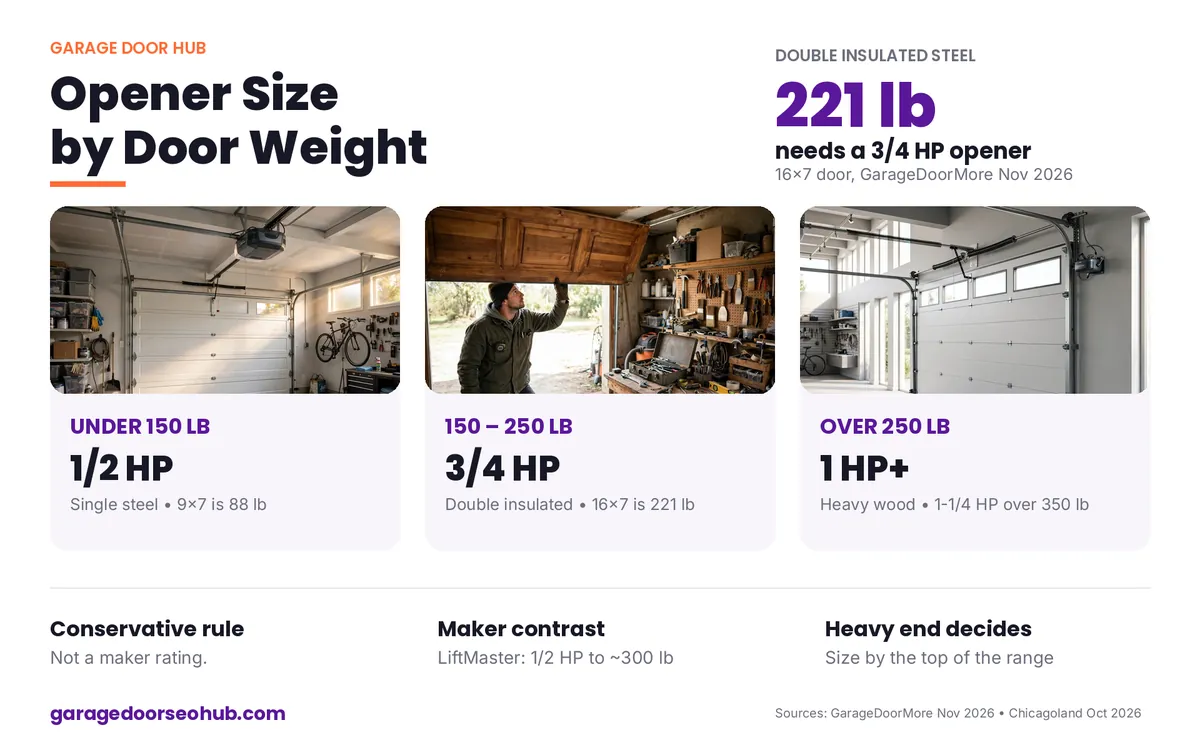
A 9 by 7 single steel door weighs 88 pounds and needs a 1/3 HP opener. A 16 by 7 double insulated steel door weighs 221 pounds and needs a 3/4 HP opener. Doors over 250 pounds need 1 HP or more. Enter your door size and material below to get the weight range, horsepower and drive type in seconds.
Garage Door Hub connects you with a trusted local pro. Need a repair? Need a replacement? Start here. First, find out what it should cost.
Size your opener
Size by door weight, not by garage size. The heavy end of the weight range decides the horsepower.
| What you need | Result |
|---|---|
| Door weight | |
| Horsepower | |
| DC equivalent | |
| Drive type |
Weights: GarageDoorMore, Nov 2026 (steel figures); wood 2.05 lb/sq ft is the GarageDoorMore species midpoint (Nov 2026) — Atlanta gives 3.5–5.0 as a high-end figure (see article). HP bands are a conservative rule, not a maker rating: LiftMaster rates 1/2 HP to about 300 lb and 3/4 HP to about 500 lb.
What size garage door opener do I need?
Size the opener by the weight of the door, not by the size of the garage. A light single steel door and a heavy double wood door can be the same size on the wall and need very different motors.
The rule this calculator uses is conservative, and you should know that it is not a manufacturer rule. It comes from Tallyard and from Chicagoland Garage Door, Oct 2026:
| Door weight (heavy end of range) | Conservative size |
|---|---|
| 125 lb or less | 1/3 HP |
| 125 to 150 lb | 1/2 HP |
| 150 to 250 lb | 3/4 HP |
| 250 to 350 lb | 1 HP |
| Over 350 lb | 1 1/4 HP |
The makers rate their openers higher. LiftMaster rates a 1/2 HP opener to about 300 lb and a 3/4 HP opener to about 500 lb (GuideToGarageDoorRepair, 2025). Genie rates its 1/2 HPc chain drive to 350 lb (Chicagoland Garage Door, Oct 2026). So a 200 lb door does not need 3/4 HP by the maker's rating — but the calculator still recommends 3/4 HP, because an opener running well below its maximum lasts longer, runs quieter, and still lifts the door on a cold morning when the springs are stiff.
The calculator sizes up one band when the door opens 8 or more times a day, or when you plan to insulate the door later. Insulation adds weight — a 2-inch steel-backed insulated door weighs about 40% more than the same door non-insulated — so size for the door you will have, not the door you have today.
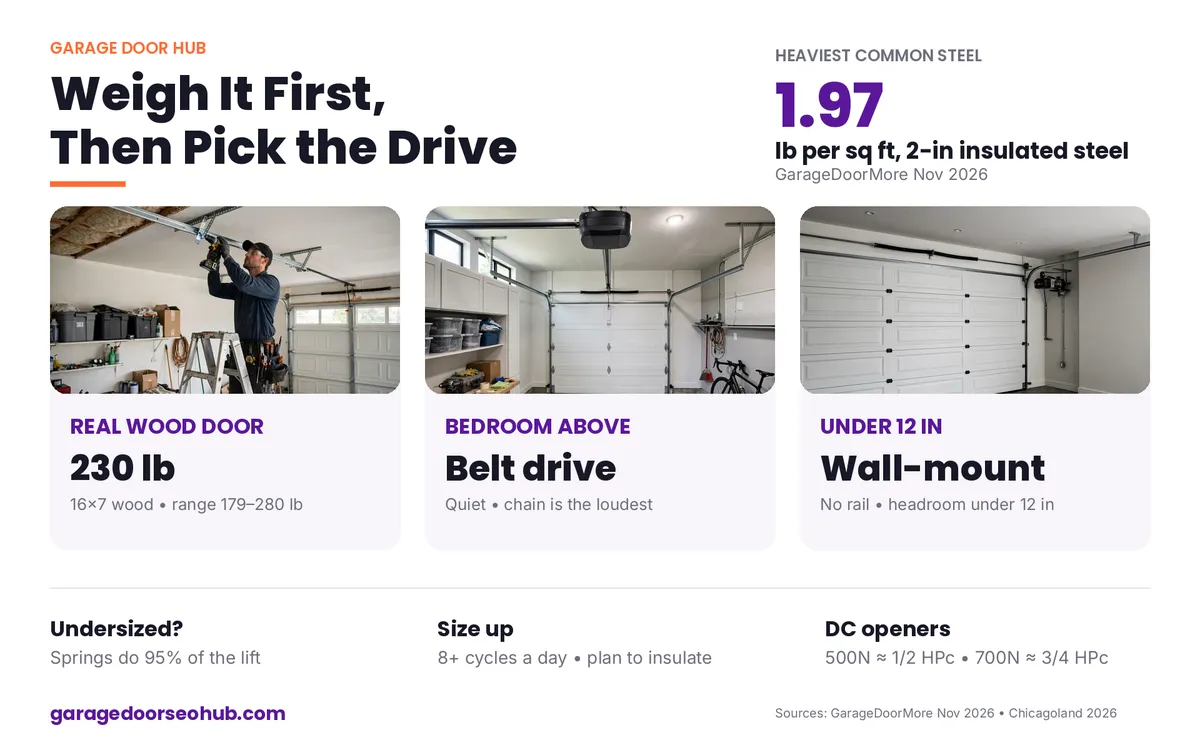
If the top of your door's weight range passes 350 lb, the calculator moves you to 1 1/4 HP. A 16 by 7 solid wood door weighs about 230 lb, with a range of 179 to 280 lb. The point estimate says 3/4 HP. The heavy end of the range says 1 HP. Buy the bigger motor.
How much does a garage door weigh?
A door's weight is its area times its weight per square foot. The calculator shows the weight as a range, because sources disagree by about 40% on the same door. A single number would be false precision.
| Door type | Pounds per square foot |
|---|---|
| Steel, single layer, non-insulated | 1.40 |
| Steel, double layer, vinyl-backed | 1.50 |
| Steel, 1 3/8-in steel-backed | 1.63 |
| Steel, 2-in steel-backed, insulated | 1.97 |
| Aluminium | 1.20 |
| Fibreglass | 1.60 |
| Vinyl | 1.50 |
| Solid wood | 2.05 |
Sources: GarageDoorMore, Nov 2026, for the steel figures. Wood varies the most — and the sources disagree about it. GarageDoorMore, Nov 2026, gives pine 1.60 to 1.80, cedar 1.70 to 2.10 and oak 2.20 to 2.50 lb per square foot, while Atlanta Garage Doors, 2026, gives solid wood 3.5 to 5 lb per square foot. The calculator uses 2.05, the midpoint of GarageDoorMore's species figures. Atlanta's 3.5 to 5 lb per square foot stays only as a high-end figure. Weigh a real wood door before you buy — do not trust any per-square-foot estimate for wood.
Worked examples from the calculator, all tested:
- A 9 by 7 single steel door, non-insulated: 63 square feet times 1.40 is 88 lb, range 85 to 95 lb. That is a 1/3 HP opener.
- A 16 by 7 steel door, non-insulated: 112 square feet times 1.40 is 157 lb, range 152 to 170 lb. That is a 3/4 HP opener by the conservative rule, even though a 1/2 HP is rated to about 300 lb by LiftMaster.
- A 16 by 7 steel door, 2-inch insulated: 112 square feet times 1.97 is 221 lb, range 214 to 239 lb — 2-in steel-backed, the heaviest insulated construction, so it sits just above GarageDoorMore's 180–220 lb general insulated-double range. That is a 3/4 HP opener, belt drive if a bedroom sits above the garage.
- A 16 by 7 solid wood door: 112 square feet times 2.05 is 230 lb, range 179 to 280 lb. The point estimate says 3/4 HP; the heavy end of the range says 1 HP. Buy the bigger motor.
- An 18 by 8 steel door, 2-inch insulated, 8 cycles a day: 144 square feet times 1.97 is 284 lb, range 275 to 307 lb. The base band is 1 HP; heavy use sizes it up one band to 1 1/4 HP. (v8 change: v7 showed this door as 1 HP, which contradicted its own size-up rule.)
Windows and decorative overlays add about 15 lb each. Check the exact weight of your door before a spring or cable job with the garage door weight calculator. An 8 by 7 steel door weighs 83 lb on the site's spring table — inside this calculator's 76 to 84 lb range for that door, so the two figures agree. If you need the spring size for that weight, use the garage door spring calculator.
Chain, belt or wall-mount drive?
The motor size decides whether the door moves. The drive type decides how loud it is and whether it fits.
Chain drive is the cheapest and the strongest. It is also the loudest. It suits a detached garage, a heavy door, and a buyer who wants the lowest price. A chain-drive opener costs about $405 installed (GarageCalculator, Oct 2026).
Belt drive is quiet. It suits an attached garage, and it is the right choice when a bedroom sits above the garage. A belt-drive opener costs about $505 installed (GarageCalculator, Oct 2026). The calculator recommends belt drive whenever you tick the bedroom box.
Wall-mount (jackshaft) drive has no rail. It mounts on the wall beside the door and turns the torsion shaft directly. It is the answer when headroom is under 12 inches. A standard rail opener needs 12 inches of headroom, and 15 inches with the rail and opener fitted. A wall-mount opener costs $600 to $1,300 or more installed (InspectandTest, Oct 2026).
Headroom under 5 inches is a different problem. Garaga's rear-mounted low-headroom kit needs 5 inches, and a front-mounted torsion kit needs 8 inches. Below 5 inches, a sectional door may not fit at all. The calculator flags that and tells you to check with a pro before buying anything.
A screw-drive opener sits between chain and belt on noise and price. It suits mild climates and light doors. It is not the calculator's default for any door, because chain and belt cover the same jobs better.
HPc and newtons: what DC openers mean
Newer openers use DC motors, and DC motors are not rated in horsepower. They are rated in HPc (horsepower comparable) or in newtons of lifting force. The two numbers do not mean the same thing, and the box rarely explains it.
The translation the calculator uses, from Crosby Garage Doors:
- 500N is about 1/2 HPc
- 700N is about 3/4 HPc
There is no standard published figure for a 1 HP or 1 1/4 HP DC opener, so the calculator says so instead of inventing one. If your door needs 1 HP or more, check the maker's newton rating for that model before you buy.
One more thing the box will not tell you: HPc is a marketing number, not a measured horsepower. Two openers labelled 3/4 HPc from different makers can lift different weights. The weight of your door is the number that matters. That is why the calculator starts from weight and works forward, instead of starting from the label on the box.
Check the springs before you buy an opener
The springs do about 95% of the lifting. The opener only guides the door and finishes the last bit of the lift. A bigger opener cannot compensate for bad springs, and buying one to fix a heavy door is money spent on the wrong part.
Test the balance before you buy. Disconnect the opener and lift the door by hand. It should move smoothly and stay halfway open when you let go. If it is heavy, drops, or slams shut, the springs are worn or the door is out of balance. Fix that first.
A torsion spring lasts 10,000 to 20,000 cycles. One cycle is one open and one close. At 4 cycles a day, a 10,000-cycle spring lasts about 6.8 years. At 2 cycles a day, it lasts about 13.7 years. If your springs are near the end of that range, price the spring job with the garage door repair cost calculator before you price a new opener — a spring pair costs $150 to $350 installed (HomeGuide, Oct 2026), and a new opener on worn springs will strain from day one. Garage Door Hub connects you with a local pro near you, fast — a spring check costs less than a new motor.
Do not adjust or replace a torsion spring yourself. A wound spring holds 150 to 200 foot-pounds of torque. A pro job takes 60 to 90 minutes. If the cables are worn too, check the length with the garage door cable length calculator before you book.
How much does a new garage door opener cost in 2026?
This tool sizes the opener. It does not price it. The prices below are context only, so you know what the size you just found will cost.
A chain-drive opener costs $350 to $650 installed. A belt-drive opener costs $400 to $800 installed. A wall-mount opener costs $600 to $1,300 or more installed (InspectandTest, Oct 2026). GarageCalculator, Oct 2026, puts the typical installed figures lower, at about $405 for chain, $505 for belt, and $900 for wall-mount.
A 1/2 HP opener costs $180 to $280 installed. A 3/4 HP opener costs $250 to $400 installed. A 1 HP or larger opener costs $350 to $550 installed (Medium, 28 Feb 2026 — a weak source, use it as a cross-check only). Stepping up from 1/2 to 3/4 HP adds $50 to $150 to the unit price. A heavier insulated door costs more twice over — the door and the motor — so check the insulation with the garage door R-value calculator before you finalise the size: a 2-inch insulated steel door weighs about 40% more than the same door non-insulated.
Price your exact opener, with the drive type and the size from this calculator, with the garage door opener cost calculator. If the opener repair is close to a new unit, the repair-vs-replace check is on the garage door repair vs replace calculator — a repair over half the price of a new opener usually means replace. Price the door itself with the garage door cost calculator if the door is the real problem, not the motor.
5 questions to ask before you buy
- How much does my door weigh, and what is the weight range? Get the number, not a guess — the whole size depends on it.
- Is the door balanced, and do the springs have life left? A door that drops or slams needs springs, not a bigger motor.
- How many times a day does the door open? Eight or more cycles a day means size up one band.
- Is there a bedroom above the garage, and is the headroom 12 inches or more? The first decides belt vs chain. The second decides rail vs wall-mount.
- What is the warranty on the motor and on the labour? A new opener should carry at least 1 year on labour, and the motor warranty should be in writing.
Get 2 to 3 quotes for any job over $500. For a second opinion, use the calculator hub. To reach a pro, use the contact page.
Garage Door Hub connects homeowners with trusted local garage door pros. Need a repair? Need a replacement? Start here. First, find out what it should cost. Then, price your exact job with our free calculator. Next, find a pro near you. Fast. No jargon. No guesswork. No surprise bills. Just clear prices, honest guides, and a local pro you can call today.
Frequently asked questions
What size garage door opener do I need for a 16x7 double door?
A 16 by 7 steel door weighs about 157 lb non-insulated and 221 lb insulated (2-in steel-backed), so a 3/4 HP opener is the conservative size. A 1/2 HP is rated to about 300 lb by LiftMaster, but 3/4 HP lasts longer.
Is 1/2 HP enough for a double garage door?
By the maker's rating, yes — LiftMaster rates 1/2 HP to about 300 lb, and most double steel doors weigh 150 to 250 lb. By the conservative rule this calculator uses, no — a double door gets 3/4 HP for longer life.
What horsepower opener do I need for a wood garage door?
A 16 by 7 solid wood door weighs about 230 lb, range 179 to 280 lb. That needs a 1 HP opener — the point estimate says 3/4 HP, but the heavy end of the range decides. Wood is the heaviest common door material, at about 2.05 lb per square foot (GarageDoorMore species midpoint, Nov 2026); Atlanta Garage Doors, 2026, gives 3.5 to 5.0 as a high-end figure, so weigh a real wood door before you buy.
What is HPc on a garage door opener?
HPc is horsepower comparable, the rating used for DC motors. 500N is about 1/2 HPc and 700N is about 3/4 HPc. HPc is not the same as measured horsepower, so size by your door's weight, not by the label.
Do I need a jackshaft opener for low headroom?
Yes, if your headroom is under 12 inches. A standard rail opener needs 12 inches, 15 inches with the rail fitted. A wall-mount jackshaft opener needs no rail. Below 5 inches of headroom, a sectional door may not fit at all.