
Insulating a garage door can save $50 to $200 a year on heating in Ohio, depending on the door, fuel, and whether the garage is heated. A DIY kit on a double door pays back in about 1.3 years. A new insulated door takes about 17 years to pay back from energy alone — a full-door payback, counting the whole $2,600 door against the about $154 a year it saves. Use the calculator below to price it.
Garage Door Hub connects you with a trusted local pro. Need a repair? Need a replacement? Start here. First, find out what it should cost.
Price your insulation saving
Heating saving only, in dollars per year. Pick your door, your garage, your fuel and your climate — the saving is calculated from heating degree days, not a national average.
| Route | Cost | Payback |
|---|---|---|
| DIY R-8 kit | ||
| Pro retrofit, same kit | ||
| New insulated door (U-0.19) |
Prices: EIA, Aug 2026 (electricity 19.38¢/kWh Ohio) and 12-month average to May 2026 (gas $1.48/therm); HomeGuide, Nov 2025 (kit and door costs); EngineeringToolbox, 5 Mar 2025 (degree days). Detached-heated saving uses a 0.5 model factor — see the article. Cooling savings are not estimated.
How much can you save by insulating your garage door?
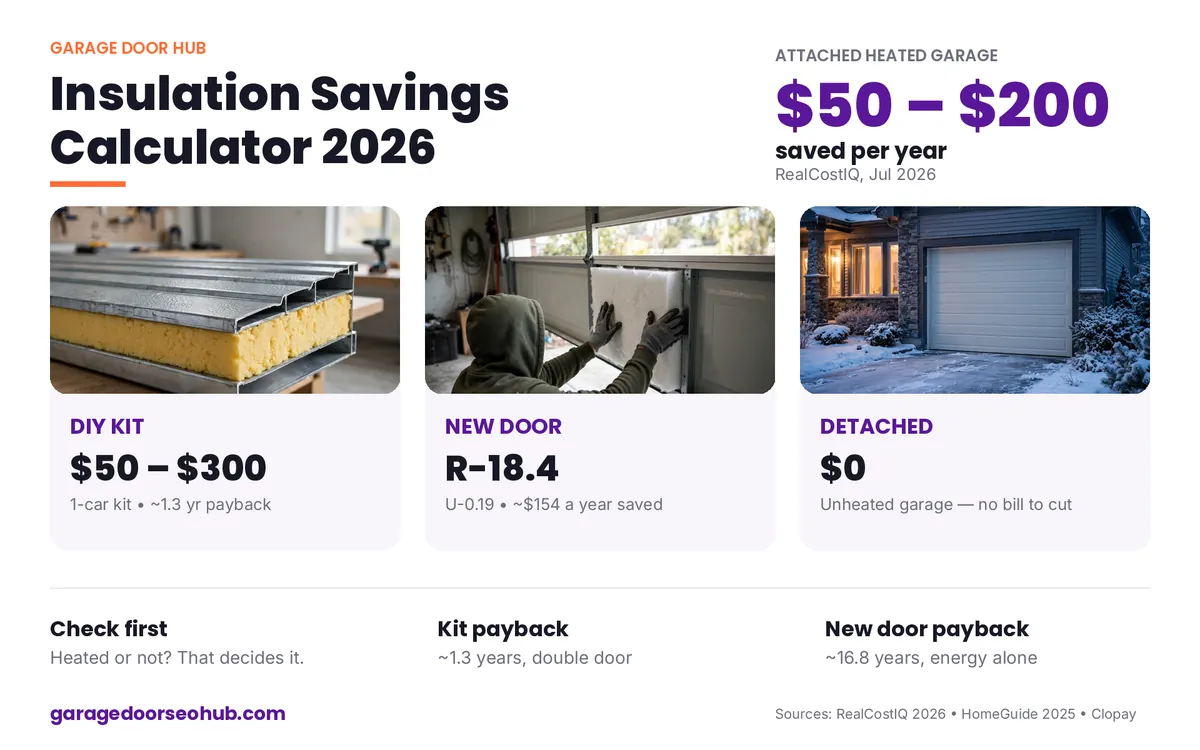
For an attached, heated garage in Ohio, most homeowners save $50 to $200 a year. That range comes from several sources, and they do not all agree, because the saving depends on the door, the fuel, and how warm the garage is kept. A detached, unheated garage saves $0 on heating — there is no heating bill to cut.
| Situation | Typical saving per year | Source |
|---|---|---|
| Attached garage, heated, gas heat | $50–$150 | garage.uclfootball.com, Oct 2026 |
| Attached garage, heated, any fuel | $60–$200 | RealCostIQ, Jul 2026 |
| Attached garage, R-12 or better door | $50–$100 | CostInspector, 2026 |
| Detached garage, heated (model) | About half the attached figure | v8 model factor 0.5 — see gaps |
| Detached garage, unheated | $0 | Armorthane, 2026 |
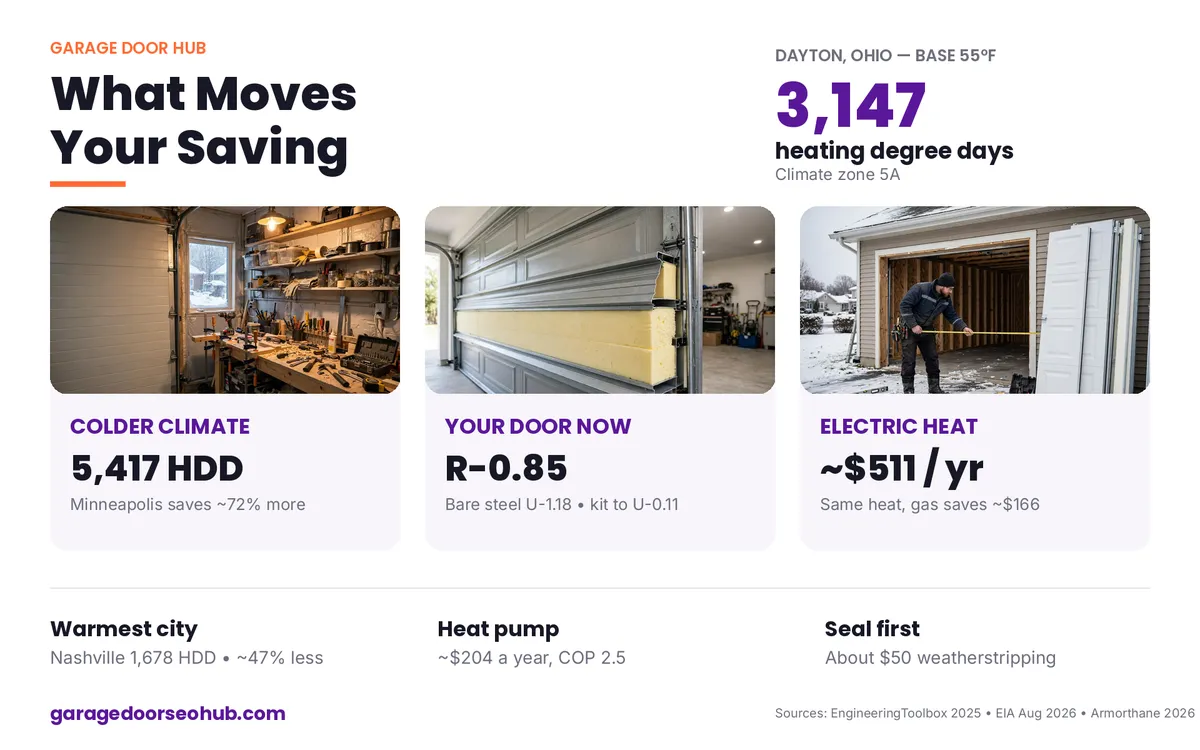
The calculator on this page does the calculation properly: it takes your door size, your current insulation, your fuel and its price, and your climate's heating degree days, and works out the saving in dollars. It does not use a national average — a door in Minneapolis (5,417 degree days, base 55°F) saves about 72% more than the same door in Dayton (3,147), and a door in Nashville (1,678) saves about 47% less.
Be sceptical of any claim that insulating a garage door saves 15% of your energy bill. Armorthane traces that number to ENERGY STAR's modelled savings for whole-house air sealing and insulation, not to garages. A garage door is one surface of one room. It cannot cut 15% off a whole house bill.
R-value vs U-factor: what the numbers mean
R-value measures resistance to heat flow. U-factor measures how much heat gets through. They are opposites: U equals 1 divided by R. A lower U-factor is better. A U-0.20 door lets through half the heat of a U-0.40 door.
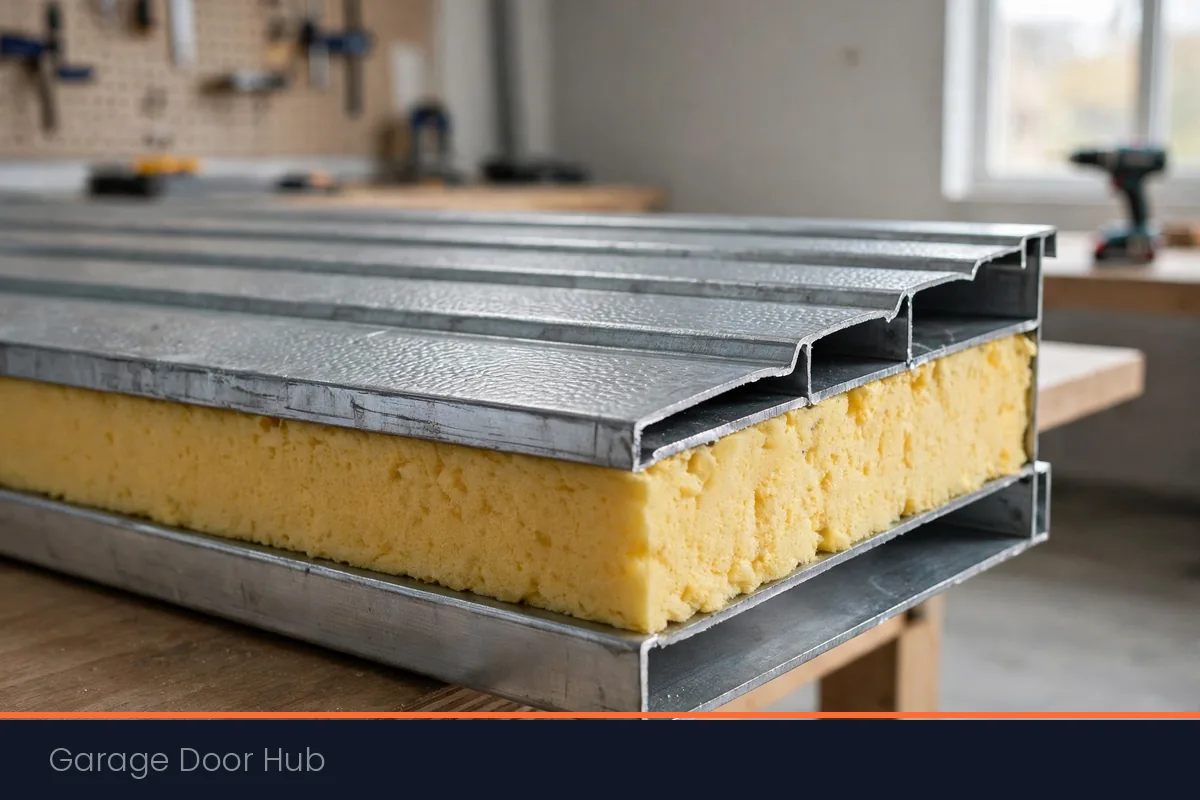
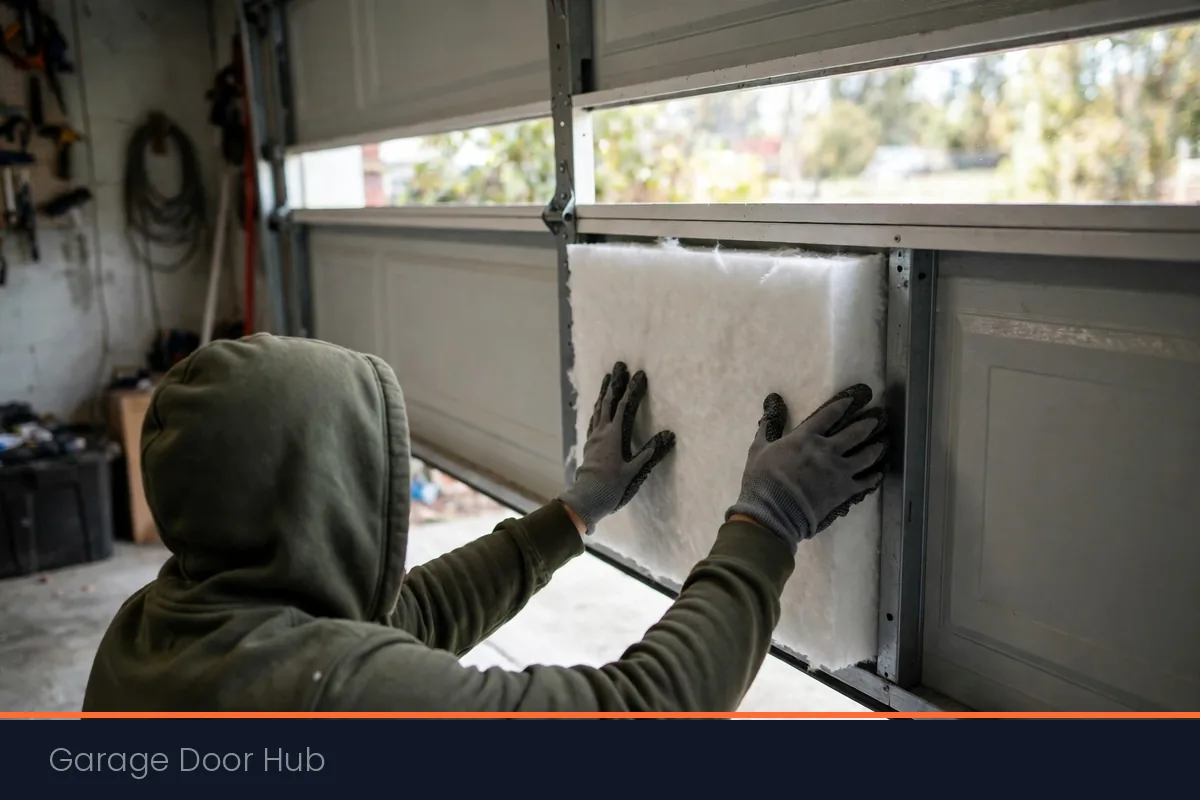
A bare single-skin steel door is about R-0.85 at mid-panel (DASMA method, via Armorthane, 2026). That is the steel skin plus the thin air films inside and outside — the steel itself counts as zero. Add a 2.25-inch R-8 fibreglass kit and the panel reaches about R-8.85 on paper.
Paper R-value is not the whole story. A tested U-factor (ANSI/DASMA 105) measures the whole installed door, joints, hardware and perimeter included. Two doors with the same panel R-value can have different tested U-factors, because one seals better than the other. Clopay's 2-inch polyurethane door is R-18.4 on paper but tests at U-0.19 for the whole door; its 1-3/8-inch door is R-12.9 and tests at U-0.21 (Clopay Architectural Series spec, current). Amarr's triple-layer polyurethane doors reach R-13.35 to R-19.40 (Amarr, via Farnsworth Garage, 2026). This calculator compares by U-factor, and it uses a manufacturer's tested U-factor for a new door. Never present a mid-panel R-value as a whole-door performance figure.
Check what your door is now with the garage door R-value calculator. A bare steel door is R-0.85. A 2-layer door is R-6 to R-9. A 3-layer door is R-12 to R-18. If you only need the cost of insulating, without the savings, use the garage insulation cost calculator.
How the calculator works
The maths is steady-state heat loss, the method Armorthane uses. Heat lost through the door in a year equals door area, times U-factor, times heating degree days, times 24 hours. The saving is the same sum with the old U-factor minus the new one, then divided by heating efficiency and fuel energy, then multiplied by the fuel price.
Dayton, Ohio, is in DOE climate zone 5A (Montgomery County) and has 3,147 heating degree days at base 55°F (EngineeringToolbox, updated 5 Mar 2025). Base 55°F matters, because a garage held at 50°F is not a house held at 65°F. Using the base-65°F figure of 5,622 would inflate the saving by about 80%. The calculator defaults to 3,147, and offers Cincinnati (3,003), Cleveland (3,795), Chicago (3,743), Nashville (1,678) and Minneapolis (5,417) as presets, plus a custom degree-day input. If your city is not listed, pick the closest climate or type your own figure — do not use Dayton's number for a house in Florida.
Ohio energy prices in the calculator are gas $1.48 per therm (EIA 12-month average to May 2026, via WhereMyMoney, updated 29 Oct 2026) and electricity 19.38 cents per kWh (EIA, Aug 2026). Note the gas conflict: EIA's May 2026 Ohio spot price was about $2.20 per therm, 49% above the 12-month average, because gas prices swing with the season. The $1.48 average is the right default for an annual saving, but type your own price from your bill if you want your number, not Ohio's. A gas furnace at 80% efficiency is the default. Electric resistance heat is 100% efficient but costs about 3 times as much per unit of heat, so it saves about 3 times as many dollars. A heat pump at 250% efficiency (a COP of 2.5) sits between the two.
Worked example, on the calculator defaults: a 16x7 double door, 112 square feet, bare steel at U-1.18 upgraded with an R-8 kit to U-0.11. The U-factor change is 1.06. Heat saved is 112 times 1.06 times 3,147 times 24, about 9.0 million BTU a year. At 80% furnace efficiency that is about 112 therms of gas, and at $1.48 a therm it is about $166 a year. A $220 DIY kit pays back in about 1.3 years.
Cooling savings are not estimated. In Ohio, heating dominates, and no source found gives a defensible door-only cooling formula. The calculator says so on the results panel rather than inventing a number.
DIY kit vs pro retrofit vs new insulated door
Three routes, three very different paybacks. The saving per year is nearly the same for the kit and the pro retrofit, because both fit the same R-8 kit. The new door saves slightly less per year, because its tested U-factor of 0.19 is worse than the kit's 0.11 on paper — but the new door also buys a new door, not just insulation.
| Route | Typical cost, double door | Saving per year | Payback |
|---|---|---|---|
| DIY fibreglass kit, R-8 | $220 | About $166 | About 1.3 years |
| Pro retrofit, same R-8 kit fitted | $450 | About $166 | About 2.7 years |
| New insulated door, tested U-0.19 | $2,600 | About $154 | About 16.8 years (full-door payback) |
Costs: DIY kit for a 2-car door $90 to $530, for a 1-car door $50 to $300 (HomeGuide, Nov 2025). Named kits: Owens Corning about $120 to $185, Matador EPS R-4.8 about $80 to $100, Reach Barrier about $59 to $90 (MyGarageFix, updated 12 Nov 2026). A pro retrofit of an existing door costs $100 to $800, labour and materials (HomeGuide, Nov 2025). A new insulated door costs $750 to $1,900 for a single door and $1,500 to $3,700 or more for a double, installed (HomeGuide, Nov 2025). See the HomeGuide garage insulation cost guide, Nov 2025 and the MyGarageFix insulation kit guide, updated 12 Nov 2026.
The kit wins on payback because it is cheap and the door is the same door. The new door loses on payback because you are paying for a whole door to get the insulation — its about 16.8-year figure is a full-door payback ($2,600 ÷ about $154/yr), not an insulation-premium payback. Buy a new door for comfort, durability, safety sensors and resale — not for energy payback. Price the door with the garage door cost calculator and the full job with the garage door replacement cost calculator. If your door is old and failing as well as cold, run the garage door repair vs replace calculator first — insulation does not fix a broken spring. And if you are weighing a new door against a repair bill, price the repair with the garage door repair cost calculator.
Attached vs detached garage: when insulation pays
Attached garages pay back fastest, because the garage shares a wall and often a ceiling with the house. Heat leaking through the door warms the garage, and a warm garage warms the rooms beside it — or, in winter, the cold garage pulls heat out of those rooms. The US Department of Energy's guidance, cited by Armorthane, is to insulate the walls between living spaces and unheated garages, and to seal air leaks first.
If a room sits above or beside the garage — a bedroom, a home office, a laundry room — the comfort gain is usually larger than the dollar saving. A floor above a cold garage is a cold floor. Insulation will not show up fully on the heating bill, but it will show up under your feet.
Detached garages are different. If the garage is detached and unheated, insulating the door saves $0 on heating, and the calculator says so honestly. If it is detached and heated, the calculator counts about half the attached saving — a stated model, not a measurement, because a detached garage does not pull heat out of the house and is usually held cooler. Insulate it for comfort if you work in there, or if you store things that dislike the cold. Otherwise spend about $50 on weatherstripping first. Air leaking around the door edges usually loses more heat than the panel itself, and weatherstripping pays back faster than insulation in almost every garage.
Garage Door Hub connects you with a local pro near you, fast.
What moves your savings up or down
Four things move the saving by more than the kit costs.
How warm you keep the garage. The calculator uses heating degree days for a garage held at 50°F. Hold it at 65°F and the saving roughly doubles. Hold it at 40°F and it roughly halves. Setpoint is the single biggest lever, and it is yours to choose.
Air sealing. A door that leaks air around the edges loses heat through the gaps, and insulation does not fix gaps. Seal the perimeter and the bottom seal first. The calculator assumes a reasonably sealed door. If yours whistles in a wind, fix that before you buy a kit.
Fuel and efficiency. Electric resistance heat saves about 3 times as many dollars as gas for the same heat, because electricity costs more per unit of heat — on the calculator defaults, electric resistance saves about $511 a year against $166 for gas. A heat pump saves about $204 a year, because it is about 2.5 times as efficient as resistance heat. The calculator lets you change the fuel, the price and the efficiency — the defaults are Ohio gas at $1.48 a therm and 80% efficiency, and Ohio electricity at 19.38 cents per kWh (EIA, Aug 2026).
What the door is now. The saving comes from the change in U-factor, not from the new U-factor alone. A bare steel door at U-1.18 upgraded to U-0.11 saves about $166 a year on a double door. A door that is already R-12, at about U-0.08, saves almost nothing from a kit — the calculator tells you the door is already better insulated and stops there. Check how long the rest of the door will last before you spend on it with the garage door lifespan calculator, and what a new door returns at resale with the garage door ROI calculator.
5 questions to ask before you book
- What is the tested U-factor of the door or kit, not just the panel R-value? A mid-panel R-value is not a whole-door figure.
- What is the total price, in writing, for the kit, the fitting, or the new door — parts, labour and removal as separate lines?
- Is the bottom seal and the perimeter weatherstripping included, or priced separately? Gaps lose more heat than the panel.
- If it is a new door, does the price include new tracks, springs and hardware, or reuse the old ones?
- How long is the warranty on the door and on the fitting? A new insulated door should carry a multi-year warranty on the door itself.
Get 2 to 3 quotes for any job over $500. For a second opinion, use the calculator hub. To reach a pro, use the contact page.
Garage Door Hub connects homeowners with trusted local garage door pros. Need a repair? Need a replacement? Start here. First, find out what it should cost. Then, price your exact job with our free calculator. Next, find a pro near you. Fast. No jargon. No guesswork. No surprise bills. Just clear prices, honest guides, and a local pro you can call today.
Frequently asked questions
How much money can you save by insulating a garage door?
In an attached, heated garage in Ohio, most homeowners save $50 to $200 a year. On the calculator defaults — a 16x7 double door, bare steel, gas heat — the saving is about $166 a year. A detached, unheated garage saves $0 on heating.
Is it worth insulating a garage door?
A DIY kit is worth it: about $220 on a double door, paying back in about 1.3 years. A pro retrofit at about $450 pays back in about 2.7 years. A new insulated door at about $2,600 takes about 16.8 years to pay back from energy alone (full-door payback) — buy it for comfort and durability, not for payback.
What R-value should a garage door have in Ohio?
An insulated door is usually R-9 to R-12, and a 3-layer door reaches R-12 to R-18. A bare steel door is about R-0.85. The tested U-factor matters more than the panel R-value, because it measures the whole installed door.
How much does it cost to insulate a garage door?
A DIY kit costs $50 to $300 for a single door and $90 to $530 for a double door (HomeGuide, Nov 2025). A pro retrofit costs $100 to $800. A new insulated door costs $750 to $1,900 single and $1,500 to $3,700 or more double, installed.
Does insulating a garage door help if the garage is detached and unheated?
No, not on the heating bill — the saving is $0, because there is no heating bill to cut. Insulate it for comfort if you use the space. Otherwise spend about $50 on weatherstripping first, because air leaks lose more heat than the panel.