
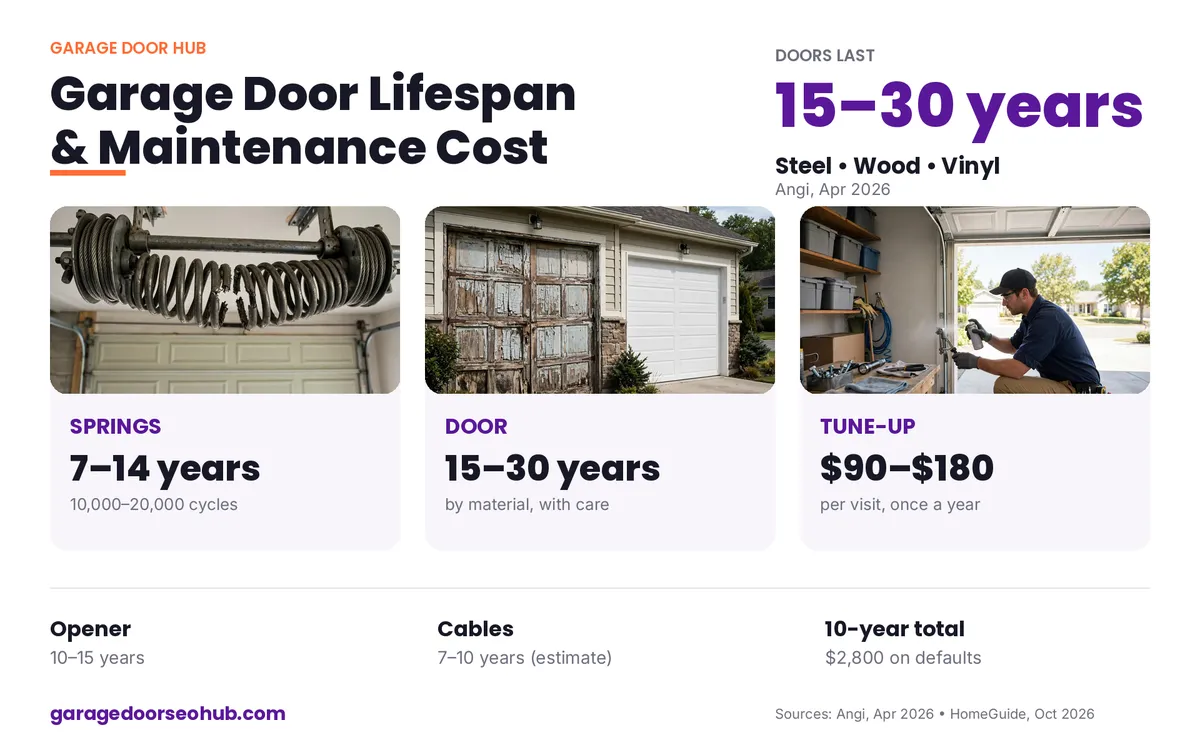
Most garage doors last 15 to 30 years. Springs last 7 to 14 years, counted in cycles, not years. Openers last 10 to 15 years. Cables last 7 to 10 years. Use the free calculator below. Enter your door age, spring rating, and daily use. You get each part’s replacement year and your total for 10, 15, and 20 years.
Garage Door Hub connects you with a trusted local pro. Need a repair? Need a replacement? Start here. First, find out what it should cost.
How long will your door last?
Each part has its own clock. Enter your ages and daily use — the calculator gives every replacement year and your 10, 15 and 20-year totals.
| Part | Due | Cost in 10 years |
|---|---|---|
| Springs | ||
| Cables | ||
| Rollers | ||
| Opener | ||
| Door itself | ||
| Tune-ups (10 years) | Every year |
Lifespans: Angi, Apr 2026; Good Golly Garage, Apr 2026; HomeAdvisor, Jun 2026; Fixr, Jan 2025; Farnsworth Garage, Sep 2026. Costs: Fixr, Jan 2025; HomeAdvisor, 17 Jun 2026; GarageDoorLocator, 2026. Cable life (7–10 years) is an estimate; the maintenance effect on door life is a model — see the article.
How long does a garage door last?
It depends on the material, and on whether anyone maintains it. A steel door lasts 15 to 30 years. A wood door lasts 15 to 25 years. An aluminium door lasts 15 to 25 years. Fibreglass lasts 20 to 30 years. Vinyl and composite doors last 25 to 35 years (Good Golly Garage, Apr 2026). Angi, updated 10 April 2026, agrees on 15 to 30 years overall, with solid wood at 20 to 30 years and wood composite at 15 to 20 — so a solid-wood door with diligent refinishing can outlast the 15 to 25 range this calculator uses.
Those ranges are for the door panels and frame. The parts inside it fail sooner. Springs, cables and rollers wear out on a cycle count, not on the calendar. An opener has its own clock. That is why this calculator shows each part separately, instead of one number for the whole door.
One contrast to know: the National Association of Home Builders / Bank of America life-expectancy study (2007) puts garage doors at 10 to 15 years — far shorter than the 15 to 30 years in current guides. That study is old and conservative, and it assumes average maintenance. A neglected door can wear out that fast; a maintained one usually does not.
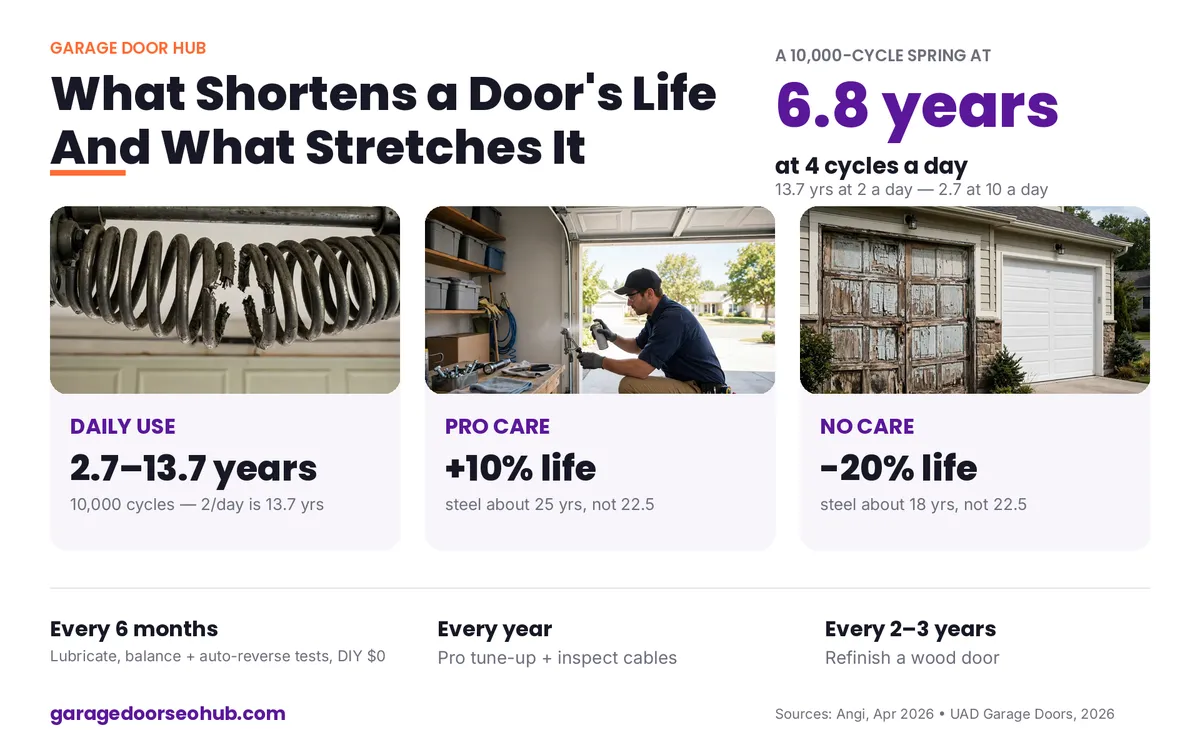
Maintenance moves the door’s life by a visible amount. The calculator uses a simple model for it: no maintenance takes 20% off the door’s expected life, DIY care every year keeps it at the midpoint, and a professional inspection every year adds 10%. That is a model assumption, labelled as one on the page — not a measured figure from a study. A steel door at the 22.5-year midpoint lasts about 18 years with no maintenance and about 25 years with a pro visit every year.
How long do garage door springs last?
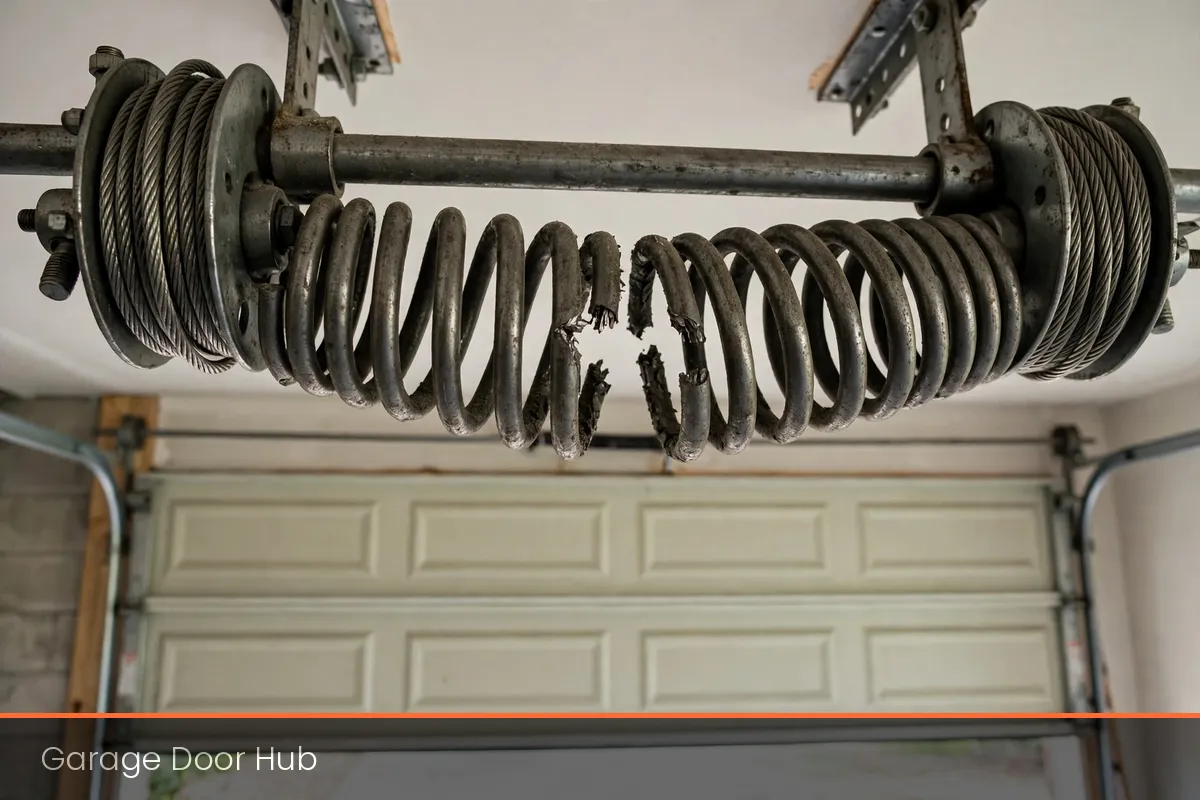
Springs last by cycles, not by years. One cycle is one open and one close. The formula is simple: years = rated cycles divided by cycles per day times 365.
A standard torsion spring is rated for 10,000 cycles. That rating is a spring manufacturer and distributor catalogue convention — it is not a DASMA standard and not an ANSI standard (Farnsworth Garage, Sep 2026). Saying so matters, because the number looks official and it is not. It is still the figure every source uses, so the calculator uses it too, and says where it comes from. Standard torsion springs run 10,000 to 20,000 cycles (HomeGuide, Oct 2026), which is 7 to 14 years at normal use.
At 4 cycles a day, 10,000 cycles last 6.8 years. At 3 cycles a day, they last 9.1 years. At 2 cycles a day, they last 13.7 years. At 10 cycles a day — a family that uses the garage as its front door — they last 2.7 years (UAD Garage Doors, 23 Jan 2026). Same springs, 11 years of difference. That is the whole point of this calculator: never quote spring life in years without asking how many times a day the door moves.
High-cycle springs change the maths. A 15,000-cycle spring lasts 10 to 12 years at normal use. A 20,000-cycle spring lasts 12 to 15 years. A 25,000-cycle spring lasts 15 to 20 years. At 10 cycles a day, a 25,000-cycle spring lasts 6.8 years where a standard spring lasts 2.7. High-cycle springs add $50 to $150 per pair (Tallyard, 2026). If your door cycles 8 or more times a day, that upgrade pays for itself in avoided call-outs.
Extension springs are shorter-lived: 5 to 7 years in most sources, against 7 to 12 years for torsion springs (Frisco Garage Door Pros, 25 Oct 2026). Replace both springs at once. The second spring has done the same cycles as the first and will fail within months. A torsion pair costs $200 to $350 installed (Fixr, 31 Jan 2025) or $200 to $500 (Housecall Pro, Mar 2026) — the calculator uses $275, the midpoint of the narrower range, and you can change it.
Do not replace a torsion spring yourself. A wound spring holds 150 to 200 foot-pounds of torque. It can break bones or blind you. Spring and cable work is pro-only — see the Farnsworth Garage guide to how long garage door springs last, Sep 2026. A pro job takes 60 to 90 minutes.
If you want the spring size for your door, use the garage door spring calculator. Check the door weight first with the garage door weight calculator — an 8×7 steel door weighs 83 lbs.
How much does garage door maintenance cost?
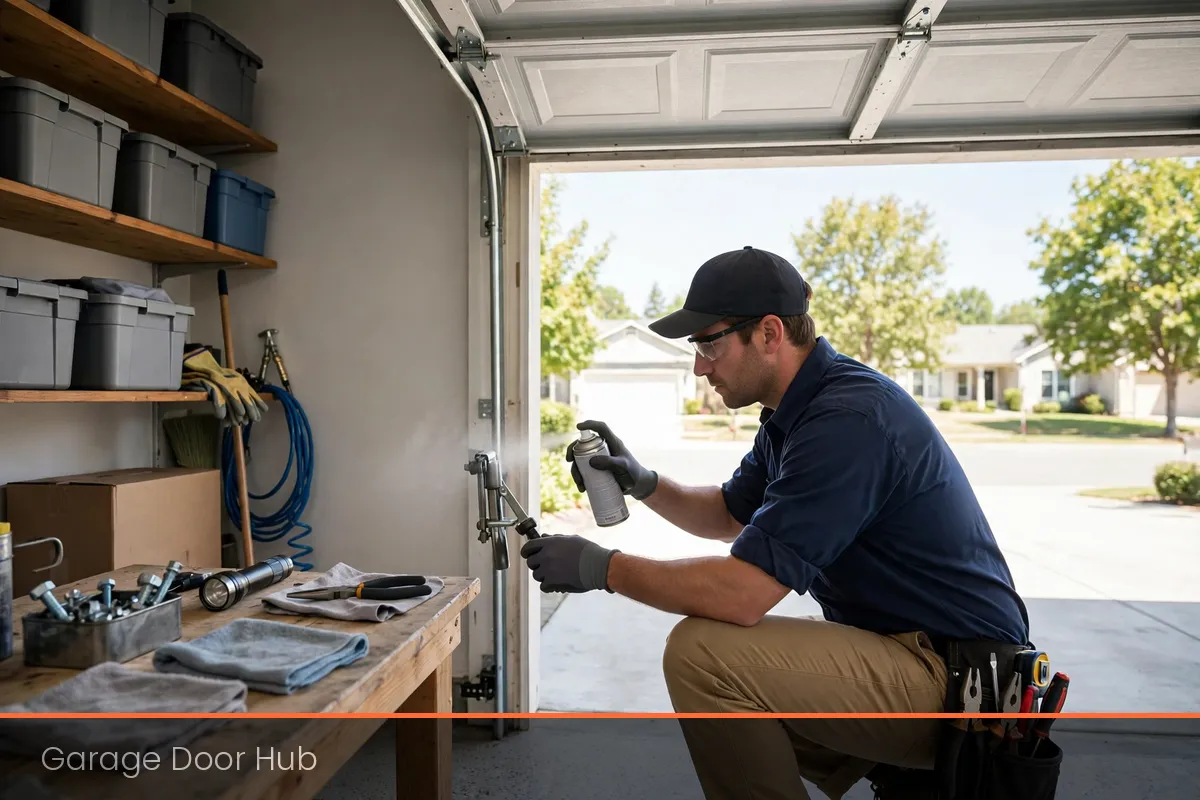
A tune-up costs $90 to $180 per visit (GarageDoorLocator, 2026). That visit covers lubrication, tightening, a balance test and a safety check. Once a year is the standard schedule. The calculator uses $135, the midpoint, and adds one visit a year when you select professional maintenance.
| Part | Expected life | Typical replacement cost, installed, 2026 | Calculator default |
|---|---|---|---|
| Torsion spring pair | 10,000 cycles (6.8 years at 4 cycles a day) | $200–$350 | $275 |
| Extension spring pair | 5–7 years | $150–$200 | $175 |
| Lift cables (pair) | 7–10 years (estimate) | $150–$300 | $225 |
| Rollers (full set) | 10–15 years | $100–$250 | $175 |
| Opener | 10–15 years | $300–$800 | $500 |
| Tune-up / inspection | Every year | $90–$180 per visit | $135 |
| One panel | As needed | $250–$900 | — |
| New door, full replacement | 15–30 years | $754–$1,707 | $1,231 |
Sources: Fixr, 31 Jan 2025; Housecall Pro, Mar 2026, via Zarla, Nov 2026; HomeGuide, Nov 2026; GarageDoorLocator, 2026; HomeAdvisor, 17 Jun 2026; Angi, 21 Sep 2026. Cable life of 7 to 10 years is an estimate — no single sourced figure was found in the research, and the calculator labels it as one. Weatherstripping has no sourced lifespan figure either, so the calculator does not give it a replacement year. Inspect it every year and replace it when it cracks or gaps. Cable and panel ranges match the garage door repair cost calculator exactly — the same figures, so the two pages never disagree.
Most individual repairs cost $150 to $350, average about $265 (HomeAdvisor, 20 Jun 2026). Price any single repair with the repair cost calculator before you compare it with a replacement.
What does a garage door cost over 10, 15 and 20 years?
Run the calculator on its defaults and you get a real budget. A double steel door installed in 2020, torsion springs rated 10,000 cycles, 4 cycles a day, opener the same age, professional maintenance every year: the springs are due in 2027, the opener in 2033, the door in 2045. The 10-year total is $2,800. The 15-year total is $3,975. The 20-year total is $6,781 — that one includes a new door at $1,231, because the door itself falls due inside 20 years.
The 10-year total is made of $550 for two spring replacements, $225 for cables, $175 for rollers, $500 for the opener, and $1,350 for ten annual tune-ups. Nothing in that list is a surprise. That is the point. A door does not cost you $2,800 in one bill. It costs you a spring here, a tune-up there, and an opener in year 7.
Change one input and watch the budget move. Set cycles per day to 10 and the springs are due in under 3 years instead of 7. Set it to 2 and they last almost 14 years. Switch the door to wood with no maintenance and the door life drops to 16 years. Those are the two levers that matter most: how often the door moves, and whether anyone looks after it. If insulation is part of the plan, check what it saves with the garage door insulation savings calculator, and what a new door returns at resale with the garage door ROI calculator.
When should you replace your garage door instead of repairing it?
Replace it when the door and the opener are both past their expected life. The calculator says so plainly when that happens. A 22-year-old steel door with a 14-year-old opener and 9-year-old springs is done: every part is overdue, and the next repair only buys months. The research test case for that system puts a $350 repair against a $1,231 replacement door — 28.43% — so the repair looks cheap on the 50% rule alone. It is not cheap, because the door it repairs is finished.
Use the 50% rule as the second check. If a single repair costs more than 60% of a new door, replace the door. If it costs less than 40%, repair it. Between 40% and 60%, look at the age of what is left. Price the two sides of that decision with the garage door repair vs replace calculator and the garage door replacement cost calculator. A new door itself costs $754 to $1,707 installed, average $1,231 (Angi, 21 Sep 2026; HomeAdvisor, 17 Jun 2026) — price the exact door with the garage door cost calculator.
A door under 10 years old with one failed part is almost always a repair. A door over 20 years old with 2 or 3 faults is a replacement. Garage Door Hub connects you with a local pro near you, fast — get 2 to 3 written quotes for any job over $500.
Watch: Garage Door Springs 101: How they Work and Why they Matter — A1 Garage Door Service. The video is embedded on the A1 page updated 26 Jan 2026; its own publish date could not be verified from that page, so no date is claimed here.
Garage door maintenance schedule
| When | What to do | Who | Cost |
|---|---|---|---|
| Every 6 months | Lubricate rollers, hinges and springs | DIY | $0 |
| Every 6 months | Balance test and auto-reverse test | DIY | $0 |
| Every year | Professional inspection and tune-up | Pro | $90–$180 |
| Every year | Inspect cables and weatherstripping | DIY or pro | $0 to inspect |
| As needed | Replace springs, cables, rollers | Pro only | See the cost table above |
| Every 2–3 years | Refinish a wood door | DIY or pro | Get a quote |
The balance test takes 2 minutes. Disconnect the opener, lift the door halfway by hand, and let go. A balanced door stays where you leave it. A door that falls or flies up has a spring problem — call a pro. The auto-reverse test is the 2×4 test: lay a 2×4 flat on the floor under the door and close it. The door must reverse on contact. If it does not, stop using the opener and call a pro. Federal law (UL 325) has required auto-reverse since 1993.
Lubricate with a silicone-based garage door lubricant, not WD-40 and not grease. Wipe the sensor lenses clean at the same time. Most sensor calls are a dirty lens, not a broken sensor.
5 questions to ask before you book
- What is the cycle rating of the springs you will fit — 10,000 or high-cycle? A 10,000-cycle spring is standard.
- Are both springs being replaced, and are the cables being checked at the same time? A second visit costs another $50 to $75 service fee.
- What is the total price, in writing, before you start? Parts, labour and fee, as 3 lines.
- What is the warranty on parts and on labour? A spring job should carry at least 1 year on labour.
- How old is my opener, and is it worth replacing with the springs? An opener over 10 years old on a door that needs springs is often cheaper to replace in the same visit.
Get 2 to 3 quotes for any job over $500. For a second opinion, use the calculator hub. To reach a pro, use the contact page.
Garage Door Hub connects homeowners with trusted local garage door pros. Need a repair? Need a replacement? Start here. First, find out what it should cost. Then, price your exact job with our free calculator. Next, find a pro near you. Fast. No jargon. No guesswork. No surprise bills. Just clear prices, honest guides, and a local pro you can call today.
Frequently asked questions
How long does a garage door last?
Most residential doors last 15 to 30 years, depending on material and maintenance. Steel lasts 15 to 30 years, wood 15 to 25, aluminium 15 to 25, fibreglass 20 to 30, and vinyl or composite 25 to 35 years.
How long do garage door springs last?
A standard torsion spring lasts 10,000 cycles. At 4 cycles a day that is 6.8 years. At 2 cycles a day it is 13.7 years. At 10 cycles a day it is 2.7 years. High-cycle springs rated 25,000 cycles last 15 to 20 years at normal use.
How much does garage door maintenance cost per year?
A professional tune-up costs $90 to $180 per visit (GarageDoorLocator, 2026), once a year. Lubrication and safety tests every 6 months cost $0 if you do them yourself.
When should I replace my garage door instead of repairing it?
Replace it when the door and the opener are both past their expected life, or when a single repair costs more than 60% of a new door. A 22-year-old door with a 14-year-old opener is a replacement, not a repair.
Is it worth replacing a 20 year old garage door?
Usually yes, if it needs another repair. A 20-year-old door with repeat failures is a replacement candidate even for a modest repair, because the next part is likely to fail within months.