
Use this garage door wind load calculator if you live in Florida or Texas and want to know whether your door needs impact rating. Pick your county, and it shows your wind speed, the impact answer, the W-rating band and the approvals to ask for, plus what a wind-rated door costs in 2026, in 30 seconds, before you order it.
Garage Door Hub connects you with a trusted local pro. Need a repair? Need a replacement? Start here. First, find out what it should cost.
Check your wind rating
Florida and Texas only. County figures are a starting point — your address can differ, so confirm the exact PSF in the Clopay WindCode calculator.
| What it means | Your result |
|---|---|
| Design wind speed | |
| Exposure | |
| Impact rating needed | |
| Impact test | |
| W-rating band (Clopay) | |
| Required design pressure | |
| Typical installed cost | |
| Approvals to ask for |
Wind speeds and W bands: Clopay WindCode Florida guide, 8th Edition Florida Building Code / ASCE 7-22, opened 15 Nov 2026. Costs: Meazora, Jun 2026; Republic Windows, Oct 2026; CMC Door Service, Oct 2026. The 175 mph W band was corrected in v8 — the earlier W8–W9 band was wrong. Verify everything with your local building official — this checker is not a permit determination.
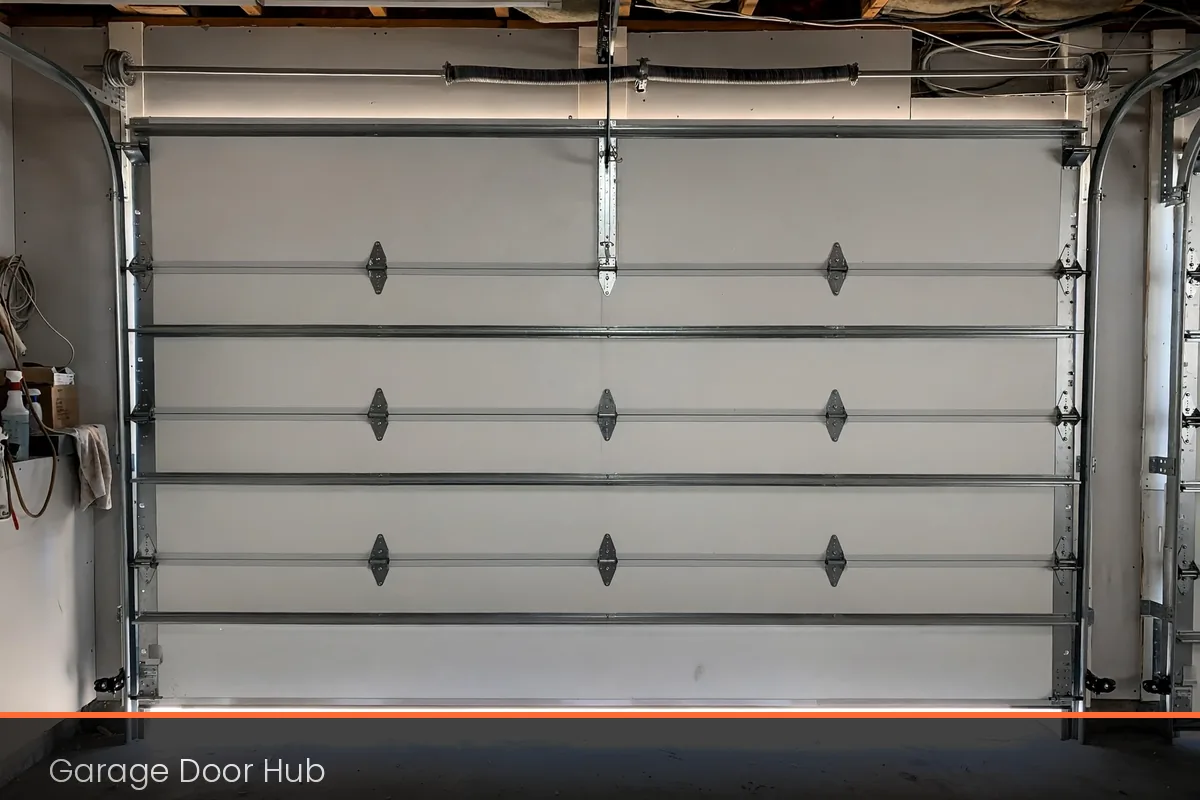
What is a garage door wind load rating?
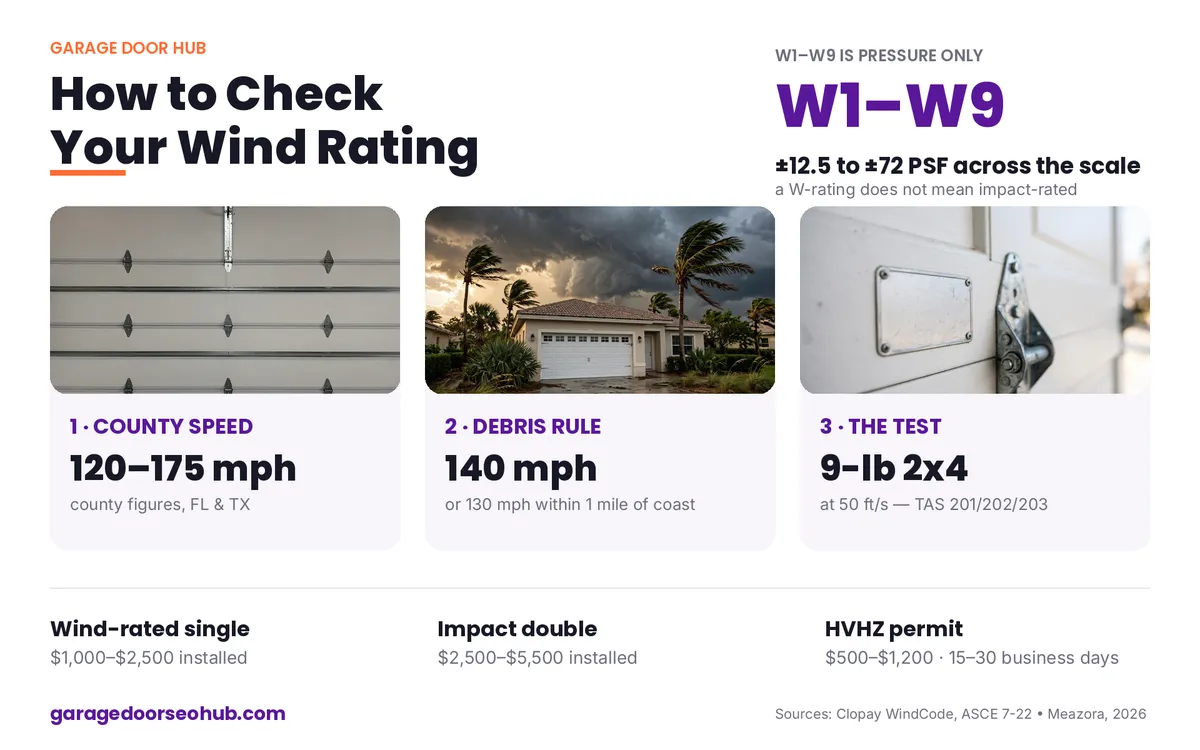
A wind load rating is the pressure a garage door is built to resist, measured in pounds per square foot (PSF). Two numbers matter. Design pressure is the pressure your house's location requires — a positive number for wind pushing in, a negative number for wind pulling out. Your door's rated design pressure must equal or exceed the required pressure. A door is lab-tested at 1.5 times its design pressure (ANSI/DASMA 108 / ASTM E330). So a door rated for +20/−24 PSF is tested to +30/−36 PSF (UAD, 1 Oct 2026).
Clopay, the manufacturer standard, rates doors on its WindCode scale from W1 to W9. W1 is ±12.5–16.5 PSF. W9 is ±62–72 PSF. The full scale is W1 ±12.5–16.5, W2 ±15.5–19, W3 ±20–21, W4 ±25–29, W5 ±30–33, W6 ±36–42, W7 ±42–48, W8 ±46–62, W9 ±62–72 PSF (Clopay WindCode, opened 13 Nov 2026).
Pressure is not the same as impact. A W-rating is pressure only. It does not by itself mean the door is impact-rated. A door can hold the pressure and still fail when a 9-lb 2x4 hits it at 50 feet per second. That is why the calculator gives you two answers: the pressure band and the impact answer. Do not buy on one of them alone.
The pressure your house needs comes from the code chain, not from a shortcut. ASCE 7 gives the design wind speed for your address, then exposure, roof height, enclosure and where the door sits on the wall set the pressure. A door near a corner needs a higher negative pressure than a door in the middle of the wall, because wind curls around corners. This checker gives you the Clopay table pressure for your speed, exposure, roof height and storeys, and sends you to Clopay for the corner-adjusted figure and for any speed the table does not list. That is the honest split: a pre-checker here, the real calculation there.
The 175 mph correction: why v8 changes the W band
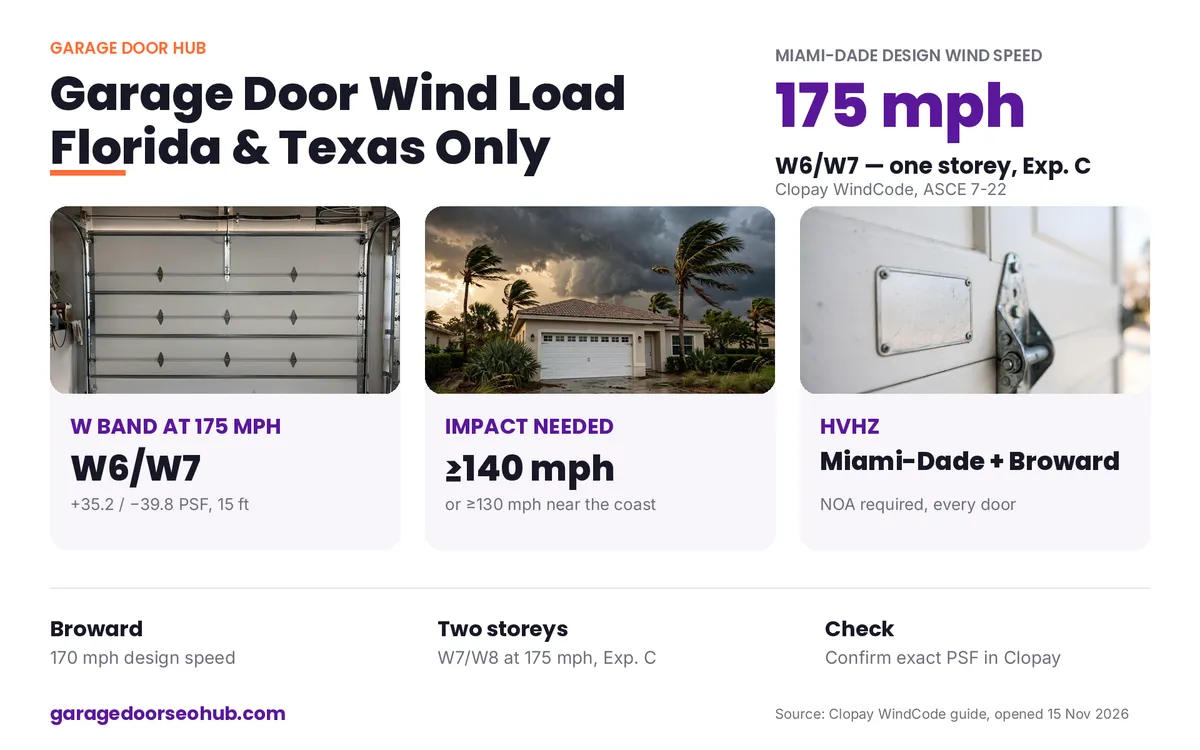
The earlier version of this page showed W8–W9 at 175 mph and labelled it indicative. That band was wrong. The Clopay WindCode Florida guide based on the 8th Edition Florida Building Code and ASCE 7-22, opened 15 Nov 2026, gives these W bands at 175 mph, Exposure C:
| Home | 175 mph, Exposure C — W band | Required design pressure, 15 ft roof |
|---|---|---|
| One storey | W6/W7 | +35.2 / −39.8 PSF |
| Two storeys | W7/W8 | +33.7 / −37.5 PSF |
Source: Clopay WindCode Florida guide, ASCE 7-22 edition, design-pressure table and W-rating guide, p.3, opened 15 Nov 2026. W9 at Exposure C only appears at 200 mph for a two-storey home. At 200 mph, one storey, the band is W8. So W8–W9 at 175 mph overstated the required rating by one to two bands — a door bought to W9 would have been stronger than the code requires, and a reader who trusted the old band would have overpaid or been quoted the wrong door. The calculator now uses the guide's full W table for every exposure, storey and speed, and shows the table PSF wherever the speed is one the guide lists.
Do I need an impact-rated garage door?
It depends on where you live, not on how strong the door looks. Three cases need large-missile impact rating.
First, the High-Velocity Hurricane Zone. That is Miami-Dade County (175 mph design wind speed) and Broward County (170 mph) only. In the HVHZ, every garage door needs large-missile impact rating, whether or not the door has windows. Standard windows are not available there. The test is TAS 201/202/203 — a 9-lb 2x4 fired at 50 feet per second.
Second, the wind-borne debris region outside the HVHZ. That is any area with a design wind speed of 140 mph or more, or 130 mph or more within 1 mile of the coast. Orlando (Orange County, 140 mph) is in it. Galveston (145 mph) is in it. Houston (Harris County, 130 mph) is not, unless the house sits within a mile of the coast — the calculator now applies that coast rule in Texas as well as Florida.
Third, Texas Gulf Coast counties at 140 mph or more, under the same debris rule. The test there is ASTM E1996, the large-missile test.
If none of those applies, you still need a wind-rated door — just not an impact-rated one. A wind-rated door resists the pressure. An impact-rated door resists the pressure and the flying debris. The calculator tells you which one you need, and the test standard to ask for by name.
What approvals does a wind-rated garage door need?
Ask for the approval number, not the sales claim. A door that is "hurricane rated" with no number is a claim, not a rating.
In Florida outside the HVHZ, you need a Florida Product Approval, called an FL number. In the HVHZ, you need a Miami-Dade NOA (Notice of Acceptance) as well. A Florida Product Approval alone is not enough in Miami-Dade or Broward — that is the most common mistake in the HVHZ, and the calculator flags it. The NOA is the county's own approval, and it is what the inspector asks for.
In Texas, you need a TDI product evaluation from the Texas Department of Insurance. On the Gulf Coast, you also need a WPI-8 Certificate of Compliance for TWIA windstorm cover. Without the WPI-8, the house may not be insurable through TWIA. Ask the installer for both documents before you pay a deposit.
Every opening matters for insurance. In Florida, the full wind-mitigation credit on form OIR-B1-1802, question 9, needs every opening protected, the garage door included (Republic Windows, Oct 2026). A rated door with an unprotected garage door next to it does not get the full credit. If you are replacing the door for insurance, get the mitigation form filled in after the install, not before.
How much does a wind-rated garage door cost in 2026?
A wind-rated door costs 30% to 50% more than a standard door (Meazora, Jun 2026). The gap is reinforcement: struts, heavier hinges, reinforced track and brackets.
| Door | Typical cost in 2026, installed |
|---|---|
| Wind-rated single (9x7) | $1,000–$2,500 |
| Wind-rated double (16x7) | $2,000–$4,500 |
| Impact-rated single (9x7) | $2,250–$4,200 |
| Impact-rated double (16x7) | $2,500–$5,500 |
| South Florida solid impact door | $2,800–$4,200 |
| Miami 1-car, from | $2,250 |
| Miami 2-car, from | $3,800 |
| Clopay Classic insulated 2-car, Miami, from | $5,350 |
Sources: Meazora, 23–28 Jun 2026; Republic Windows, Oct 2026; CMC Door Service, Oct 2026. Every row in this table matches the calculator above exactly — the calculator cost band and the table cost band are the same numbers for the same size and impact answer. Premium and custom hurricane-rated doors run $2,200 to $8,000 or more. A permit in the HVHZ costs $500 to $1,200, with a 15- to 30-business-day review (HireDoorPro, 2026).
One wider range to know about: Angi, updated 14 Oct 2026, puts hurricane garage doors nationally at $800 to $10,000, average $6,000, with a single at $800 to $6,200 and a double at $2,000 to $10,000. That range is wider because it mixes materials, sizes and WindCode ratings across the whole country. The table above is Florida-specific and size-specific, which is why it is narrower. If a quote lands above $5,500 for a standard double, ask which rating, material and glass it prices — the Angi range shows such quotes exist, but they are not the typical Florida figure in this table.
Price a standard door first with the garage door cost calculator, so you can see what the wind rating adds. If the job includes a new opener, price that separately with the garage door opener cost calculator. Then price the full job with the garage door replacement cost calculator. If your current door is sound and only the rating is wrong, price the repair instead with the garage door repair cost calculator — but a repair cannot add a wind rating to a door that was never built for one. If the door is heavy, check its weight first with the garage door weight calculator — an 8x7 steel door weighs 83 lbs. To see what a new door returns at resale, use the garage door ROI calculator.
Florida vs Texas: what is different?
Florida runs on the Florida Building Code, 8th edition (2023, effective 31 Dec 2023), which uses ASCE 7-22. Texas runs on the 2021 International Building Code with state amendments, which uses ASCE 7-16. The code edition matters: an older Clopay brochure that uses ASCE 7-16 or 7-10 gives different pressures from the current Florida code. Check the edition on any table you read. The 9th Edition of the Florida Building Code was posted for review on 22 Dec 2025 (PermitPlace, 2026) but is not yet in force — the 8th Edition is still the edition that governs in November 2026.
Florida's HVHZ is unique. No Texas county has an equivalent: Miami-Dade and Broward are the only two counties in the country with the large-missile-for-every-door rule. Texas has no HVHZ, but the Gulf Coast has the TWIA/WPI-8 system instead. A door that passes in Houston may not pass in Galveston, 50 miles away, because the design wind speed jumps from 130 mph to 145 mph. TWIA is the insurer of last resort across 14 Gulf Coast counties (Mockingbird Garage Doors, published 1 Apr 2026, updated 23 May 2026).
Exposure is the same in both states. B is urban, suburban or wooded. C is open terrain or grassland — all of Miami-Dade and Broward is Exposure C unless D applies. D is flat and unobstructed, within 600 feet of the ocean or a large body of water (Clopay). If your house faces open water, say so: it changes the pressure — and in this calculator, changing exposure changes both the W band and the design pressure.
What the Clopay WindCode calculator does that this checker does not
This checker answers three questions: your wind speed, impact yes or no, and which approvals to ask for — plus the W band and, where the Clopay table lists your speed, the required design pressure in PSF. It does not answer the corner-adjusted pressure, or the exact PSF for a speed the table does not list, such as 125 or 145 mph. That is Clopay's job.
Use the Clopay WindCode calculator with the same inputs — code body, wind speed, exposure, building size, roof height and angle, enclosure, door size, and distance to the corner — and it returns the +/− PSF and the W-rating. Take that number to your dealer and to your building official. If the Clopay number and this checker disagree on impact or approvals, trust Clopay and your local building official, not this page. Wind speed varies inside a county, and this checker uses county figures, not your address. The ASCE Hazard Tool gives the wind speed for a specific address — use it when the county figure and your street disagree. For a price check on a hurricane-rated door nationally, see the Angi hurricane garage door cost guide, updated 14 Oct 2026.
5 questions to ask before you order
- What is the FL number, NOA number, or TDI evaluation number for this exact door? Write it down and check it before you pay.
- What is the door's rated design pressure, +/− PSF, and what test standard was it tested to? The label on the door must show both.
- Is the door impact-rated, and to which test — TAS 201/202/203 in Florida, or ASTM E1996 in Texas? Ask for the test report.
- What is the permit cost and review time in my county? In the HVHZ, budget $500 to $1,200 and 15 to 30 business days.
- Will this door get the full wind-mitigation credit on my insurance form? Get the answer in writing from your insurer, not from the installer.
Get 2 to 3 quotes for any job over $500. For a second opinion, use the calculator hub. To reach a pro, use the contact page. Garage Door Hub connects you with a local pro near you, fast. Before you order, check how long a door like yours should last with the garage door lifespan calculator, and price a single panel first with the garage door panel replacement cost calculator if only one section is damaged.
Garage Door Hub connects homeowners with trusted local garage door pros. Need a repair? Need a replacement? Start here. First, find out what it should cost. Then, price your exact job with our free calculator. Next, find a pro near you. Fast. No jargon. No guesswork. No surprise bills. Just clear prices, honest guides, and a local pro you can call today.
Frequently asked questions
What wind rating does my garage door need in Florida?
It depends on your county. Miami-Dade needs 175 mph and Broward 170 mph, both in the High-Velocity Hurricane Zone with large-missile impact rating. At 175 mph, Exposure C, the Clopay ASCE 7-22 guide gives W6/W7 for a one-storey home and W7/W8 for a two-storey home, with a required pressure of +35.2 / −39.8 PSF at 15 ft for one storey. Orlando needs 140 mph and is in the wind-borne debris region.
What is a Miami-Dade NOA for a garage door?
A Notice of Acceptance is Miami-Dade County's own product approval. In the High-Velocity Hurricane Zone you need an NOA as well as a Florida Product Approval — the FL number alone is not enough. Ask for the NOA number before you pay.
What is the difference between wind rated and impact rated garage doors?
A wind-rated door resists pressure, measured in PSF. An impact-rated door resists pressure and flying debris, tested with a 9-lb 2x4 at 50 feet per second (TAS 201/202/203 in Florida, ASTM E1996 in Texas). A W-rating is pressure only and does not mean impact-rated.
How much does a hurricane rated garage door cost?
A wind-rated single door costs $1,000 to $2,500 installed and a double $2,000 to $4,500 (Meazora, Jun 2026). An impact-rated double costs $2,500 to $5,500. In Miami, a 2-car door starts from $3,800 (CMC Door Service, Oct 2026).
Does a wind-rated garage door lower my insurance?
It can, through the wind-mitigation credit — but only if every opening is protected, the garage door included (form OIR-B1-1802, question 9). Get the mitigation form filled in after the install and ask your insurer what the credit is worth.