
Garage Size Calculator
Building a new garage or planning a major renovation is an exciting project, but it requires meticulous planning to get right. One of the most common—and costly—mistakes homeowners make is underestimating the amount of space they actually need. You might think you know the dimensions of your car, but once you factor in opening doors, walking around the vehicle, storing lawn equipment, and adding a workbench, that “spacious” garage can quickly feel incredibly cramped.
That is exactly why we created the garage size calculator. If you are wondering how big should a garage be, this tool takes the guesswork out of your planning phase. By accounting for your specific vehicles, your desired storage needs, and essential layout considerations, our calculator provides an accurate estimate of the dimensions required for your perfect garage.
Use our Garage Size Calculator above to instantly estimate the perfect garage dimensions for your vehicles and storage needs, and read on below to understand the science behind proper garage layout planning.
Garage Door SEO Hub, focus exclusively on SEO for garage door companies, helping garage door businesses generate qualified leads, attract ready to book local customers, and turn Google searches into consistent leads.
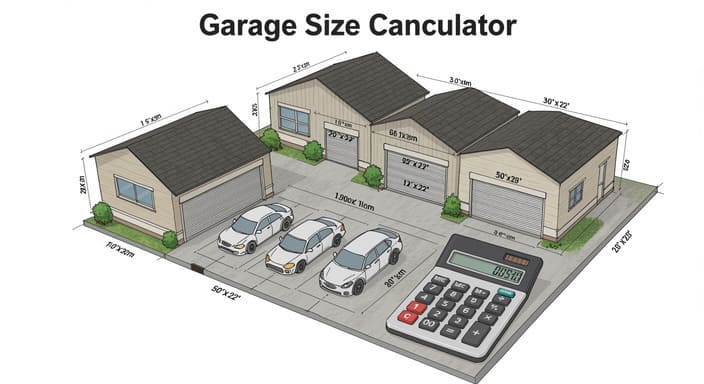
Advanced Garage Size Calculator
Determine the perfect garage size for your vehicles, storage, and workspace needs with accurate cost estimations
Vehicle Information
Vehicle #1
Space Requirements
Recommended Garage Size
Expert Tip
Consider adding 10-15% extra space for future storage needs. Garage sizes between 20×20 and 24×30 are most cost-effective to build. If your dimensions exceed 30ft in either direction, costs increase significantly due to additional structural requirements.
What Is a Garage Size Calculator?
A garage size calculator is an advanced digital garage planning tool designed to help homeowners, builders, DIY planners, and architects figure out the exact footprint required for a functional garage. Rather than relying on generic, one-size-fits-all blueprints, this garage dimensions calculator allows you to input your specific requirements to generate a customized space estimate.
The tool works by combining your vehicle parking space dimensions with the necessary safety clearances, walking paths, and additional square footage needed for storage or work areas. It acts as a comprehensive garage square footage calculator, outputting the ideal width and depth for your project. Whether you are building from scratch or looking to maximize an existing space, a garage size estimator ensures you don't end up with a garage that is too small for your SUV or too large for your budget.
Why Use a Garage Size Calculator?
Building or remodeling a garage without proper planning often leads to tight parking spaces or insufficient storage. A garage size calculator solves this problem by giving you accurate measurements tailored to your exact needs.
Key Benefits:
- Provides enough space for cars, SUVs, or trucks.
- Helps plan for extra features like cabinets, gym equipment, or tool benches.
- Ensures proper clearance for opening doors and safe vehicle movement.
- Helps meet local building codes and zoning requirements.
- Saves money by avoiding incorrect sizing or material waste.
Using this tool early in your project can help you visualize your garage layout and avoid expensive design mistakes later.
How the Garage Size Calculator Works
A garage size calculator uses your input data to suggest the perfect garage dimensions and layout. It considers both your current needs and potential future requirements to create a well-planned design.
Key Inputs Include:
- Number of Cars: Single, double, or triple garage spaces.
- Car Dimensions: Size of sedans, SUVs, or trucks.
- Storage or Workspace Needs: Space for shelves, workbenches, or gym equipment.
- Door Clearance and Ceiling Height: Ensures safe and easy access.
- Extra Features: Areas for laundry setups, bikes, or hobby corners.
Outputs You Get:
- Recommended width, length, and ceiling height.
- Ideal garage door sizes (single wide door or dual doors).
- Layout suggestions for efficient space usage and traffic flow.
This tool acts as a garage measurement planner that prevents design mistakes, maximizes space, and ensures smooth parking and movement inside the garage.
Why Garage Size Planning Matters
Skipping the planning phase and jumping straight into construction is a recipe for disaster. Proper garage construction planning matters because concrete and framing are difficult and expensive to move once they are in place. Proper sizing prevents daily frustrations and costly future renovations.
You Might Like : All Garage Door Calculators
Vehicle Parking Space
The primary function of any garage is vehicle storage space. Without precise parking space dimensions, you risk building a garage where you can park your car, but you can't comfortably open the doors to get out. Proper planning ensures you have enough room to pull in, park safely, and exit the vehicle without dinging your doors against the walls or adjacent cars.
Storage Requirements
Garages rarely hold only cars. They act as the primary storage hub for most homes. If you fail to account for garage storage space, your vehicles will quickly be competing for floor space with lawnmowers, bicycles, holiday decorations, and trash cans. Planning for storage ensures these items have dedicated zones that don't encroach on your parking area.
Future Expansion
Your current vehicle might be a compact sedan, but what happens if your family grows and you purchase a minivan or a large truck? Planning for future expansion means asking yourself, "what size garage do I need for an SUV?" before the concrete is poured. A well-planned garage accommodates not just your life today, but your lifestyle five to ten years down the road.
Get our Garage Door Seo Services Today
How to Use the Garage Size Calculator
Our garage space calculator is designed to be highly intuitive. By following a few simple steps, you can quickly determine your ideal garage square feet.
Step 1 – Enter Vehicle Dimensions
Begin by inputting the number of vehicles you plan to park inside. The calculator allows you to select standard vehicle sizes (Compact, Sedan, SUV, Truck) or enter the exact length and width of your specific vehicles. If you have oversized mirrors or tow hitches, be sure to account for them here.
Step 2 – Add Clearance Space
Next, you will define the breathing room around your vehicles. The calculator will prompt you to set your preferred clearance for the front, rear, and sides of the cars. We recommend selecting standard safety clearances (usually 2.5 to 3 feet per side) to ensure you can open doors fully and walk safely around the bumpers.
Step 3 – Include Storage or Work Area
Do you want a row of 2-foot-deep storage cabinets along the back wall? Do you need a 6-by-8-foot area for a woodworking bench? Input your garage storage space and workshop requirements in this step. The calculator will add this necessary garage floor space calculation to the vehicle footprint.
Step 4 – Calculate Total Garage Size
Once you hit "Calculate," the tool will process your inputs and generate your ideal garage layout planning dimensions. It will output the recommended total width, total depth, and total square footage, giving you a reliable baseline to take to your architect or contractor.
Standard Garage Dimensions
While custom sizing is always best, it helps to understand standard garage dimensions. These industry baselines give you a starting point when visualizing your new addition.
Single Car Garage Size
A single car garage size typically ranges from 10 to 12 feet in width and 20 to 24 feet in depth.
- 10x20 feet: The bare minimum. Fits a compact car, but opening doors will be very tight, with zero room for storage.
- 12x24 feet: Highly recommended for a single car. This allows for comfortable door opening and leaves room at the back for a small workbench or a lawnmower.
Two Car Garage Size
The standard double garage dimensions range from 20 to 24 feet in width and 20 to 24 feet in depth.
- 20x20 feet: Technically fits two cars, but it is a tight squeeze. You will have to carefully shimmy out of your vehicles.
- 24x24 feet: The ideal standard. This is the standard garage size for 2 cars with storage, providing ample room to open all doors and line the side walls with shelving.
Three Car Garage Size
A three-car garage typically requires 30 to 36 feet in width and 20 to 24 feet in depth.
- 30x20 feet: Fits three mid-sized cars with minimal clearance.
- 36x24 feet: Provides luxurious spacing for three vehicles, or easily fits two cars while leaving the third bay entirely dedicated to a workshop, gym, or riding mower storage.
Garage Size for Trucks and SUVs
If you drive a heavy-duty pickup truck or an extended SUV, standard dimensions will not cut it. A garage size calculator for trucks will usually recommend a minimum depth of 24 to 28 feet and an oversized garage door height (usually 8 to 9 feet tall instead of the standard 7 feet) to accommodate lifted suspensions and roof racks.
Garage Size Formula Explained
If you are wondering how the calculator works behind the scenes, the home garage measurements are based on a simple, yet highly effective formula:
Total Garage Size = Vehicle Length/Width + Clearance Space + Storage Space
Let's break that down:
- Vehicle Dimensions: The physical footprint of the metal, glass, and rubber of your cars.
- Clearance Requirements: The invisible "bubble" around the car needed for door opening space and comfortable walking room.
- Storage/Workspace: The dedicated perimeter or extra bay designated for cabinets, tools, and human activity.
By summing these three elements on both the X (width) and Y (depth) axes, you arrive at the minimum safe and functional dimensions for your build.
Recommended Clearance Space for Vehicles
One of the biggest factors in learning how to calculate garage size for two cars is understanding clearance. A car may only be 6 feet wide, but it needs significantly more space to be usable. Here are the recommended clearances you should input into your garage planning calculator:
- Side clearance (between car and wall): 2.5 to 3 feet. This allows a standard car door to open to its first detent (the click that holds it open) so the driver can comfortably step out.
- Center clearance (between two parked cars): 3 to 4 feet. You need extra room here so that both the driver of the right car and the passenger of the left car can open their doors simultaneously without playing bumper cars.
- Front clearance (between car bumper and front wall/storage): 3 to 5 feet. This provides a safe walkway to cross in front of the car and access the door to your house.
- Rear clearance (between car bumper and garage door): 2 to 3 feet. You need enough room to walk behind the vehicle while the garage door is closed, and enough space to open a hatchback or trunk without it scraping the garage door panels.
Garage Layout Planning Tips
A successful garage requires more than just four walls and a roof. Excellent garage layout planning considers how you will interact with the space daily.
Space for Garage Doors
Don't forget the vertical and overhead space! Garage doors require tracks, torsion springs, and an electric opener on the ceiling. Ensure your ceiling height is at least 12 to 18 inches higher than your garage door height to accommodate this hardware.
Walkways and Access
Always map out the natural traffic flow. If the door leading into your kitchen is on the far left side of the garage, ensure you leave a clear, 3-foot wide walking path from the garage door to the kitchen door that won't be blocked by parked cars or bicycles.
Storage Cabinets
If you plan to install base cabinets along the walls, remember that standard garage cabinets are 18 to 24 inches deep. If you put cabinets on both side walls, you have instantly reduced the usable parking width of your garage by up to 4 feet! Always add cabinet depth to your total width calculation.
Workshop Areas
A garage size for workshop and parking requires its own dedicated zone. A standard workbench is 2 feet deep, but you need an additional 3 feet of standing room in front of it to work comfortably. Therefore, a workshop along the back wall requires extending the depth of your garage by a minimum of 5 feet.
Garage Size Examples
To help you visualize how these numbers come together, let's look at a few real-world scenarios and see how the calculator solves them.
Example: Single Car Garage
- Scenario: You have a Honda Civic (approx. 6ft W x 15ft D) and want basic wall hooks for a bike, but no large cabinets.
- Calculation: * Width: 6ft (car) + 3ft (left clearance) + 3ft (right clearance) = 12 feet wide.
- Depth: 15ft (car) + 3ft (front clearance) + 3ft (rear clearance) = 21 feet deep.
- Result: A 12x21 foot garage is perfect.
Example: Two Car Garage
- Scenario: You want to know how to calculate garage size for two cars—specifically, two mid-sized SUVs (each approx. 6.5ft W x 16ft D). You also want 2-foot deep storage shelves on the back wall.
- Calculation:
- Width: 6.5ft (SUV 1) + 6.5ft (SUV 2) + 3ft (left wall) + 3ft (center space) + 3ft (right wall) = 22 feet wide.
- Depth: 16ft (SUVs) + 3ft (rear trunk clearance) + 3ft (front walking clearance) + 2ft (back wall shelves) = 24 feet deep.
- Result: A 22x24 foot garage is the minimum required size for this setup.
Example: Garage with Workshop
- Scenario: You have two standard sedans, but you are an avid woodworker who needs a serious 6-foot deep workspace area along the back.
- Calculation:
- Width: 24 feet (standard comfortable double width).
- Depth: 20 feet (standard car footprint + basic clearance) + 6 feet (dedicated workshop zone) = 26 feet deep.
- Result: A 24x26 foot garage gives you a beautiful double parking space with a massive, uncrowded workshop in the rear.
Common Garage Planning Mistakes
Even with the best intentions, homeowners often fall into these traps. Avoid them by trusting your calculator's output!
- Underestimating storage space: People assume a 20x20 garage holds two cars and all their boxes. It doesn't. If you want a 20x20 garage, plan on parking one car and using the rest for storage.
- Ignoring door clearance: Squeezing a 6-foot wide car into an 8-foot wide bay looks fine on paper until you try to swing the car door open and realize you only have 12 inches to squeeze out.
- Not planning for larger vehicles: Building a garage specifically for your current Mini Cooper is a bad idea if you ever plan to buy a Ford F-150, or if you plan to sell your home to someone who does.
- Poor layout planning: Placing the pedestrian door directly behind where a car parks means you can never enter the garage if a vehicle is parked there. Always account for door swings and walkways.
Tips for Choosing the Right Garage Size
- Plan for future vehicles: Always round up. If your calculator says you need 21.5 feet of width, build it to 24 feet. Vehicles are trending larger, not smaller.
- Leave room for tools: If you do your own oil changes or home repairs, you need space for a rolling tool chest and a floor jack. Add an extra 2 feet of depth or width to accommodate mobile tools.
- Consider resale value: A spacious, well-thought-out 24x24 two-car garage is a massive selling feature for a home. A cramped 20x20 garage that barely fits two cars is often viewed as a negative by potential buyers.
FAQs About Garage Size Calculations
1. What is the standard garage size? The most common standard garage sizes are 12x20 feet for a single-car garage and 24x24 feet for a two-car garage. However, "standard" doesn't always mean "optimal," which is why calculating for your specific vehicles is crucial.
2. How many square feet is a two car garage? A typical two-car garage ranges from 400 square feet (20x20 ft) to 576 square feet (24x24 ft). If you want ample room for storage, you should aim for the higher end of that spectrum.
3. What size garage do I need for an SUV? SUVs require more depth and height than standard cars. You should plan for a minimum depth of 24 feet. Additionally, ensure your garage door is at least 7.5 to 8 feet tall to clear roof racks and lifted suspensions.
4. How much space should be around a parked car? For optimal comfort and safety, you should leave a minimum of 2.5 to 3 feet of clearance on the sides of the car for doors, 3 feet in the rear for trunk access, and 3 to 4 feet in the front for a walking path.
5. Can a garage be used as a workshop? Absolutely! However, you must plan for it. A standard vehicle takes up about 20 feet of depth. To safely add a workshop, you should extend the depth of the garage to at least 24 to 26 feet to allow for workbenches and standing room.
6. How do I calculate garage square footage? Simply multiply the total interior width of the garage by the total interior depth. For example, a garage that is 22 feet wide and 24 feet deep is 528 square feet (22 x 24 = 528).
Ready to Build Your Dream Garage?
Use our Garage Size Calculator at the top of the page to instantly estimate the perfect garage dimensions for your vehicles and storage needs. Once you have your dimensions locked in, be sure to explore our other helpful garage planning tools to complete your project setup: