

Short answer: Repair vs replace your garage door comes down to the 50% rule: if the repair costs more than half a new door, replace it. Most single repairs stay well below it. A full door replacement costs $754 to $1,707 installed, average $1,231 (HomeAdvisor, 17 June 2026), so repair usually wins: a $400 spring repair is about a third of that average.
Garage Door Hub connects you with a trusted local pro. Get a clear price for your garage door repair or replacement first.
Table of Contents
-
1. Repair vs Replace Garage Door: The 50% Rule Explained
-
2. How Old Is Too Old? The Age Threshold Table
-
3. Cost Per Year: The Second Test
-
4. The Safety Gate: When Repair Is Not an Option
- 5. What Replacement Pays Back: ROI and Resale Value
-
6. How to Decide in 10 Minutes
Video: Repair vs Replace Your Garage Door? The 50% Rule + Cost Per Year (2026) (Coming Soon)
Frequently Asked Questions
- When should I replace my garage door instead of repairing it?
- What is the 50% rule for garage doors?
- How long does a garage door last?
- Is it worth replacing a 20 year old garage door?
- How much does garage door repair cost vs replacement cost?
- Should I repair or replace my garage door if the opener is broken?
Every homeowner with an old garage door faces the same choice when it rattles, the spring snaps, or the opener gives up: fix what you have, or buy a new door? Two tests answer it — the 50% rule and cost per year — with real 2026 prices below.
Know this up front: one repair on its own almost never calls for a new door. Replacement makes sense when age, repeat repairs, safety problems, or a door that leaks heat month after month point the same way.
1. Repair vs Replace Garage Door: The 50% Rule Explained
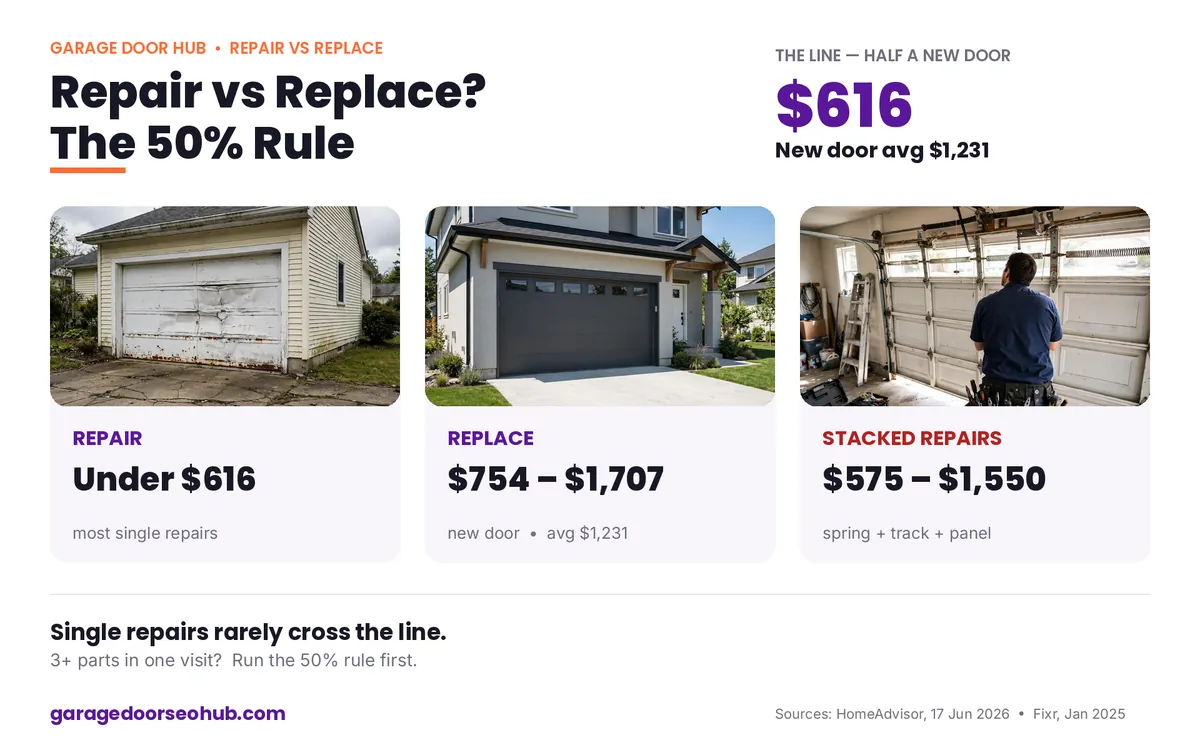
The 50% rule is the standard way to make the call: if a repair quote is more than half the cost of a similar new door, replacement is the better spend over time, while a repair well under half is worth doing. This section explains the rule, shows what single repairs cost against the line, and covers what happens when repairs stack up.
A full door replacement costs $754 to $1,707 installed, average $1,231 (HomeAdvisor, 17 June 2026), so half that average — about $616 — is your line: below it, repair usually wins; above it, replacement does, above all when the door is old.
What single repairs cost
Single repairs sit well below that $616 line:
- Torsion spring pair: $200 to $350 installed (Fixr, Jan 2025; HomeGuide, Nov 2026).
- Opener repair: $100 to $300 (Fixr, Jan 2025).
- Full opener replacement: $300 to $800.
- Single panel: $250 to $900 (HomeAdvisor, Jun 2026; HomeGuide, Oct 2026).
None comes close to the $616 line on its own.
When repairs stack up
Stacked repairs are what cross the line: a door that needs a spring pair, a track repair and a panel in one visit can add up to $575 to $1,550, and a failing opener on top can push the total past the 50% line in a single job. If your quote names three or more parts, run the 50% rule before you agree to anything. Price your exact job first with our Garage Door Replacement Cost Calculator.
- A door needing a spring pair, a track repair and a panel in one visit can add up to $575 to $1,550.
- If your quote names three or more parts, run the 50% rule before you agree to anything.
2. How Old Is Too Old? The Age Threshold Table
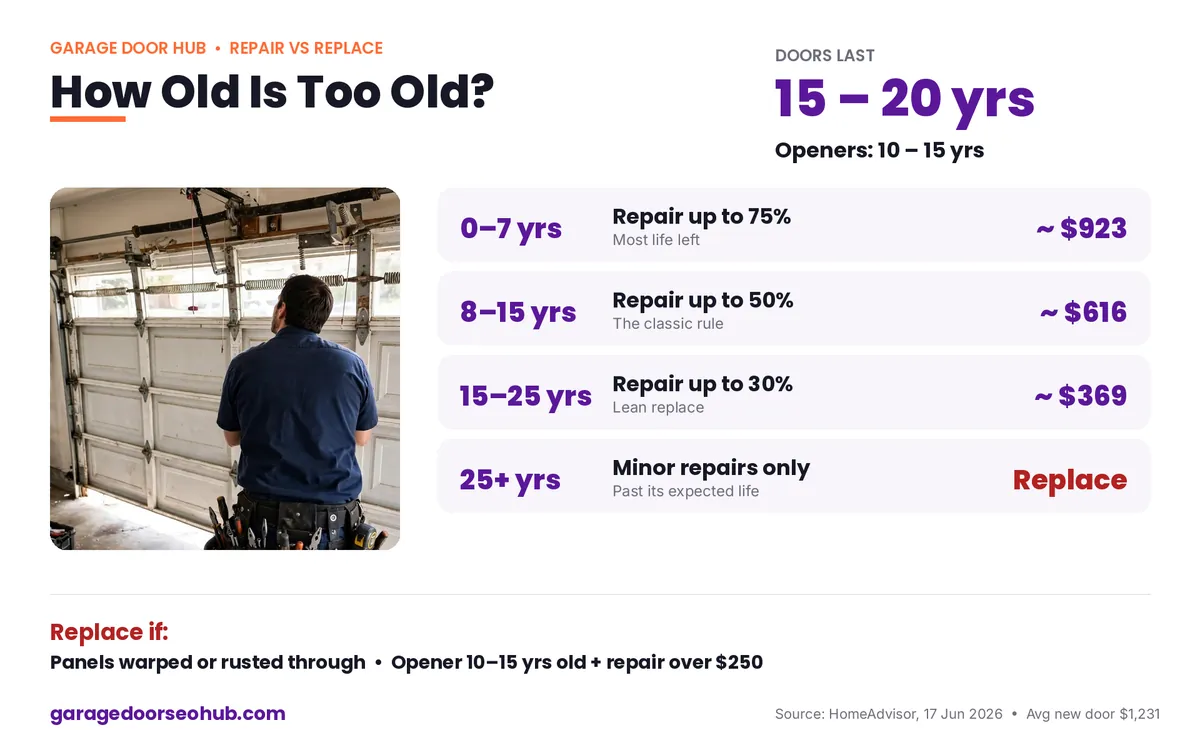
Age changes how the 50% rule works: a five-year-old door that needs a spring is a clear repair, with a decade or more of life left, while the same spring on a twenty-year-old door is a harder call, since another part is likely to fail soon. Most doors last 15 to 20 years and most openers 10 to 15, and the figures below use the $1,231 average (HomeAdvisor, 17 June 2026).
| Door age | Repair threshold | What it means |
|---|---|---|
| 0–7 years | Repair up to 75% of a new door (about $923) | Most of its life left. Repair unless there is major damage. |
| 8–15 years | Repair up to 50% of a new door (about $616) | The classic 50% rule — judge each quote against half the replacement cost. |
| 15–25 years | Repair up to 30% — lean replace (about $369) | Parts keep failing — a repair over 30% of a new door is usually money lost. |
| 25+ years | Minor repairs only | Past its expected life. Fix only small, cheap faults — or replace it. |
Two extra age rules
Two more age rules sit outside the table above. One covers the opener, which ages faster than the door, and the other covers doors built before the 1993 sensor requirement.
- Opener age: if your opener is 10 to 15 years old and the repair is over $250, replacing it is usually the better spend, with quieter running, battery backup and modern safety sensors.
- Missing sensors: a door with no photo-eye safety sensors predates the 1993 federal requirement, and replacement should be on the table whatever the quote says.
For a part-by-part breakdown, see our guide to garage door repair cost by part.
3. Cost Per Year: The Second Test
While the 50% rule looks at one repair, cost per year looks at the whole picture: divide the repair cost by the extra years it buys, do the same for a new door, and the lower number wins. This section runs the test on a 12-year-old door first, where repair wins, and then on a 19-year-old door, where the answer flips.
Example: a 12-year-old door
This example comes from our Repair vs Replace calculator: a 12-year-old door needs a spring pair at $400, buying about 7 more years at roughly $57 per year, while a new door at the $1,231 average (HomeAdvisor, 17 June 2026) should last about 20 years at roughly $62 per year. The calculator calls it REPAIR: the repair is 21% of replacement cost, with a break-even of 3.1 years.
- A spring pair at $400 buys about 7 more years — roughly $57 per year.
- A new door at the $1,231 average should last about 20 years — roughly $62 per year — so the calculator calls it REPAIR.
When the answer flips
Change the numbers and the answer flips: a 19-year-old door needs a spring pair, a panel and a track repair totalling $1,800, buying only 3 more years at $600 per year — far above the $62 per year of a new door — so replacement wins. This second test catches the door that looks cheap to fix once yet costs a lot to keep — check the payback side with our Garage Door ROI Calculator.
- A 19-year-old door needs a spring pair, a panel and a track repair totalling $1,800.
- That buys only 3 more years at $600 per year — far above the $62 per year of a new door — so replacement wins.
4. The Safety Gate: When Repair Is Not an Option
Some problems end the repair-or-replace debate before the math starts. This section lists the faults that mean replacement should be on the table whatever the quote says, and the checks that are safe to do yourself.
Problems that end the debate
Some problems end the debate before the math starts — if any of these apply, get a replacement assessment from a pro:
- Spring or cable damage with a door that will not stay put: springs and cables hold huge tension, and a sagging or crooked door means the track or door itself may be damaged.
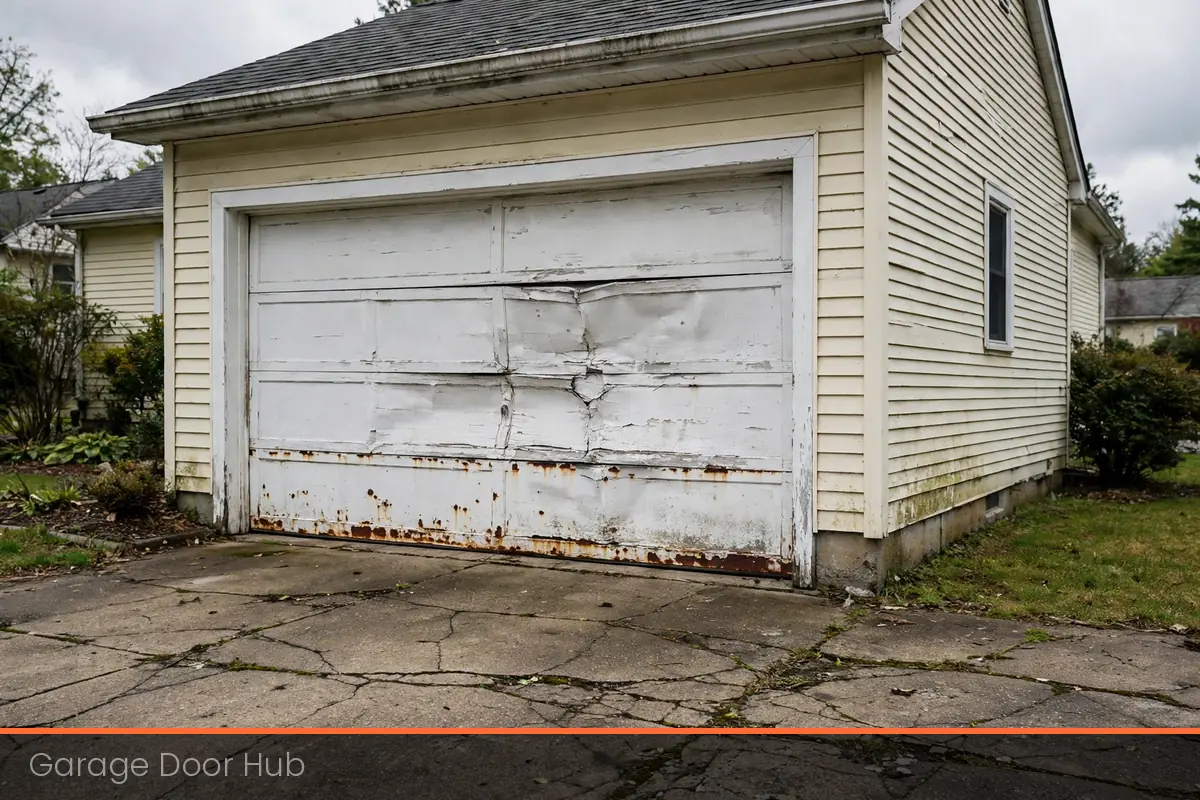
- Warped or rusted-through panels: a bent or rusted panel cannot be made sound again. A single panel costs $250 to $900 (HomeAdvisor, Jun 2026; HomeGuide, Oct 2026), but with two or more panels gone, replacement is usually cheaper than rebuilding the door.
- Missing safety features: no photo-eye sensors, or an opener with no auto-reverse.
Safe checks to do yourself
Safe checks you can do yourself include testing the auto-reverse each month, wiping the sensor lenses, lubricating rollers and hinges, and tightening loose bolts — but never touch a spring, a cable, or a track adjustment yourself. If you are unsure whether your door is safe, our Garage Door Repair Guide covers the warning signs, and our guide to how to choose a garage door repair company explains how to find a pro you can trust.
- Test the auto-reverse each month, wipe the sensor lenses, lubricate rollers and hinges, and tighten loose bolts.
- Never touch a spring, a cable, or a track adjustment yourself.
5. What Replacement Pays Back: ROI and Resale Value
Replacement is the only repair that pays you back at resale: in the 2025 Remodeling Cost vs Value Report a garage door ranked first of 28 projects across the country, returning about 268%, but only for the project Zonda defines in that report, at a $4,672 average job cost (Zonda, 2025) — not a typical replacement price. In the East North Central region — Ohio, Indiana, Illinois, Michigan and Wisconsin — the same report gives a 282.2% return, on a $4,357 job cost against $12,298 in resale value (Zonda, 2025).
That does not mean a new door is free, but it is one of the few home spends that comes back at sale, and it also pays while you live there through better insulation, quieter running, and a door that opens every time. Weigh that payback next to the 50% rule: when your door is young and the repair is small, resale alone is no reason to replace it.
6. How to Decide in 10 Minutes
This section turns the whole guide into a ten-minute routine. Work through the six-step checklist below in order, and by the end you will have a clear repair-or-replace answer.
10-minute checklist
Work through these six steps in order: each one takes a minute or two, and together they give you a clear repair-or-replace answer.
- Get the repair quote in writing, naming the part.
- Find your door’s age on the label inside the door or opener.
- Apply the 50% rule with the $754 to $1,707 replacement range, average $1,231 (HomeAdvisor, 17 June 2026), adjusted by your age threshold.
- Run the cost-per-year test.
- Check the safety gate: springs, cables, warped panels and missing sensors.
- Get a second quote over $1,000 — a good pro will walk you through the numbers.
Video: Repair vs Replace Your Garage Door? The 50% Rule + Cost Per Year (2026) (Coming Soon)
A 60 to 120 second video for this guide is coming soon, covering the 50% rule, the cost-per-year comparison, the $400 vs $1,231 worked example, and the age table. No video is embedded here yet.
Garage Door Hub connects homeowners with trusted local garage door pros. Need a repair? Need a replacement? Start here. First, find out what it should cost. Then, price your exact job with our free calculator. Next, find a pro near you. Fast. No jargon. No guesswork. No surprise bills. Just clear prices, honest guides, and a local pro you can call today.
Frequently Asked Questions
When should I replace my garage door instead of repairing it?
Replace it when the repair costs more than half a new door — the 50% rule — or over 30% of replacement cost on a door older than 15 years. Also replace it if panels are warped or rusted through, or it has no photo-eye safety sensors.
What is the 50% rule for garage doors?
If a repair estimate exceeds roughly 50% of the cost of a comparable new garage door, replacement is the more economical choice. With the average replacement at $1,231 installed (HomeAdvisor, 17 June 2026), the line sits at about $616.
How long does a garage door last?
Most garage doors last 15 to 20 years, and most openers 10 to 15 years. A torsion spring is typically rated for about 10,000 cycles — roughly 7 years at four cycles a day. Regular lubrication, sensor cleaning and tightening loose bolts stretch that life.
Is it worth replacing a 20 year old garage door?
Usually yes, if it needs more than a minor repair. At 20 years parts will keep failing, and a repair over 30% of a new door — about $369 against the $1,231 average (HomeAdvisor, 17 June 2026) — is usually money lost. Replacement also brings modern safety sensors and a 268% return at resale for the project Zonda defines (Zonda, 2025).
How much does garage door repair cost vs replacement cost?
Most repairs cost $155 to $379, averaging $265 (Angi, updated 21 October 2026). A spring pair is $200 to $350 installed (Fixr, Jan 2025; HomeGuide, Nov 2026) and a panel is $250 to $900. A full replacement costs $754 to $1,707 installed, averaging $1,231 (HomeAdvisor, 17 June 2026) — so a typical repair is roughly 22% of an average replacement.
Should I repair or replace my garage door if the opener is broken?
Repair the opener if it is under 10 years old — an opener repair costs $100 to $300 (Fixr, Jan 2025). Replace it if it is 10 to 15 years old and the repair is over $250, or it lacks safety sensors and auto-reverse. A full opener replacement at $300 to $800 is still only a fraction of a new door.