

Short answer: A garage door that reverses or will not close is usually stopped by its safety sensors: two photo-eye sensors sit 4 to 6 inches high, and anything breaking the beam sends the door back up after it starts down. Clear the path, wipe both lenses, and check both lights are steady, not blinking — and if they will not stay steady, call a pro.
Garage Door Hub connects you with a trusted local pro. Get a clear price for your garage door repair or replacement first.
Table of Contents
- 1. How the Garage Door Safety System Works
-
2. Why Your Garage Door Won’t Close: Causes in Order
-
3. What It Costs to Fix a Door That Won’t Close
- 4. Symptom to Cause to Safe Check
-
5. How to Test the Auto-Reverse Safety Feature
- 6. When to Call a Pro
Video: Garage Door Reverses or Won’t Close? Causes & Fixes (2026) (Coming Soon)
Frequently Asked Questions
- Why does my garage door keep reversing?
- Why won’t my garage door close all the way?
- How do I test the auto-reverse safety feature?
- Why does my garage door only close when I hold the button down?
- What does it mean when my garage door sensor light is blinking?
- How much does it cost to fix a garage door that won’t close?
A garage door that starts down and then goes back up is doing what it was designed to do: refusing to close because it thinks something is in the way. Nine times out of ten it is something low down — a bin, a broom handle, a spider web, or dust on a lens. This guide explains the safety system, the causes, and when to call a pro.
This is a closing problem, not an opening one, so if your door will not open at all, see Garage Door Won’t Open? 7 Causes & What to Check First. For the full map of every repair problem, start with our Garage Door Repair Guide.
1. How the Garage Door Safety System Works
Every modern opener has two safety features, and either can make a door reverse. This section explains how each one works — the photo-eye sensors that watch the doorway, and the auto-reverse that stops the door on contact — so you can tell which feature is stopping your door.
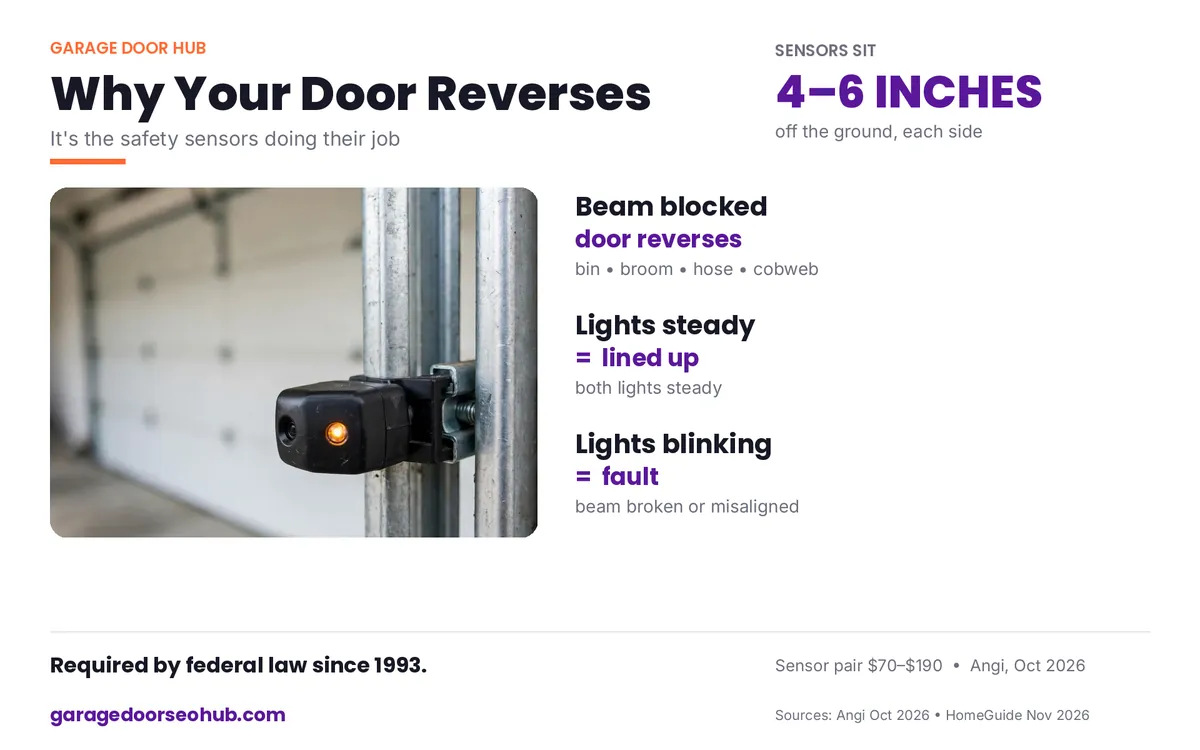
- The photo-eye sensors: two small boxes on either side of the door, 4 to 6 inches off the ground. One sends an invisible beam across the opening and the other receives it, so anything breaking the beam as the door closes makes it stop and go back up.
- Auto-reverse: if the door hits something solid, the opener senses the extra push and reverses.
Federal law requires both features: photoelectric sensors on post-1993 doors, and automatic reversal on all residential openers since 1 January 1993. Pre-1993 openers without sensors are unsafe, so call a pro about those.
Each sensor has a light. Colours vary by brand, but the rule is the same: both lights steady means the beam is lined up, while a blinking light means it is broken or out of line. On Chamberlain, LiftMaster and Craftsman openers, 10 flashes is the sensor fault code, so if you see that, start there.
2. Why Your Garage Door Won’t Close: Causes in Order
Work through these in order: most reversing doors are fixed by the first two. The causes run from the simplest — something blocking the beam — through dirty lenses, misaligned sensors and track trouble, to settings that have drifted.
Something is blocking the beam
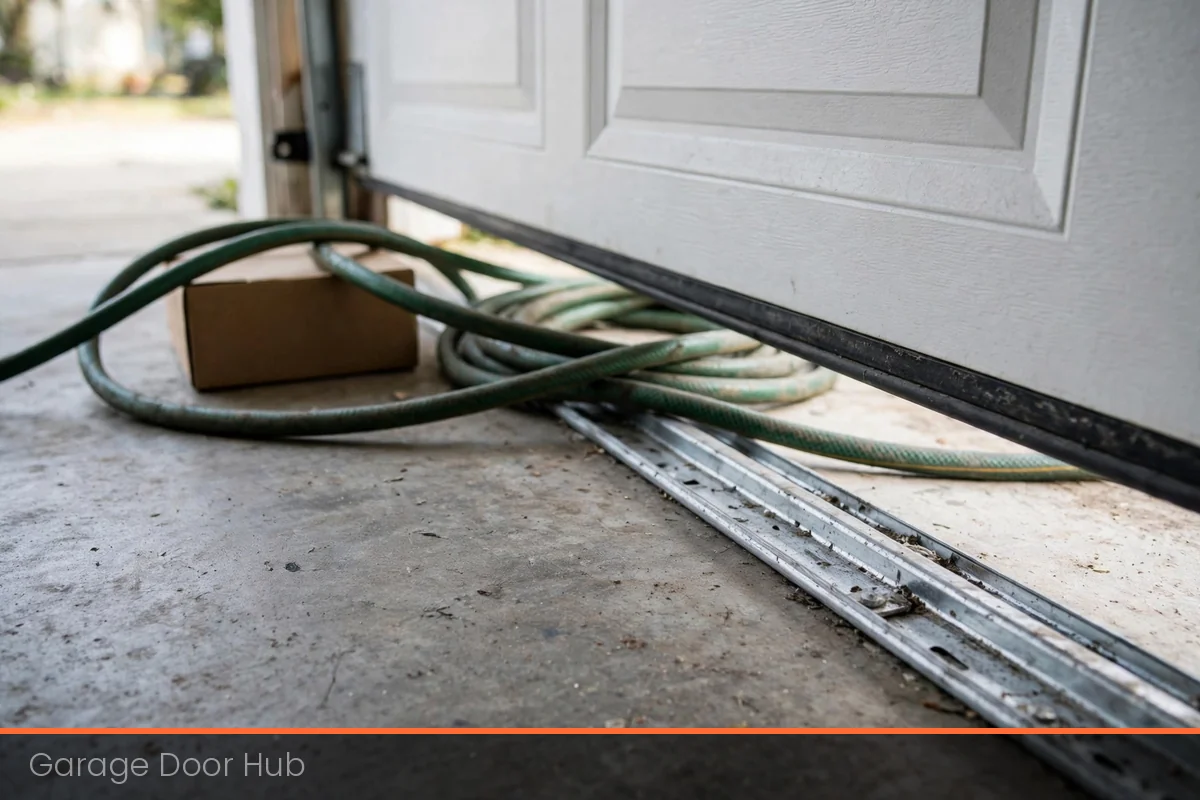
This is the most common cause: the beam sits only 4 to 6 inches off the ground, so anything low blocks it — a bin, bag, broom, hose, toy, or car bumper. Clear everything from the floor, then try the door again.
- The beam sits only 4 to 6 inches off the ground, so anything low blocks it — a bin, bag, broom, hose, toy, or car bumper.
- Clear everything from the floor, then try the door again.
Dirty or cobwebbed sensor lenses
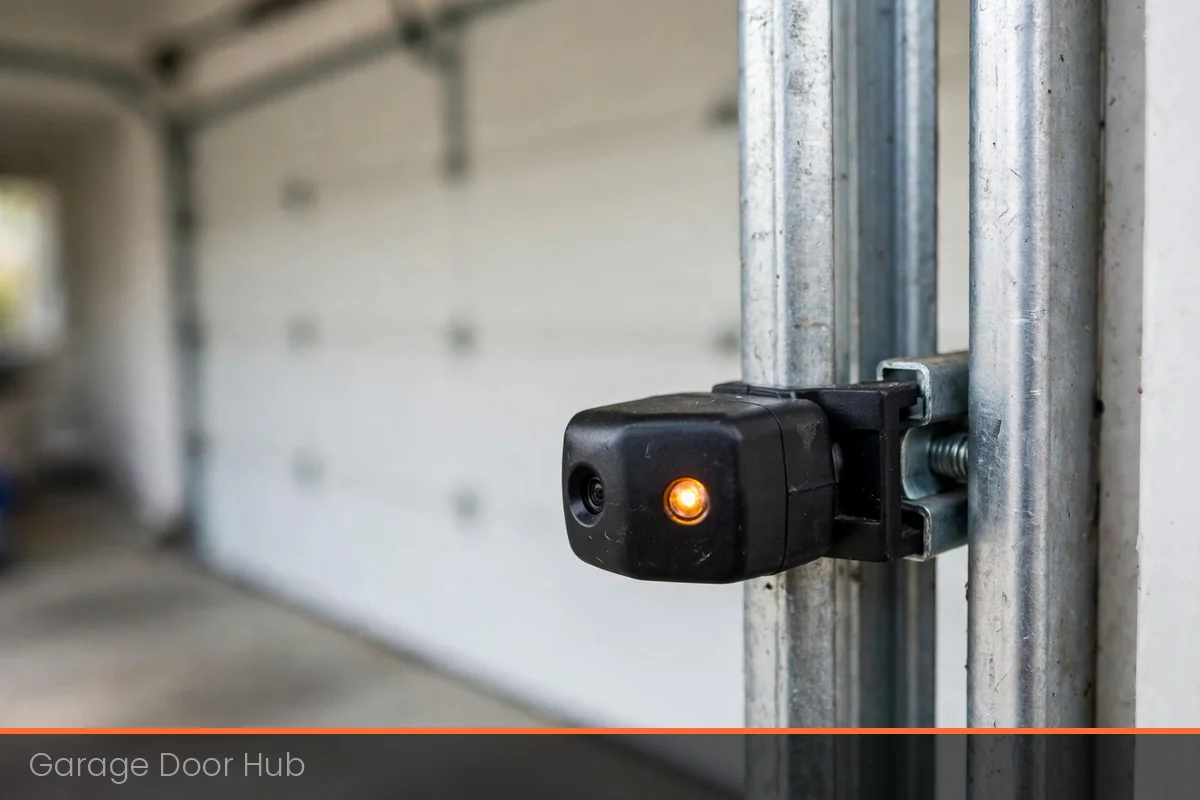
The sensor lenses face each other across the opening, collecting dust, cobwebs and dead insects. A single cobweb across a lens can scatter the beam and make the door reverse. Wipe both lenses with a soft, dry cloth.
- The lenses face each other across the opening and collect dust, cobwebs and dead insects.
- A single cobweb across a lens can scatter the beam and make the door reverse — wipe both lenses with a soft, dry cloth.
Misaligned sensors
A bump from a car, bike or bin can tilt one sensor a few millimetres — enough to break the beam — so both sensors should point straight at each other, at the same height. If one is loose, push it back until its light goes steady, but a bent bracket, or a sensor that will not stay steady, is a pro job.
- A bump from a car, bike or bin can tilt one sensor a few millimetres — enough to break the beam.
- Both sensors should point straight at each other, at the same height; a bent bracket, or a sensor that will not stay steady, is a pro job.
Track obstruction or a bent track
A box, tool, or debris in the track can stop the door partway down and make the opener reverse it, so look along both tracks for anything wedged in them, and check for a bent section near the bottom. Clearing debris is safe, but straightening a bent track is a pro job.
- A box, tool, or debris in the track can stop the door partway down and make the opener reverse it.
- Clearing debris is safe, but straightening a bent track is a pro job.
Limit or force settings have drifted
The opener has two settings: the travel limit, which tells the door where the floor is, and the force setting, which sets how hard a push counts. Both can move out of place over time, especially after a spring replacement. If the limit is too high, the door stops short of the floor and reverses; if the force is too low, it reverses at the slightest friction. Turning the force up too far switches off the safety feature, so if the door still reverses with the sensors and track clear, call a pro.
- The travel limit tells the door where the floor is; the force setting sets how hard a push counts.
- Turning the force up too far switches off the safety feature — if the door still reverses with the sensors and track clear, call a pro.
3. What It Costs to Fix a Door That Won’t Close
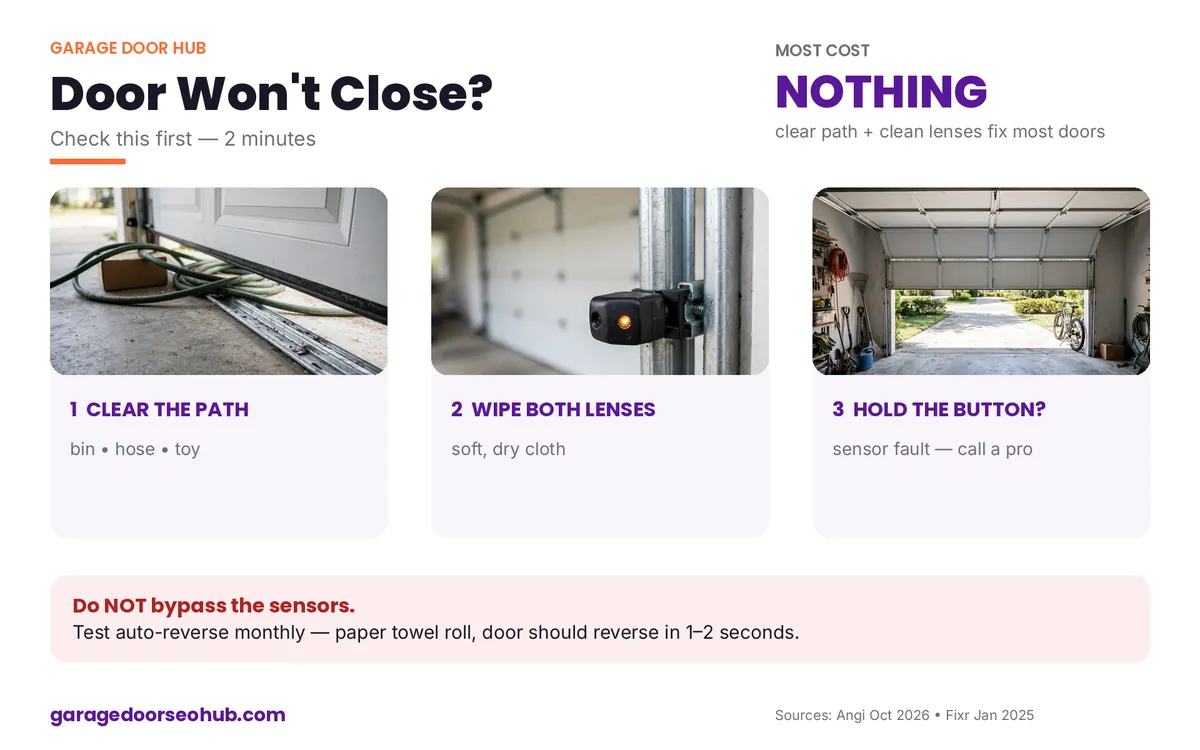
Most reversing doors cost nothing to fix: try these three free checks first. This section then gives the typical 2026 installed prices for the parts that do fail, so you can tell a fair quote from an inflated one.
- Clear the doorway.
- Wipe both lenses clean.
- Realign the sensors until both lights stay steady.
What a failed part costs
When a part has failed, these are the typical 2026 installed prices, parts and labour included.
| Repair | Typical cost in 2026, installed | What it covers | Source |
|---|---|---|---|
| Safety sensor pair | $70–$190 | New sensor pair, fitted and aligned | Angi, Oct 2026 |
| Track repair | $125–$300 | Bent track straightened or replaced | HomeGuide, Nov 2026 |
| Opener repair | $100–$300 | Gear, circuit board, capacitor or motor part | Fixr, Jan 2025 |
| Service call fee | $50–$75 | Trip and diagnosis, often credited toward the repair | HomeAdvisor, Jun 2026 |
- A safety sensor pair costs $70 to $190 installed, fitted and aligned.
- A track repair costs $125 to $300, an opener repair $100 to $300, and a service call $50 to $75 — often credited toward the repair.
A new opener, installed, costs $300 to $800. Price the options first with the Garage Door Opener Cost Calculator and the Garage Door Service Price Calculator.
4. Symptom to Cause to Safe Check
Match what your door does to the likely cause. This table pairs each symptom with the cause behind it and the safe check to try, so find your symptom first, then work from the cause it points to.
| Symptom | Likely cause | Safe check |
|---|---|---|
| Door starts down, then goes back up | Beam blocked or sensor misaligned | Clear the path, wipe both lenses, check both lights are steady |
| Door only closes if you hold the wall button | Sensor fault — holding the button overrides them | Clean and realign the sensors; if it still needs the button held, call a pro |
| Sensor light blinking, or opener flashes 10 times | Sensor fault (Chamberlain, LiftMaster, Craftsman) | Wipe lenses, check wiring, realign sensors |
| Door closes halfway, then reverses | Track obstruction or bent track | Clear debris from the tracks; bent track — call a pro |
| Door stops just short of the floor | Travel limit setting has drifted | Call a pro to reset the limit |
| Door reverses on contact with an object | Auto-reverse working as designed | Remove the object, then test the auto-reverse monthly |
5. How to Test the Auto-Reverse Safety Feature
Two quick tests prove the safety system still works, and both take about two minutes. Run them once a month, and if either test fails, stop using the door and call a pro the same day.
The paper-towel test
Test the auto-reverse once a month. It takes two minutes and proves the safety system still works.
- Place a roll of paper towels flat in the centre of the doorway.
- Close the door.
- The door should touch the roll and reverse within a second or two.
- If it crushes the roll and keeps going, the safety system has failed, so stop using the door and call a pro the same day.
The broom-handle sensor test
Also test the sensors once a month: wave a broom handle through the beam as the door closes, and it should reverse at once. If it does not, clean and realign the sensors, and if they still do not reverse the door, call a pro.
- Wave a broom handle through the beam as the door closes.
- The door should reverse at once.
- If it does not, clean and realign the sensors, and if they still do not reverse the door, call a pro.
6. When to Call a Pro
Most reversing doors are fixed by clearing the path, wiping the lenses and realigning the sensors, but call a pro when those steps fail, or when the fault is in the wiring or the opener. This section lists the five warning signs that mean the job is beyond a homeowner fix.
- Lights that will not stay steady
- Loose or chewed wiring
- An opener light flashing 10 times
- A bent track
- Settings that need adjusting
For wider sensor and remote faults — dead batteries, a dead keypad, a remote that lost pairing — see Garage Door Sensors, Remote & Keypad Troubleshooting. A loud bang and a door that will not lift point to a different fault: Broken Garage Door Spring? Signs, Cost & Why It’s Pro-Only.
Do not bypass the sensors. Never tape over a sensor, wire around it, or disconnect it to make the door close: that switches off a safety feature that stops the door closing on a person. If the sensors will not work, the door stays open until a pro fixes them.
Video: Garage Door Reverses or Won’t Close? Causes & Fixes (2026) (Coming Soon)
A 60 to 120 second video is coming soon. It will cover the sensor check, the auto-reverse test, and the $70 to $300 fix costs. No video is embedded here yet.
Garage Door Hub connects homeowners with trusted local garage door pros: start by finding out what your job should cost, then price it with our free calculator and find a pro near you. Fast, with no jargon, no guesswork and no surprise bills: clear prices, honest guides, and a local pro you can call today.
Frequently Asked Questions
Why does my garage door keep reversing?
The most common reason is the safety sensors. Something is blocking the beam, a lens is dirty or cobwebbed, or a sensor has been knocked out of line. Clear the path, wipe both lenses, and check both sensor lights are steady.
Why won’t my garage door close all the way?
Usually it is a blocked or misaligned sensor, debris in the track, or a travel limit setting that has drifted. Clear the opening and wipe the lenses. If the door still stops short with a clear path and steady lights, a pro needs to reset the limit.
How do I test the auto-reverse safety feature?
Once a month, place a roll of paper towels flat in the centre of the doorway and close the door. It should touch the roll and reverse back up within a second or two. If it crushes the roll, stop using the door and call a pro.
Why does my garage door only close when I hold the button down?
Holding the wall button down overrides the safety sensors, so a door that only closes this way has a sensor fault. Clean both lenses, check both lights are steady, and realign any sensor that is out of line. If it still needs the button held, call a pro.
What does it mean when my garage door sensor light is blinking?
A blinking sensor light means the beam is broken or misaligned. Wipe both lenses, clear the opening, and gently realign the sensors until both lights go steady. On Chamberlain, LiftMaster and Craftsman openers, 10 flashes is the sensor fault code. If it keeps blinking, the sensor or wiring may need replacing.
How much does it cost to fix a garage door that won’t close?
It depends on the cause. A sensor pair costs $70 to $190 (Angi, Oct 2026). A track repair costs $125 to $300 (HomeGuide, Nov 2026). An opener repair costs $100 to $300 (Fixr, Jan 2025).