

Short answer: A broken garage door spring usually announces itself with a loud bang, after which the door will not lift, or lifts a few inches and stops, while a single torsion spring costs $140 to $270 to replace, a pair $200 to $350, and an extension pair $120 to $250 — so do not fix it yourself, since springs hold deadly force, and call a trained pro.
Garage Door Hub connects you with a trusted local pro. Get a clear price for your garage door repair or replacement first.
Table of Contents
- 2. Torsion vs Extension Springs in Plain English
-
3. How Much Does It Cost to Replace a Garage Door Spring?
-
4. How Long Do Garage Door Springs Last?
-
5. Safety Warning: Do Not Repair a Spring Yourself
- 6. What a Pro Does in 60 to 120 Minutes
Video: Broken Garage Door Spring? Signs, Cost & Why It’s Pro-Only (2026) (Coming Soon)
Frequently Asked Questions
A broken garage door spring is the most common major garage door repair, and the most dangerous one to get wrong. The springs carry the door’s full weight, so the opener only guides it up and down — but when a spring snaps, that weight comes back all at once.
Not sure which problem you have? The Garage Door Repair Guide maps each symptom to its cause and price.
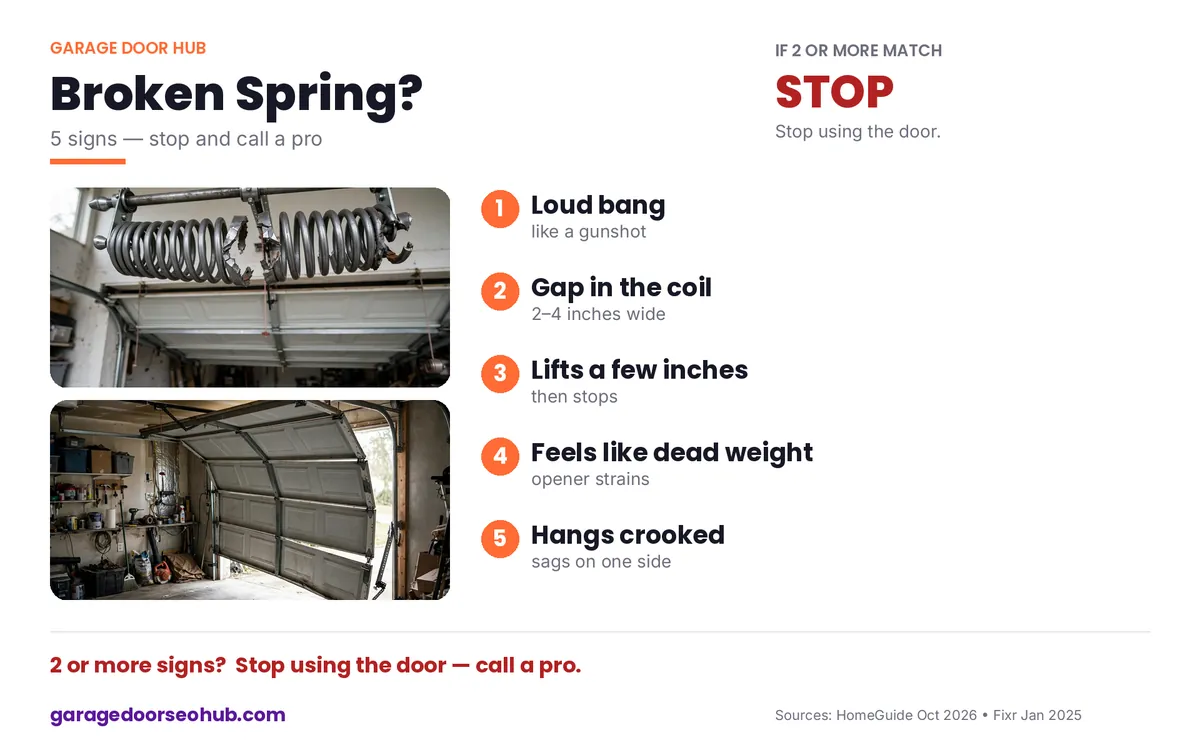
1. 5 Signs of a Broken Garage Door Spring
A broken spring gives itself away in five ways, and this section walks through each one so you can match what your door is doing to the fault. If two or more signs below match, stop using the door and call a pro, and do not keep pressing the opener button, since it can strip the opener gear and turn one repair into two.
A loud bang, like a gunshot, from the garage
This is the classic sign: a snapping torsion spring sounds like a gunshot inside the garage, so if you heard a loud bang and the door now acts differently, check the spring above the door first.
- The bang is the spring itself snapping, not the opener or the door.
- If the door acts differently right after the bang, check the spring above the door first.
The door will not lift, or lifts only a few inches
With a broken spring, the opener may hum and strain, but the door stays put, lifts a few inches and stops, or drops back down, because the opener cannot lift the door’s dead weight without the spring. If your door will not open at all, read the full diagnostic: Garage Door Won’t Open? 7 Causes & What to Check First.
- The opener hums and strains, but the door stays put, lifts a few inches and stops, or drops back down.
- The opener cannot lift the door’s dead weight without the spring.
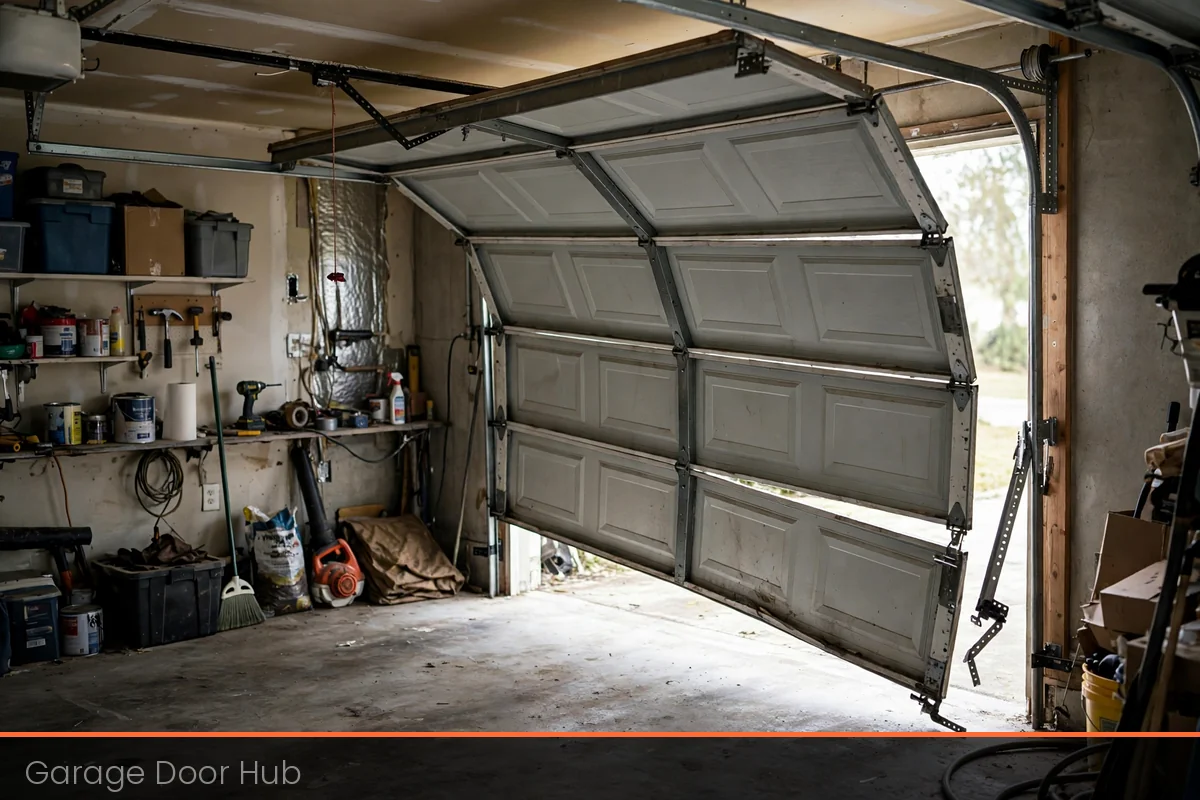
The door hangs crooked or sags on one side
If your door has two springs and only one breaks, it may lift unevenly and hang crooked, with one side rising while the other drags. A crooked door can also point to a track problem: Garage Door Off Track or Sagging? Causes & Fixes.
- With two springs and only one broken, the door may lift unevenly and hang crooked.
- One side rises while the other drags — and a crooked door can also point to a track problem.
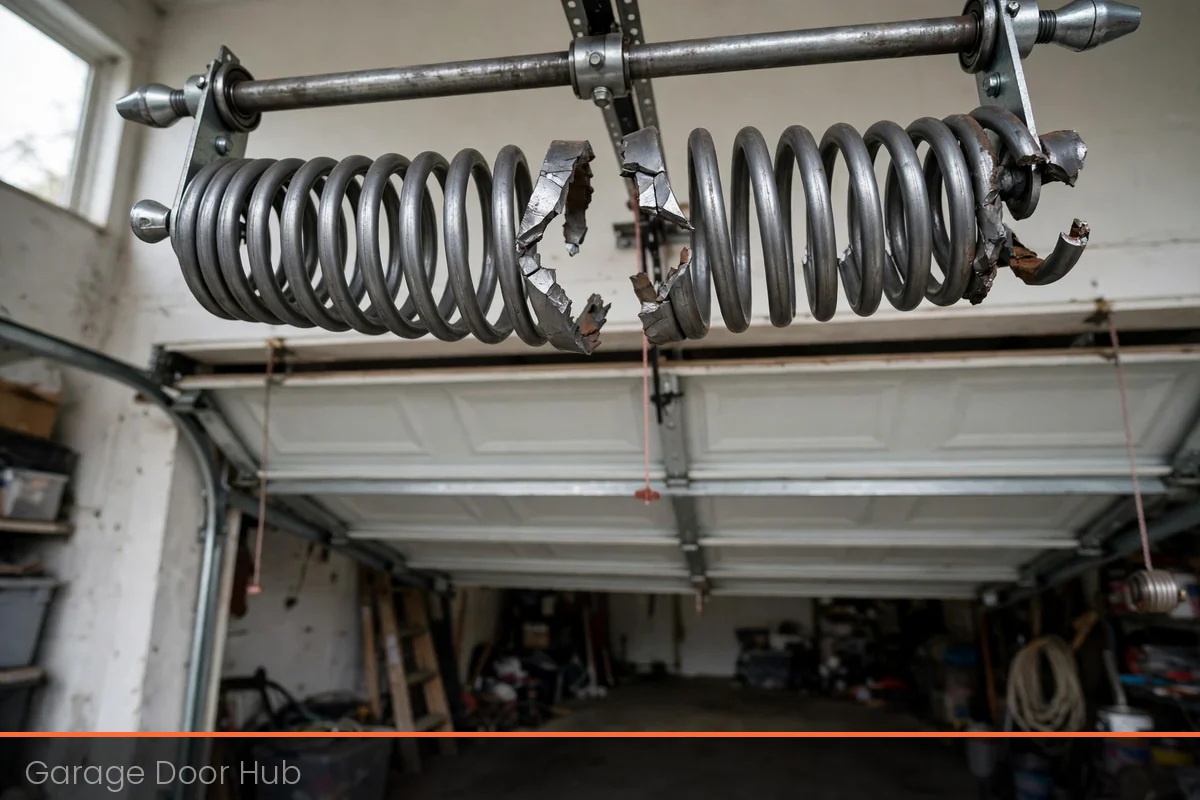
A visible gap in the spring coil
Look at the torsion spring above the door: a healthy spring is one continuous coil, while a broken one has a clear gap, usually two to four inches wide, where the coil snapped. Extension springs along the sides stretch out visibly when they break, so a gap there is your answer — and do not touch the spring.
- A healthy torsion spring is one continuous coil; a broken one has a clear gap, usually two to four inches wide.
- Extension springs along the sides stretch out visibly when they break — and do not touch the spring.
The opener strains, or the door feels like dead weight
Lift the door by hand only if it is fully closed. A door with a working spring feels light, while one with a broken spring feels like dead weight, so if it feels heavy, lower it gently, leave it closed, and call a pro.
- Lift the door by hand only if it is fully closed.
- A door with a working spring feels light; one with a broken spring feels like dead weight.
2. Torsion vs Extension Springs in Plain English
There are two kinds of garage door spring, and the type changes the cost. A torsion spring sits above the door on a metal shaft, twisting to store energy as the door closes and unwinding to lift it, while an extension spring runs along each side, stretching as the door closes and pulling it up. Extension springs are common on older, lighter doors, and cost less.
A pro can tell the type in seconds. One safety fact: extension springs should always have a safety cable through them, so a broken spring cannot fly across the garage — and if yours do not, ask the pro.
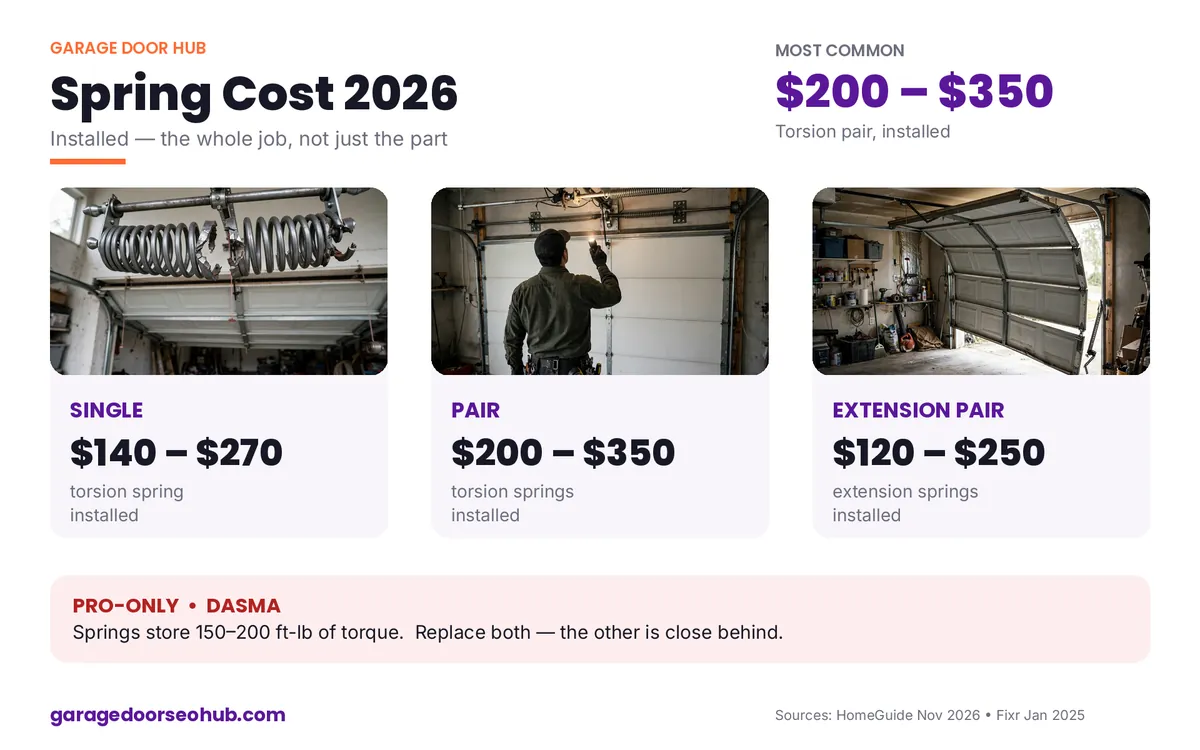
3. How Much Does It Cost to Replace a Garage Door Spring?
Spring replacement is priced by type and by whether one spring or a pair is fitted, so use these ranges to check a quote, not as a fixed price, since prices vary by door size, spring quality and region. Each price is the whole installed job.
| Spring job | Typical cost, installed | Source |
|---|---|---|
| Torsion spring, single | $140–$270 | HomeGuide via TrueRepairCost, 9 Nov 2026 |
| Torsion spring, pair | $200–$350 | Fixr, Jan 2025; HomeGuide, Nov 2026 |
| Extension spring, pair | $120–$250 | Fixr, Jan 2025; HomeGuide, Nov 2026 |
| Lift cable, pair | $100–$250 | Working range: Fixr, Jan 2025, $100–$200; HomeGuide, Nov 2026, $80–$185 |
| Service call fee | $50–$75 | HomeAdvisor, Jun 2026; HomeGuide, Nov 2026, $50–$100 |
| Emergency premium, after hours | +$75–$150 | EstimatorSuite, Jul 2026 |
| Emergency premium, holiday | +$150–$300 | EstimatorSuite, Jul 2026 |
What pushes a spring quote up
For cables, openers and panels, see Garage Door Repair Cost by Part 2026. Price your door with the Garage Door Spring Calculator, and see the Angi spring replacement cost guide, 30 October 2026. Two things move a quote up:
- A double door, which needs heavier springs.
- A high-cycle spring, which costs more up front and lasts much longer. High-cycle springs rated for 25,000 cycles or more add $30 to $80 per spring.
GarageCalculator, October 2026, gives $435 to $470 for a torsion pair — well above the $200 to $350 range most sources agree on. See also the RoofToYard repair cost guide, November 2026.
4. How Long Do Garage Door Springs Last?
A standard spring is rated for about 10,000 cycles — one open and one close — and lasts roughly 7 to 10 years in normal use (HomeGuide, October 2026). At two cycles a day, 10,000 cycles last 13.7 years; at four a day, 6.8 years. A high-cycle spring rated for 20,000 to 25,000 cycles lasts roughly 15 to 20 years, so it costs more but you replace it half as often.
Why cold weather breaks springs
Cold weather is the other factor, since springs break more often in winter: cold steel turns brittle, and a spring that has done 9,000 cycles is close to its limit, so a cold snap is often the final push. If your springs are over seven years old and winter is coming, have a pro inspect them: an inspection is far cheaper than an emergency call-out at night.
- Cold steel turns brittle, so winter is when springs break most often.
- A spring that has done 9,000 cycles is close to its limit, and a cold snap is often the final push.
There is no safe way to make a worn spring last longer. A silicone-based spray can cut noise, but it will not bring back a spring that has used up its cycles.
5. Safety Warning: Do Not Repair a Spring Yourself
A wound spring stores enough force to break bones and cause serious eye injuries, so spring work is never a do-it-yourself job. Read what is at stake below, then leave the repair to a trained pro.
Warning: springs hold deadly force. A wound torsion spring stores 150 to 200 foot-pounds of twisting force. It can break bones, cause serious eye injuries, and kill. The Door & Access Systems Manufacturers Association (DASMA) states that spring systems are dangerous and only trained professionals should repair them.
Never do any of these with a spring:
- Do not wind or unwind a torsion spring.
- Do not remove the bolts holding the spring to the shaft.
- Do not try to stretch an extension spring back into place.
- Do not prop a heavy door open while you work underneath it.
Why both springs get replaced
Replace both springs, even if only one broke. The two springs have done the same work for the same number of cycles, so when one fails, the other is close behind it, and replacing both at one visit costs less than two separate call-outs.
These checks are safe to do yourself:
- Check the power.
- Change the remote batteries.
- Wipe the sensor lenses.
- Lubricate the rollers.
- Tighten loose bolts.
Springs, cables and track work are pro-only.
6. What a Pro Does in 60 to 120 Minutes
A standard spring replacement takes about 60 to 90 minutes for one spring, and 75 to 120 for a pair (EstimatorSuite, July 2026). Knowing the steps helps you judge the visit.
- The pro secures the door, then releases the broken spring’s tension in a controlled way.
- They fit new springs, matched to your door’s weight and size.
- The pro tensions the new springs, tests the door balance, and runs the opener through a few cycles.
- They check the cables, rollers and brackets for wear. If the cables are frayed, replace them at the same visit. A cable pair costs $100 to $250 (working range: Fixr, January 2025; HomeGuide, November 2026). The Garage Door Cable Length Calculator shows how cable and spring sizes match the door.
Video: Broken Garage Door Spring? Signs, Cost & Why It’s Pro-Only (2026) (Coming Soon)
A 60 to 120 second video is coming soon. It will cover the five spring signs, the spring cost table and the spring calculator, ending with one warning: never wind or unwind a spring yourself. No video is embedded here yet.
Garage Door Hub connects homeowners with trusted local garage door pros: start by finding out what your job should cost, then price it with our free calculator and find a pro near you. Fast, with no jargon, no guesswork and no surprise bills: clear prices, honest guides, and a local pro you can call today.
Frequently Asked Questions
How do I know if my garage door spring is broken?
The clearest signs are a loud bang like a gunshot, a visible gap in the spring coil, and a door that will not lift or lifts only a few inches. If you see a gap in the coil, the spring is broken. Stop using the door.
How much does it cost to replace a garage door spring?
A single torsion spring costs $140 to $270 installed (HomeGuide via TrueRepairCost, 9 November 2026). A pair costs $200 to $350 (Fixr, January 2025; HomeGuide, November 2026). An extension spring pair costs $120 to $250 (Fixr, January 2025; HomeGuide, November 2026).
How long do garage door springs last?
A standard spring is rated for about 10,000 cycles, lasting roughly 7 to 10 years in normal use (HomeGuide, October 2026). A high-cycle spring is rated for 20,000 to 25,000 cycles and lasts roughly 15 to 20 years.
Can I still open my garage door with a broken spring?
You should not try. The door becomes dead weight without its spring, and it can slam down without warning. If the door is closed, leave it closed and call a pro.
Should I replace both springs if only one broke?
Yes. Both springs have done the same work for the same number of cycles, so when one fails, the other is close behind it. Replacing both at one visit costs less than two separate call-outs.
Why did my garage door spring break in cold weather?
Cold steel is more brittle, so a spring that has nearly used up its cycles is more likely to snap on a freezing morning. If your springs are over seven years old, have them inspected before winter.