

Short answer: A noisy garage door is usually caused by worn rollers, dry hinges, loose bolts, or a chain-drive opener. Lubricate the pivots, roller bearings and springs with silicone spray or white lithium grease every 3 to 6 months, since nylon rollers run quieter than steel and a belt-drive opener beats a chain drive, but if you hear a loud bang, stop and call a pro.
Garage Door Hub connects you with a trusted local pro. Get a clear price for your garage door repair or replacement first.
Table of Contents
- 1. What Each Garage Door Noise Means
-
2. Worn Rollers: The Most Common Cause of a Noisy Garage Door
-
3. Dry Hinges: The Squeak That Lubrication Fixes
-
4. Loose Hardware: The Rattle You Can Fix With a Socket Wrench
-
5. Chain-Drive Opener: The Loudest Part of Many Doors
-
6. Balance and Spring Fatigue: The Groan That Means Stop
-
7. Bent or Dirty Track: The Scrape That Gets Worse
-
8. Nylon Rollers vs Steel Rollers: Which Is Quieter?
- 9. Safe DIY Quiet Fixes (and What to Leave Alone)
Video: Why Is My Garage Door So Loud? 6 Causes & Quiet Fixes (2026) (Coming Soon)
Frequently Asked Questions
- Why is my garage door so noisy?
- How do I make my garage door quieter?
- Should I lubricate my garage door rollers?
- Are nylon rollers quieter than steel rollers?
- Why does my garage door grind when opening?
- Is a chain-drive or belt-drive opener quieter?
- When should I call a pro about a noisy garage door?
A noisy garage door is the door telling you something is wearing out: most doors open and close three or four times a day, and every cycle wears the rollers, hinges and springs a little more. A door that used to glide quietly and now grinds, squeaks or rattles usually needs lubrication, new rollers, or tightened bolts. For the full map of every repair problem, see our Garage Door Repair Guide.
1. What Each Garage Door Noise Means
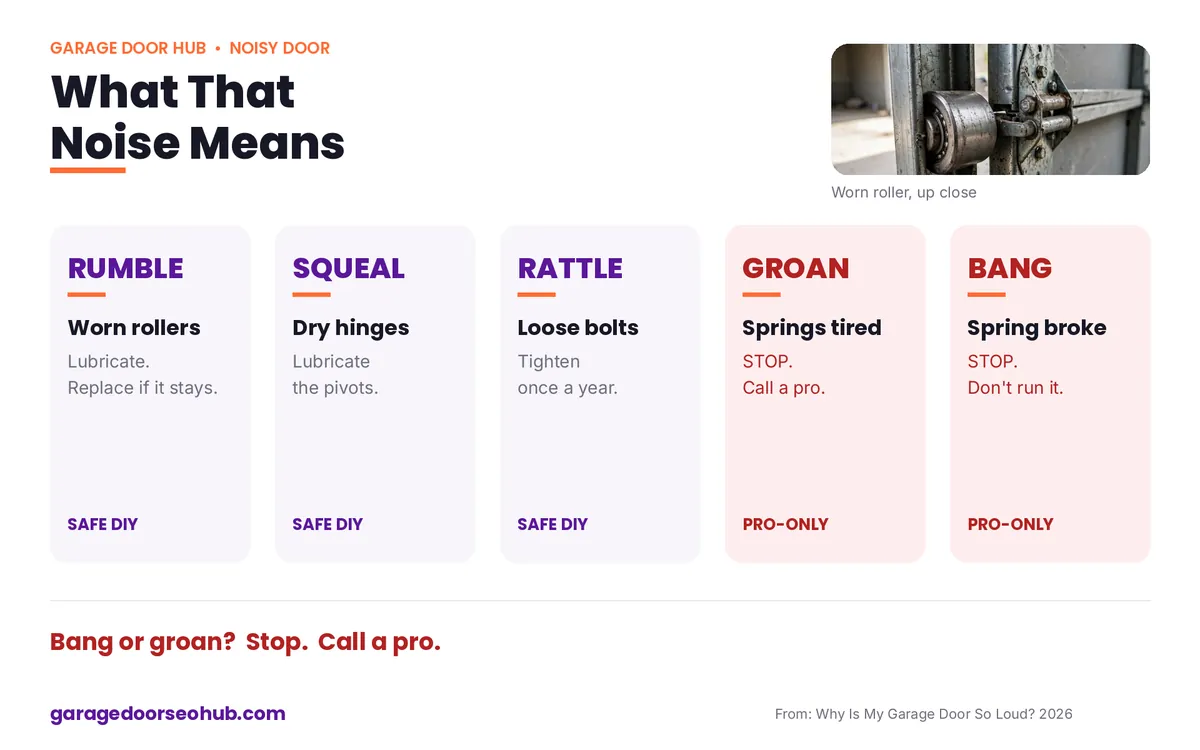
Have someone else run the door while you listen from a safe distance, then match the sound to the table. Each sound points to a different worn part, so matching it first tells you which section below to read and whether the fix is safe DIY or pro-only.
| Sound | Likely cause | What to do |
|---|---|---|
| Low rumble or grinding | Worn roller bearings | Lubricate; replace rollers if it continues |
| High squeak or squeal | Dry hinges, dry bearings | Lubricate hinge pivots and roller bearings |
| Rattle or vibration | Loose bolts, nuts or brackets | Tighten hardware once a year |
| Clanking from the opener | Chain-drive opener | Lubricate chain; a belt drive is quieter at replacement |
| Groan or strain | Spring fatigue, bad balance | Stop and call a pro — springs are pro-only |
| Loud bang | Broken spring, snapped cable | Stop. Do not run the door. Call a pro. |
| Scraping or rubbing | Bent or dirty track | Clean the track; track work is pro-only |
2. Worn Rollers: The Most Common Cause of a Noisy Garage Door
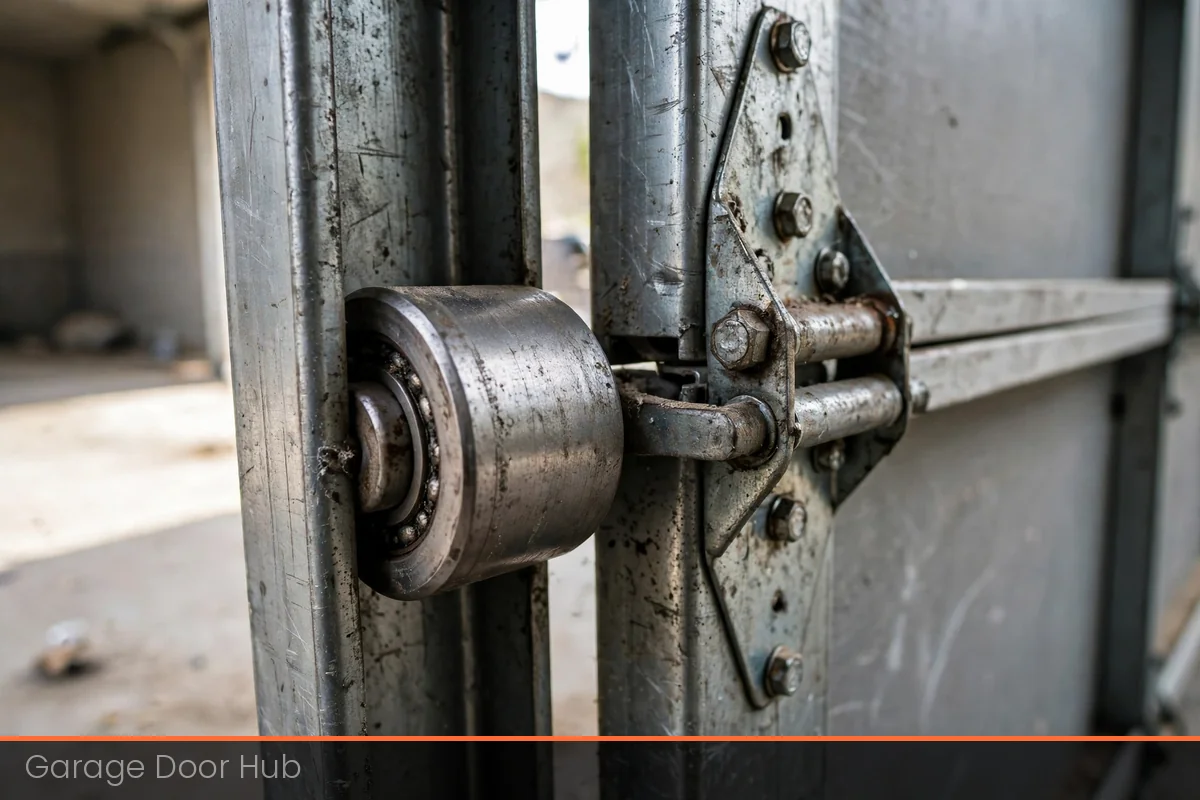
Rollers are the small wheels that carry the door up and down inside the track, ten to twelve of them, each with a bearing. When a bearing wears out, the roller drags and grinds against the track, giving the low rumble many homeowners notice first.
Roller swap costs
A full set of rollers costs $100 to $150 installed (Fixr, January 2025), and a nylon roller set costs about $95 to $150, but roller replacement is not a beginner job — the rollers sit in the track under spring tension.
- If lubrication does not quiet the grinding, ask a pro to price a swap.
- If the noise started after a knock, read our guide on a garage door off track or sagging, since a bent track can make rollers grind too.
3. Dry Hinges: The Squeak That Lubrication Fixes
Hinges join the door panels and let them fold around the top curve of the track, so when a hinge pivot pin dries out, metal rubs on metal and you hear a high-pitched squeak.
Lubricating a hinge
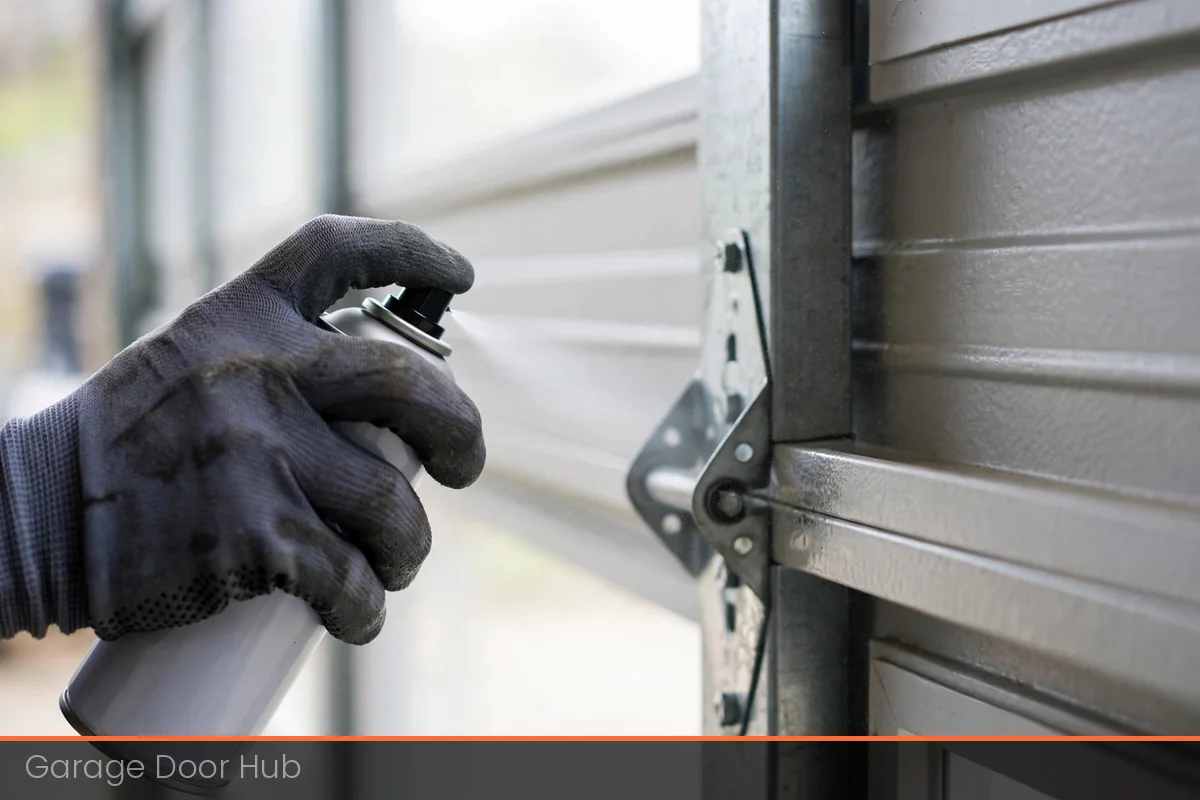
Spray silicone lubricant or white lithium grease onto each hinge pivot, then run the door up and down a few times to work it in. Repeat every 3 to 6 months:
- Use silicone spray or white lithium grease.
- Do not use WD-40 long-term: it is a solvent, not a lubricant, so it frees stuck parts, then dries out and draws in grit.
4. Loose Hardware: The Rattle You Can Fix With a Socket Wrench
A garage door shakes a little every time it moves, and that shaking loosens bolts over a year or two. These parts back off first:
- Nuts on the track brackets.
- Hinge bolts.
- Opener rail screws.
Bolts never to loosen
Once a year, with the door closed, snug every bolt and nut you can reach with a socket wrench, firm, not forced.
- Never loosen the bolts on the bottom roller brackets or spring hardware — those parts are under spring tension.
5. Chain-Drive Opener: The Loudest Part of Many Doors
Sometimes the door itself is fine and the opener makes the noise. This section explains how to tell the two apart, what a chain drive costs to quiet or replace, and when a belt drive is the better buy.
Is the opener the problem?
Sometimes the noise comes from the opener, not the door: chain-drive openers are the loudest common type, and the metal chain rattles and clanks as it pulls the trolley along the rail, and the sound carries into rooms above the garage.
- If the door is quiet when lifted by hand with the opener disconnected, yet loud when the opener runs, the opener is the problem.
- Check the chain tension and lubricate it.
If you are replacing an opener, a belt-drive model is the quietest choice — the right pick when a bedroom sits above the garage. Opener replacement costs $300 to $940 (Fixr, January 2025), or $600 to $1,350 (A1 Garage, November 2026), so check the size your door needs with our Garage Door Opener Size Calculator. If the opener strains or the door feels heavy, see our guide on a broken garage door spring.
6. Balance and Spring Fatigue: The Groan That Means Stop
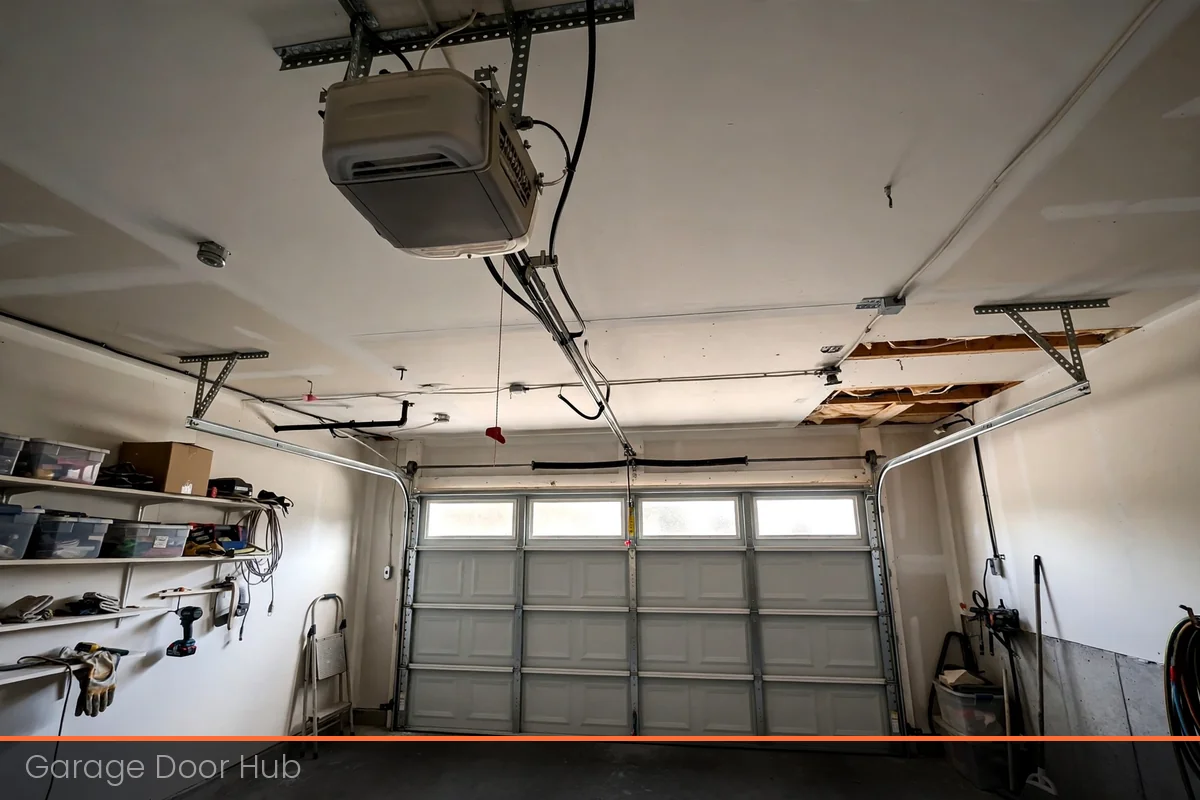
A groaning door is often a tired spring, not a dry hinge. This section shows the simple balance test that tells you whether the springs still carry the door’s weight, and why a failed test means stop and call a pro.
Balance test
Test the balance this way:
- Disconnect the opener.
- Lift the door halfway by hand.
- Check it stays put and feels light to lift.
- If it groans, strains or feels heavy, stop: the springs are no longer doing their share, and the opener is dragging the full weight of the door.
Springs wear out bit by bit, so the groan creeps in slowly, and a tired spring close to breaking can drop the door. A single torsion spring costs $140 to $270 installed (HomeGuide via TrueRepairCost, 9 Nov 2026), and a pair costs $200 to $350 installed (Fixr, Jan 2025; HomeGuide, Nov 2026), but never adjust, unwind or replace a spring yourself: a wound torsion spring stores enough force to break bones, and spring work is pro-only.
7. Bent or Dirty Track: The Scrape That Gets Worse
A faulty track shows up as scraping, usually at the same point in the door’s travel every time. Dirt and grit build up inside the track and grind against the rollers, while a small dent — from a car bumper, a ladder or a bicycle handlebar — makes the roller catch and scrape as it passes.
Cleaning the track
Cleaning the track is safe DIY: with the door closed, wipe the inside of both tracks with a damp cloth, but do not grease the track, since grease collects grit and makes rollers slip.
- Only the rollers and hinges get lubricant.
- Straightening a bent track means working on a door under spring tension, so that is pro work.
8. Nylon Rollers vs Steel Rollers: Which Is Quieter?
If new rollers are the fix, the next choice is the material. This section compares steel and nylon rollers on noise, strength and price, so you can pick the quieter set with your eyes open.
Steel rollers
Steel rollers are the standard fit on most doors.
- Strong and cheap.
- Noisy, since steel on steel rattles with every cycle.
Nylon rollers
Nylon rollers are quieter by a clear margin.
- The nylon tyre soaks up shaking.
- Most run on sealed ball bearings that spin smoothly for years.
A nylon set costs about $95 to $150, against $100 to $150 installed for a full set (Fixr, January 2025). If the rumble is the only fault, a roller swap is the single biggest noise cut you can buy, so ask a pro to price it.
9. Safe DIY Quiet Fixes (and What to Leave Alone)
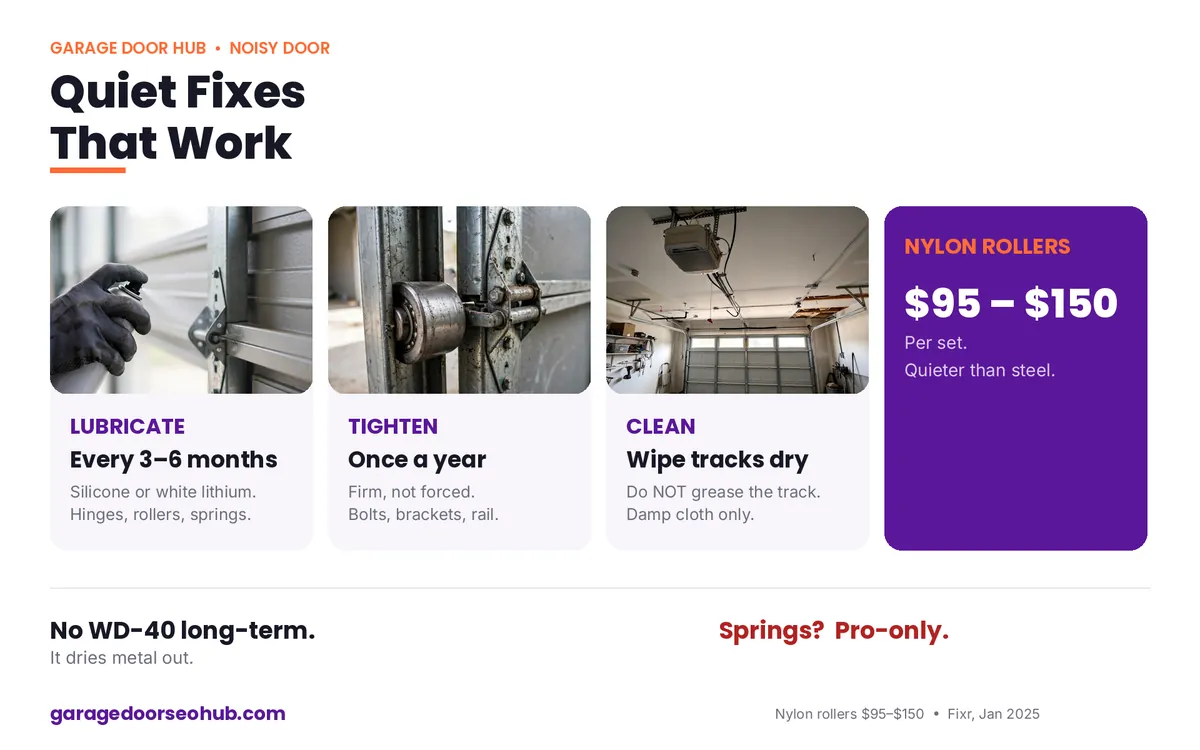
Three safe fixes cover most noisy doors:
- Lubricate: spray silicone lubricant or white lithium grease on every hinge pivot, roller bearing, and spring, every 3 to 6 months. Do not use WD-40 as a long-term lubricant — it dries out and draws in grit.
- Tighten: once a year, snug the bolts on the hinges, track brackets and opener rail — firm, not forced — and never touch the bottom roller brackets or spring hardware.
- Clean: wipe the inside of both tracks with a damp cloth. Keep the track clean and dry — do not grease it.
Leave the rest to a pro:
- Springs and cables.
- Track straightening.
- Roller replacement.
- Any door that hangs crooked or will not stay balanced.
Price your exact job first with the Garage Door Repair Cost Calculator.
Video: Why Is My Garage Door So Loud? 6 Causes & Quiet Fixes (2026) (Coming Soon)
A 60 to 120 second video for this guide is coming soon, covering the six causes of noise, the safe lubrication and tightening checks, and the warning signs that mean stop and call a pro. No video is embedded here yet.
Garage Door Hub connects homeowners with trusted local garage door pros. Need a repair? Need a replacement? Start here. First, find out what it should cost. Then, price your exact job with our free calculator. Next, find a pro near you. Fast. No jargon. No guesswork. No surprise bills. Just clear prices, honest guides, and a local pro you can call today.
Frequently Asked Questions
Why is my garage door so noisy?
Most noisy garage doors have worn rollers, dry hinges, loose bolts, or a chain-drive opener. A low rumble means worn roller bearings, a squeal means dry hinges, and a rattle means loose hardware. Lubricate hinges, bearings and springs with silicone spray or white lithium grease every 3 to 6 months.
How do I make my garage door quieter?
Lubricate every hinge pivot and roller bearing with silicone or white lithium grease, tighten loose bolts, and clean the tracks. For a bigger drop, fit nylon rollers (about $95 to $150 per set).
Should I lubricate my garage door rollers?
Yes. Lubricate the roller bearings — not the tyre that touches the track — with silicone spray or white lithium grease every 3 to 6 months. Do not grease the track, and do not use WD-40 long-term: it evaporates and attracts grit.
Are nylon rollers quieter than steel rollers?
Yes, clearly. Nylon rollers absorb vibration and run on sealed ball bearings, so they are much quieter than steel rollers. A nylon set costs about $95 to $150 (Fixr, January 2025).
Why does my garage door grind when opening?
Grinding usually means worn roller bearings, a dirty track, or a roller catching on a bent track section. Clean the track first, then lubricate the roller bearings. If the grinding continues, the rollers are likely worn out, or the track needs a pro to straighten it.
Is a chain-drive or belt-drive opener quieter?
A belt-drive opener is quieter. Chain drives use a metal chain that rattles, while belt drives use a rubber belt that runs almost silently. Opener replacement costs $300 to $940 (Fixr, January 2025), or $600 to $1,350 (A1 Garage, November 2026).
When should I call a pro about a noisy garage door?
Call a pro if you hear a loud bang, if the door groans or feels heavy, if it hangs crooked or comes off its track, or if lubrication and tightening do not fix it. Springs, cables and track alignment are pro-only — a wound spring stores enough force to break bones.