

Short answer: A new garage door costs $754 to $1,707 installed in 2026, with most homeowners paying about $1,231 on average (Angi, 21 September 2026). Choose size first, then material, insulation, style and opener, and vet the installer last. Get two or three written quotes, each set out line by line, and check licence, insurance and warranties before you pay a deposit.
Garage Door Hub connects you with a trusted local pro. Get a clear price for your garage door repair or replacement first.
Table of Contents
- 1. Choose a New Garage Door in Six Steps
-
2. What Size Garage Door Do You Need?
-
3. Which Material Fits Your Home and Climate?
-
4. What to Check in a Written Quote
-
5. How to Vet a New-Door Installer
-
6. Red Flags and the Deposit Rule
Video: How to Choose a New Garage Door 2026 (Coming Soon)
How to Choose a New Garage Door — Frequently Asked Questions
- How much does a new garage door cost in 2026?
- What size garage door do I need?
- Do I need a new garage door opener with a new door?
- What warranty should a new garage door have?
- Is a deposit normal for a new garage door?
- How do I know if a garage door installer is legitimate?
- How long does it take to install a new garage door?
A new garage door is the biggest single buy in this part of your home, and it is also the part you see every day. The door takes up 30 to 40 percent of a home’s front face (DASMA, Winter 2005), so the wrong size, the wrong material or the wrong installer shows for years. This guide walks through the choice in order, so you pick the door first and the installer last, not the other way round. It is one part of our full new garage door guide, which covers cost, materials, insulation, styles and lifespan in depth.
1. Choose a New Garage Door in Six Steps
The order matters. Size sets what will fit and what it will cost, material sets how long it lasts and how much care it needs, insulation sets how it handles heat and cold, style sets how it looks, and the opener has to match the weight of the door you picked. The installer comes last, because you cannot vet a quote until you know what door is being quoted. Work through the steps in order and you will not pay for a door that does not fit your opening, your climate or your budget.
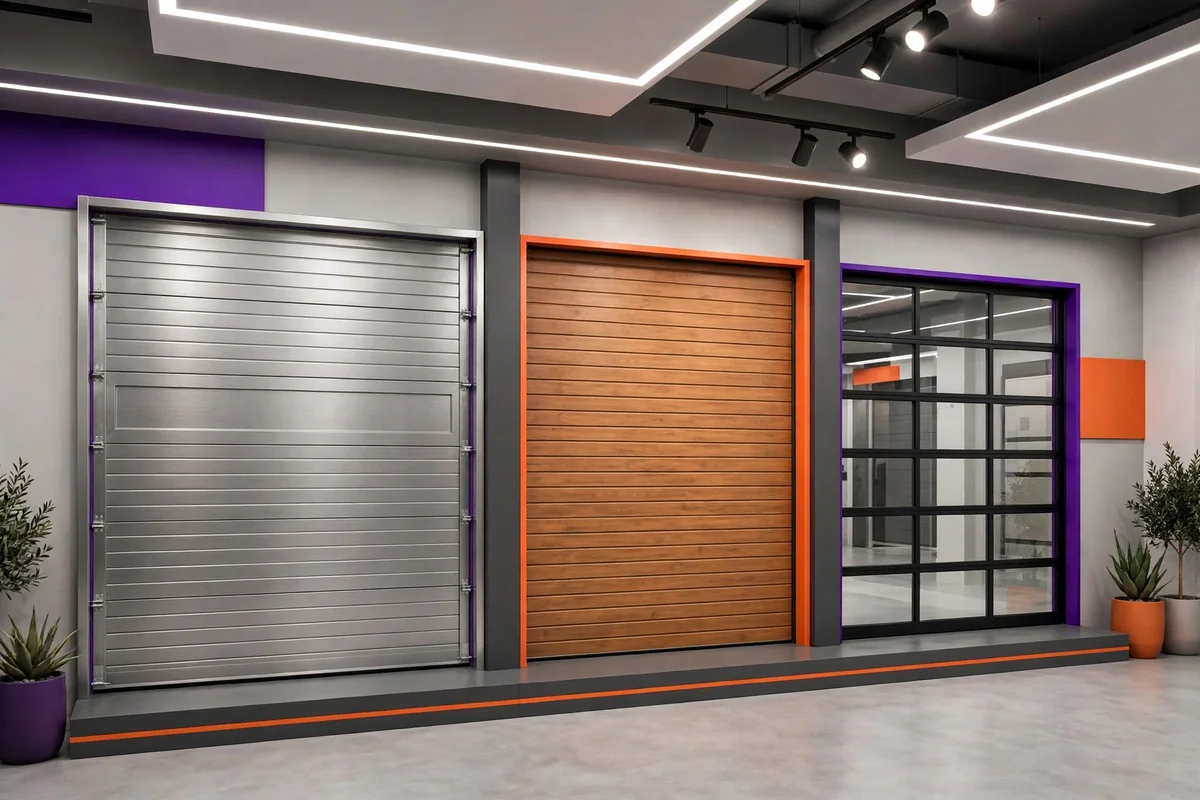
- Size. Measure the opening, the headroom and the sideroom before you look at any door. A single door is most often 9 by 7 feet, and a double door is most often 16 by 7 feet.
- Material. Steel suits most homes, wood suits a traditional look with more care, and aluminium suits damp or coastal air. Pick the material for your climate, not just for the photo.
- Insulation. An attached garage needs more insulation than a detached one. Polystyrene gives R-6 to R-9, and polyurethane gives R-12 to R-18.
- Style. Match the door to the house: carriage house for a farmhouse look, flush panels for a modern look, and windows only where they suit the front of the home.
- Opener. Check that the opener can lift the new door, and size it with our Garage Door Opener Size Calculator. A new opener add-on costs $200 to $1,300 installed (Angi, 21 September 2026).
- Installer. Get two or three written quotes for the same door, check licence and insurance, and get the warranties in writing before you pay anything.
Skip a step and the cost shows up later. A door ordered to the wrong size cannot be fitted, a light opener strains under a heavy wood door, and a quote with no door model named cannot be compared with any other quote. A like-for-like swap takes 3 to 6 hours to install (HomeGuide; Angi), so most of the time you spend is in the choice, not on the day itself.
2. What Size Garage Door Do You Need?
Size is the first choice because it fixes the price range and rules out doors that will not fit. A single garage most often takes a 9 by 7 foot door, and a double garage most often takes a 16 by 7 foot door (OGD, 7 May 2026; Angi, 4 August 2026). Single widths run 8, 9 and 10 feet, double widths run 12, 14, 16 and 18 feet, height is 7 feet as standard and 8 feet is now common. Measure your own opening rather than trusting the size of the old door, because the old door may have been fitted to a rough opening that was never quite right.
Measure the opening first
Measure twice, in daylight, with the old door closed. Write each number down as you go, because a quote built on a guess is a quote that changes on the day. These are the five numbers that matter.
- Width of the opening, measured inside the jambs at the widest point.
- Height of the opening, measured from the floor to the top of the opening.
- Headroom, the space from the top of the opening to the ceiling: 12 to 15 inches for standard tracks.
- Sideroom, the space each side of the opening: 3 and three-quarter inches per side, and 5 and a half inches is better for doubles.
- Backroom, the depth into the garage: the door height plus about 18 inches.
One double door or two singles
A double garage can take one wide door or two single doors, and the choice changes how you use the space. One wide door gives a clear opening for a large car or for moving bulky items, while two singles let you open one side only and keep the other side shut against heat, cold and dust. The price differs too, so check it before you choose: our guide to new garage door cost by size sets out single and double prices side by side.
- One double door: one wide opening, one opener, one set of tracks.
- Two single doors: open one side only, and a fault on one side leaves the other side working.
- Two singles need a centre post, which takes up wall space between the doors.
- Ask for both options priced on the same quote, so the choice is made on real numbers.
3. Which Material Fits Your Home and Climate?
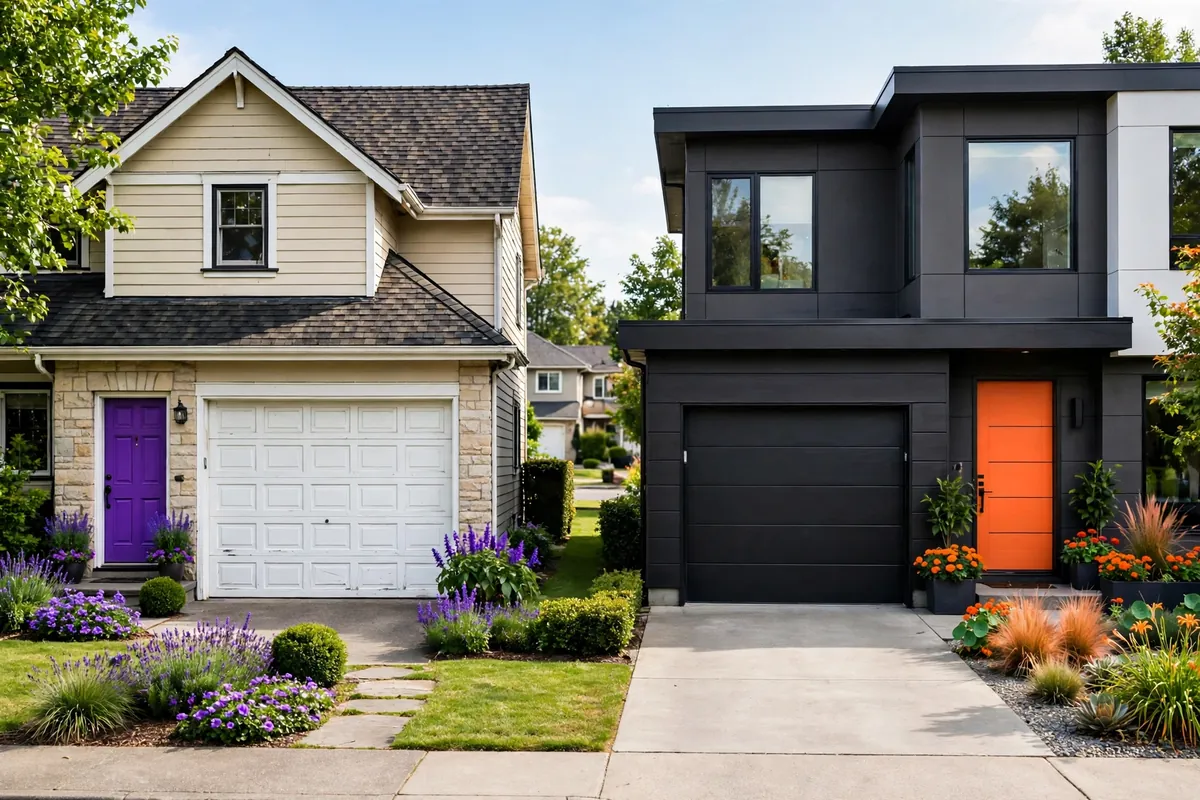
Material sets the look, the weight, the care the door needs and how long it lasts. Steel is the common choice across the United States, with over 80 percent of residential sales (GarageDoorLocator, 2026). Wood looks warm and traditional but needs regular care, aluminium stays light and resists rust in damp air, and glass gives a modern full-view look at a much higher price. The table below gives the installed cost per door for each material (Angi, 21 September 2026), so you can see the spread before you fall for a style.
| Material | Installed cost per door | Source |
|---|---|---|
| Steel | $650–$3,200 | Angi, 21 Sep 2026 |
| Aluminium | $600–$2,900 | Angi, 21 Sep 2026 |
| Vinyl | $800–$2,500 | Angi, 21 Sep 2026 |
| Fibreglass | $800–$2,700 | Angi, 21 Sep 2026 |
| Wood | $900–$4,500 | Angi, 21 Sep 2026 |
| Composite / faux wood | $650–$4,800 | Angi, 21 Sep 2026 |
| Glass | $2,500–$8,000 | Angi, 21 Sep 2026 |
Steel, wood and aluminium at a glance
Most buyers end up choosing between steel, wood and aluminium, so it helps to see them side by side. Steel is strong, cheap to keep and comes insulated in single, double and triple layers. Wood is the warmest looking of the three but it can warp, rot and needs refinishing. Aluminium is light and resists rust, which suits damp and coastal air, but it dents more easily than steel. Our full comparison of the best garage door material covers all six materials, with lifespan and care for each.
- Steel: strong, low care, insulated options, can dent and can rust if the coating fails.
- Wood: warm and traditional, heavy, needs refinishing and can warp or rot.
- Aluminium: light, resists rust, suits coastal air, dents more easily than steel.
- Fibreglass and composite: wood look with less care, and a wide price range by brand.
- Glass: modern full-view look, the highest price in the table, and no verified R-value to quote.
What pushes the price up
The door itself is only part of the bill. Insulation, windows, a new opener, removal of the old door and a permit each add to the total, and labour is priced on top. Labour per door is $200 to $500, averaging $350 (Angi, 21 September 2026). Ask for each of these as its own line on the quote, so you can see what you are paying for.
- Insulation: an insulated door costs $200 to $800 more (Titanium Garage Door, 31 May 2026).
- Windows in the top panel, decorative hardware and a carriage-house look.
- Old-door removal and disposal: $50 to $200 (Angi, 21 September 2026).
- Permit where one is required: $40 to $120 (Angi, 21 September 2026), though most like-for-like swaps need none.
- Labour: $200 to $500 per door, averaging $350 (Angi, 21 September 2026).
4. What to Check in a Written Quote
A quote is only useful if it names exactly what you are buying. A single total with no detail cannot be compared with another quote, and it cannot be checked when the crew arrives. Get the quote in writing before any work starts, and check that every line below is on it. If a line is missing, ask for it to be added. A good installer will add it without a fuss.
The six lines every quote must name
These six lines are the whole job, set out so two quotes can be compared line by line. Two quotes for the same door should name the same door, the same insulation and the same opener. If they do not, you are not comparing the same job. Price your own job first with our Garage Door Cost Calculator, then check each quote against it.
- Door model: brand, model name and size, so you know what is being fitted.
- Insulation: the type and R-value, such as polystyrene R-6 to R-9 or polyurethane R-12 to R-18.
- Spring type and cycle rating: torsion or extension, and how many cycles the springs are rated for.
- Opener model: brand and model, or a clear note that the old opener is being reused.
- Labour: the install charge as its own line, not folded into the door price.
- Fees: removal and disposal, permit, and any other charge, each named.
Warranties in writing
A warranty spoken on the phone is worth very little when something fails a year later. Get the manufacturer warranty on the door and the workmanship warranty on the install in writing, on the quote or on the contract, before you sign. Clopay authorised dealers give a minimum one-year installation warranty, so use that as your floor and ask for more where it is offered.
- Manufacturer warranty: what parts it covers and for how long.
- Workmanship warranty: what the install itself covers and for how long.
- Minimum one-year installation warranty from Clopay authorised dealers.
- Ask what the warranty does not cover, and who to call when you need it.
- Keep the written warranty with the quote, not just in an email thread.
5. How to Vet a New-Door Installer
Vetting an installer for a new door is not the same job as vetting a company for a repair. A repair vetting checks who can fix a fault today, while a new-installation vetting checks who can order, fit and stand behind a door that should last 15 to 30 years. Our guide on how to choose a garage door repair company covers the repair side in full. The checks below are for a new installation only, and they take an hour at most.
Licence and insurance checks
Licence and insurance are the two checks that cost you nothing and save you the most. A licence number you have looked up yourself proves the company is allowed to do the work, and proof of liability insurance proves you are covered if something goes wrong on your property. Do both before you sign, not after.
- Ask for the licence number, then look it up yourself with the state or local authority.
- Ask for proof of liability insurance and check the company name matches the quote.
- Check recent reviews under one consistent company name, not several names.
- Ask how long the company has fitted the brand of door on your quote.
Two or three quotes, compared like for like
Two or three quotes are enough to find the fair price, and more than three mostly adds noise. The trick is to make each quote describe the same job, so the prices mean something. Give each installer the same door model, the same size and the same insulation, then compare the totals line by line.
- Same door model, size and insulation on every quote.
- Same opener model, or the same note that the old opener stays.
- Same fees listed: removal, permit and labour as separate lines.
- A quote far below the others usually leaves something out, so ask what it is.
- Keep all quotes in writing, and keep the one you accept with the contract.
6. Red Flags and the Deposit Rule
Most installers are honest, but the garage door trade has a known scam pattern, and it follows the same shape every time: a low price to get in the door, then a much higher price once the crew is on site. The red flags below are the shape of that pattern. One flag on its own is a warning. Two or more mean you should walk away and call the next company on your list.
Four red flags
These four flags come up again and again in complaints about new-door sales. The bait-and-switch version runs like this: a low phone quote of $29 to $99, then a price that jumps by $800 to $2,000 or more once the crew is on site. If you see that jump, stop the job and get a second quote before you agree to anything.
- Bait-and-switch: a $29 to $99 quote that jumps $800 to $2,000 or more on site.
- Cash-only payment, or full payment before any work starts.
- No brand or model named on the quote, so you cannot check what you are buying.
- Same-day pressure: sign now or the price goes up, or the slot goes to someone else.
Deposit on a custom door
A deposit is normal when the door is custom or special-order, because the installer has to order a door made for your opening and cannot sell it on to the next house if you change your mind. What is not normal is paying the full amount before work starts. Pay a deposit, get it in writing, and pay the rest when the door is fitted and working.
- A deposit on a custom or special-order door is normal.
- Full payment before work starts is not normal: walk away if it is demanded.
- Get the deposit amount, the door model and the expected fit date in writing.
- Keep a receipt for every payment, and pay the balance only once the door is fitted.
Video: How to Choose a New Garage Door 2026 (Coming Soon)
A 60 to 120 second video for this guide is coming soon. It will cover the six decision steps, what a written quote must name, how to vet an installer, and the red flags to walk away from. No video is embedded here yet.
Garage Door Hub connects homeowners with trusted local garage door pros. Need a repair? Need a replacement? Start here. First, find out what it should cost. Then, price your exact job with our free calculator. Next, find a pro near you. Fast. No jargon. No guesswork. No surprise bills. Just clear prices, honest guides, and a local pro you can call today.
How to Choose a New Garage Door — Frequently Asked Questions
How much does a new garage door cost in 2026?
A new garage door costs $754 to $1,707 installed, averaging about $1,231 (Angi, 21 Sep 2026). Size, material, insulation, windows and the opener move the price, so price your exact job first and compare written quotes line by line.
What size garage door do I need?
Measure the opening, not the old door. A single garage most often takes a 9 by 7 foot door, and a double garage most often takes a 16 by 7 foot door (OGD, 7 May 2026; Angi, 4 Aug 2026). Also check headroom, sideroom and backroom before you order.
Do I need a new garage door opener with a new door?
Not always. If your opener is old, noisy or too weak for the new door, replace it at the same time. A new opener add-on costs $200 to $1,300 installed (Angi, 21 Sep 2026).
What warranty should a new garage door have?
A manufacturer warranty on the door and a workmanship warranty on the install, both in writing. Clopay authorised dealers give a minimum one-year installation warranty, so use that as your floor.
Is a deposit normal for a new garage door?
Yes, for a custom or special-order door. Full payment before work starts is not normal, so pay a deposit, get it in writing, and pay the balance once the door is fitted and working.
How do I know if a garage door installer is legitimate?
Check the licence number yourself, ask for proof of liability insurance, get two or three written itemised quotes, and get the manufacturer and workmanship warranties in writing before you sign.
How long does it take to install a new garage door?
A like-for-like swap takes 3 to 6 hours (HomeGuide; Angi). A custom door, a new opener or extra work such as a new frame takes longer, so ask for the expected time on the quote.