

Short answer: A carriage house door costs more than plain steel, and the look drives the price. An installed double Coachman door costs $2,200 to $4,000, while a Canyon Ridge double costs $2,800 to $5,500 (GarageDoorLocator, 2026). The door covers 30 to 40 percent of the front of the house (DASMA, 2005), so style is not a small detail.
Garage Door Hub connects you with a trusted local pro. Get a clear price for your garage door repair or replacement first.
Table of Contents
-
1. What Is a Carriage House Garage Door?
-
2. Carriage House Garage Doors: Gallery, Coachman and Canyon Ridge Tiers
-
3. Modern Garage Door Styles for 2026
-
4. 2026 Colours and Windows
-
5. Curb Appeal: Why the Door Matters So Much
-
6. How to Choose a Style for Your House
-
7. Carriage House Cost vs Plain Steel — Is the Premium Worth It?
Video: Carriage House and Modern Garage Door Styles 2026 (Coming Soon)
Carriage House and Modern Garage Door Styles — Frequently Asked Questions
- What is a carriage house garage door?
- How much does a carriage house garage door cost?
- Which is better, Coachman or Canyon Ridge?
- Do black garage doors increase curb appeal?
- Which garage door style suits a modern farmhouse?
- Are carriage house garage doors worth the premium?
- Is faux wood better than real wood for a garage door?
Carriage house doors copy the look of old barn doors, while modern doors strip that look right back to clean lines and glass. Both styles can lift the front of a house, but they suit different homes, and they cost very different amounts. This guide explains the three Clopay carriage house tiers, the main modern styles, the 2026 colours and windows buyers are choosing, and how to pick a style that fits your house. It is part of our new garage door guide, so you can price the door first and then choose the look.
1. What Is a Carriage House Garage Door?
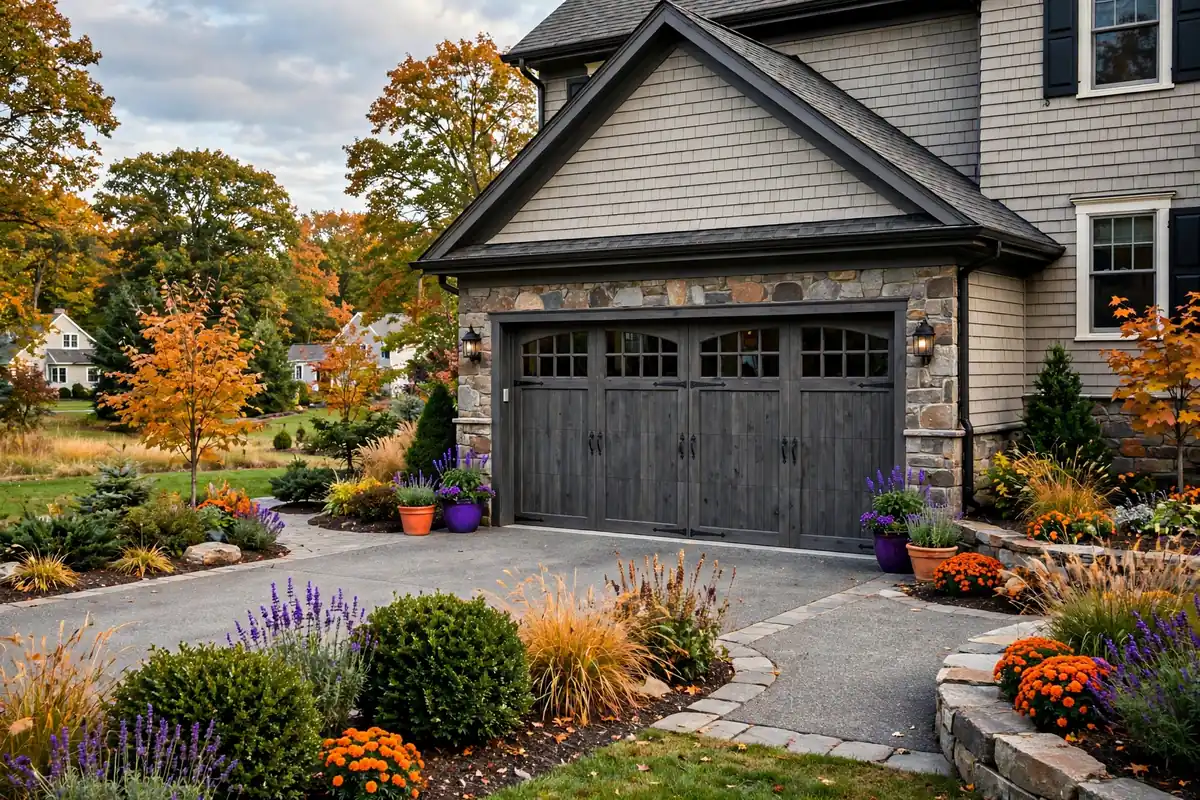
A carriage house garage door looks like a pair of old swing-out barn doors, but it works like a normal modern door. It lifts up in sections on a track, just like a plain steel door, while the face is made to look like two hinged doors with vertical boards, cross buck framing, and black handles and hinges. The hardware is for show in most cases, and the door opens with a standard opener.
What makes it look like a carriage house
The look comes from a small set of details that repeat across brands, and Clopay sets the pattern other makers follow. Once you know the details, you can spot a carriage house door at a glance, and you can tell a cheap grooved copy from a deep overlay door.
- Vertical grooved boards or raised panels that read as two separate doors.
- Cross buck or X-brace framing on the face, often in a darker trim colour.
- Black pull handles and strap hinges, fixed on the face for looks.
- Windows in the top row, often in a row of small square panes or an arched top.
- A wood tone or a wood-look finish, even when the door itself is steel.
Carriage house vs plain steel
A plain steel door and a carriage house door can share the same steel core, the same springs, and the same opener. The difference is the face, and that face is what you pay for. A plain door is flat and quiet in the best sense, while a carriage house door is meant to be seen, so it suits a house where the garage faces the street.
- Plain steel costs less and suits a modern or plain front.
- Carriage house costs more for the overlay, the hardware, and the finish.
- Both open the same way, on the same track, with the same opener.
- Insulation depends on the build, not the style, so check the R-value on the model you pick.
- Steel makes up over 80 percent of United States residential garage door sales (GarageDoorLocator, 2026), so most carriage house doors start as steel.
2. Carriage House Garage Doors: Gallery, Coachman and Canyon Ridge Tiers
Clopay sells carriage house doors in three clear tiers, and the tier sets the look, the build, and the price. Gallery is the budget way in, Coachman sits in the middle, and Canyon Ridge is the premium faux-wood door. The table below gives the installed double-door ranges we could source, with the source and year on each row, and the sections below explain what each tier is made of.
| Clopay tier | What it is | Installed double door | Source |
|---|---|---|---|
| Gallery | Grooved steel, budget tier | No installed double-door range sourced | — |
| Coachman | Steel with composite overlay, mid tier | $2,200–$4,000 | GarageDoorLocator, 2026 |
| Canyon Ridge | 4–5-layer composite faux wood, premium tier, R up to 20.4 | $2,800–$5,500 | GarageDoorLocator, 2026 |
Price your exact size with our Garage Door Cost Calculator before you ask for a quote, because size, insulation, windows, and hardware move the price inside those ranges.
Gallery — budget grooved steel
Gallery is the budget carriage house door. It is grooved steel, so the carriage house look comes from grooves pressed into the steel face, not from a separate overlay stuck on top. That keeps the cost down, and it keeps the door light and simple to maintain.
- Grooved steel face with a carriage house pattern, no overlay.
- Lowest cost of the three Clopay carriage house tiers.
- Steel body, so it will not rot or warp like real wood.
- Best for a farmhouse look on a tight budget.
- No installed double-door price was sourced for Gallery, so no figure is given here.
Coachman — mid-range steel and composite overlay
Coachman is the middle tier, and it is the one most buyers end up with. It starts as a steel door, then adds a composite overlay that gives the face real depth, with raised boards and trim that catch the light in a way grooves alone cannot. An installed double Coachman door costs $2,200 to $4,000 (GarageDoorLocator, 2026).
- Steel door with a composite overlay for a deeper carriage house face.
- Installed double door: $2,200 to $4,000 (GarageDoorLocator, 2026).
- Looks closer to real wood than grooved steel, without the upkeep of wood.
- A good fit when the garage faces the street and the house is a farmhouse or traditional style.
- Check the insulation level on the model you pick, because the overlay alone does not set the R-value.
Canyon Ridge — premium composite faux wood
Canyon Ridge is the premium tier, built as a 4 to 5-layer composite faux-wood door. It is made to look and feel like real wood, with grain and depth across the face, but it is composite, so it does not need the sanding and refinishing that real wood needs. An installed double Canyon Ridge door costs $2,800 to $5,500 (GarageDoorLocator, 2026), and its R-value runs up to 20.4 (DoorServPro from Clopay 2026 literature, 5 July 2026).
- 4 to 5-layer composite faux-wood build, premium tier.
- Installed double door: $2,800 to $5,500 (GarageDoorLocator, 2026).
- R-value up to 20.4 (DoorServPro from Clopay 2026 literature, 5 July 2026).
- Closest look to real wood in the Clopay carriage house range.
- Best for a high-end front, or for a home where the garage door is the main feature of the facade.
3. Modern Garage Door Styles for 2026
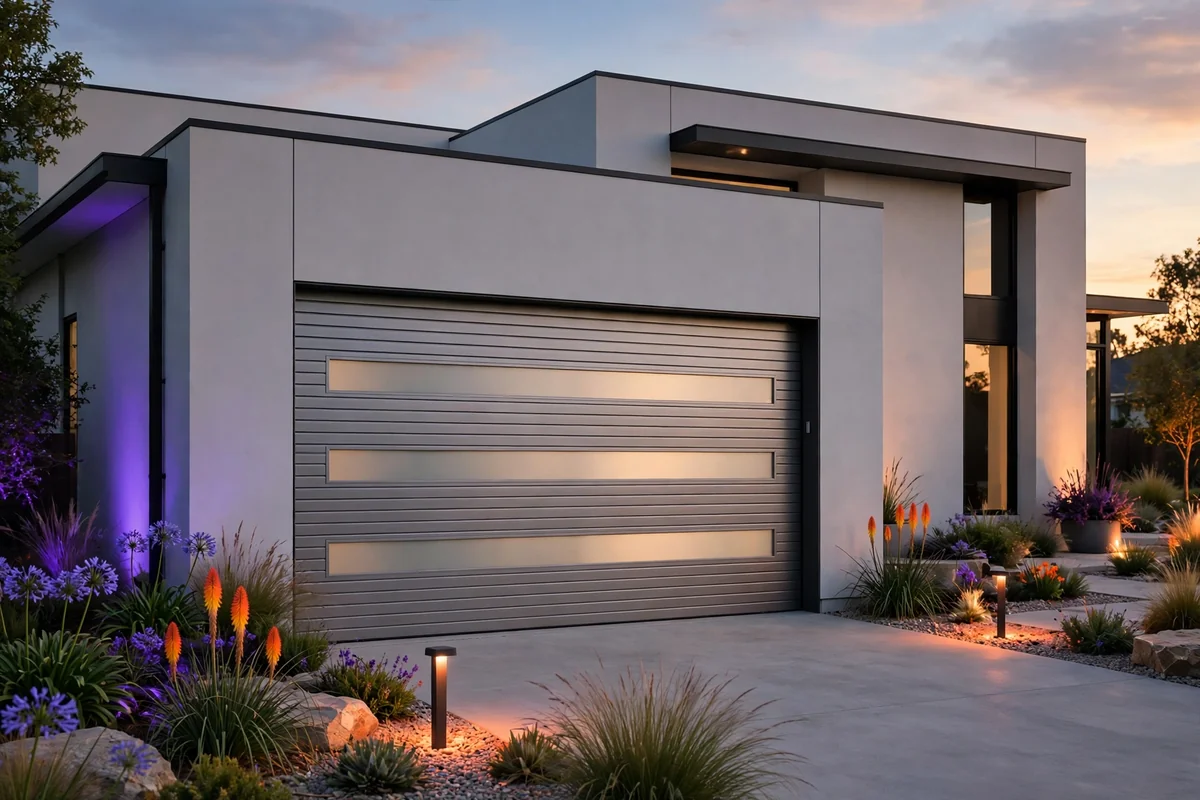
Modern garage door styles go the other way from carriage house: less detail, not more. The 2026 modern look is a flat face, long clean lines, and glass where the top row used to be. It suits a new build, a remodel with flat roof lines, and any house where the garage door should blend in rather than stand out as a fake barn door. The material matters as much as the shape, so read our guide to the best garage door material before you pick a modern face.
Flush and minimalist panels
Flush panels are flat, with no raised squares and no grooves, and that flat face is the core of the modern look. The door reads as one clean slab, and the lines come from the thin gaps between sections, not from decoration on the face.
- Flat face with no raised panels or grooves.
- Long horizontal lines from the section joints.
- Suits modern, mid-century, and plain-front homes.
- Shows dust and dents more than a grooved face, so keep the finish in mind.
- Works well in matte black, charcoal, white, and grey.
Full-view glass doors
Full-view glass doors replace most of the solid face with glass panels set in an aluminium frame. They let light into the garage, and they turn the door into a window wall when it is closed. Frosted or tinted glass keeps the inside private while still letting light through.
- Glass panels in an aluminium frame, not a solid steel face.
- Frosted or tinted glass for privacy with light.
- Best for a garage used as a workshop, gym, or living space.
- Glass costs far more than steel: glass doors run $2,500 to $8,000 installed (Angi, 21 September 2026).
- Do not pick full-view glass for a cold garage without checking the insulation, because glass holds heat far less well than an insulated steel panel.
Mixed materials
Mixed-material doors pair two looks on one face, most often wood-look panels with black steel frames, or glass with a wood-tone frame. The mix keeps a modern door from looking plain, and it lets the door pick up a colour or material already on the house, such as a wood front door or black window frames.
- Wood-look panels with black steel or aluminium frames.
- Glass sections set beside solid wood-look sections.
- Matches a wood front door or black window trim.
- Costs more than a single-material door, because two finishes are built into one door.
- Ask for a sample of both finishes together before you order, because the mix can clash in real light.
4. 2026 Colours and Windows
Colour and windows do more to change a door than the panel shape does, and the 2026 trends are clear: dark doors, wood tones, and tall narrow windows down the sides. A dark door makes a white house look sharper, a wood tone warms up a grey house, and side-stacked windows add light without the old row of small squares across the top.
Matte black and charcoal
Matte black and charcoal are the dominant colours for 2026, across both carriage house and modern doors (Clopay; Overhead Door Kalamazoo, 2026; RJ Garage Door Service, updated November 2026). Matte black reads as modern and bold, while charcoal is a softer dark grey that suits brick and stone fronts.
- Matte black is the leading 2026 colour for modern and carriage house doors.
- Charcoal suits brick, stone, and grey siding better than pure black.
- Dark doors show dust and water marks more than white doors.
- Pair a black door with black handles, black lights, and black window frames for a set look.
- Check the finish warranty, because dark colours can fade faster in strong sun.
Wood-look walnut and cedar
Wood-look walnut and cedar are the warm 2026 colours, and they come as a finish on steel or composite, not as real wood. Walnut is dark and rich, cedar is lighter and warmer, and both give a farmhouse or traditional house a wood front without the upkeep of a real wood door.
- Walnut is dark and rich; cedar is lighter and warmer.
- Wood-look finish on steel or composite, not real wood.
- Suits farmhouse, craftsman, and traditional homes.
- Real wood doors cost $900 to $4,500 installed (Angi, 21 September 2026), while composite and faux wood run $650 to $4,800 installed (Angi, 21 September 2026).
- Faux wood needs far less upkeep than real wood, which needs refinishing to stop it drying out and cracking.
Vertical side-stacked windows
Vertical side-stacked windows are the 2026 window trend: a tall stack of narrow windows down one or both sides of the door, instead of a row across the top. The stack draws the eye up, it lets light in low on the door, and it fits the long clean lines of a modern door far better than a top row of squares.
- Tall stack of narrow windows down one or both sides of the door.
- Frosted or tinted glass keeps the garage private.
- Suits modern and flush-panel doors best.
- Side windows cost more than a plain top row, so get the window price in the written quote.
- Check that the window frames match the door colour, because a mismatch shows at once on a dark door.
5. Curb Appeal: Why the Door Matters So Much
Curb appeal is the first look a buyer or a guest gets of a house, and the garage door takes up a large share of that first look. A tired door drags the whole front down, while a door that fits the house lifts it. That is why style is not a finishing touch to pick last, but one of the first choices in a new door job.
The 30 to 40 percent rule
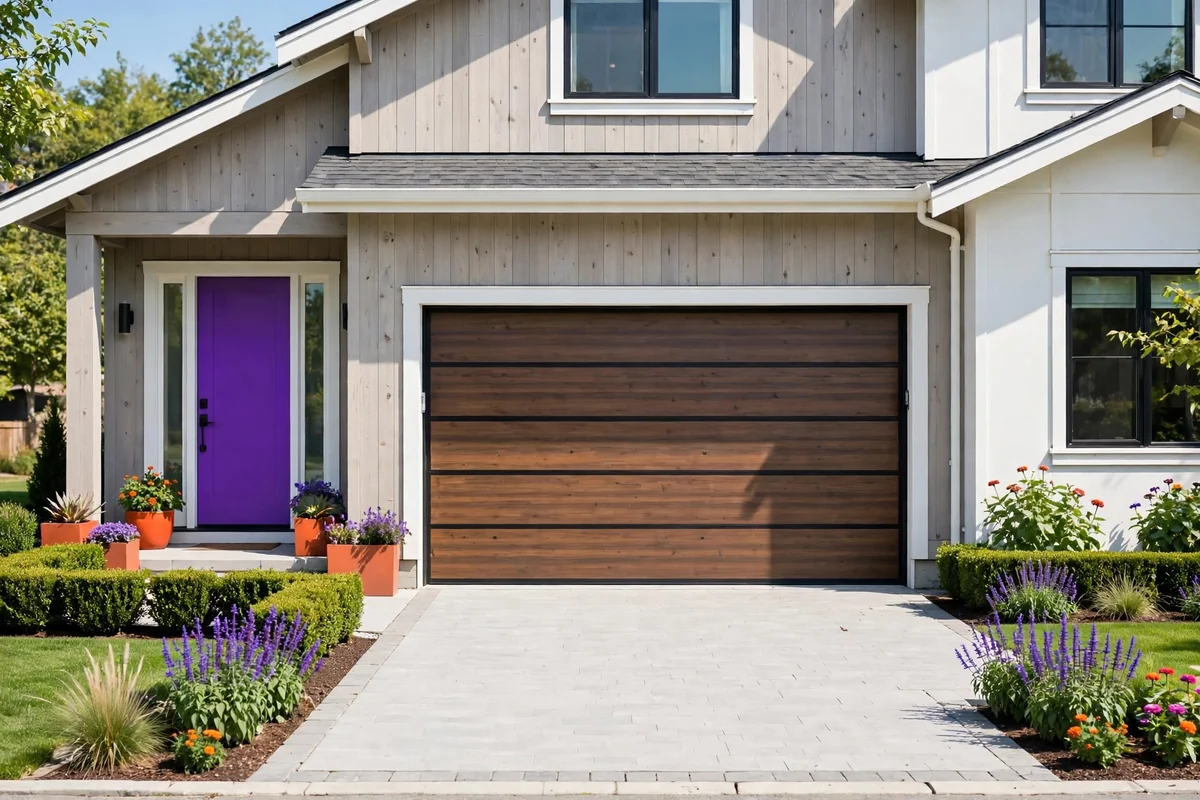
The garage door covers 30 to 40 percent of a home front facade (DASMA, Winter 2005, still the cited origin, with no newer measurement found). That share is why a new door changes the look of a house more than a new front door or new lights can, and why a wrong style shows up at once from the street.
- Door is 30 to 40 percent of the front facade (DASMA, 2005).
- No newer measurement of that share was found, so the 2005 figure is cited as the origin.
- A front-facing garage makes the share larger; a side garage makes it smaller.
- Colour, windows, and hardware all count, because the door is so large.
- Stand on the street and look at the whole front before you pick a style, not just at a sample in a showroom.
Small changes that lift the front of the house
You do not need the most costly door to lift the front of the house. A few small changes, picked to fit the house, can make a plain door look cared for, and they cost far less than a full premium door.
- Match the door colour to the trim, the front door, or the roof, not to the siding alone.
- Add windows to the top row or the sides for light and balance.
- Fit black handles and hinges on a carriage house door for a finished look.
- Keep the driveway and the area in front of the door clear and clean.
- Replace a dented or faded door before you spend on small extras, because no handle fixes a tired face.
6. How to Choose a Style for Your House
Choosing a style is easier when you work in order: house first, door second, colour and windows last. A style that suits a modern farmhouse can look wrong on a brick colonial, and a dark modern door can clash with a white picket front. The steps below keep the choice tied to the house you have, not to a photo you liked.
Match the style to the house
Each house style has a door style that fits it without a fight, and the match below is a safe starting point. Use it to narrow the choice to two or three doors, then pick between them on colour and price.
- Modern farmhouse: carriage house, wood-look walnut or cedar, black hardware.
- Modern or new build: flush panels, matte black or charcoal, side-stacked windows.
- Traditional or colonial: carriage house with a top row of windows, white or wood tone.
- Craftsman: carriage house or grooved steel, warm wood tone, square windows.
- Mid-century: flush panels, full-view glass, or a plain face with a long window row.
Choose in order
Work through these steps in order, and do not pick a colour before you have picked a style. Each step narrows the next one, so you end up with a door that fits the house and the budget, not just a colour you liked in a photo.
- Look at the house style and the roof line, and pick carriage house or modern.
- Pick the tier or build: grooved steel, overlay, composite faux wood, or glass.
- Pick the insulation level for an attached garage, and check the R-value.
- Pick the colour: matte black, charcoal, wood-look, white, or grey.
- Pick the windows: top row, side stack, frosted, or none.
- Price the exact door with a calculator, then get two or three written quotes for that same door.
What to ask for in a written quote
Get the quote in writing, set out line by line, before any work starts. A quote that names the door model, the insulation, and the hardware lets you compare two installers on the same door, while a quote that only says “new garage door” does not.
- Door model, size, colour, and window layout, named in full.
- Insulation type and R-value, in writing.
- Spring type and cycle rating, opener model if one is included, labour, and fees.
- Removal and disposal of the old door, and whether a permit is needed.
- Manufacturer warranty and workmanship warranty, in writing.
7. Carriage House Cost vs Plain Steel — Is the Premium Worth It?
A carriage house door costs more than a plain steel door of the same size, and the gap comes from the overlay, the finish, and the hardware. The question is not whether the premium is real, but whether it buys something you will see and use every day. For a front-facing garage, it often does; for a side garage you rarely see from the street, it often does not.
What the premium buys
The premium buys looks first, and build second. A Coachman double at $2,200 to $4,000 (GarageDoorLocator, 2026) costs more than a plain steel door, because the overlay and the finish take more work to build. A Canyon Ridge double at $2,800 to $5,500 (GarageDoorLocator, 2026) costs more again, because the composite faux-wood build and the higher R-value cost more to make.
- A deeper face with raised boards and trim, not just grooves in steel.
- A wood look without the upkeep of real wood.
- Higher insulation on the premium tier: Canyon Ridge R up to 20.4 (DoorServPro from Clopay 2026 literature, 5 July 2026).
- Black hardware and window layouts that plain steel doors do not offer.
- A front that fits a farmhouse or traditional house, where plain steel can look bare.
For scale, a typical new door installed costs $754 to $1,707, average $1,231 (Angi, 21 September 2026, 15,434 verified projects), while steel doors run $650 to $3,200 installed (Angi, 21 September 2026). Carriage house doubles sit above that average, because they are larger doors with a premium face.
When the premium is worth it
The premium is worth it when the door is the face of the house, when you plan to sell soon, or when the old door is tired and the new one will be seen every day. It is harder to justify when the garage faces away from the street, when the house is plain and modern, or when the budget would be better spent on insulation or a sound opener. Work out the payback for your own door with our Garage Door ROI Calculator, and read the full return figures in our guide to garage door replacement ROI. Note that the 267.7 percent national return in that guide is for one defined insulated steel door, not for carriage house doors in particular, so do not read it as a carriage house return.
- Worth it: front-facing garage, farmhouse or traditional house, selling soon.
- Worth it: old door is dented, faded, or out of line with the house style.
- Not worth it: side garage rarely seen from the street.
- Not worth it: budget is tight and insulation or a sound opener matters more.
- Not worth it: house is plain and modern, where a flush panel fits better.
Video: Carriage House and Modern Garage Door Styles 2026 (Coming Soon)
A 60 to 120 second video for this guide is coming soon. It will cover the three Clopay carriage house tiers, the modern flush and glass styles, the 2026 colours and side-stacked windows, and how to pick a style for your house. No video is embedded here yet.
Garage Door Hub connects homeowners with trusted local garage door pros. Need a repair? Need a replacement? Start here. First, find out what it should cost. Then, price your exact job with our free calculator. Next, find a pro near you. Fast. No jargon. No guesswork. No surprise bills. Just clear prices, honest guides, and a local pro you can call today.
Carriage House and Modern Garage Door Styles — Frequently Asked Questions
What is a carriage house garage door?
A carriage house garage door looks like a pair of old swing-out barn doors, with vertical boards, cross buck framing, and black handles and hinges, but it lifts up in sections on a track like a normal modern door.
How much does a carriage house garage door cost?
An installed double Coachman door costs $2,200 to $4,000, and an installed double Canyon Ridge door costs $2,800 to $5,500 (GarageDoorLocator, 2026). No installed double-door price was sourced for the budget Gallery tier.
Which is better, Coachman or Canyon Ridge?
Canyon Ridge is the premium tier, with a 4 to 5-layer composite faux-wood build and R up to 20.4, while Coachman is a steel door with a composite overlay at a lower price. Pick Canyon Ridge for the closest wood look, and Coachman for the same style at a mid-range price.
Do black garage doors increase curb appeal?
Matte black and charcoal are the leading 2026 colours, and a black door can sharpen a white or light house front. The gain comes from the whole front matching, so pair a black door with black trim, lights, and window frames.
Which garage door style suits a modern farmhouse?
A carriage house door in a wood-look walnut or cedar finish, with black handles and hinges, suits a modern farmhouse best. A flush modern door can look bare against farmhouse trim and a pitched roof.
Are carriage house garage doors worth the premium?
Yes, when the garage faces the street, the house is a farmhouse or traditional style, or you plan to sell soon. They are harder to justify for a side garage rarely seen from the street, or when the budget is better spent on insulation or a sound opener.
Is faux wood better than real wood for a garage door?
Faux wood is better for most homes, because it gives the wood look without sanding and refinishing, and it will not rot or warp like real wood. Real wood suits a high-end traditional home where the owner accepts the upkeep.