

Seaside Garage Door Experts puts most garage door repairs at $110 to $680 in 2026, and a full new door at $1,180 to $7,280.
That spread decides whether a claim pays. A repair under your deductible is cheaper to pay yourself than to file.
This guide shows what insurance covers, what warranties cover, and how to claim. It is general guidance, not advice on your own policy.
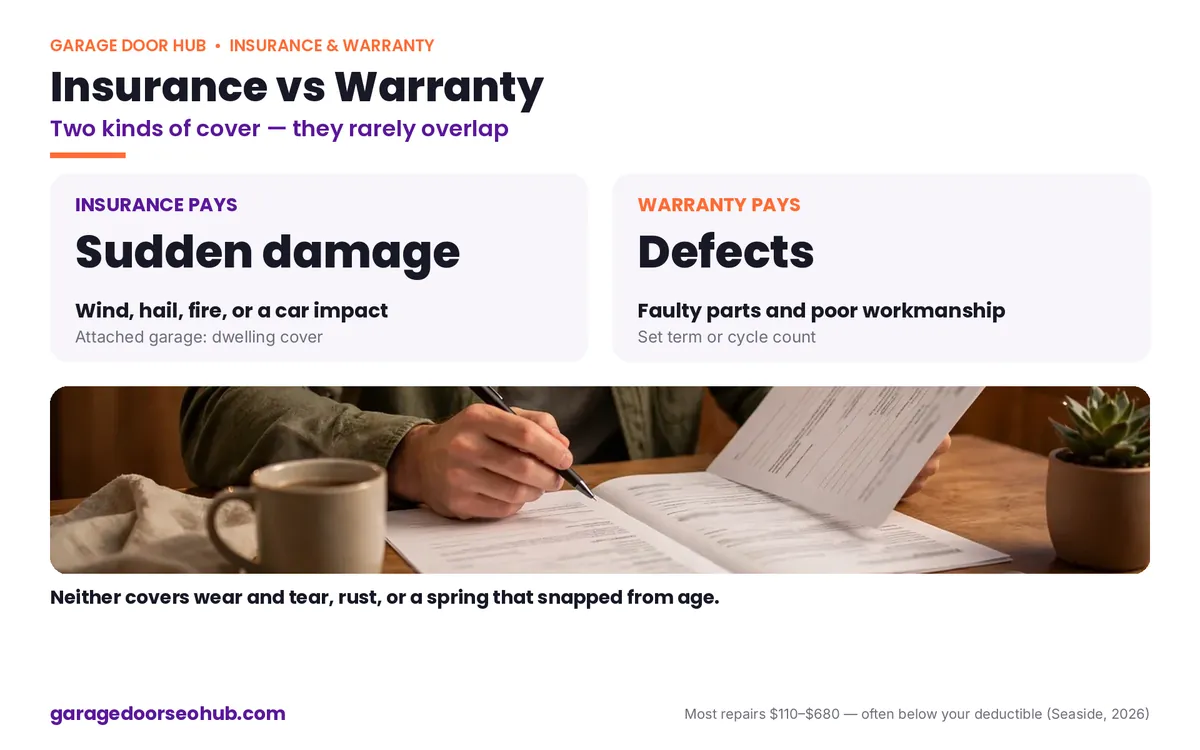
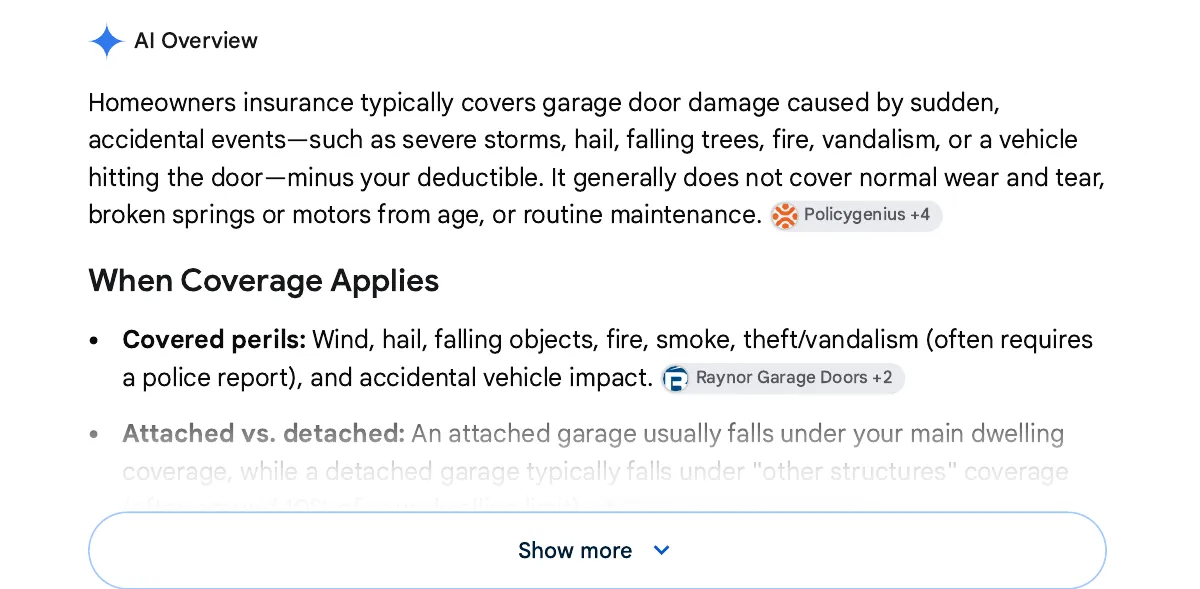
Homeowners insurance covers garage door damage from a covered peril, like wind, hail, fire, or a car impact, but it does not cover wear and tear, rust, or a spring that snapped from age (Seaside Garage Door Experts, 7 Nov 2026). Warranties cover defects in parts and workmanship, not accidents or weather. Check your deductible first, since most repairs cost $110 to $680 and often fall below it.
Garage Door Hub connects you with a trusted local pro. Get a clear price for your garage door repair or replacement first.
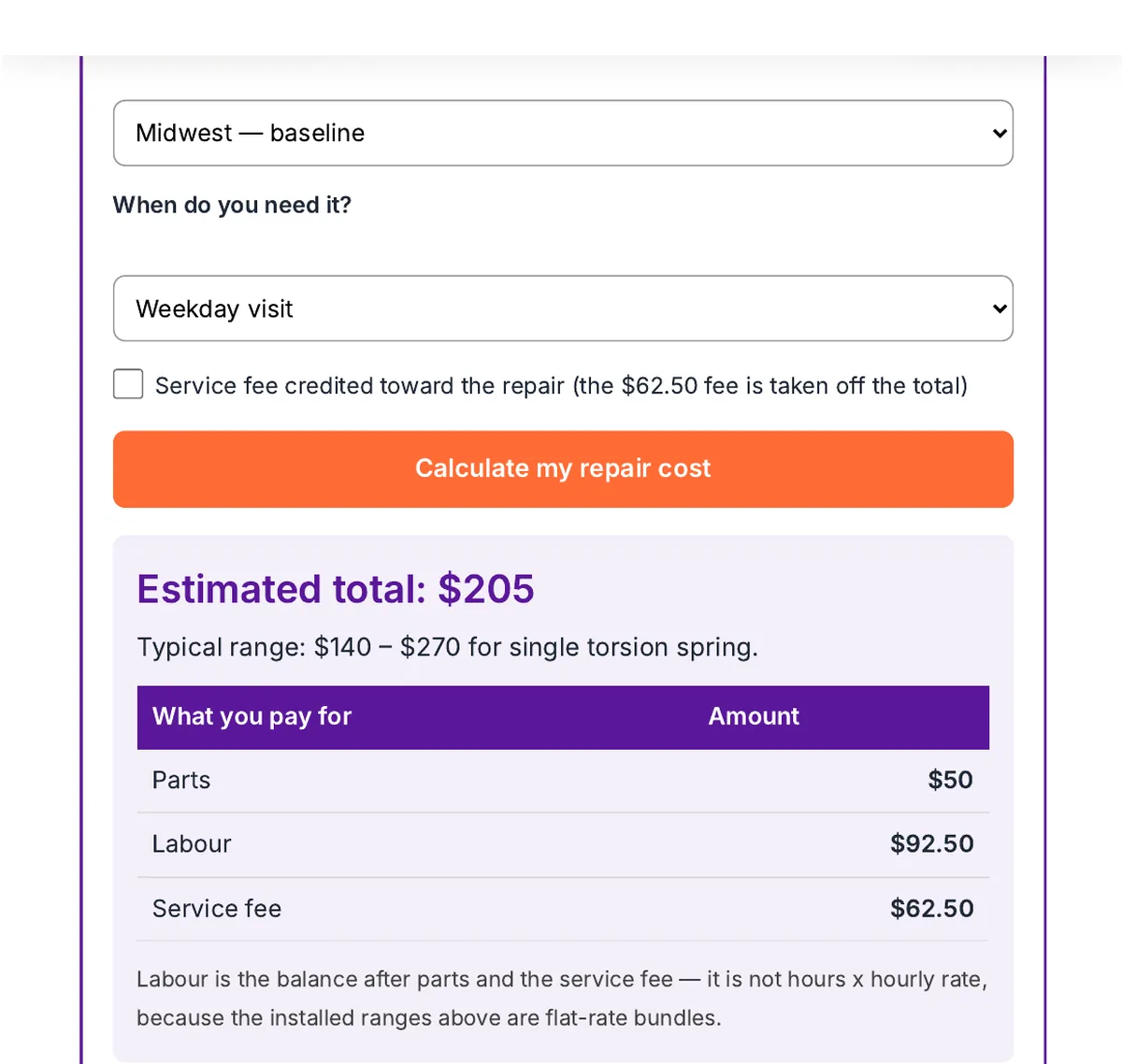
Price your job first with the free calculators below. They give you a number before you call anyone.
Repair Cost Calculator — price the repair before you decide whether to claim
Door Cost Calculator — price a full replacement if the damage is past repair
Replacement Cost Calculator — compare repair against replacement for a claim
- Enter your door size and the part that failed.
- Note the price, then read the key takeaways and Section 1.
- Use the price in the cost table to check any quote you get.
Key takeaways
- Insurance pays for sudden damage, not for parts that wore out.
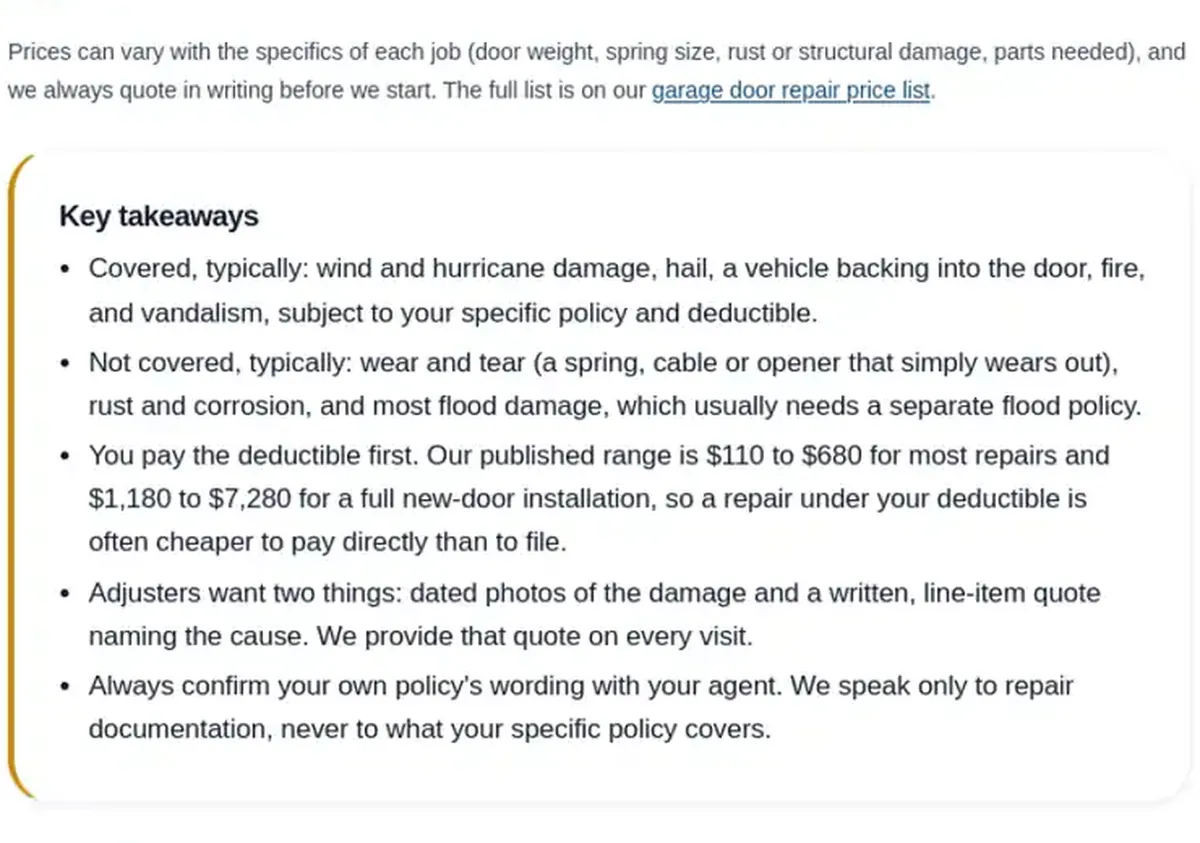
- Most repairs cost $110 to $680, often below a typical deductible.
- Warranties cover defects, not accidents, weather, or poor maintenance.
- Attached garages sit under dwelling cover; detached garages sit under other structures.
- Photos, receipts, and a written quote make or break a claim.
Table of Contents
-
1. How garage door insurance works
-
2. What insurance covers: sudden damage
-
3. What insurance does not cover: wear and age
-
4. What a garage door warranty covers
-
5. Warranty vs insurance: which one pays
-
6. How to claim: six steps in order
- Watch: What a garage door warranty really covers
- FAQ
1. How garage door insurance works
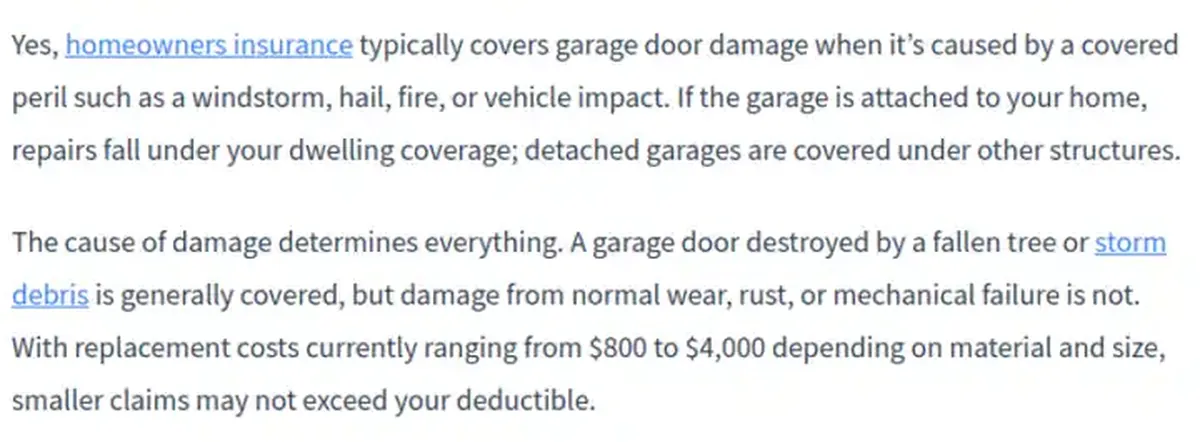
Homeowners insurance treats your garage door as part of your home’s structure. An attached garage sits under dwelling cover, and a detached garage sits under other structures.
The cause of damage decides everything. The same cracked panel is a covered claim if a tree limb hit it, and an out-of-pocket repair if it rotted with age.
For the full cost picture, see the garage door costs guide. It prices every part, from a seal to a full door, in one table.
Attached vs detached garages
An attached garage is covered under your dwelling coverage, since it is part of the house. A detached garage is covered under other structures, with its own limit.
Check how your garage is listed. The limit for other structures is often lower than the dwelling limit.
- Attached garage: dwelling coverage, same limit as the house.
- Detached garage: other structures, often a lower limit.
- Check your policy for the exact limit on each part.
- Ask your agent if the wording is unclear; do not guess.
The deductible math
You pay the deductible first, and the insurer pays the rest. Most repairs cost $110 to $680, so a repair under your deductible is cheaper to pay directly.
A full new door costs $1,180 to $7,280 (Seaside Garage Door Experts, 7 Nov 2026). That is where a claim usually starts to pay.
- Most repairs: $110 to $680 (Seaside, 7 Nov 2026).
- Full new door: $1,180 to $7,280 (Seaside, 7 Nov 2026).
- Get the written quote first, then decide whether to claim.
- A small claim can raise your premium, so weigh it twice.
2. What insurance covers: sudden damage
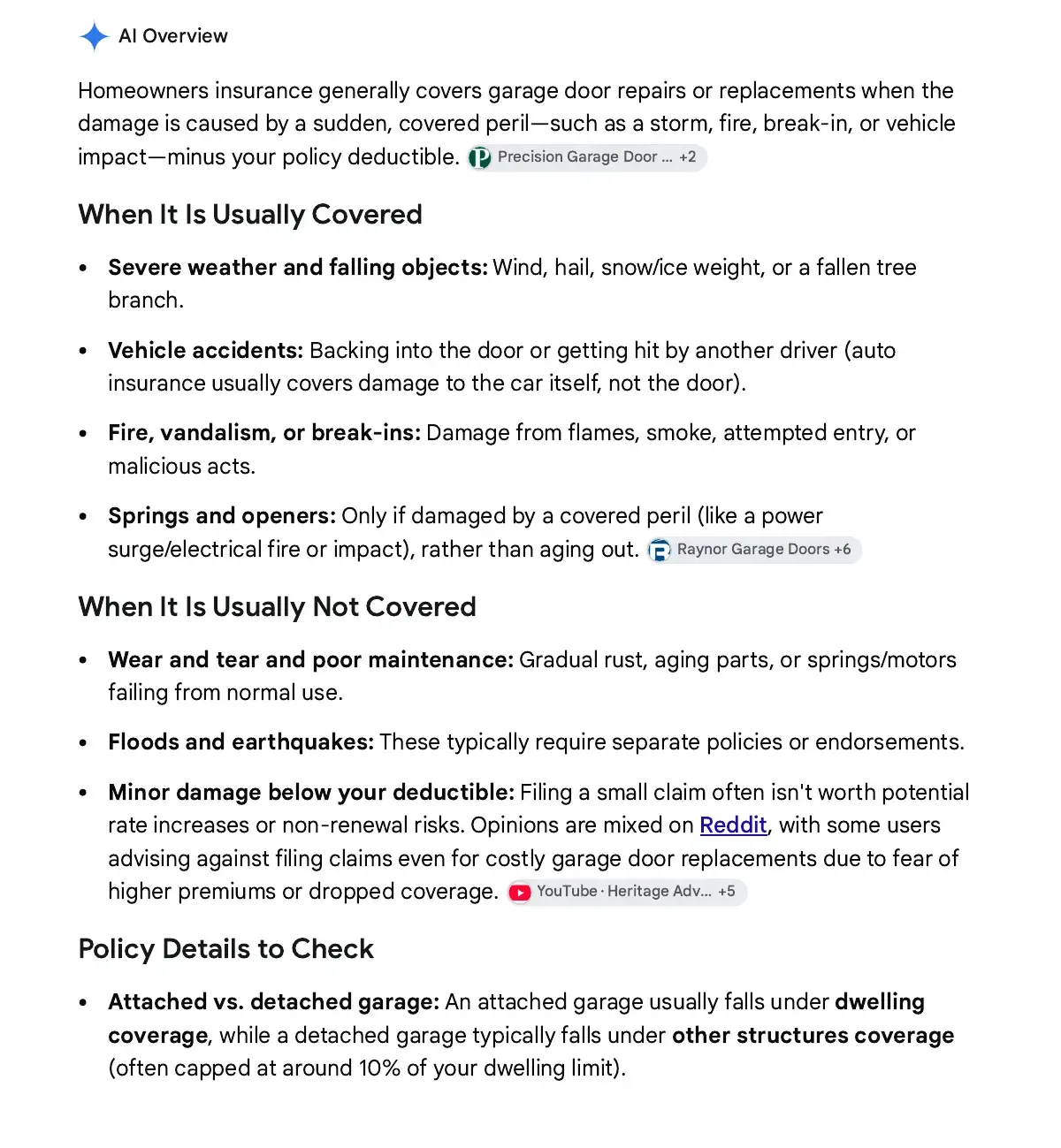
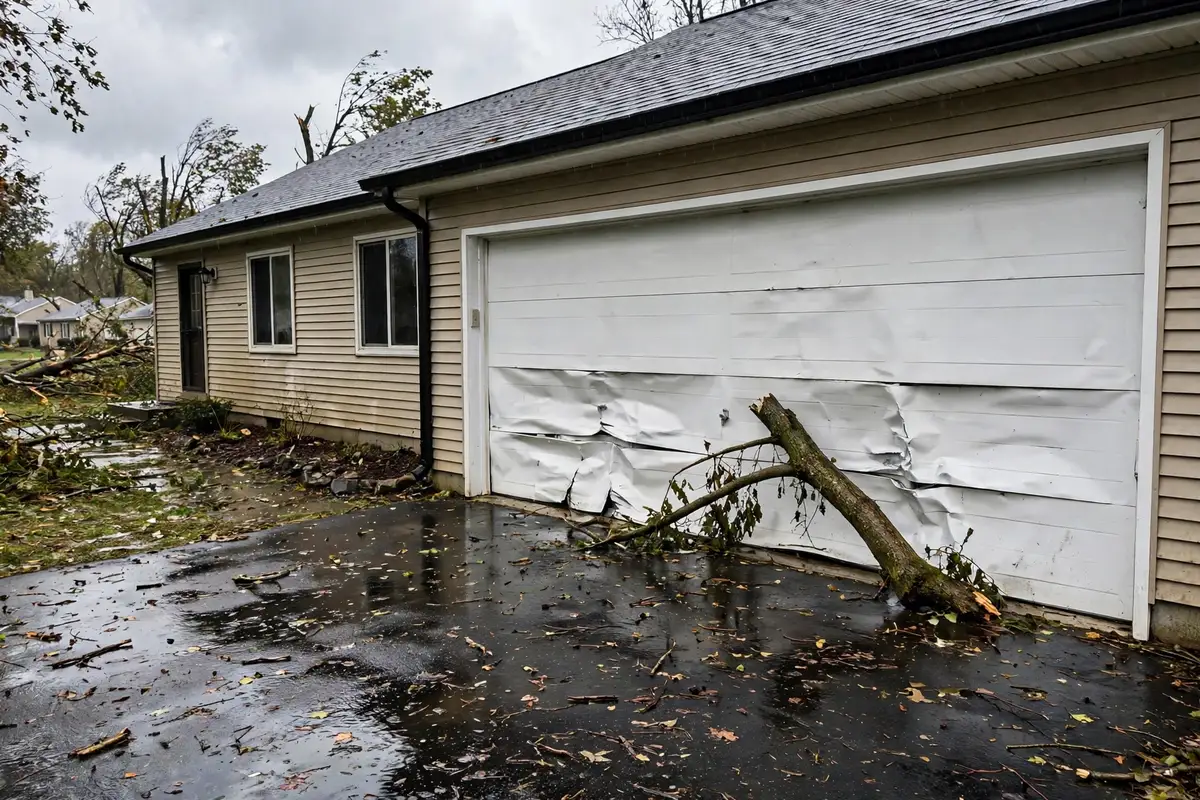
Insurance pays for sudden, accidental damage from a covered peril. Wind, hail, fire, vandalism, and vehicle impact are the common ones.
Each policy lists its own perils. Read your policy, and ask your agent before you assume a cause is covered.
Covered perils
Wind and hail damage panels, springs, and openers in one storm. A fallen tree or flying debris counts as a covered event too.
Fire, lightning, and vandalism are covered on most standard policies. A car hitting the door is covered, often through auto insurance first.
- Wind, hail, and storm debris.
- Fallen tree or limb on the door.
- Fire, lightning, and vandalism.
- Vehicle impact, often through auto cover first.
- Break-in damage to the door or opener.
Flood and storm surge
Standard homeowners policies exclude flood, including storm surge. Flood cover is usually a separate policy.
In Florida, hurricane damage also carries a separate hurricane deductible, often 2, 5, or 10 percent of the dwelling limit.
- Flood is excluded from standard homeowners policies.
- Storm surge counts as flood, not wind, in most policies.
- Florida hurricane deductibles are often a percentage, not a flat sum.
- Ask your agent which policy applies before you file.
3. What insurance does not cover: wear and age
Insurance is meant for sudden loss, not for parts wearing out. Wear and tear, rust, and mechanical breakdown are excluded on most policies.
The biggest mistake is assuming insurance will cover a spring that snapped from age. It will not.
Wear and tear
A torsion spring is built for a set number of cycles and is expected to wear out. A spring that breaks on its own is wear and tear.
The same goes for an opener that quits after years of use, and for cables that fray from age.
- Spring snapped from age: not covered.
- Opener motor burned out after 12 years: not covered.
- Rust, corrosion, and rot: not covered.
- Poor maintenance and neglect: not covered.
Mechanical breakdown and neglect
Mechanical breakdown from age is excluded, even when the part fails without warning. A door that stops working because it was never serviced is neglect.
The exception is a part broken by a covered event. A spring broken by a car hitting the door is part of that claim.
- Breakdown from age: excluded.
- Damage from lack of maintenance: excluded.
- Part broken by a covered event: part of that claim.
- Keep service records; they prove the door was maintained.

4. What a garage door warranty covers
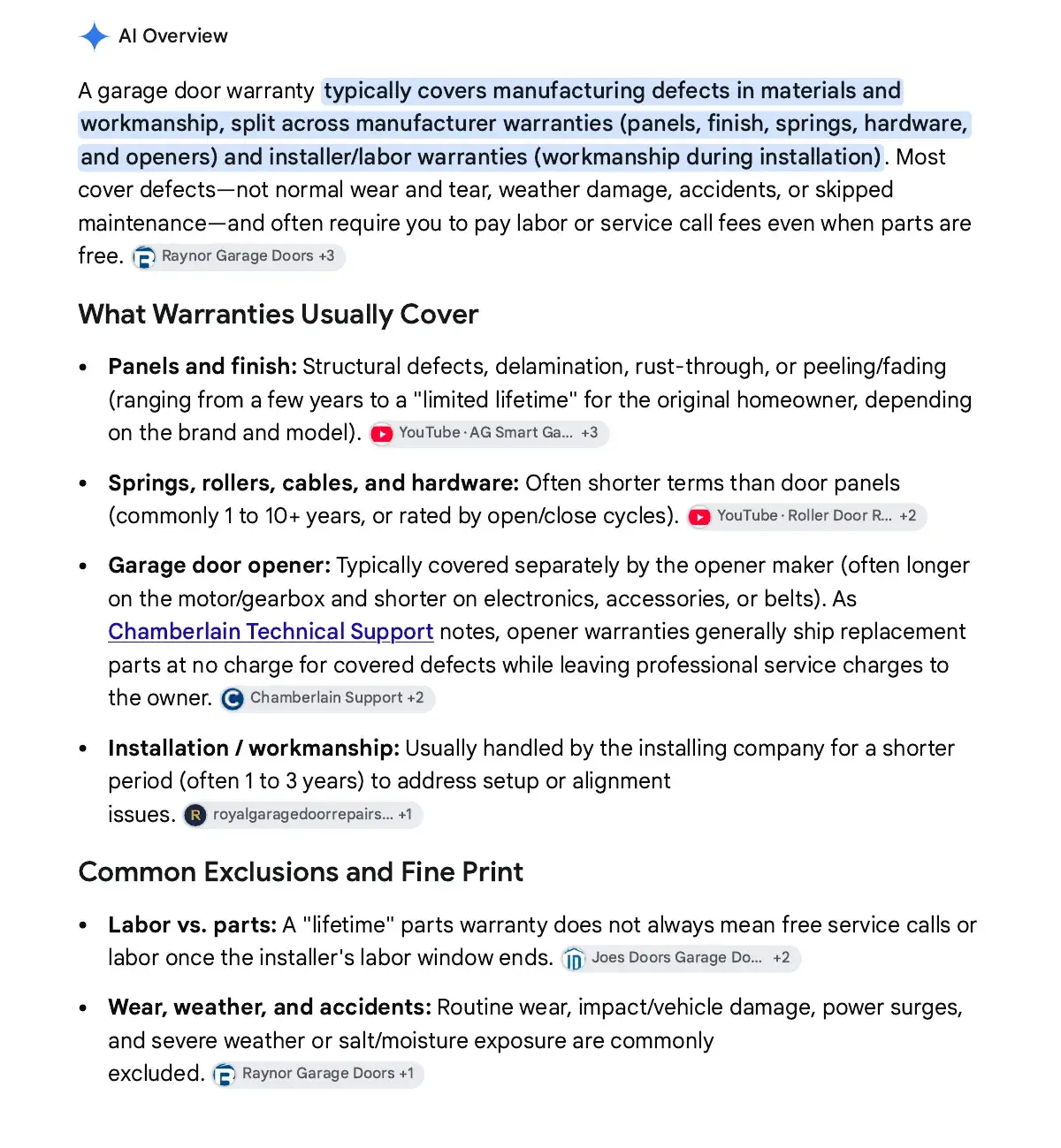
A warranty is a maker or installer promise that specific parts will perform for a set period, under normal use and proper maintenance.
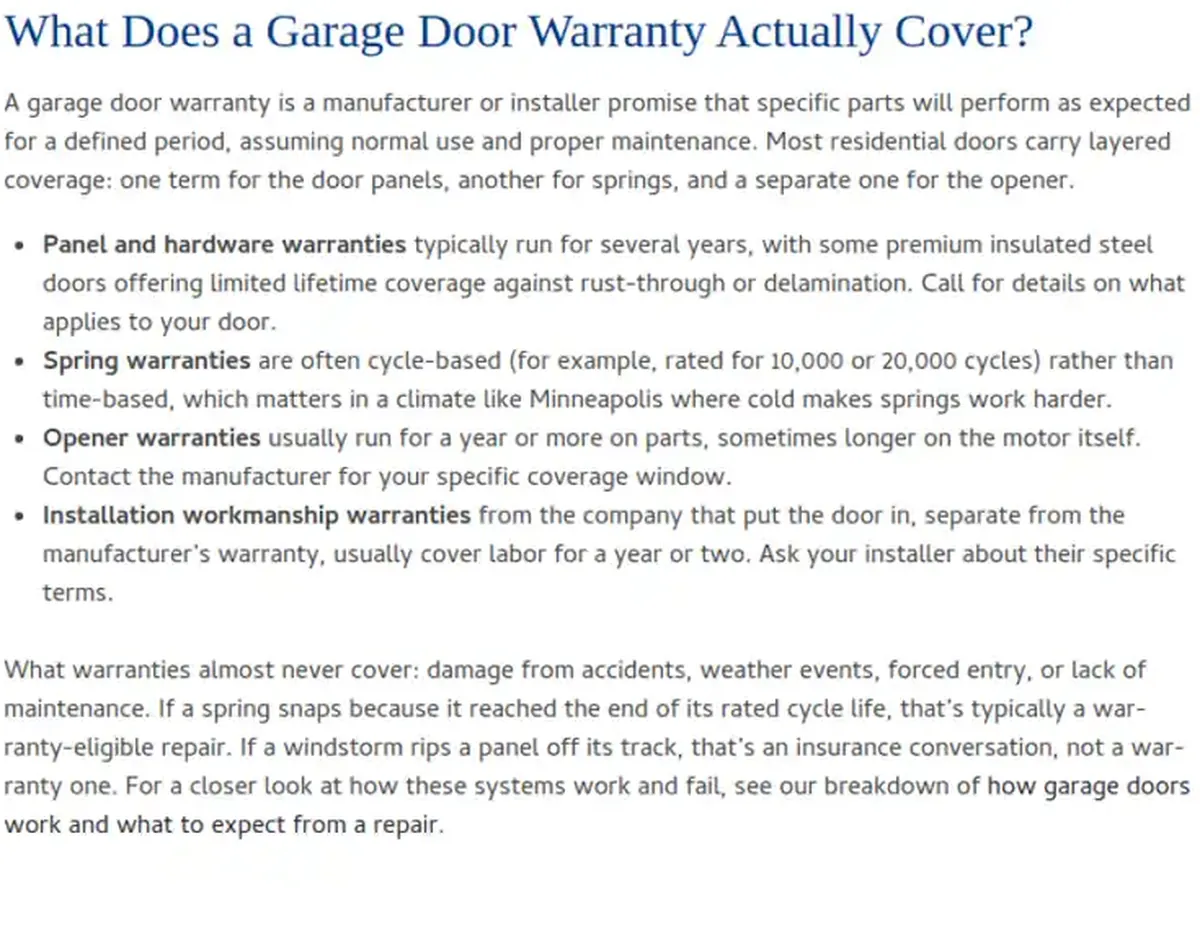
Most doors carry layered cover: one term for panels, another for springs, and a separate one for the opener.
Manufacturer warranty
Panel and hardware warranties run for several years, with some premium insulated steel doors offering limited lifetime cover against rust-through or delamination.
Spring warranties are often cycle-based, for 10,000 or 20,000 cycles, rather than time-based. Opener warranties run a year or more on parts, longer on the motor.
- Panels: several years, some lifetime against rust-through.
- Springs: often 10,000 or 20,000 cycles, not years.
- Opener: a year or more on parts, longer on the motor.
- Warranties cover defects, not accidents or weather.
Workmanship warranty
The installer warranties the fitting, not the parts. A door that sags because it was fitted out of true is a workmanship claim.
Workmanship cover usually runs one to two years. Get it in writing, with the term and the exclusions named.
- Covers fitting faults, not part defects.
- Usually one to two years, in writing.
- Ask who pays labor if a part fails under warranty.
- Keep the install receipt and the warranty card together.
5. Warranty vs insurance: which one pays
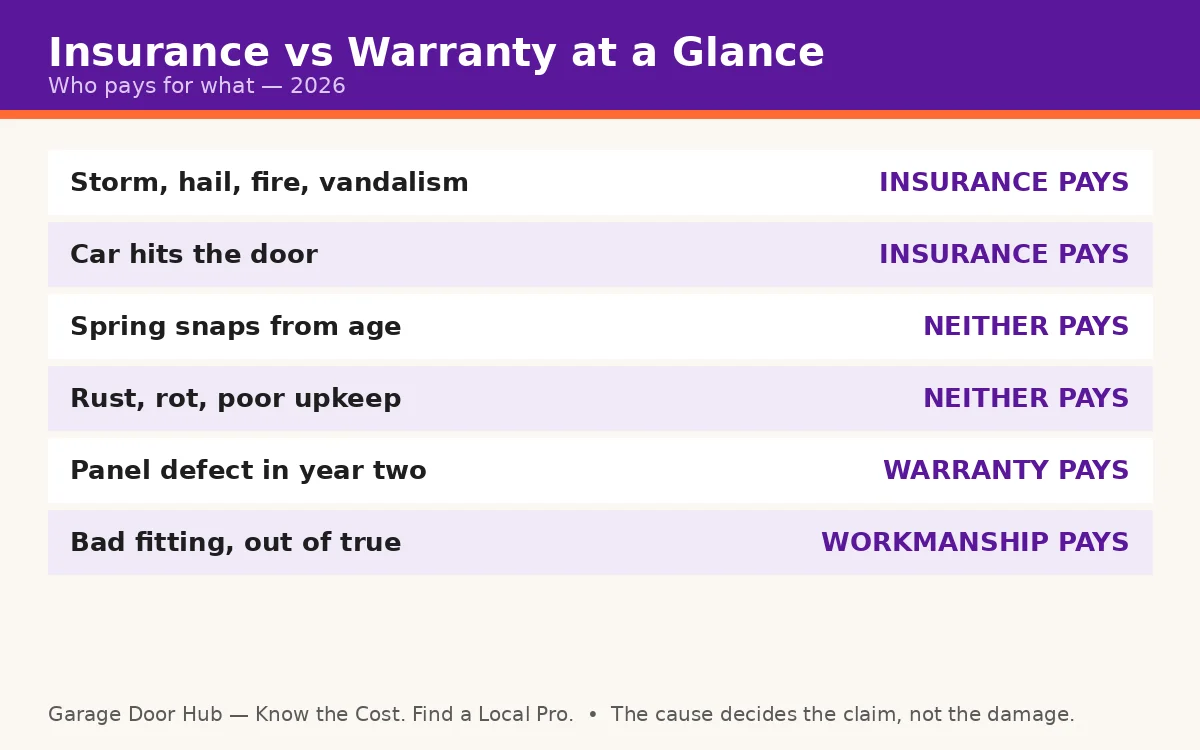
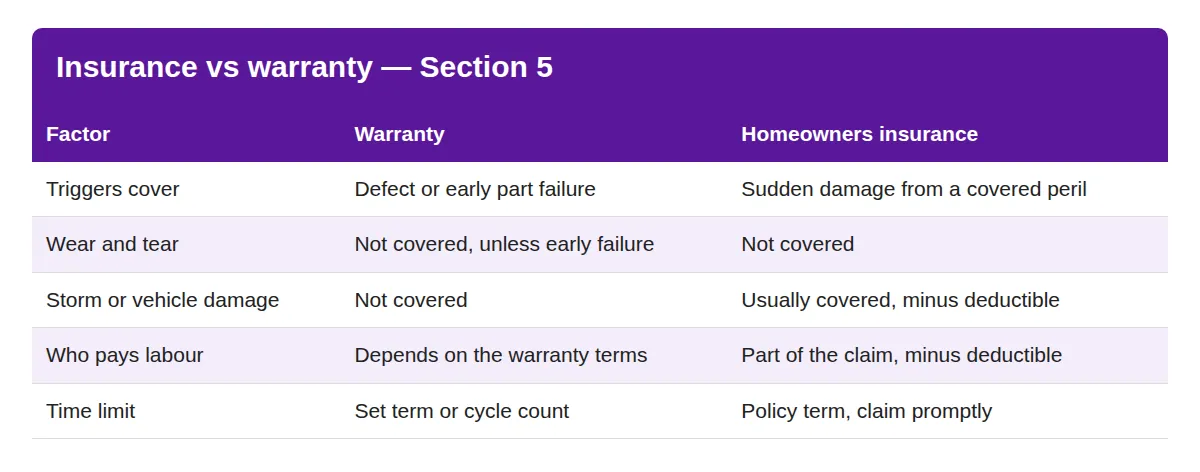
Warranty and insurance cover different things, and they rarely overlap. A defect is a warranty claim, and sudden damage is an insurance claim.
This table puts them side by side. Find your cause, then follow the right route.
| Factor | Warranty | Homeowners insurance |
|---|---|---|
| Triggers cover | Defect or early part failure | Sudden damage from a covered peril |
| Wear and tear | Not covered, unless early failure | Not covered |
| Storm or vehicle damage | Not covered | Usually covered, minus deductible |
| Who pays labor | Depends on the warranty terms | Part of the claim, minus deductible |
| Time limit | Set term or cycle count | Policy term, claim promptly |
Which route to take
A panel that delaminates in year two is a warranty claim. A panel crushed by a car is an insurance claim.
When both could apply, start with the warranty. It costs nothing to ask, and it leaves your claims record clean.
- Defect under normal use: warranty first.
- Sudden damage from a peril: insurance first.
- Both could apply: ask the warranty holder first.
- Never file two claims for the same damage.
Home warranties are different
A home warranty is a service contract, not insurance. Plans that include garage doors usually cover opener and spring parts that fail from normal use.
They do not cover panels or tracks. Read the plan before you buy it, and check the service fee per visit.
- Home warranty: a service contract, not insurance.
- Covers opener and spring parts that fail from normal use.
- Does not cover panels or tracks.
- Check the service fee and the cover cap per visit.
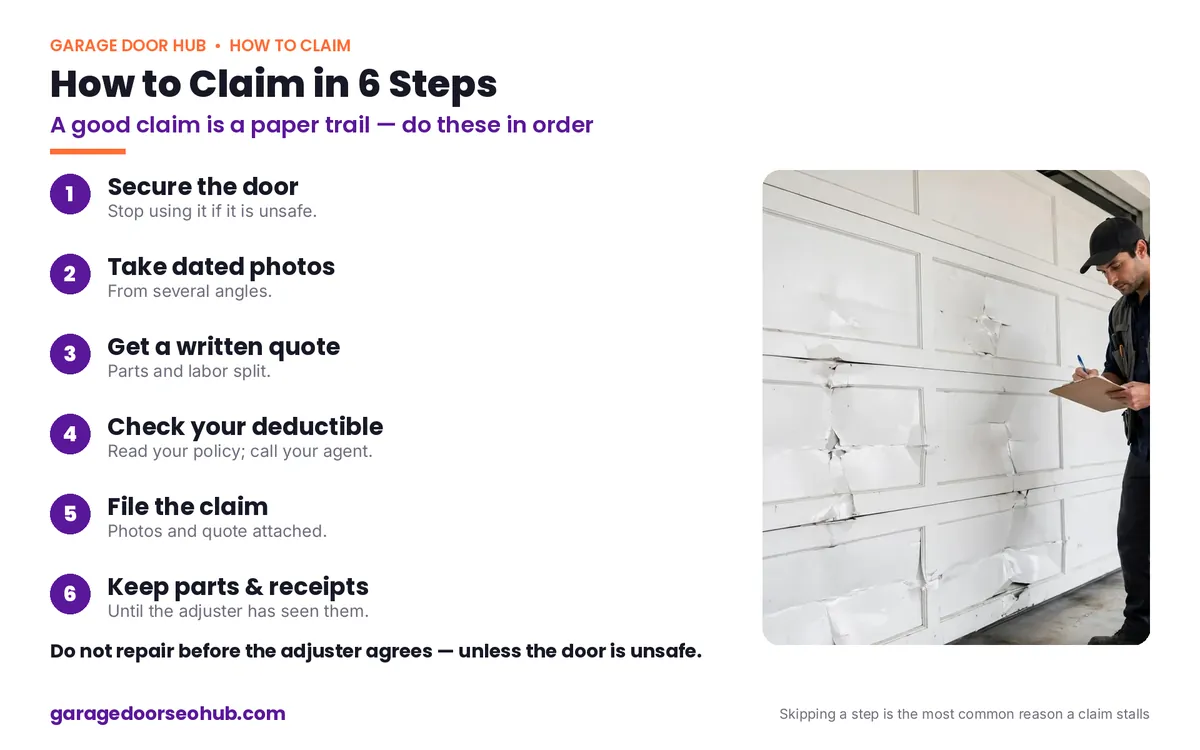
6. How to claim: six steps in order
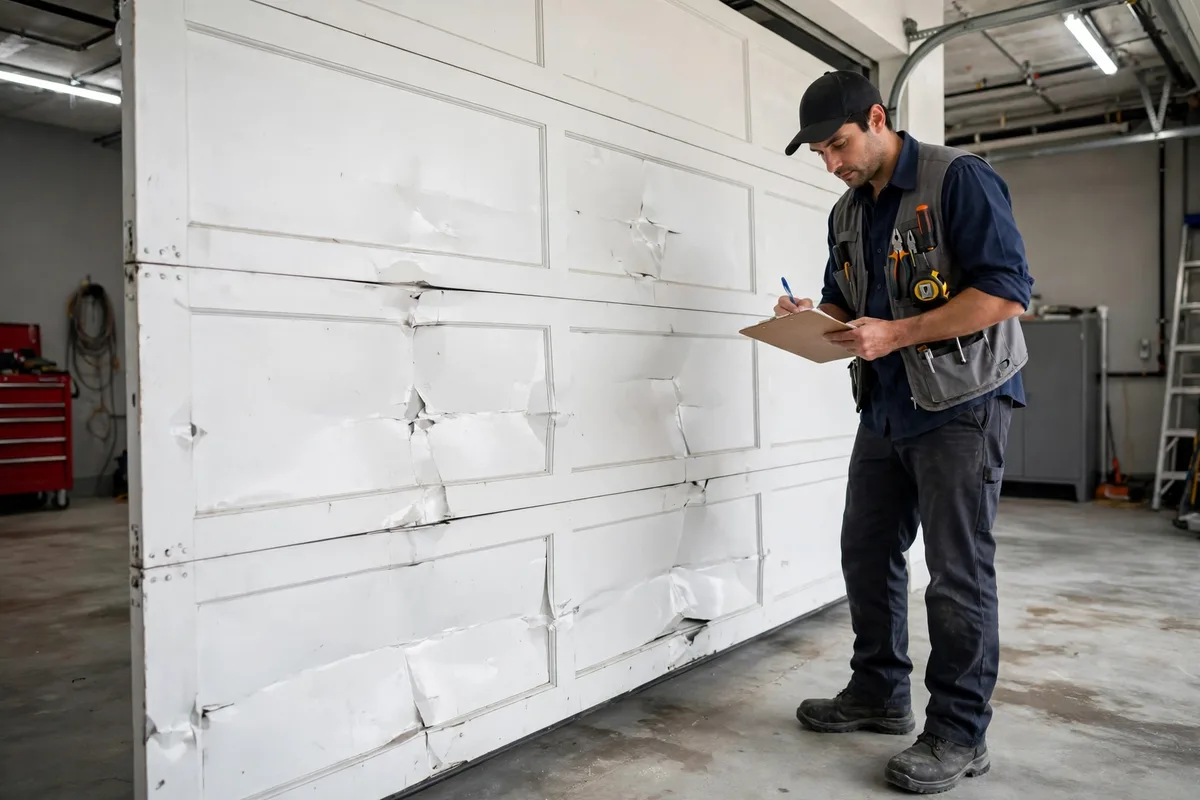
A good claim is a paper trail. Photos, a written quote, and prompt filing turn a maybe into a yes.
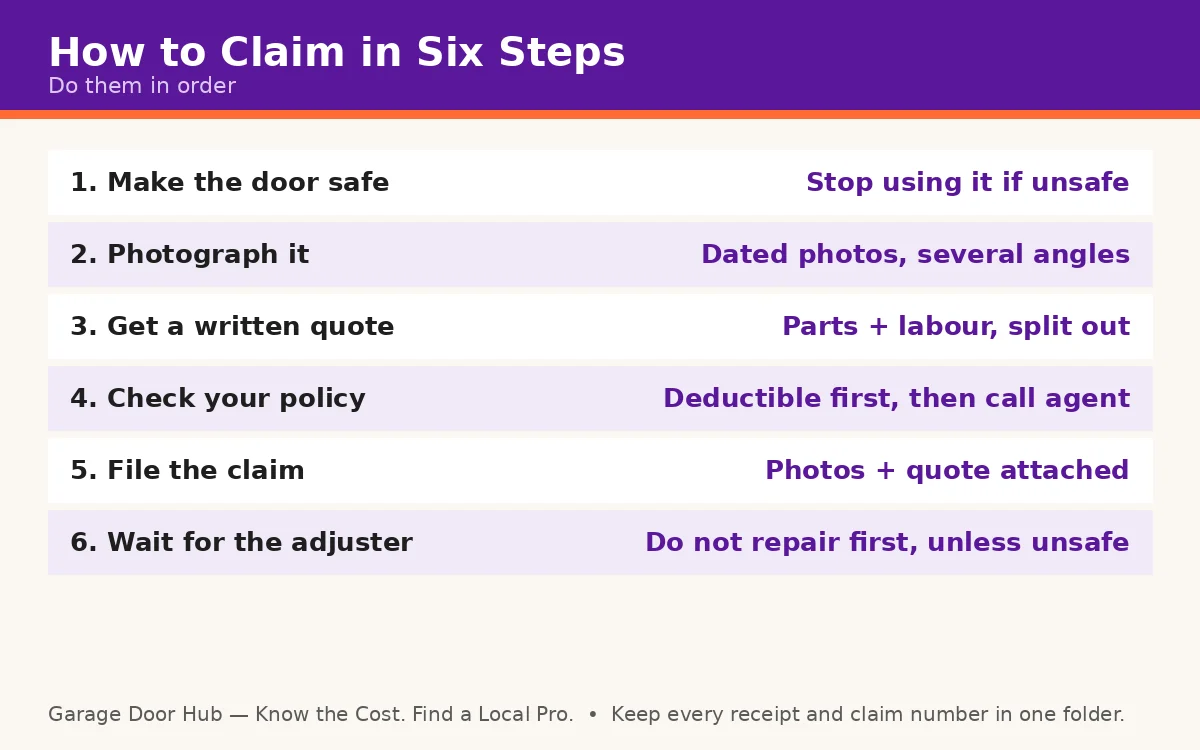
Do these steps in order. Skipping one is the most common reason a claim stalls.
The steps, in order
Work through these steps in order, and keep a copy of everything. The insurer may send an adjuster, or it may settle on your photos and quote.
- Stop using the door if it is unsafe, and make it secure.
- Take dated photos of the damage, from several angles.
- Get a written quote from a local pro, parts and labor split.
- Read your policy, check your deductible, and call your agent.
- File the claim with the photos and quote attached.
- Do not repair before the adjuster agrees, unless the door is unsafe.
- Keep the broken parts until the adjuster has seen them.
- Note the date, time, and cause of the damage.
- Keep every receipt, email, and claim number in one folder.
If the claim is denied
A denial is not the end. Ask for the denial in writing, with the policy clause it relies on.
Check the clause against your policy. If the cause was a covered peril, appeal with your photos and the pro’s written report.
- Ask for the denial in writing, with the clause cited.
- Check the clause against your own policy wording.
- Appeal with photos and a written report from your pro.
- Your agent can help; a public adjuster is a last resort.
Watch: What a garage door warranty really covers
A1 Garage Door Service’s Garage Authority Podcast breaks down garage door warranties on YouTube, from part and labor warranties to what “lifetime warranty” really means.
- Homeowners insurance covers sudden damage like wind, hail, fire or a car impact — not wear and tear, rust or a spring that snapped from age.
- Warranties cover defects in parts and workmanship, not accidents or weather.
- Check your deductible first, since most repairs cost $110 to $680 and often fall below it.
Video: A1 Garage Door Service, YouTube. Checked 21 November 2026.
Garage Door Hub connects homeowners with trusted local garage door pros. Need a repair? Need a replacement? Start here. First, find out what it should cost. Then, price your exact job with our free calculator. Next, find a pro near you. Fast. No jargon. No guesswork. No surprise bills. Just clear prices, honest guides, and a local pro you can call today.
FAQ
Does homeowners insurance cover a broken garage door spring?
Usually not. A spring is built for a set number of cycles and is expected to wear out, so a spring that breaks on its own is wear and tear. The exception is a spring broken by a covered event, like a car hitting the door.
Will homeowners insurance pay for a new garage door?
It can, when a covered event damaged the door past repair. The policy pays for a replacement of like kind, minus your deductible. A full new door costs $1,180 to $7,280 (Seaside Garage Door Experts, 7 Nov 2026).
Does a home warranty cover a garage door?
A home warranty is a separate service contract, not insurance. Plans that include garage doors usually cover opener and spring parts that fail from normal use, but not door panels or tracks.
What does a garage door warranty cover?
A manufacturer warranty covers defects in parts under normal use: panels for several years, springs for 10,000 or 20,000 cycles, and openers for a year or more on parts. It does not cover accidents, weather, or poor maintenance.
Should I file an insurance claim for a garage door repair?
Only if the repair costs well above your deductible. Most repairs run $110 to $680 (Seaside Garage Door Experts, 7 Nov 2026), often below a typical deductible. Get a written quote first, then decide.
Sources
- Seaside Garage Door Experts, does homeowners insurance cover garage door damage, updated 7 Nov 2026 — covered vs not covered, repairs $110–$680, new door $1,180–$7,280. Checked 20 Nov 2026.
- Insuranceopedia, does homeowners insurance cover garage doors, 2026 — attached vs detached, covered perils, deductible math. Checked 20 Nov 2026.
- Sam Garage Services, garage door warranty and insurance coverage, 12 Nov 2026 — warranty layers, warranty vs insurance table, home warranty note. Checked 20 Nov 2026.
- Fix Master 96, does homeowners insurance cover garage door, 2026 — covered perils, flood exclusion, Florida hurricane deductibles. Checked 20 Nov 2026.
Last reviewed: 20 November 2026
Appendix — Related topics
You might have found this by these keywords — and if not, others might have: garage door insurance claim, garage door warranty, does homeowners insurance cover garage door, does home insurance cover garage door repair, garage door warranty coverage, garage door damage insurance claim, how long does a garage door warranty last.