

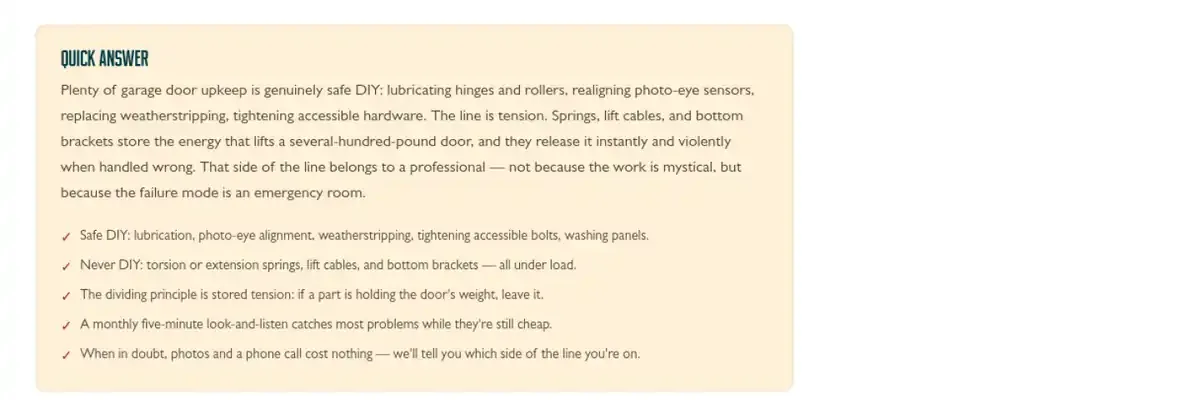
Door Serv Pro puts the line in one sentence: the line is tension. Springs, cables and bottom brackets store the energy that lifts a several-hundred-pound door.
GarageDoorLocator says the same thing with a question: does this part hold tension, or hold the door’s weight? If yes, call a pro. If no, you can likely do it yourself.
This guide draws that line in one place, job by job, with costs, so you never have to guess which side you are on.
Garage door DIY is safe for lubrication, sensor cleaning and alignment, remote batteries, tightening bolts, and washing panels. Springs, cables, bottom brackets, track realignment and bent panels are pro-only work. A torsion spring holds 150 to 200 foot-pounds of torque, and a failed DIY spring job costs 3 to 5 times more to fix (Door Serv Pro, 2026).
Garage Door Hub connects you with a trusted local pro. Get a clear price for your garage door repair or replacement first.
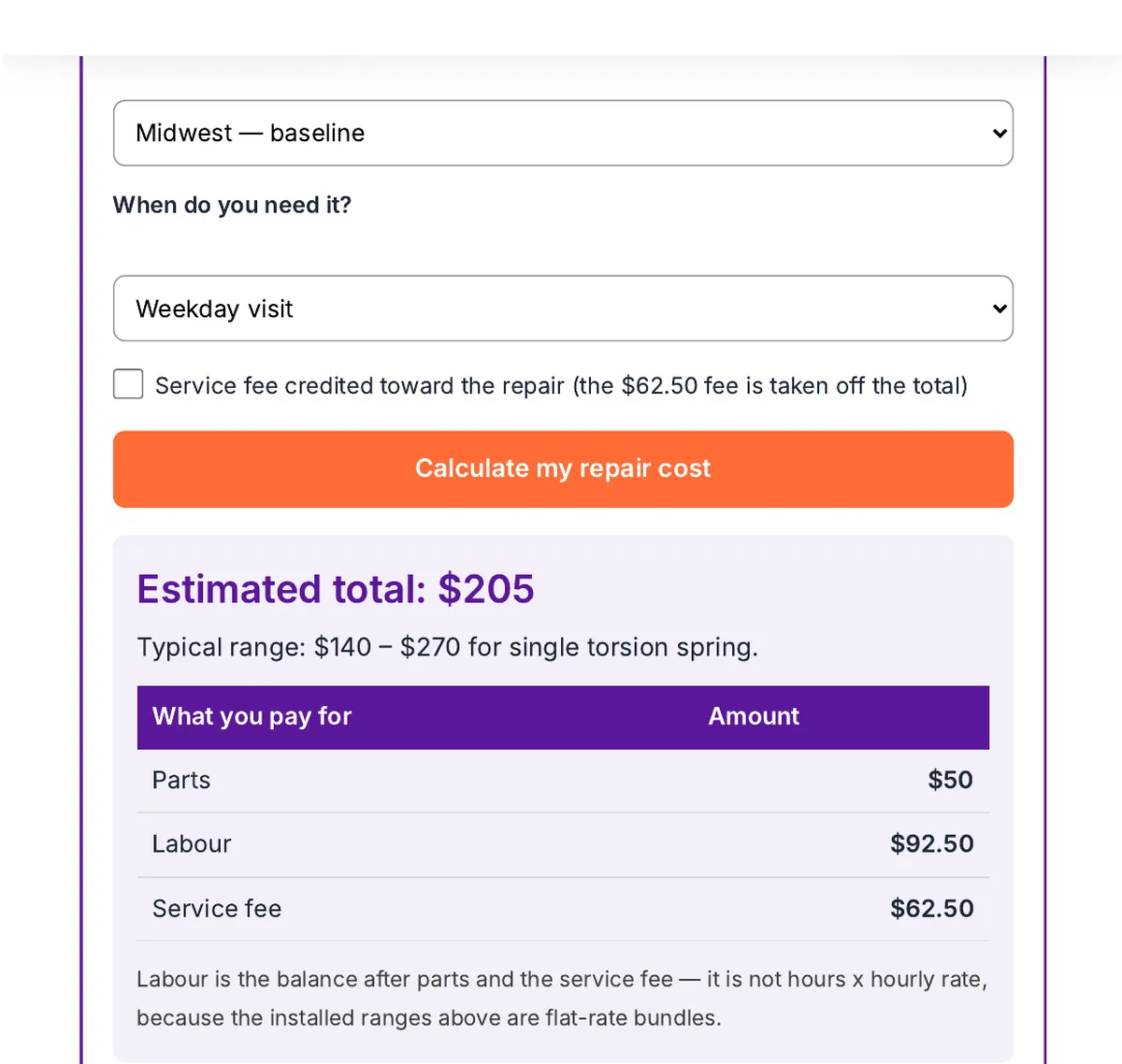
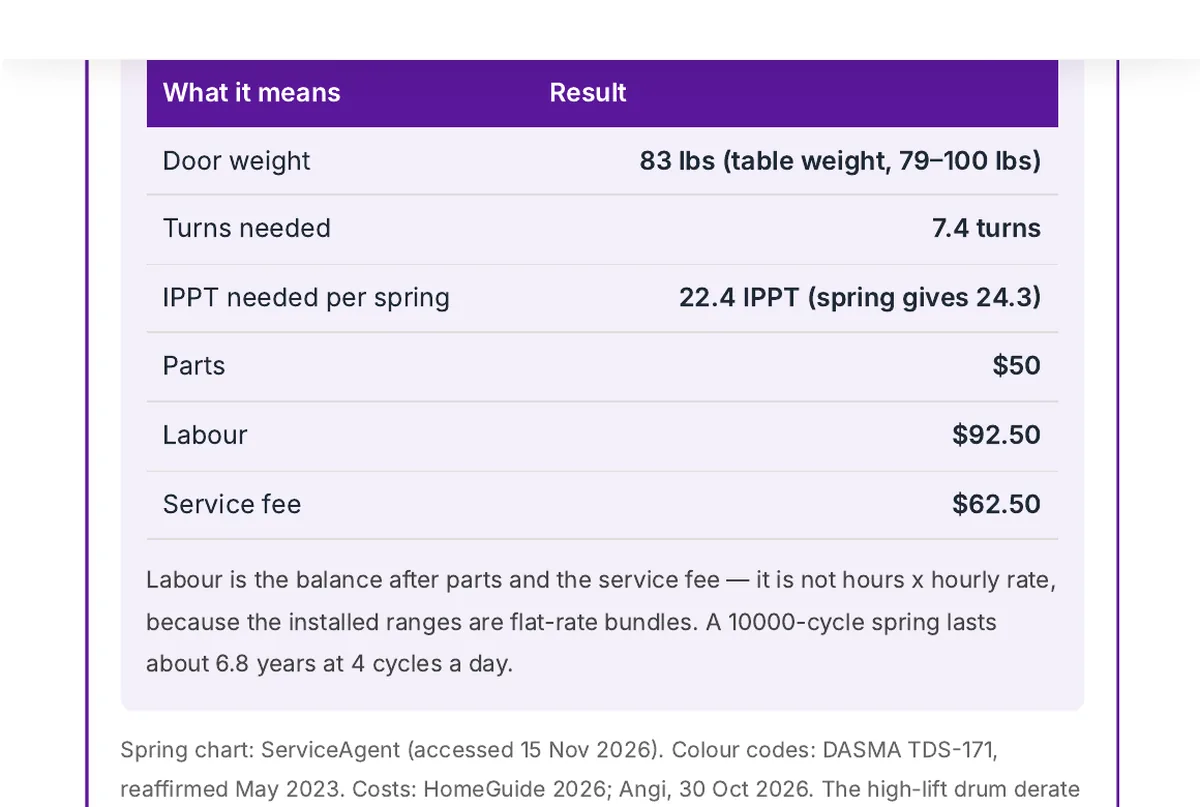
Price your job first with the free calculators below. They give you a number before you call anyone.
Repair Cost Calculator — price any repair before you call a pro.
Spring Calculator — price a spring job if the door feels heavy.
- Enter your door size and the part that failed.
- Note the price, then read the key takeaways and Section 1.
- Use the price in the guide to check any quote you get.
Key takeaways
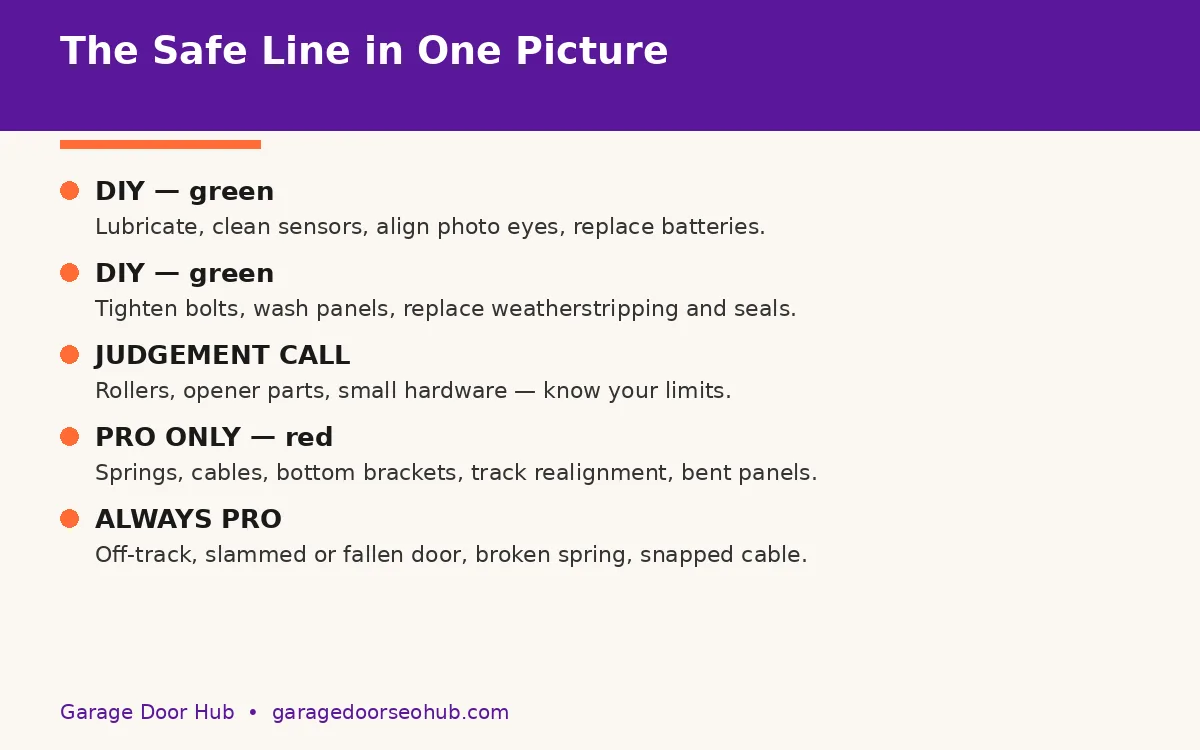
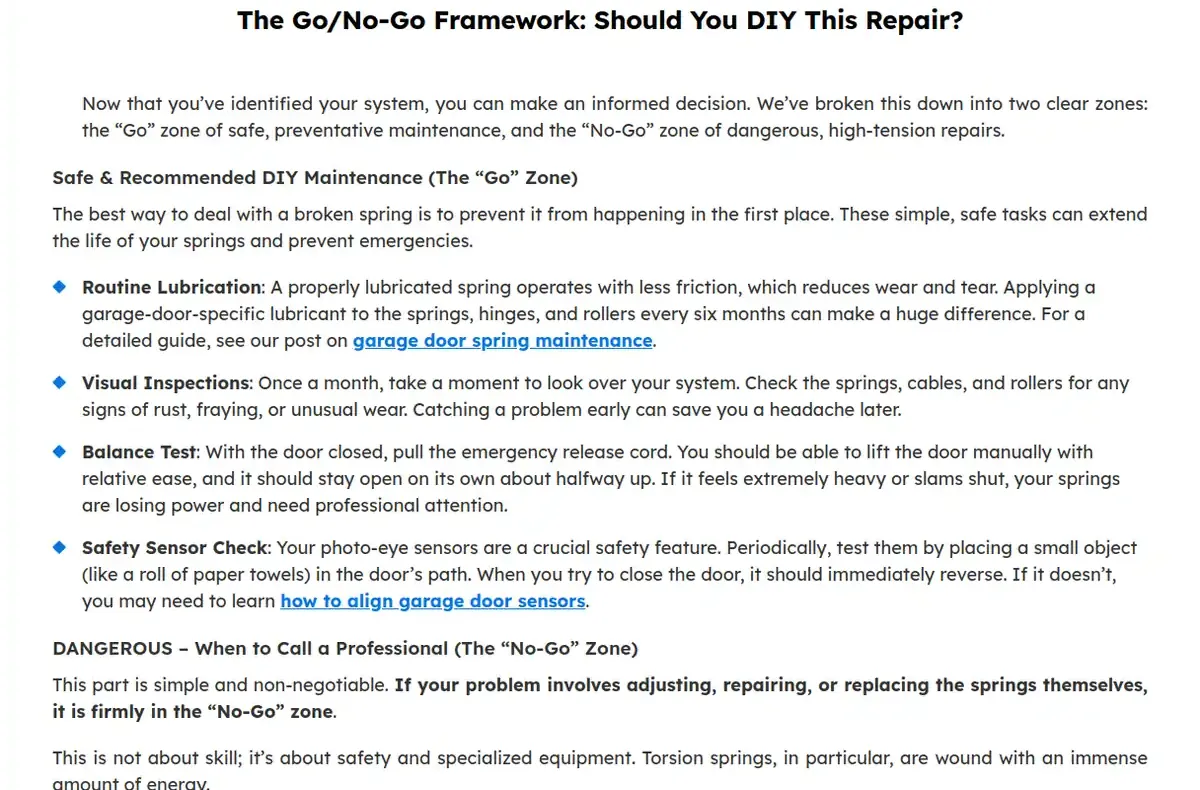
- Safe DIY: lubrication, sensors, batteries, tightening bolts, washing, seals.
- Pro-only: springs, cables, bottom brackets, track, bent panels.
- The test is one question: does it hold tension or the door’s weight?
- Rollers and opener parts are judgement calls — know your limits.
- When in doubt, a photo and a phone call cost nothing.
Table of Contents
-
1. The safe line, in one sentence
-
2. Safe DIY — the green list
-
3. Pro-only — the red list
-
4. Judgement calls — rollers, openers, small parts
-
5. Call a pro regardless of skill
-
6. What DIY saves, and what it risks
-
7. Decide in 60 seconds, and find a pro
- Watch: The DIY mistakes that turn into pro jobs
- FAQ
1. The safe line, in one sentence
The line is tension. If a part holds the door’s weight or stores the energy that lifts it, leave it to a pro. Everything else is a question of skill and tools.
One question decides it
Before you touch any part, ask: does this part hold tension, or hold the door’s weight? Yes means pro. No means you can likely do it yourself.
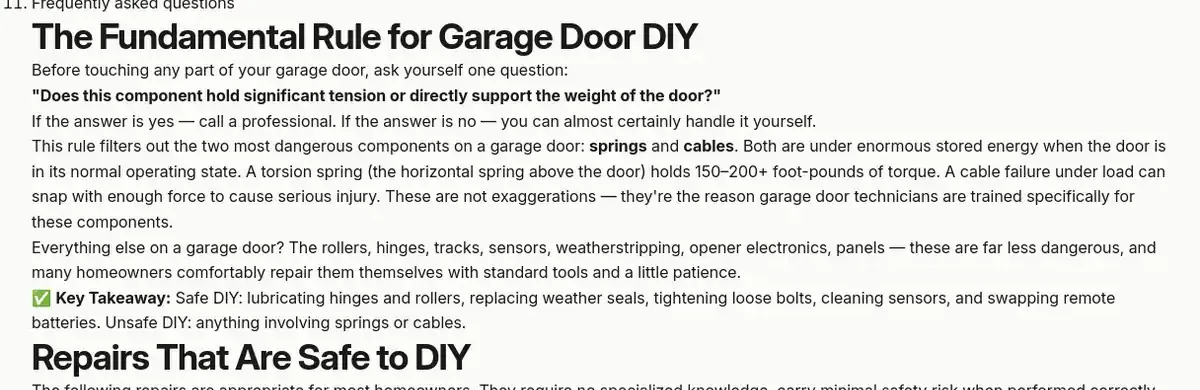
- Springs hold 150 to 200 foot-pounds of torque when wound.
- Cables carry the spring force to the bottom corners.
- Bottom brackets anchor the cables under full tension.
- Tracks hold the door’s weight in its guides.
- Everything else — sensors, batteries, seals — holds nothing.
Why care alone is not enough
A torsion spring let go with the wrong tool releases its energy in a fraction of a second. Pros use winding bars, matched specs and technique because care alone is not enough.
- The failure mode is an emergency room visit, not a redo.
- A bottom bracket unbolted while loaded releases the same energy.
- A failed DIY spring job costs 3 to 5 times more to fix.
- You can save $80 to $100 a year on safe DIY — and lose it all on one spring.
- The line is not about skill; it is about physics.
2. Safe DIY — the green list
These jobs need no special tools, carry no tension, and save real money. They are the maintenance that keeps a door quiet and safe between pro visits.
Lubrication, cleaning and sensors
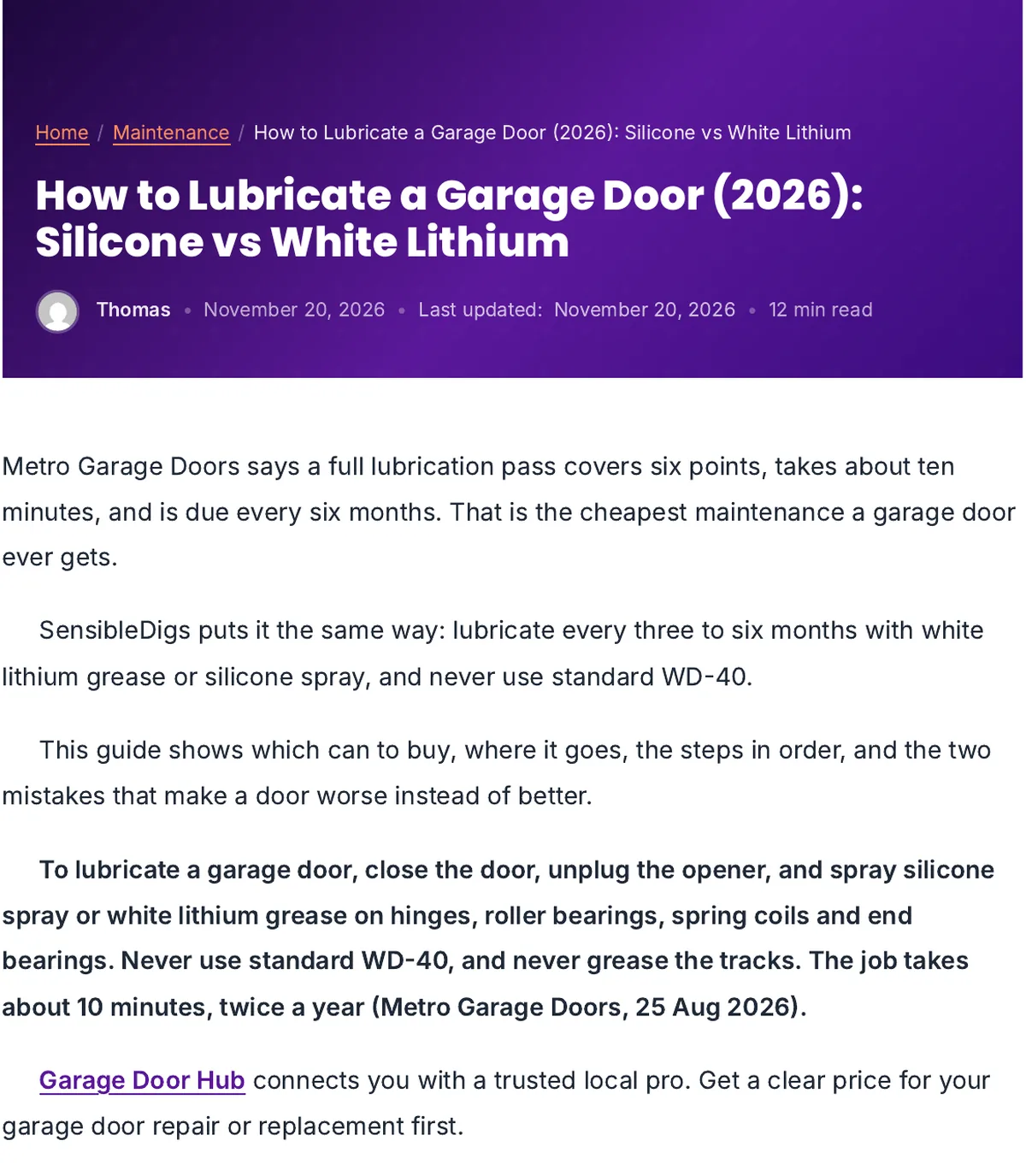
Lubrication is the highest-value DIY job on a garage door. It takes 20 minutes, costs about $15 in supplies, and prevents wear on every moving part.
- Lubricate hinges, roller bearings and spring coils — never wind a spring.
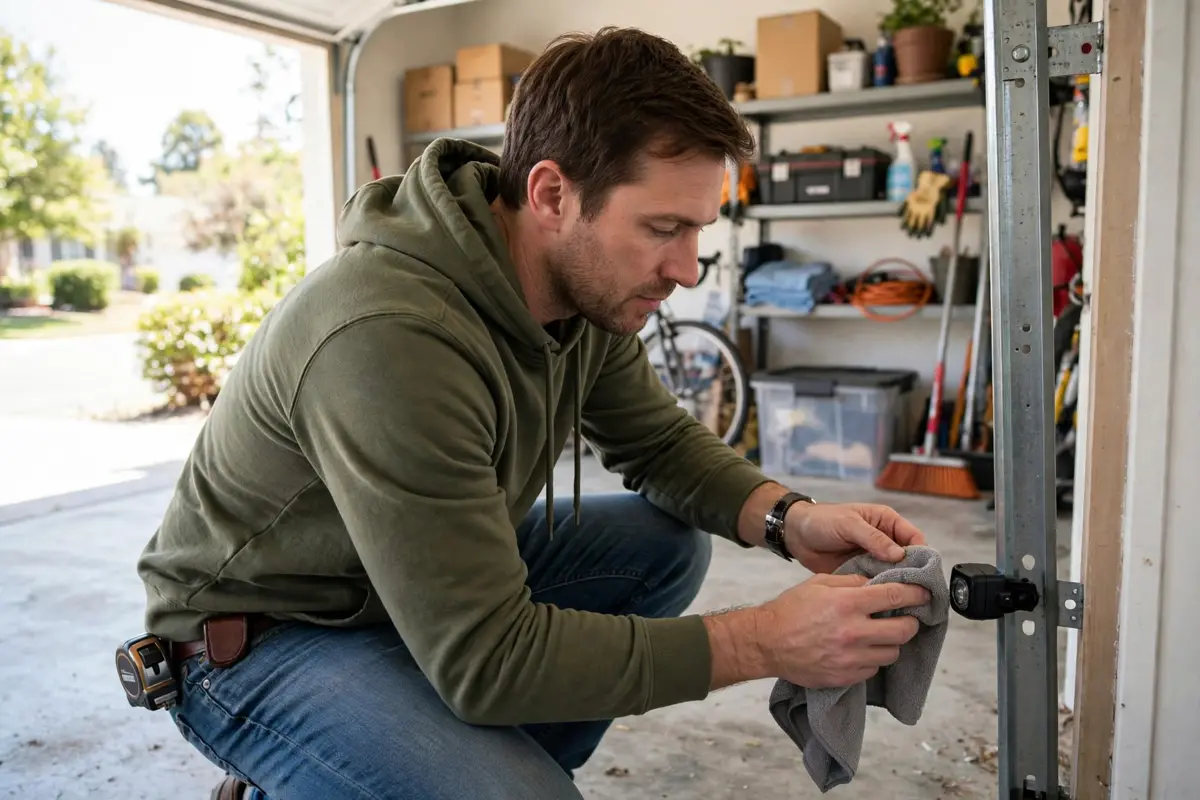
- Clean and align photo-eye sensors; wipe both lenses monthly.
- Clean the tracks with a damp rag, and leave them dry.
- Wash panels with mild soap, and touch up small paint chips.
- Full steps are in the how to lubricate a garage door guide.
Batteries, seals and bolts
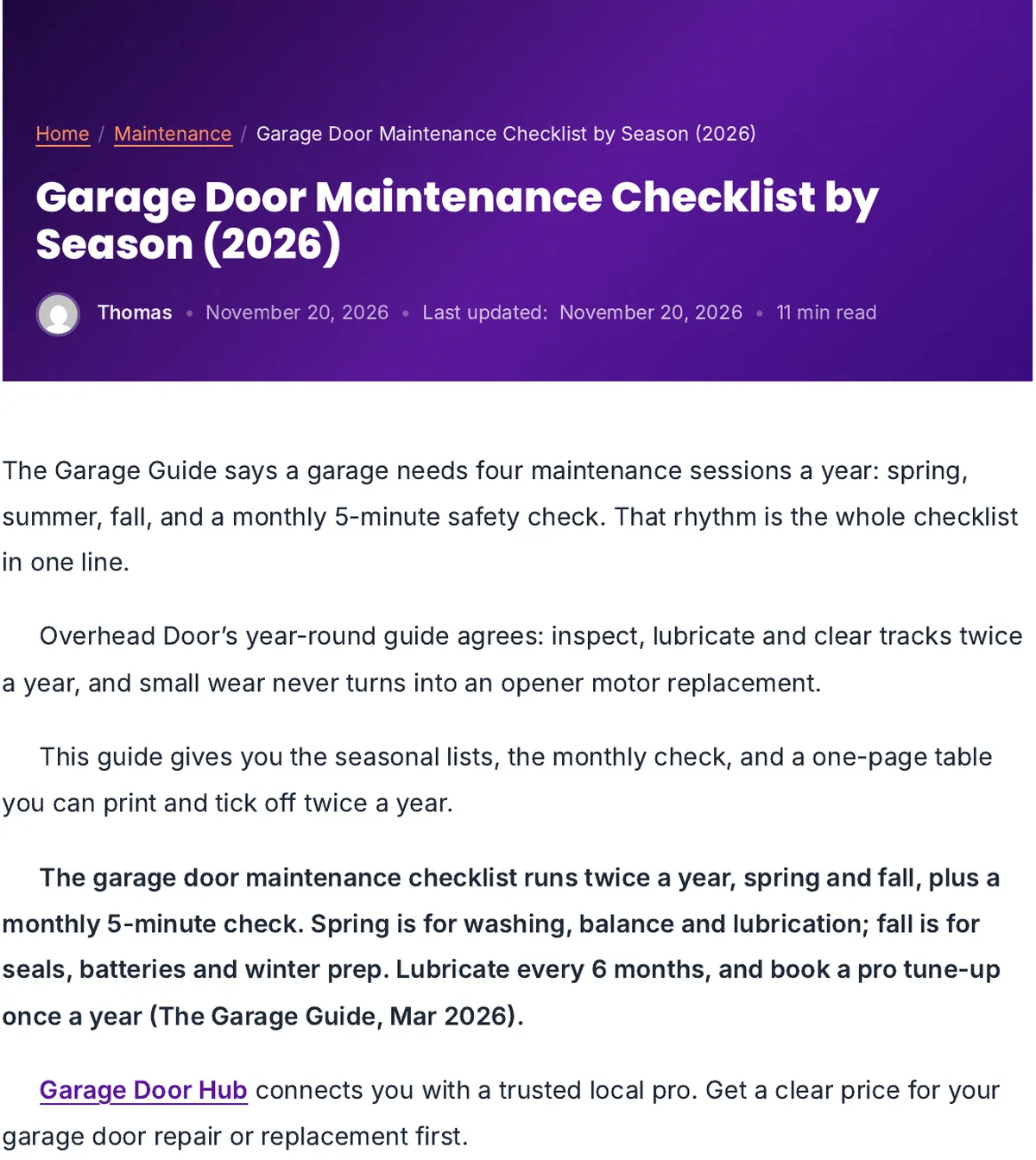
These jobs are simple, safe, and easy to forget. Put them on the seasonal checklist, and they take minutes twice a year.
- Replace remote and keypad batteries once a year, in October.
- Replace a worn bottom seal or side weatherstripping.
- Tighten hinge and track bolts you can reach with the door down.
- Test the auto-reverse and the battery backup monthly.
- For the full list, see the garage door maintenance checklist by season.
3. Pro-only — the red list
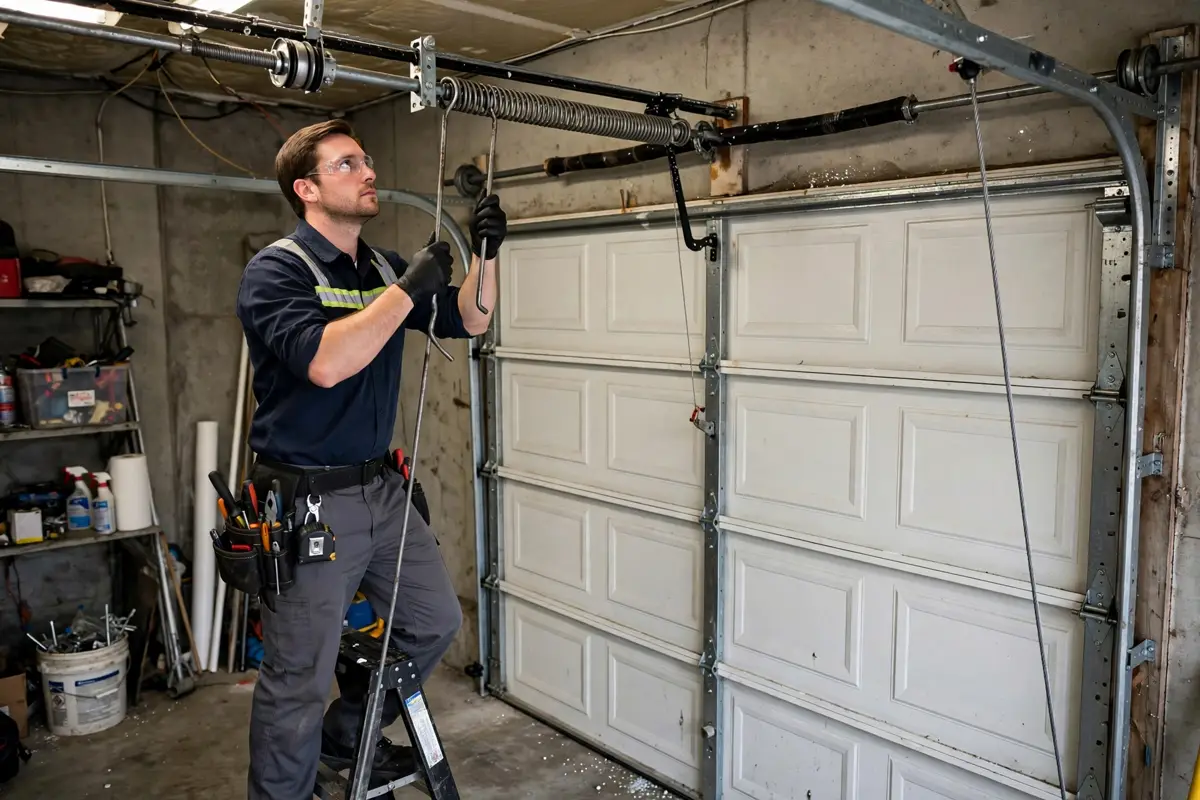
These jobs are never DIY, whatever your skill level. They hold tension, hold weight, or hold the door in its guides, and they fail violently when handled wrong.
Springs: torsion and extension
Torsion and extension springs are the most dangerous parts on any residential garage door. They hold 150 to 200 foot-pounds of torque when wound.
- Never wind, adjust or replace a torsion spring.
- Never adjust or replace an extension spring.
- A spring pair costs $200 to $350 installed (HomeGuide, Oct 2026).
- Replace springs in pairs, since both share the same age.
- Price it with the Spring Calculator.
Cables, track and bent panels
Cables, track and panels hold the door’s weight or guide its travel. A cable snap under load can cut through a glove, and a bent track can drop the door.
- Never replace a lift cable, or unbolt a bottom bracket.
- Never realign a track or pop a roller back in on your own.
- Never straighten or replace a bent panel yourself.
- A cable that jumped its drum needs a pro to re-seat it.
- A door off its track is unstable — stop using it and call a pro.
4. Judgement calls — rollers, openers, small parts
Some jobs sit between the green and red lists. Neither answer is wrong here — the trade-off is your time and risk tolerance against a modest pro bill.
Rollers and hinges
Roller and hinge replacement is a judgement call for a confident homeowner with the door closed and the opener unplugged. It is not a first DIY job.
- A full roller set costs $150 to $250 (Angi, 2026).
- Never replace rollers with the door under spring tension.
- A wobbling roller or a torn hinge stem hole means replace it.
- If a roller is out of the track, stop — that is a pro job.
- When in doubt, ask a pro to look first.
Opener parts and electronics
Opener electronics are low-tension work, but they need the right part and the right setting. A wrong board or a wrong force setting can make the door unsafe.
- Safe: batteries, remote programming, keypad codes, sensor alignment.
- Judgement: logic board, gear kit, belt or chain replacement.
- Pro: motor replacement, force and limit setting, rail work.
- A board costs $150 to $350, a motor $200 to $450.
- If the door still reverses after clean sensors, call a pro.
5. Call a pro regardless of skill
Some situations are unstable, whatever your skill level. The door’s weight is partly uncontrolled, and well-meant help makes it worse.
The door is unstable
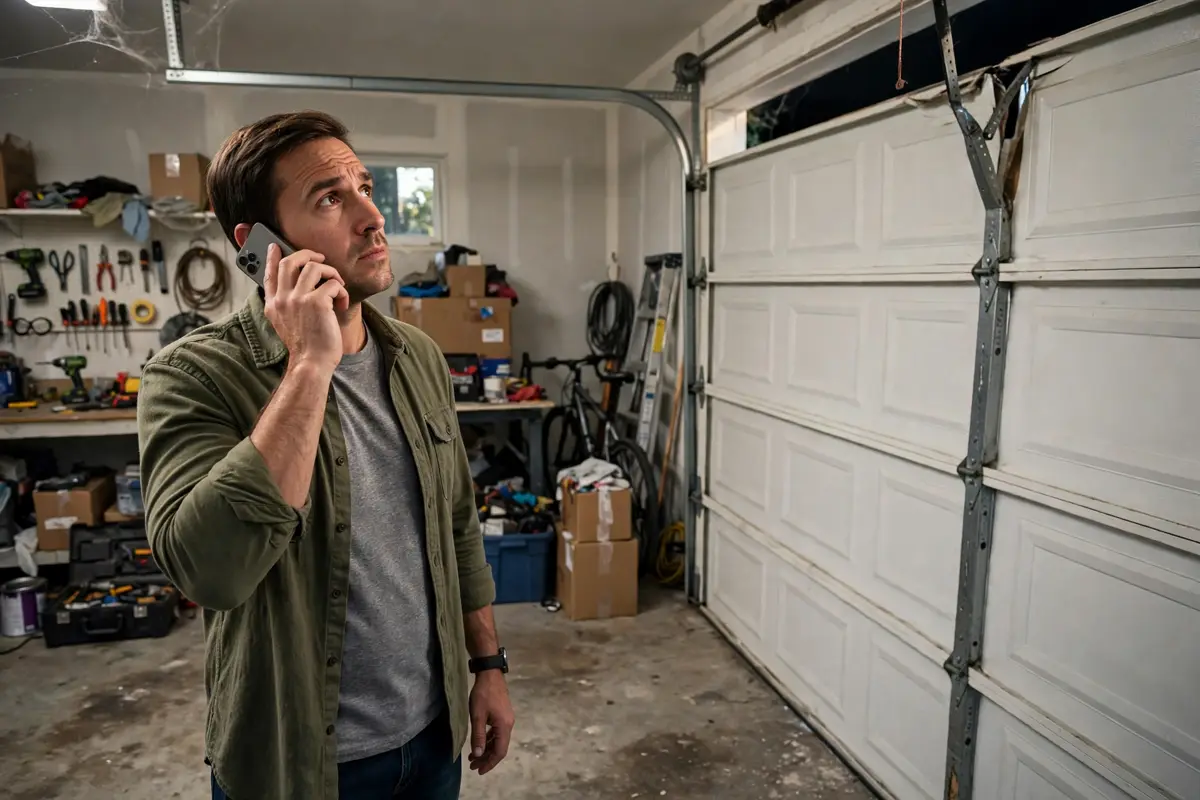
Stop using the door, keep people and pets away, and call. These are the calls a 24-hour emergency service exists for.
- The door is off its track, or a cable has jumped or snapped.
- The door slammed or fell, or anything under tension looks damaged.
- A spring has broken, and the door feels enormous.
- The door hangs crooked, drops fast, or will not stay up.
- For costs, see the garage door repair guide.
The door is stuck open
A door stuck open leaves the home unsecured, and forcing it can break the track or the panels. Secure what you can, and call a pro.
- Do not force a stuck door with the opener.
- Lock the side door, and secure valuables out of sight.
- Do not leave the home empty with the door open overnight.
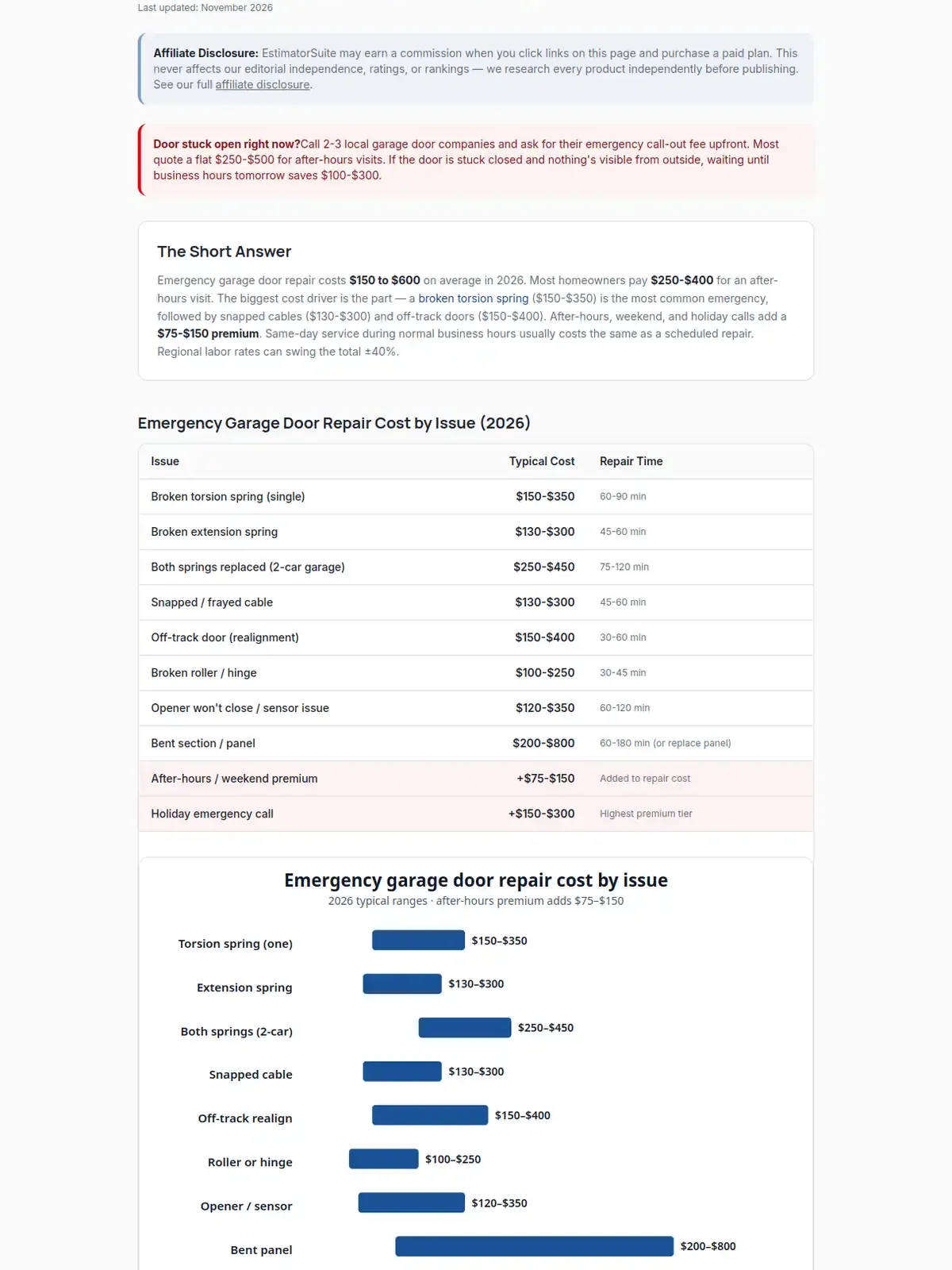
- An emergency call adds $75 to $150 (EstimatorSuite, Nov 2026).
- Waiting till morning saves money only if the door is shut and secure.
6. What DIY saves, and what it risks
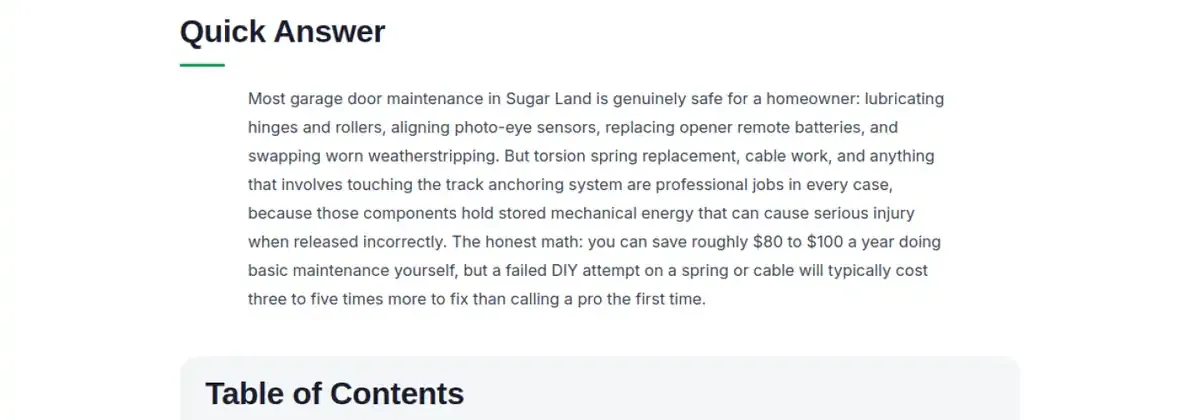
DIY maintenance saves roughly $80 to $100 a year, and it costs about $15 in supplies per pass. A pro visit costs $100 to $240, and it catches what DIY cannot see.
The honest savings
Safe DIY is genuinely worth doing. It is cheap, fast, and it catches the wear you can see — which is most of the wear there is.
- Lubrication: about $15 in supplies, 10 minutes, twice a year.
- Sensor cleaning and batteries: a few dollars, minutes each.
- Tightening bolts and washing panels: no cost but time.
- Total saving: roughly $80 to $100 a year over a pro-only routine.
- DIY complements an annual inspection; it does not replace it.
The honest risks
A failed DIY attempt on a spring or cable typically costs 3 to 5 times more to fix than calling a pro the first time. That is the maths that matters.
- A spring job gone wrong can injure you and damage the door.
- A cable job gone wrong can drop the door on a car or a person.
- A track job gone wrong can bend the track beyond repair.
- Insurance may not cover damage from a DIY repair gone wrong.
- Price any repair first with the Repair Cost Calculator.
7. Decide in 60 seconds, and find a pro
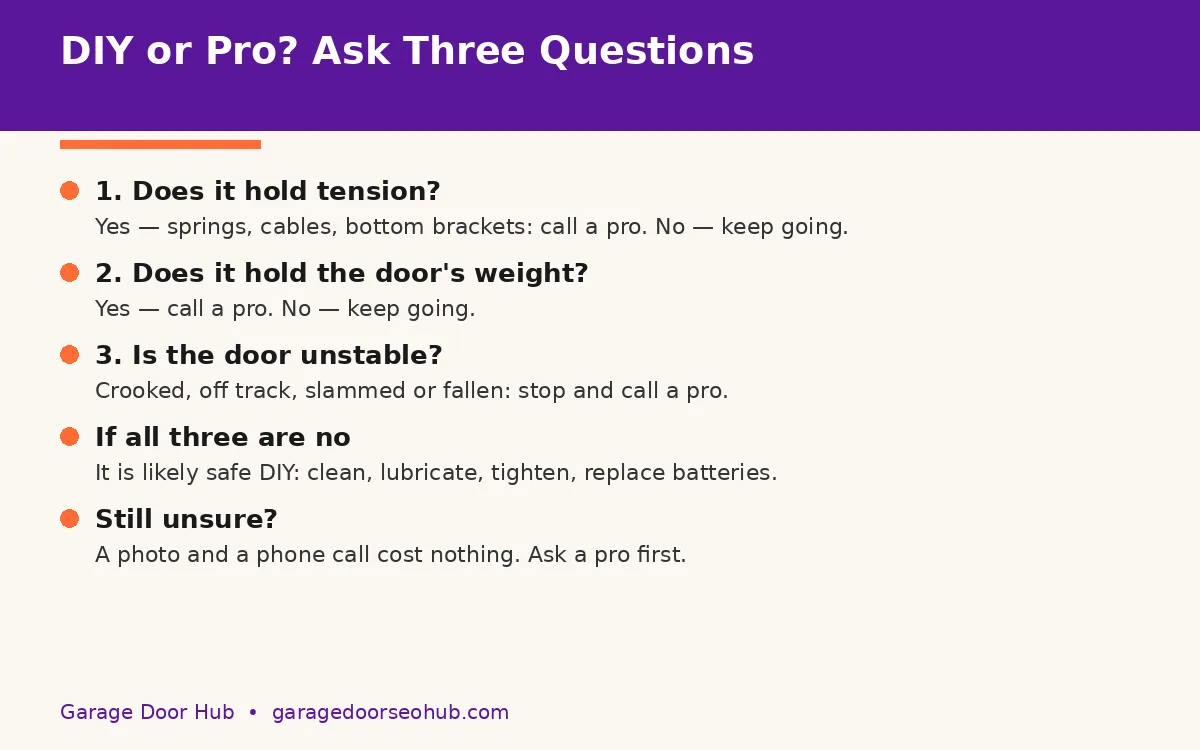
Use the three questions below whenever a job comes up. They take a minute, and they put you on the right side of the line every time.
Three questions, in order
Ask them in order, and stop at the first yes. A yes to any one of them means call a pro, whatever the job looked like at first.
- Does it hold tension? Springs, cables, bottom brackets — yes means pro.
- Does it hold the door’s weight? Track, panels, drums — yes means pro.
- Is the door unstable? Crooked, off track, slammed — yes means pro.
- If all three are no, it is likely safe DIY.
- Still unsure? A photo and a phone call cost nothing.
- Take a photo of the part, and send it to a local pro.
- Ask what the visit covers, and what costs extra.
- Get the quote in writing before work starts.
- For the whole schedule, see the garage door maintenance complete guide.
Where to go next, by job
Every cluster has a guide for its own jobs. Use the links below to go straight to the one that matches your door.
- Springs: the broken garage door spring guide.
- Manual opening: the how to open a garage door manually guide.
- Lubrication: the how to lubricate a garage door guide.
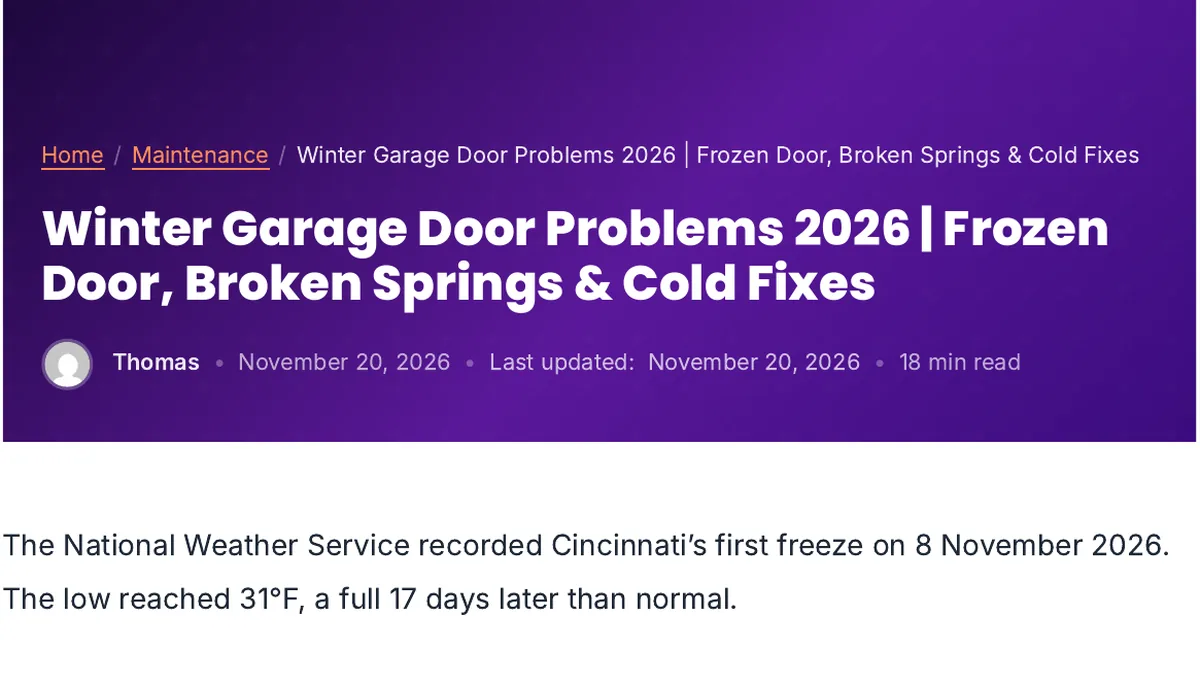
- Winter: the winter garage door problems guide.
- Costs: the garage door maintenance cost guide.
Watch: The DIY mistakes that turn into pro jobs
A1 Garage Door Service’s Garage Authority Podcast talks through the five mistakes homeowners make most, on YouTube, including YouTube-powered DIY disasters and why springs and cables are never a DIY job.
- Safe DIY covers lubrication, sensor cleaning and alignment, remote batteries, tightening bolts and washing panels.
- Springs, cables, bottom brackets, track realignment and bent panels are pro-only work.
- If a part holds tension or holds the door’s weight, call a pro.
Video: A1 Garage Door Service, YouTube. Checked 21 November 2026.
Garage Door Hub connects homeowners with trusted local garage door pros. Need a repair? Need a replacement? Start here. First, find out what it should cost. Then, price your exact job with our free calculator. Next, find a pro near you. Fast. No jargon. No guesswork. No surprise bills. Just clear prices, honest guides, and a local pro you can call today.
FAQ
What garage door repairs can I do myself?
Lubricating hinges and rollers, cleaning and aligning photo-eye sensors, replacing remote batteries, tightening accessible bolts, washing panels, and replacing weatherstripping.
What garage door repairs should I never do myself?
Never wind, adjust or replace springs, never replace lift cables, never unbolt a bottom bracket, and never realign a track or straighten a bent panel.
How do I know if a garage door job is safe to DIY?
Ask one question: does it hold tension or the door’s weight? If yes, call a pro. If no, and the door is stable, it is likely safe DIY.
How much does DIY garage door maintenance save?
About $80 to $100 a year, for about $15 in supplies per pass. A failed DIY spring or cable job typically costs 3 to 5 times more to fix than calling a pro first.
Should I call a pro if my garage door is off its track?
Yes, always. A door off its track is unstable, and forcing it makes it worse. Stop using the door, keep people away, and call a pro.
Sources
- Door Serv Pro, 2026 — the line is tension; safe DIY list; failed DIY costs 3–5 times more.
- GarageDoorLocator, 2026 — does it hold tension or weight; torsion spring $180–$350; safe DIY list.
- UAD Garage Doors, 10 Apr 2026 — Go/No-Go framework; broken-spring signs; springs are a class of their own.
- Garage Door Services Sugar Land, 2026 — save $80–$100 a year on DIY; failed DIY costs 3–5 times more.
- Angi, 2026 — roller set $150–$250; repair average $265.
- HomeGuide, Oct 2026 — spring pair $200–$350 installed.
- EstimatorSuite, Nov 2026 — after-hours premium +$75–$150.
Last reviewed: 20 November 2026
Appendix — Related topics
You might have found this by these keywords — and if not, others might have:
garage door DIY vs professional, DIY garage door repair, when to call a pro garage door, garage door repair cost DIY, garage door spring repair DIY, professional garage door repair, garage door repair near me, garage door maintenance DIY, is DIY garage door repair safe, garage door opener repair DIY