
A garage door torsion spring calculator finds the right spring for your door — wire size, inside diameter, length and turns — from your door’s size and weight. A standard 8×7 ft steel door weighs 83 lbs and needs one 218x2x26 spring: 0.218-inch wire, 2-inch inside diameter, 26 inches long, wound 7.4 turns. Use the tool below to get your size, then check it against the chart and the cost table before you book a pro.
Garage Door Hub connects you with a trusted local pro. Need a repair? Need a replacement? Start here. First, find out what it should cost.
Size your spring
Sized from your door weight in 2026. One door gives one spring size — the same 83 lbs the weight calculator uses.
| What it means | Result |
|---|---|
| Door weight | |
| Turns needed | |
| IPPT needed per spring | |
| Parts | |
| Labor | |
| Service fee |
Spring chart: ServiceAgent (accessed 15 Nov 2026). Color codes: DASMA TDS-171, reaffirmed May 2023. Costs: HomeGuide 2026; Angi, 30 Oct 2026. The high-lift drum derate and the high-cycle length factor are models, not published tables.
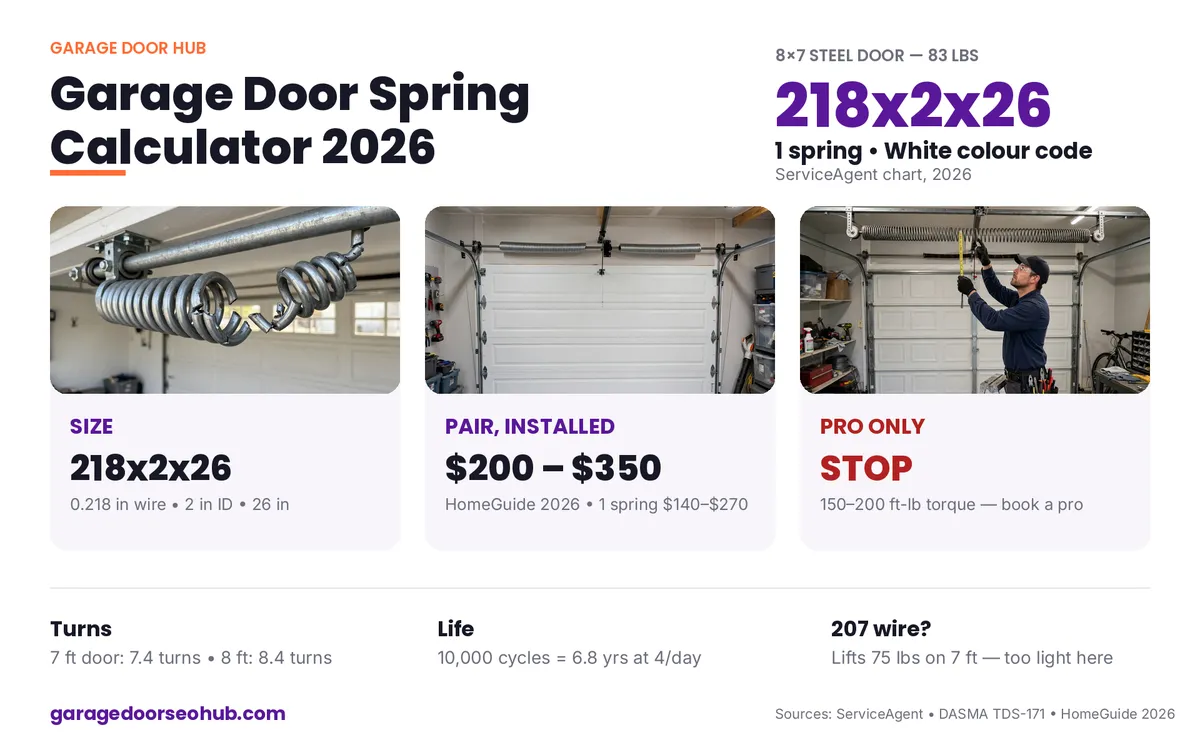
Quick answer: most homes have a 7 ft door on 4 in drums. That door needs 7.4 turns by the formula — 30 quarter turns in the garage, which installers round to 7½ turns. An 8 ft door needs 8.4 turns (34 quarter turns, or 8½ turns). One torsion spring costs $140 to $270 installed; a matched pair costs $200 to $350 installed (HomeGuide, 2026). If your door is taller than 8 ft, high-lift, or a wood door, use the tool above — the quick answer does not cover it.
How much does garage door spring replacement cost in 2026?
One torsion spring costs $140 to $270 installed, parts $30 to $70 (HomeGuide, 2026). A matched pair costs $200 to $350 installed, parts $50 to $100. That range covers most standard doors in a weekday visit, not a heavy custom door or an extension-to-torsion conversion. Angi's headline figure is higher — $150 to $350 per spring, average $250 (30 Oct 2026) — because it prices one spring in higher-cost markets, while HomeGuide's table splits parts from labor.
Watch: What Garage Door Repairs Cost in 2026 (Springs, Openers, Panels, New Doors) — American Garage Door, 5 Nov 2026. YouTube labels this video as content made with AI.
| Job | Typical cost in 2026, installed | What it usually covers |
|---|---|---|
| One torsion spring | $140–$270 | 1 spring, parts and labor |
| Matched pair of torsion springs | $200–$350 | Both springs, matched to your door weight |
| Pair of extension springs | $150–$200 | Both springs, with safety cables |
| One extension spring | $120–$160 | 1 spring, parts and labor |
| High-cycle upgrade (per spring) | +$40–$80 | Springs rated 20,000+ cycles instead of 10,000 |
| Extension-to-torsion conversion | $400–$800 | New torsion shaft, drums and springs |
| After-hours or weekend visit | +$75–$150 | Same repair, out-of-hours call-out |
| Holiday visit | +$150–$300 | Same repair, holiday call-out |
Prices move 10% to 40% by area, so two quotes for the same job can both be fair and still differ. Before you compare them, ask each one the same question: is that one spring or a matched pair, parts only or parts and labor? The full breakdown by spring type — including what a pair adds over a single spring, and what an after-hours visit adds — is in our garage door spring replacement cost guide. For the full picture across every garage door job, see our complete garage door costs guide for 2026.
Sources: Angi, 30 Oct 2026; HomeGuide, 2026, via GarageDoorInstallationCost, 10 Jun 2026; EstimatorSuite, Jul 2026 (after-hours +$75–$150, holiday +$150–$300). Fixr, Jan 2025, gives +$100–$300 as the same-day/urgent variant. Spring-size chart: ServiceAgent (accessed 21 Nov 2026). Measuring: DDM Garage Doors, Introduction to Garage Door Springs (accessed 21 Nov 2026). Turns chart: MovingUp Garage Doors (accessed 21 Nov 2026). Color codes: DASMA TDS-171, reaffirmed May 2023. See also the Angi spring replacement cost guide, 30 Oct 2026. Prices include parts and labor unless the row says otherwise. Your area moves the total by 10% to 40%. Every row in this table matches the calculator above exactly — the calculator range and the table range are the same numbers.
One number to watch: CostInspector, 2026, gives $250 to $550 for a torsion pair, and This Old House puts an installed pair at $300 to $540, average $420 (Mar 2026). Both are higher than HomeGuide's $200 to $350. They are not wrong — they price heavier doors and higher-cost markets. Before you compare two quotes, ask each one: is that one spring or a pair, parts only or parts and labor? If the door has a dented panel as well as a broken spring, price the panel first with the garage door panel replacement cost calculator — one panel costs $250 to $900 (HomeGuide, Oct 2026).
What size torsion spring do I need?
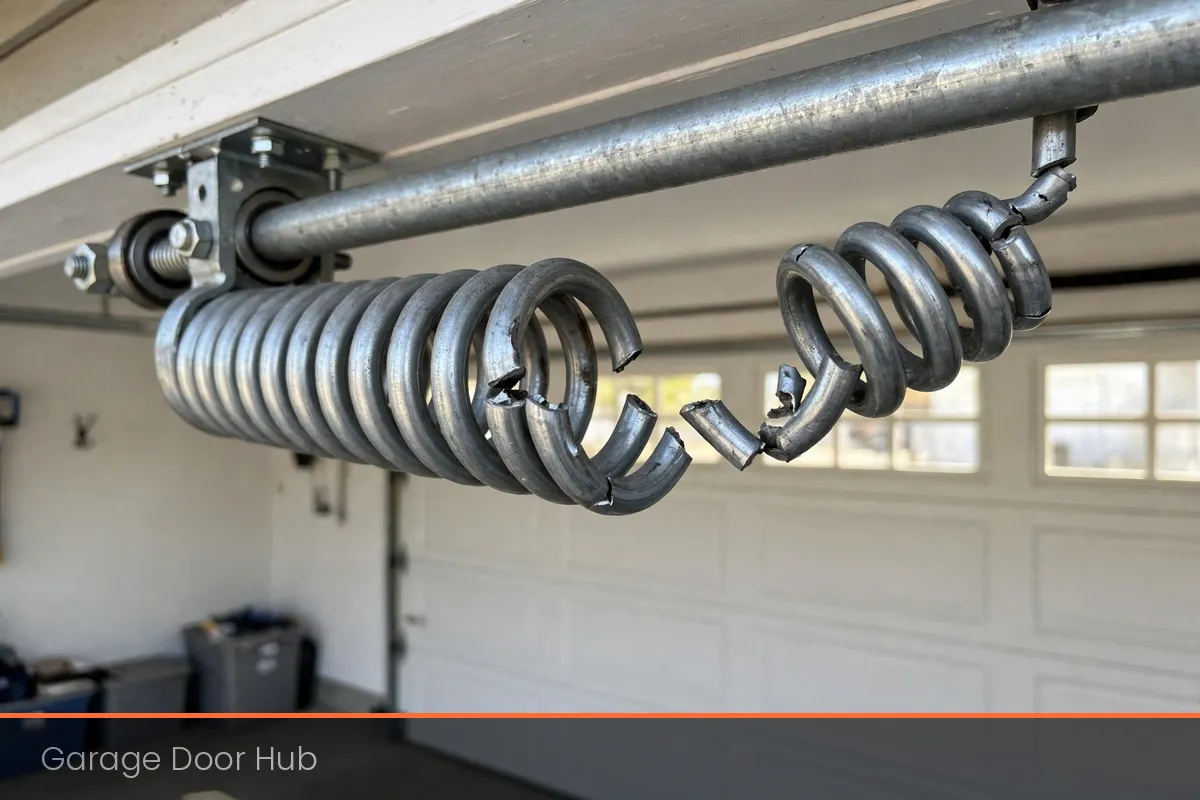
Start with the door, not the spring. The spring must lift the door's weight. A spring that is too weak leaves the door heavy. A spring that is too strong slams the door up and wears out the opener.
Use the calculator above: pick your door width, height and material. The weight comes from the site's spring table — or enter your door's known weight if you have it. On the defaults, an 8x7 steel single-layer door weighs 83 lbs and needs one 218x2x26 spring. That means 0.218-inch wire, 2-inch inside diameter, 26 inches long. One spring, not two. The 207 wire that the earlier version gave for this door lifts only 75 lbs on a 7 ft door — it lifts 83 lbs only on an 8 ft door — so it would leave this door 8 lbs heavy. If you want the full wire-by-wire breakdown, see our guide to garage door spring size, wire, length and turns.
If you are not sure of the weight, use the garage door weight calculator. An 8x7 steel door weighs 83 lbs. A double door weighs more and usually needs 2 springs. A heavy insulated door needs heavier wire than a light single-layer door of the same size — price the insulation first with the garage door R-value calculator.
| Door | Turns needed | Quarter turns | Typical wire size |
|---|---|---|---|
| 7 ft high | 7.4 turns | 30 quarter turns | 0.207–0.225 in |
| 8 ft high | 8.4 turns | 34 quarter turns | 0.207–0.225 in |
| 9 ft high | 9.3 turns | 37 quarter turns | 0.225–0.243 in |
| 10 ft high | 10.3 turns | 41 quarter turns | 0.225–0.250 in |
The formula gives 7.4 turns and the garage gives 30 quarter turns — they are the same number. Installers count quarter turns and round 7.4 to 7½, and 8.4 to 8½. If a quote or a video says 7½ turns for your 7 ft door, it agrees with this calculator; it is not a different answer.
Turns come from the door height and the drum: a 7 ft door needs 7.4 turns, an 8 ft door needs 8.4 turns (ServiceAgent, accessed 15 Nov 2026). The rule is simple: add about 1 turn for each extra foot of height. The calculator gives the exact turns for your drum diameter — a 5.25 in high-lift drum needs fewer turns (5.8 for a 7 ft door) but more torque per turn, so it needs a heavier wire.
Wire size is the thickness of the steel wire. Common residential sizes run from 0.192 to 0.312 inches. The most common are 0.218, 0.225, 0.234, 0.243, 0.250 and 0.262 inches. Thicker wire lifts more weight per turn. A 0.207-inch wire with a yellow color code lifts about 83 lbs on an 8 ft door and 75 lbs on a 7 ft door (ServiceAgent, accessed 15 Nov 2026). See also the ServiceAgent.ai spring calculator, which shows the same torque-balance method and the full color-code chart.
How to measure a garage door torsion spring
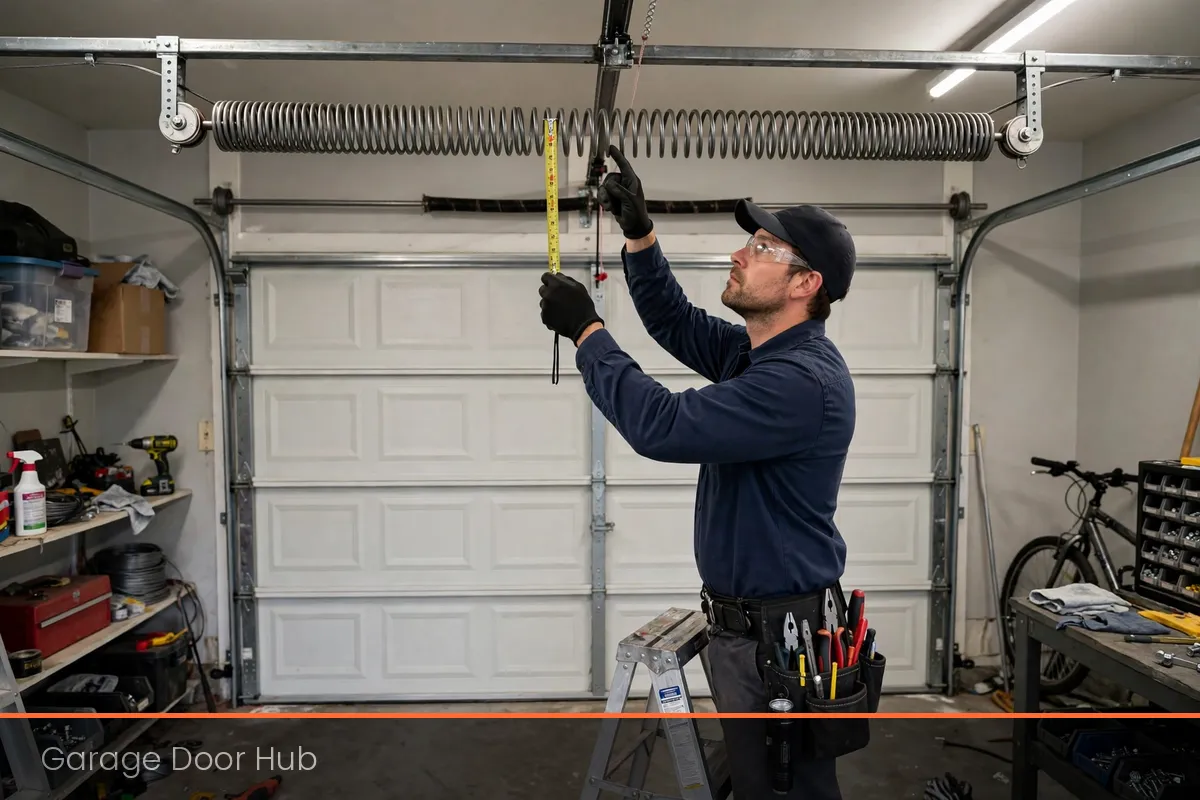
If the door worked well before the spring broke, measure the old spring. You need 4 numbers. Do not measure a spring that is still wound. If any tension is left, a pro must release it first.
Inside diameter (ID). Measure across the open center of the coil. Most homes use 1.75 or 2 inches. The cone is often stamped with the size — 175 means 1.75 inches, 200 means 2 inches.
Wind direction. Look at the winding cone. A left-wound spring (LHW) coils counter-clockwise from the cone. A right-wound spring (RHW) coils clockwise. A left-wound spring sits on the right side of the center bracket. A right-wound spring sits on the left side. Match the old spring's wind exactly — a spring wound the wrong way will not fit or work. Check the winding cone color too: a red cone is a left-wound spring (it mounts on the right side of the center bracket) and a black cone is a right-wound spring (mounts on the left). Do not confuse the cone color with the DASMA wire-size color — red wire means 0.225-inch wire, which is a different thing from a red cone. Measure both springs if you have two: about 30% of makers and service companies mix wire sizes between the pair (DDM Garage Doors, Introduction to Garage Door Springs).
Wire size. Count 20 coils and measure them end to end, then divide by 20. If 20 coils measure 4 3/8 inches, the wire is 0.218 inches. Do not use calipers alone — they are not reliable on spring wire. See the DDM Garage Doors measuring guide. Measure 10 coils too and check both numbers against the chart.
Length. Measure the relaxed spring end to end, not counting the cones. Include both broken pieces. Round to the nearest inch. Most 7 ft doors use a 25-inch spring. Most 8 ft doors use a 27-inch spring.
Watch: How To Measure Garage Door Torsion Springs — DDM Garage Doors. Title confirmed on the YouTube watch page 12 Nov 2026. The upload date was not shown in the fetched page text, so no date is given here — check it before publishing.
Torsion spring by measurements
The calculator works from your door, or from a known weight you type in.
It asks for door width, height, construction (single, double or triple layer), material and windows — and the drum diameter. Most residential drums are 4 inches. Leave the weight blank and the table weight is used; type a weighed weight in and it is used instead. The maths is a torque balance: the door weight pulling on the drums must be matched by the springs over the turns they carry. Torque is door weight times drum radius, shared by the springs. Turns come from the door height divided by pi times the drum diameter, plus 0.75 turn of preload (ServiceAgent, accessed 15 Nov 2026).
What is IPPT?
A healthy spring sits within 90 to 110% of the IPPT your door needs. IPPT means inch-pounds per turn — how much torque the spring adds for each turn of wind. It depends on wire size, inside diameter and spring length together. On the defaults, the door needs 22.4 IPPT and the 218 spring gives 24.3 IPPT — inside the band. If the spring on your door is far outside that band, the door wears out its hardware faster or risks a sudden failure. Ask a local pro to confirm the size on site before ordering.
- Below 90%: the spring is too weak for the door. The door feels heavy, the opener strains, and the spring wears out early.
- 90 to 110%: the healthy band. On the defaults, the door needs 22.4 IPPT and the 218 spring gives 24.3 IPPT — inside the band.
- Above 110%: the spring is too strong for the door. The door lifts too fast and wears out the opener and hardware.
Use the calculator above to check your own door — pick your size and material, and read the IPPT in the result.
Do not use this section to wind a spring yourself. It tells you what to order and what a fair quote looks like. It is not a winding guide.
Garage door spring weight chart by door size
Use this chart to check the weight your spring must lift, before you pick a size. The weights are for steel doors in 2026, from the site's weight table (Metro Garage Doors, 27 Apr 2026; Garage Reference, 9 Oct 2026; Clopay T50S spec table). A heavier door needs a heavier spring, and a double door usually needs 2 springs.
| Door size | Steel, non-insulated | Steel, insulated | Turns needed |
|---|---|---|---|
| 8x7 ft, single | 79–84 lbs | 87–114 lbs | 7.4 turns |
| 9x7 ft, single | 85–91 lbs | 95–127 lbs | 7.4 turns |
| 9x8 ft, single | 95–104 lbs | 105–142 lbs | 8.4 turns |
| 10x7 ft, single | 98–106 lbs | 108–145 lbs | 7.4 turns |
| 16x7 ft, double | 151–164 lbs | 168–219 lbs | 7.4 turns |
| 16x8 ft, double | 184–210 lbs | 204–253 lbs | 8.4 turns |
Find your exact weight and spring size with the garage door weight calculator, then use the calculator above to get the wire size, length and IPPT for that weight.
Wood and fiberglass doors weigh more than steel of the same size — a wood 8×7 ft door can weigh 130–180 lbs — so do not use the steel rows for them. Weigh the door or use the garage door weight calculator, then size the spring from the real weight.
Spring size chart — what one spring lifts (2 in inside diameter, 4 in drums, standard lift)
| Color | Wire | Length | Lifts, 7 ft door | Lifts, 8 ft door |
|---|---|---|---|---|
| Yellow | .207 | 24 in | 75 lb | 83 lb |
| White | .218 | 26 in | 90 lb | 100 lb |
| Red | .225 | 26 in | 104 lb | 115 lb |
| Brown | .234 | 28 in | 117 lb | 130 lb |
| Green | .243 | 30 in | 132 lb | 147 lb |
| Gold | .250 | 32 in | 141 lb | 156 lb |
| Blue | .262 | 35 in | 162 lb | 180 lb |
| Orange | .273 | 38 in | 187 lb | 201 lb |
Source: ServiceAgent spring-size chart (accessed 21 Nov 2026); color codes: DASMA TDS-171, reaffirmed May 2023. Paint fades and color codes vary by maker — confirm wire size, inside diameter and length before ordering. For a pair, add the two ratings together. Read across one row, not down one column: your door size gives the weight, your height gives the turns.
How to read this chart
Read across one row, not down one column. Your door size gives you the weight range, and the height gives you the turns. A 7 ft door needs 7.4 turns, an 8 ft door needs 8.4 turns (ServiceAgent, accessed 15 Nov 2026).
- Single door, 8x7 ft: 79–84 lbs non-insulated, 87–114 lbs insulated. On the defaults, an 8x7 steel single-layer door weighs 83 lbs and needs one 218x2x26 spring.
- Double door, 16x7 ft: 151–164 lbs non-insulated, 168–219 lbs insulated. A double door usually needs 2 springs, not 1.
- Insulation adds weight: an insulated door of the same size needs heavier wire than a light single-layer door. Price the insulation first with the garage door R-value calculator.
- Windows add weight too: 1 row of windows adds 15 lbs, full-view glass adds 75 lbs — check the weight calculator for your door.
Do not order from the weight alone. The spring also needs the right wire size, inside diameter, length and wind — check all 4 in the calculator result before you order.
Converting a spring to a different size
A thicker wire lifts more weight per turn but needs more length to give the same total torque. A thinner wire lifts less per turn. A conversion keeps the total lift the same. That is why the wire size, the length and the turns must change together — change one alone and the door will not balance.
The calculator's cycle rating does the same kind of change: a 20,000-cycle spring for the same door is about 15% longer than the 10,000-cycle spring, and a 25,000-cycle spring about 25% longer. Those length factors are a model — ServiceAgent says thicker wire and more length buy cycles, but gives no fixed factor — so treat the converted length as a starting point and confirm it against the supplier's chart. Measure the free shaft before you order a longer spring — a longer high-cycle spring must still fit on the shaft beside the drums.
Check the converted spec the same way: wire size, inside diameter, length and wind. If any of those 4 is wrong, the spring is wrong.
Extension springs: what size do I need?
Extension springs work differently: they stretch instead of twisting. The stretch is normally half the door height — a 7 ft door stretches its springs about 42 inches. An extension spring is named by length, stretch and pull: a 25-42-100 spring is 25 inches long, stretches 42 inches, and pulls 100 lbs (DDM Garage Doors). You always need two, one per side, and each one needs a safety cable through its middle — without it, a broken spring can fly across the garage. If your extension springs have no safety cables, that is the first thing to fix, before you worry about size. See our guide to extension spring safety cables and conversion to torsion.
One spring or two — and converting
If one torsion spring breaks, replace the pair together. Both springs have lived through the same cycles, so the second one is nearly as tired as the first — and a mismatched pair makes the door harder to balance. A pair costs $200 to $350 installed against $140 to $270 for one spring (HomeGuide, 2026), so the second spring is the cheap part of the visit.
Converting is the same idea in reverse: one spring can become two lighter springs, or two can become one heavier spring, as long as the total torque stays the same. The wire size, the length and the turns must change together — change one alone and the door will not balance. Two warnings: first, a longer high-cycle spring must still fit on the shaft beside the drums — measure the free shaft before you order a longer spring. Second, converting an extension system to torsion costs $400 to $800 (HomeGuide, 2026; Angi, 30 Oct 2026) because it needs a new shaft and drums, not just new springs.
After the job: the 30-second balance test
Once the pro has fitted and wound the springs, the door should balance. With the opener disconnected (pull the red release cord with the door closed), lift the door by hand to about halfway and let go:
| What the door does | What it means | Fix |
|---|---|---|
| Stays put, or moves an inch or two | Balanced | Done |
| Rises on its own | Too much tension | Take off a quarter turn on each spring |
| Drifts down or feels heavy | Not enough tension | Add a quarter turn on each spring |
| Needs a full turn or more to balance | Wrong size spring, or a broken or tired spring | Check the spring size — do not keep adding turns |
Adding turns to the wrong spring over-stresses it and shortens its life. If the door needs more than a quarter turn or two of fine-tuning, the size is wrong.
Keep the springs working smoothly with twice-yearly lubrication and inspection — see our garage door spring maintenance guide.
When this calculator does not apply
This calculator and its turns table cover standard-lift residential doors with 1¾ in or 2 in inside-diameter springs and 4 in drums — what most homes have. Do not use them for: high-lift or vertical-lift doors (the track runs up the wall before turning, so the drum takes up more cable and the turns are different); springs with any other inside diameter (2¼, 2⅝, 3⅜ or 3¾ in commercial springs); or Clopay EZ-Set and Wayne Dalton TorqueMaster systems, which are wound with their own winding units — follow the maker's instructions. For any of those, size from the drum or spring maker's chart, or ask a pro to size it on site.
How long do garage door springs last?
Springs are rated in cycles, not years. One cycle is one open and one close. A standard torsion spring is rated for 10,000 to 20,000 cycles (HomeGuide, 2026). At 2 cycles a day, 10,000 cycles last 13.7 years. At 4 cycles a day, they last 6.8 years. A family that opens the door 8 times a day wears out a standard spring in about 3.5 years.
| Cycle rating | Life at 2 cycles a day | Life at 4 cycles a day | Best for |
|---|---|---|---|
| 10,000 cycles (standard) | 13.7 years | 6.8 years | Light use, most new homes |
| 20,000 cycles | 27.4 years | 13.7 years | Busy households |
| 25,000 cycles (high-cycle) | 34.2 years | 17.1 years | Heavy daily use |
A high-cycle spring costs $40 to $80 more per spring (Garage Door Service Florida, 13 Oct 2026) and lasts about twice as long. At 4 cycles a day, that is 13.7 years instead of 6.8. Ask for the cycle rating before you approve a spring job. Most quotes list a 10,000-cycle spring by default because it is cheaper to stock.
Extension springs last less: 5,000 to 15,000 cycles, about 4 to 10 years (HomeGuide, 2026). This Old House puts extension springs at 7 to 12 years and about 10,000 cycles (Mar 2026). Torsion springs last 8 to 15 years and up to 20,000 cycles on the same measure. Cold weather makes springs break more often — the wire gets brittle in winter (Clopay, via Call the Local, Nov 2026).
Torsion vs extension springs
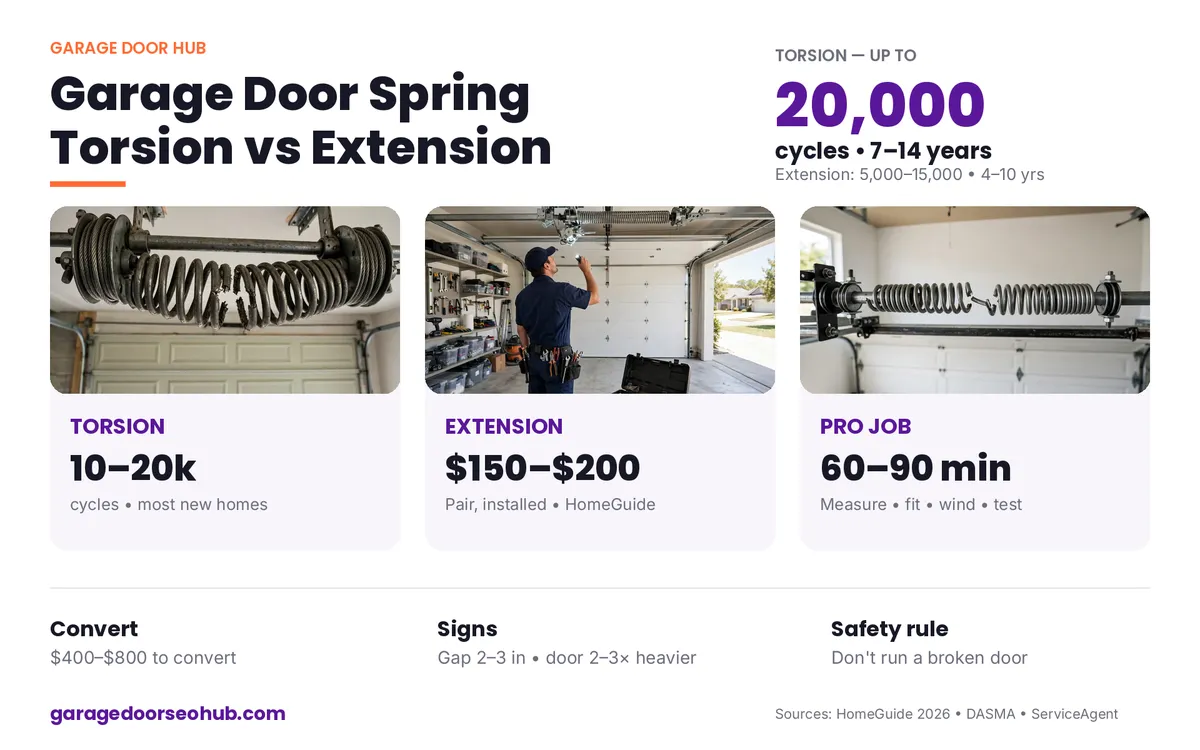
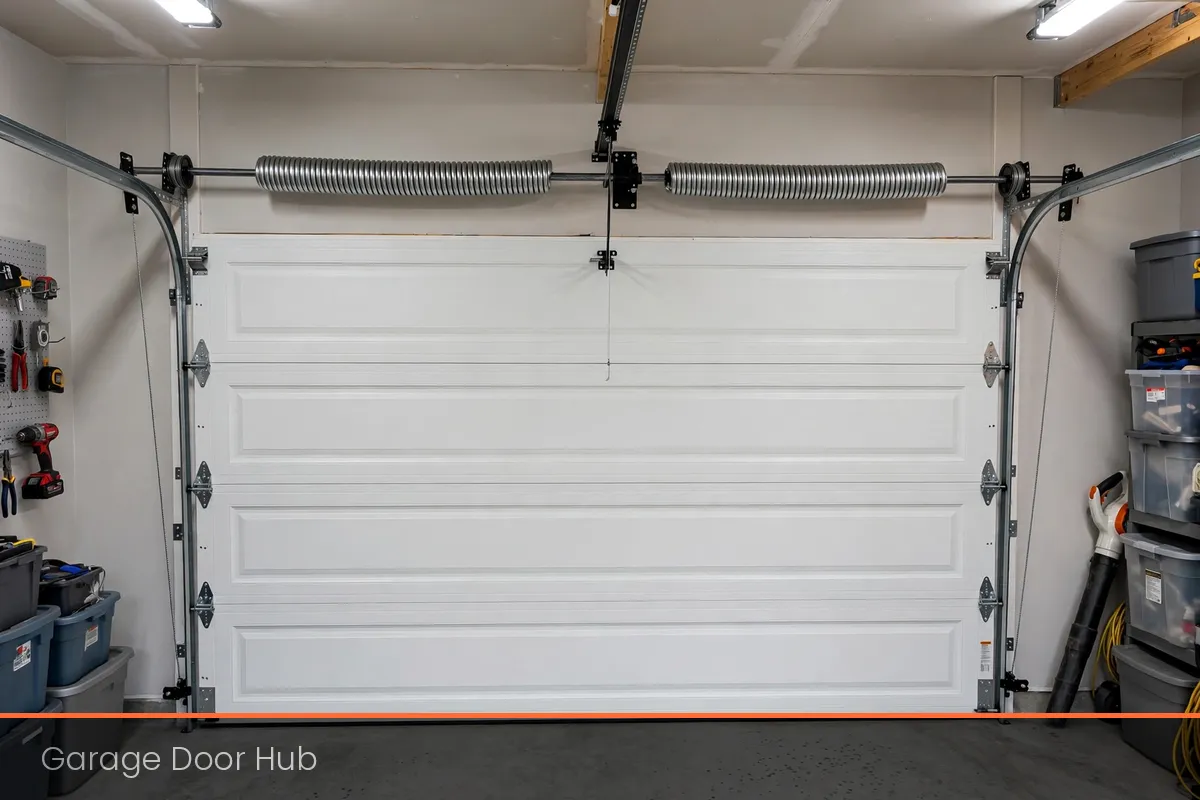
Torsion springs sit on a steel shaft above the door and twist to store energy. Extension springs sit along the sides and stretch. Torsion springs are the modern standard. They are smoother, safer and last longer.
| Torsion spring | Extension spring | |
|---|---|---|
| Where it sits | Above the door, on a shaft | Along the sides, by the tracks |
| Cycle life | 10,000–20,000 cycles | 5,000–15,000 cycles |
| Typical life | 7–14 years | 4–10 years |
| Pair replacement cost | $200–$350 | $150–$200 |
| Safety if it breaks | Stays on the shaft | Needs a safety cable to contain it |
Extension springs cost less to buy; torsion springs cost less over 15 years because they last about twice as long. Converting an extension system to torsion costs $400 to $800 (HomeGuide, 2026). One summary of the same data puts it at $200 to $500 (GarageDoorInstallationCost, 10 Jun 2026), but that summary conflicts with the HomeGuide figure it summarises, so $400 to $800 is the figure used here — ask what the conversion price includes before you compare. One installer guide puts it at $600 to $1,100 (Garage Door Pros WA, Nov 2026) — the higher figure covers a new shaft and drums on a heavy door.
Signs your spring is about to break — and the safety rule
Watch for 5 signs. A loud bang from the garage, and then the door will not open. A visible gap of 2 to 3 inches in the coil. A door that feels 2 to 3 times heavier than normal when you lift it by hand. A door that opens a few inches and stops. Cables that look loose or off the drum.
If you see a gap in the coil, do not run the opener — it will strain the motor and can strip the drive gear. Pull the red emergency release only with the door closed, and do not force the door open.
The safety rule is not negotiable: do not replace, wind or adjust a torsion spring yourself. A wound spring holds 150 to 200 foot-pounds of torque. It can break bones or blind you. DASMA, the door industry trade group, advises having springs inspected and replaced by trained door systems technicians, and says not to operate a door with a broken spring until it is replaced. A pro job takes 60 to 90 minutes. That is the whole job — measure, fit, wind, balance and test.
Watch: Garage Door Broken Spring Replacement | OC Garage Door Guys LLC — OC Garage Door Guys LLC, 29 Mar 2024. Title re-confirmed on the YouTube watch page 12 Nov 2026; date from the Repair Cost verification the same day. This video shows a replacement step by step. It is for information only — if you are not comfortable with the work, book a pro.
5 questions to ask before you book
- What is the spring size — wire, inside diameter, length and wind? Get all 4 numbers in writing.
- Is the price for one spring or a matched pair? A pair costs $200 to $350 installed.
- What is the cycle rating — 10,000 or 20,000+? A high-cycle pair adds $40 to $80 per spring.
- What is the warranty on parts and on labor? A spring job should carry at least 1 year on labor.
- What is the emergency fee tonight, separate from the spring price? Get 2 numbers, not 1.
Prices move 10% to 40% by area — compare like with like, one spring or a pair, parts and labor.
For a second opinion, use the Garage Door Hub calculator hub. To reach a pro, use the contact page. If the door is stuck open, price the repair first with the garage door repair cost calculator, and price a new door with the garage door cost calculator — or the full job with the garage door replacement cost calculator — before you decide. If the cables are worn too, check the length with the garage door cable length calculator, and the opener with the garage door opener cost calculator.
Garage Door Hub connects homeowners with trusted local garage door pros. Need a repair? Need a replacement? Start here. First, find out what it should cost. Then, price your exact job with our free calculator. Next, find a pro near you. Fast. No jargon. No guesswork. No surprise bills. Just clear prices, honest guides, and a local pro you can call today.
Watch: How to measure a torsion spring before you order one
DDM Garage Doors, a garage-door parts supplier with over 30 years in the trade, shows how to measure a torsion spring — inside diameter, wind, length and wire size — the four measurements you need before you order a replacement.
- Start with the door, not the spring — the spring must lift the door's weight.
- An 8x7 steel door weighs 83 lbs and needs one 218x2x26 spring.
- Use the result below, then book a pro to fit it — springs are under extreme tension.
Video: DDM Garage Doors, YouTube. Checked 21 November 2026.
Frequently asked questions
How much does it cost to replace a garage door spring?
One torsion spring costs $140 to $270 installed (HomeGuide, 2026). A matched pair costs $200 to $350 installed. Angi's headline figure is $150 to $350 per spring, average $250 (30 Oct 2026).
What size torsion spring do I need?
An 8x7 steel door weighs 83 lbs and needs one 218x2x26 spring — 0.218-inch wire, 2-inch inside diameter, 26 inches long. A 7 ft door needs 7.4 turns and an 8 ft door needs 8.4 turns.
How do I measure a garage door spring?
Measure 4 things from the old spring: inside diameter, wind direction (LHW or RHW), length end to end, and wire size by measuring 20 coils and dividing by 20. Only measure a spring that is unwound.
How long do garage door springs last?
Torsion springs last 10,000 to 20,000 cycles, or 7 to 14 years at normal use (HomeGuide, 2026). At 4 cycles a day, a 10,000-cycle spring lasts 6.8 years and a 20,000-cycle spring lasts 13.7 years.
Can I replace a garage door spring myself?
No. A wound torsion spring holds 150 to 200 foot-pounds of torque and can cause serious injury. Book a trained technician. A pro job takes 60 to 90 minutes.
How many turns does a garage door spring need?
A 7 ft door on 4 in drums needs 7.4 turns by the formula — 30 quarter turns, which installers round to 7½ turns. An 8 ft door needs 8.4 turns (34 quarter turns, or 8½). Turns come from the door height and the drum, not from the door's weight. A heavier door needs a stronger spring, not more turns.
What size torsion spring for a 2-car (16 ft) garage door?
A 16×7 ft steel door weighs 151–164 lbs non-insulated (168–219 lbs insulated) and usually needs a matched pair of springs, not one. Common sizes are 0.243–0.262 in wire, 2 in inside diameter, about 30–36 in long — but the exact size comes from the door's measured weight, not from the chart. Use the calculator above with your door's real weight.
How do I tell a torsion spring from an extension spring?
A torsion spring sits on a steel shaft above the door and twists. An extension spring sits along the sides, by the tracks, and stretches. If you are not sure which you have, see torsion vs extension springs: which do you have?
What does IPPT mean, in plain words?
Inch-pounds per turn — how much lifting force the spring adds for each full turn you wind into it. A healthy spring sits within 90% to 110% of the IPPT your door needs. On the standard 8×7 steel door, the door needs 22.4 IPPT and the 218 spring gives 24.3 — inside the band.
Should I replace both springs if only one broke?
Yes, on a two-spring door. Both springs have done the same number of cycles, so the unbroken one is nearly as tired. A pair costs $200 to $350 installed (HomeGuide, 2026) against $140 to $270 for one spring, and a matched pair balances better than a mixed old-and-new pair.
My door is stuck with the car inside — what do I do?
Do not run the opener and do not force the door open — a broken spring leaves the full door weight on the opener and can strip the drive gear. Pull the red emergency release only with the door closed, and do not try to lift a door that feels two to three times heavier than normal. Book a pro; a spring job takes 60 to 90 minutes.