

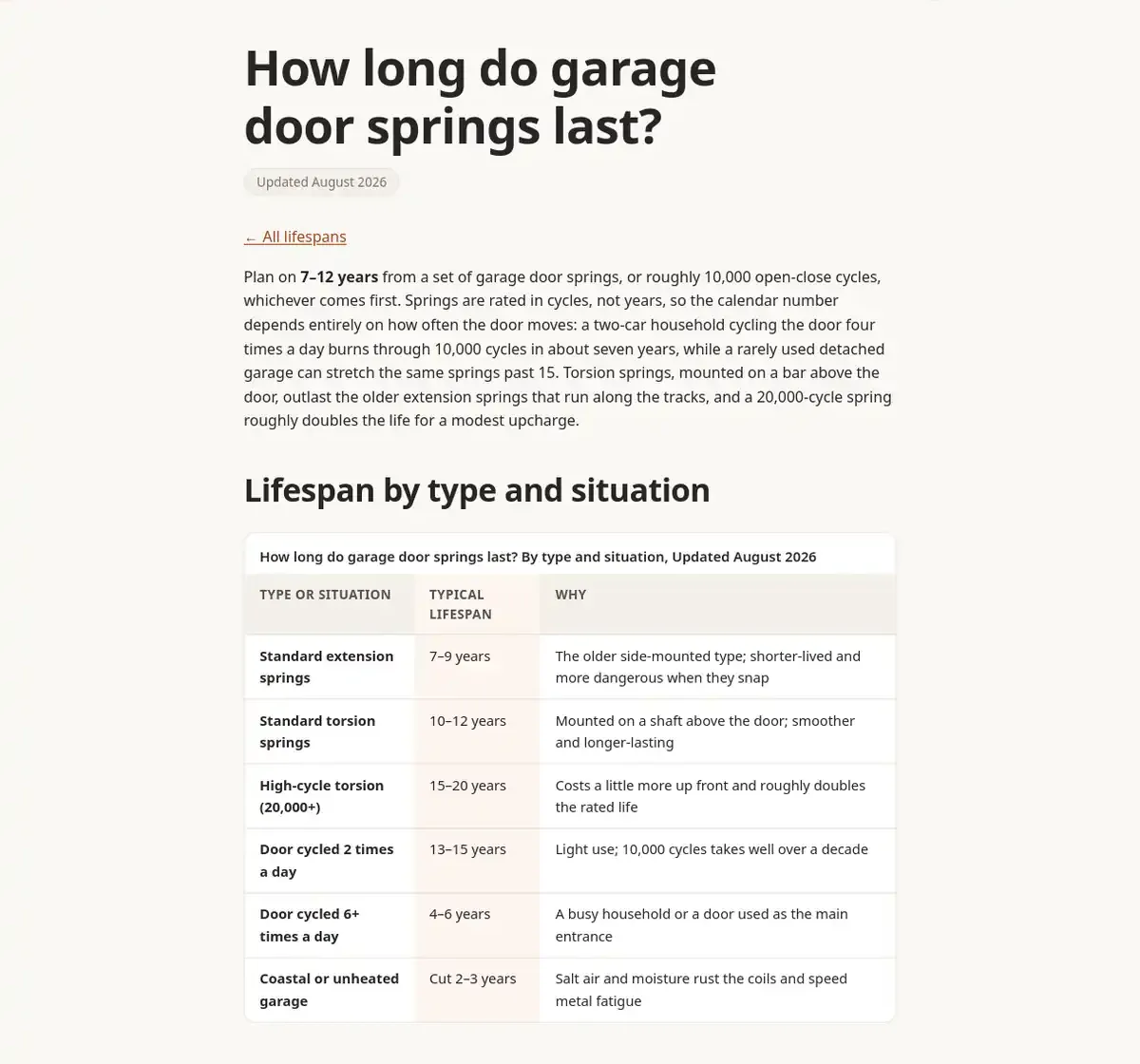
Garage Door Locator says torsion springs last 7 to 12 years, and a spring that loses tension makes the door feel heavy long before it snaps.
The opener only gives the last bit of force. When the springs lose tension, the opener takes the whole weight, and it strains or burns out.
This guide explains tension and torque in plain words, and shows the one test that tells you if your springs still match your door.
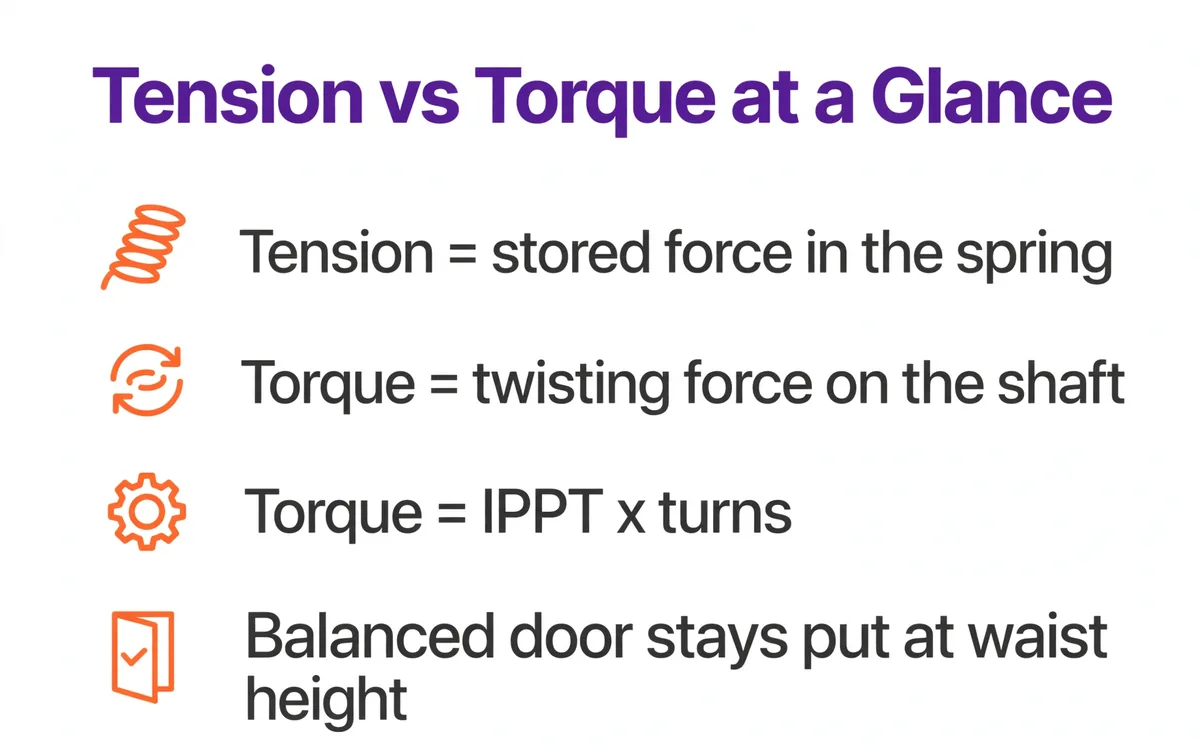
Garage door spring tension is the stored force in the spring, and torque is the twisting force it applies to the shaft. A torsion spring’s torque equals its IPPT times its turns. When tension drops, the door feels heavy and the opener strains. The balance test tells you in one minute: a balanced door stays put at waist height. Tension adjustment is pro-only.
Garage Door Hub connects you with a trusted local pro. Get a clear price for your garage door repair or replacement first.
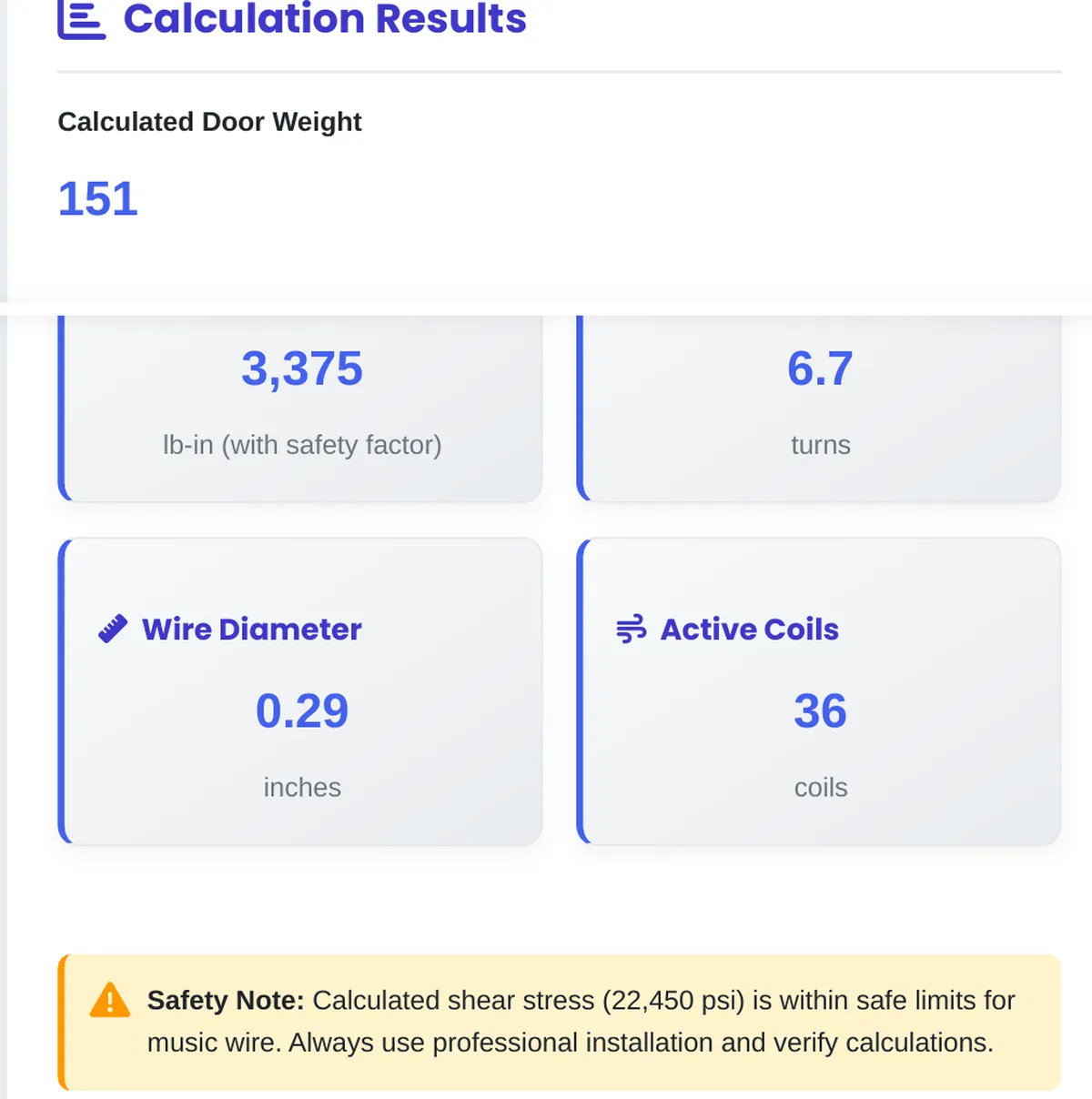
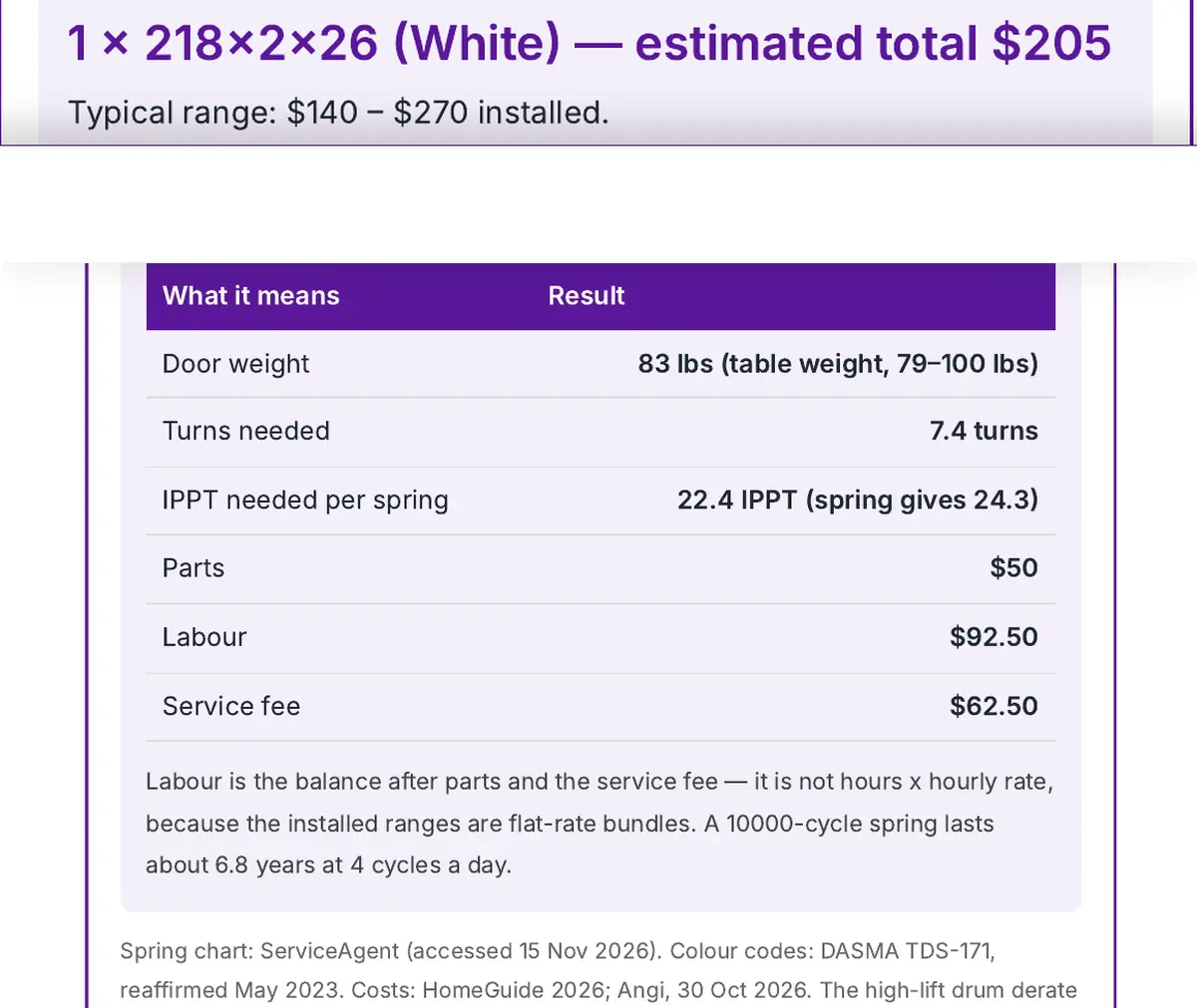
Work out your spring tension first with the free Tension Calculator below. It gives you the torque and turns for your door.
Spring Tension Calculator — work out spring tension, torque and turns for your door.
- Enter your door weight and spring size first.
- Note the torque and turns, then read the key takeaways.
- Use the balance test in Section 3 to check the result.
Key takeaways
- Tension is the stored force; torque is the twisting force on the shaft.
- A spring’s torque equals its IPPT times its turns.
- A balanced door stays put at waist height — test it twice a year.
- A heavy door usually means weak springs, not a weak opener.
- Tension adjustment is pro-only; lubrication and inspection are safe DIY.
Table of Contents
-
1. Tension and torque, in plain words
-
2. How tension lifts your door
-
3. The balance test
-
4. Why a door feels heavy
-
5. Tension and your opener
-
6. When to call a pro
-
7. Extension spring tension
- Watch: how a twisted spring lifts your door — torque, turns and the balance test
- FAQ
1. Tension and torque, in plain words
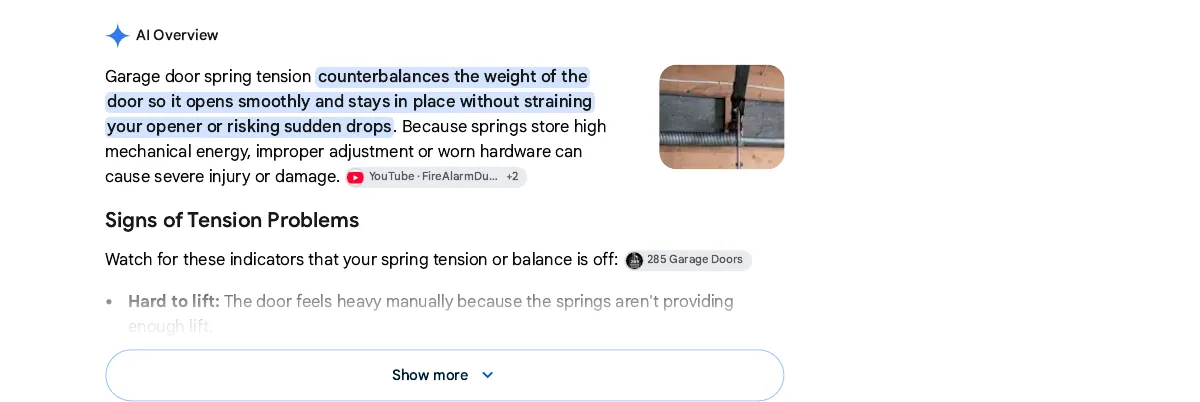
Tension and torque sound alike, but they are not the same. Tension is the force stored; torque is the twist that force makes.
Tension: the stored force
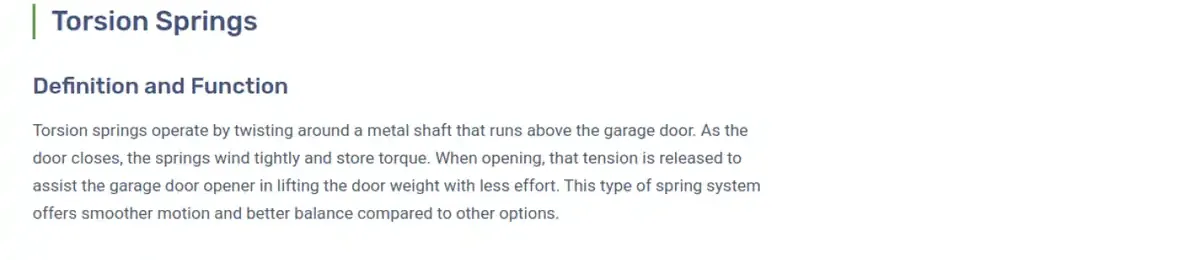
Tension is the force a spring holds when it is wound or stretched. It is the stored energy that lifts your door.
- Tension is the stored force in the spring.
- A torsion spring stores force by twisting.
- An extension spring stores force by stretching.
- More tension means more lift, up to the spring’s rating.
Torque: the twisting force
Torque is the twisting force the spring applies. It is measured in inch-pounds, and it is what the drums turn into lift.
- Torque is the twisting force on the shaft.
- A torsion spring’s torque equals its IPPT times its turns.
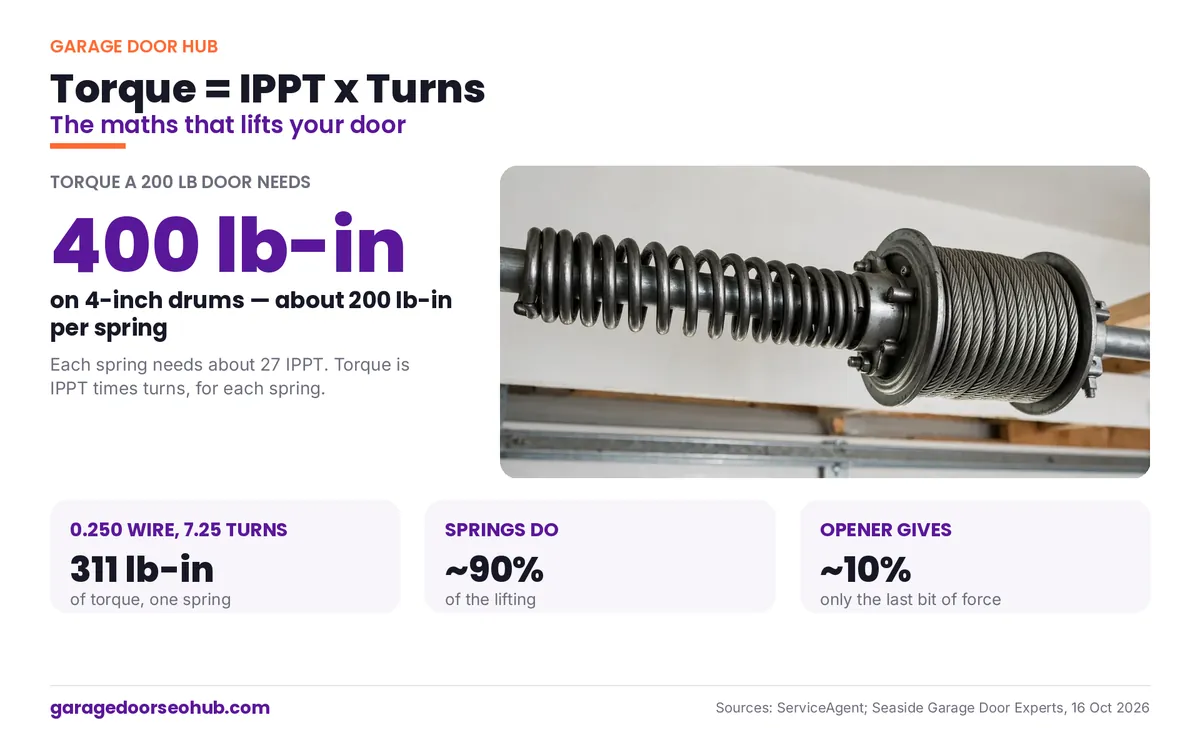
- A 0.250 wire spring at 7.25 turns holds about 311 inch-pounds.
- Torque is what turns the cable drums and lifts the door.
2. How tension lifts your door
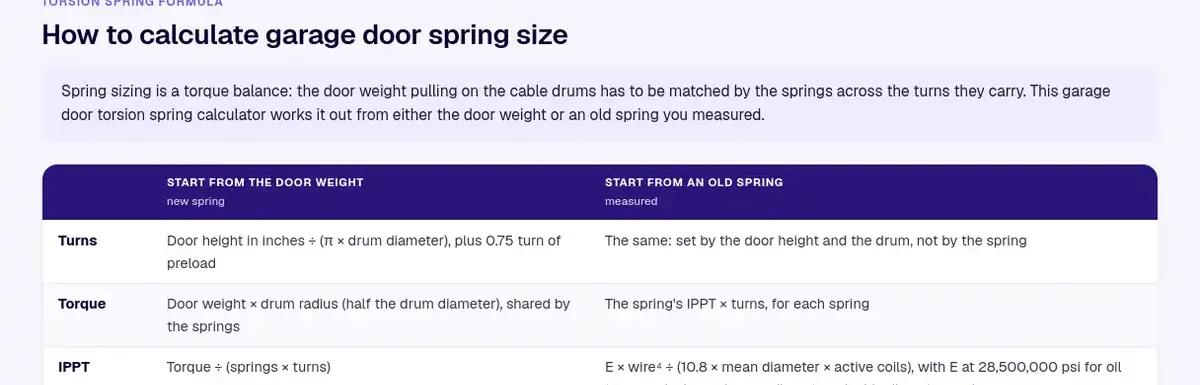
A spring lifts the door by balancing its weight. The maths is a torque balance: door weight against spring torque.
The torque balance
The door and the springs balance each other. The door pulls down with its weight, and the springs push up with their torque.

- Door torque equals door weight times drum radius.
- A 200 lb door on 4-inch drums needs 400 lb-in of torque.
- Two springs share that torque, about 200 lb-in each.
- Each spring’s IPPT times its turns must meet its share.
IPPT and turns
IPPT links the spring to the door. It is the torque one spring gives for each full turn it is wound.
- IPPT is inch-pounds per turn, the spring’s strength per turn.
- A 200 lb door needs about 27 IPPT per spring with two springs.
- Thicker wire gives more IPPT, so heavy doors need thicker wire.
- The Torsion Calculator works this out from your door weight.
Example: IPPT in full: garage door spring size, wire, length and turns guide.
3. The balance test
The balance test tells you in one minute whether the tension still matches the door. A door that will not hold still is out of balance.
How to run the test
The balance test is the one test that checks tension. It takes a minute, and it needs no tools at all.
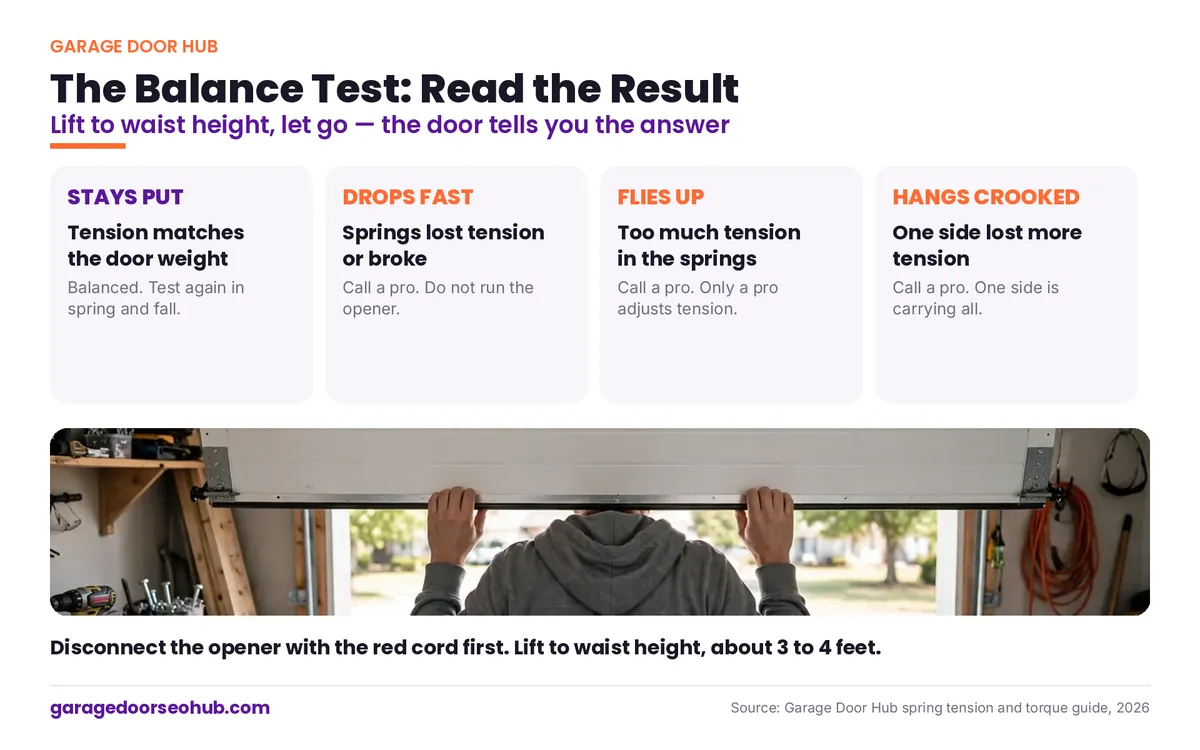
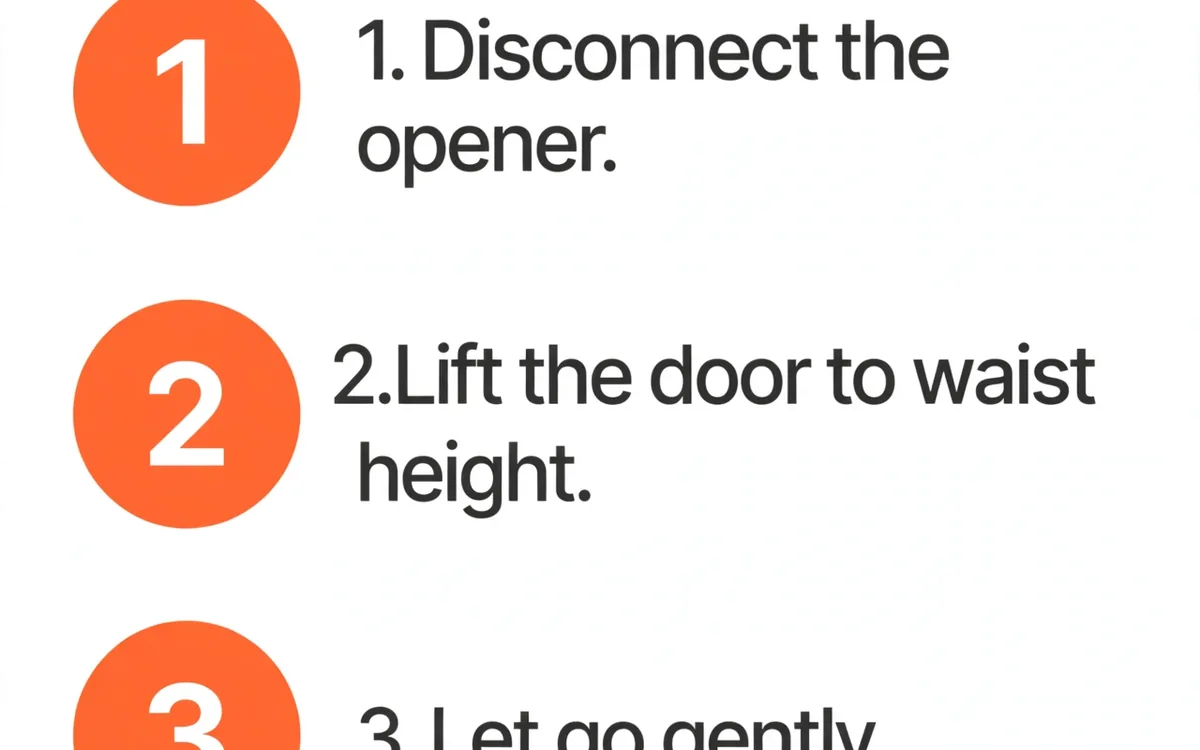
- Close the door and disconnect the opener with the red cord.
- Lift the door by hand to waist height, about 3 to 4 feet.
- Let go gently and watch what the door does.
- If it drops fast or flies up, the springs need a pro.
- Disconnect the opener with the red release cord.
- Lift the door by hand to waist height, then let go.
- A balanced door stays put at waist height.
- A door that drops fast has lost tension.
What the result means
A balanced door holds still at any height. Any other result points to the springs, and only a pro adjusts them.
- Stays put: the tension matches the door weight.
- Drops fast: the springs have lost tension or broken.
- Flies up: the springs carry too much tension.
- Hangs crooked: one side has lost more tension than the other.
4. Why a door feels heavy
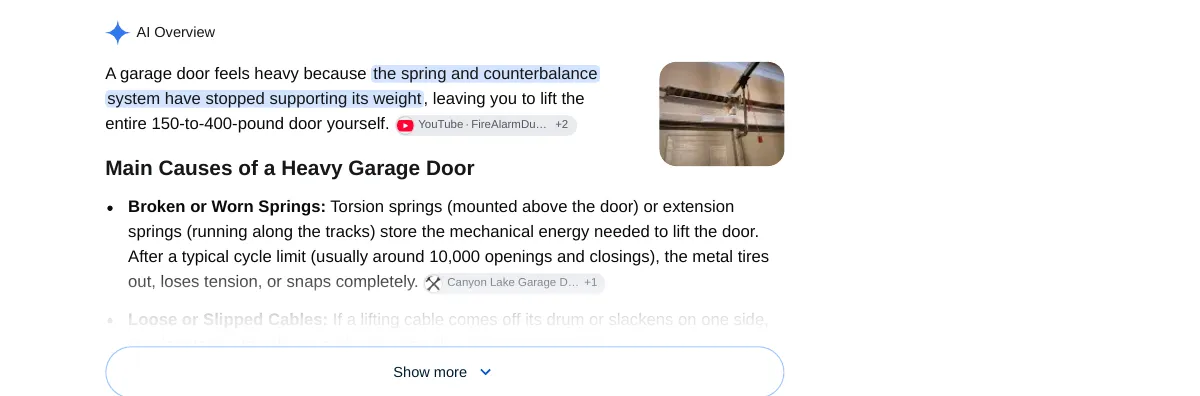
A door feels heavy when the springs stop carrying their share. The cause is almost always age, rust, or a broken spring.
A door that feels heavy
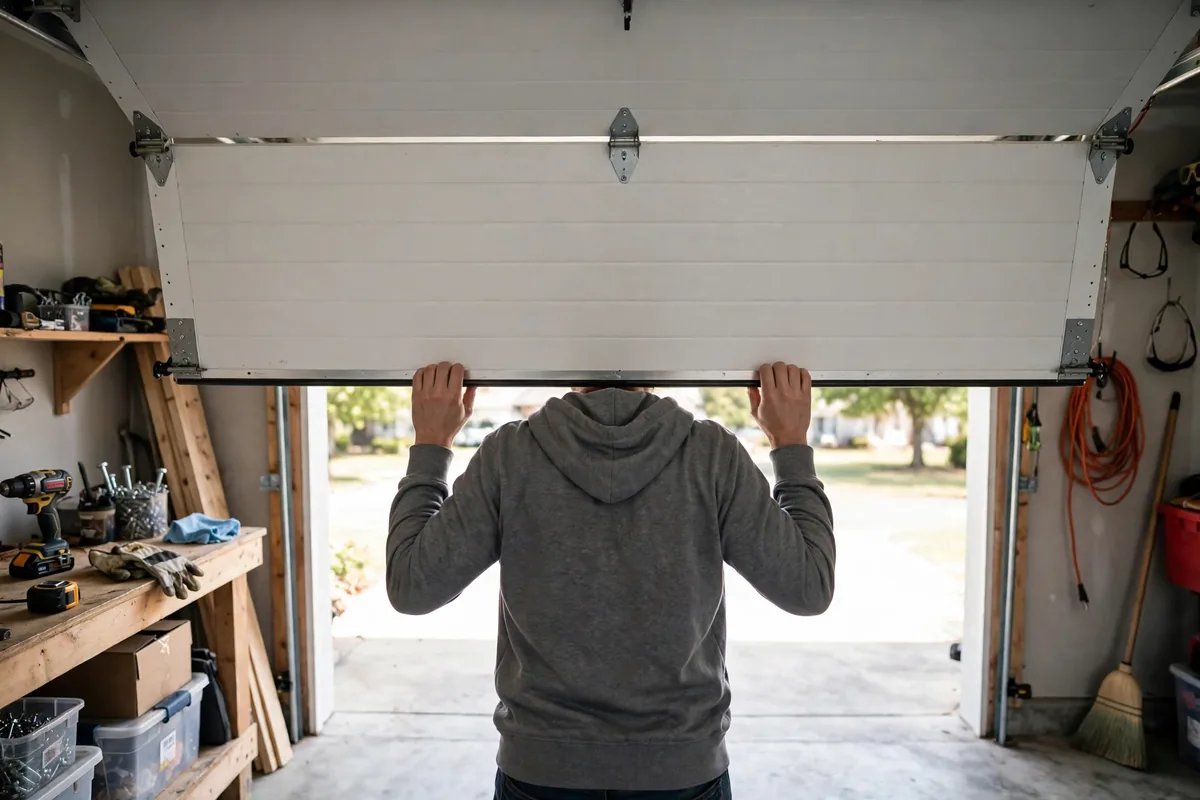
A heavy door is the first sign of lost tension. The springs are no longer carrying their share, so your hand feels the full weight.
- The door feels much heavier when you lift it by hand.
- The opener strains, stops, or reverses partway up.
- The door will not stay open on its own.
- The door hangs crooked or drops fast when you let go.
Why tension drops
Tension drops as springs age. Metal fatigue, rust, and cold all eat away at the stored force over time.
- Springs lose tension as the wire tires over thousands of cycles.
- Rust pits the wire and weakens it from the inside.
- A broken spring on one side leaves the other side to carry all.
- Cold stiffens grease and adds load in winter.
5. Tension and your opener
A straining opener is usually a spring problem, not an opener problem. The motor is doing a job the springs should do.
Opener vs springs
The opener and the springs are a team. The springs do about 90% of the lifting, and the opener only guides the door.
- The opener only gives the last bit of force, about 10%.
- A weak spring makes the opener lift the full door weight.
- The opener strains, runs hot, and wears out early.
- A new opener on weak springs will fail early too.
Fix the springs first
Never buy a bigger opener to fix a heavy door. Fix the springs first, and the old opener may work fine again.
- Fix the springs first, before you blame the opener.
- A spring pair costs $150 to $350 installed (HomeGuide, 2026).
- A new opener costs $213 to $371 installed on average.
- Test the balance before you buy any opener.
6. When to call a pro
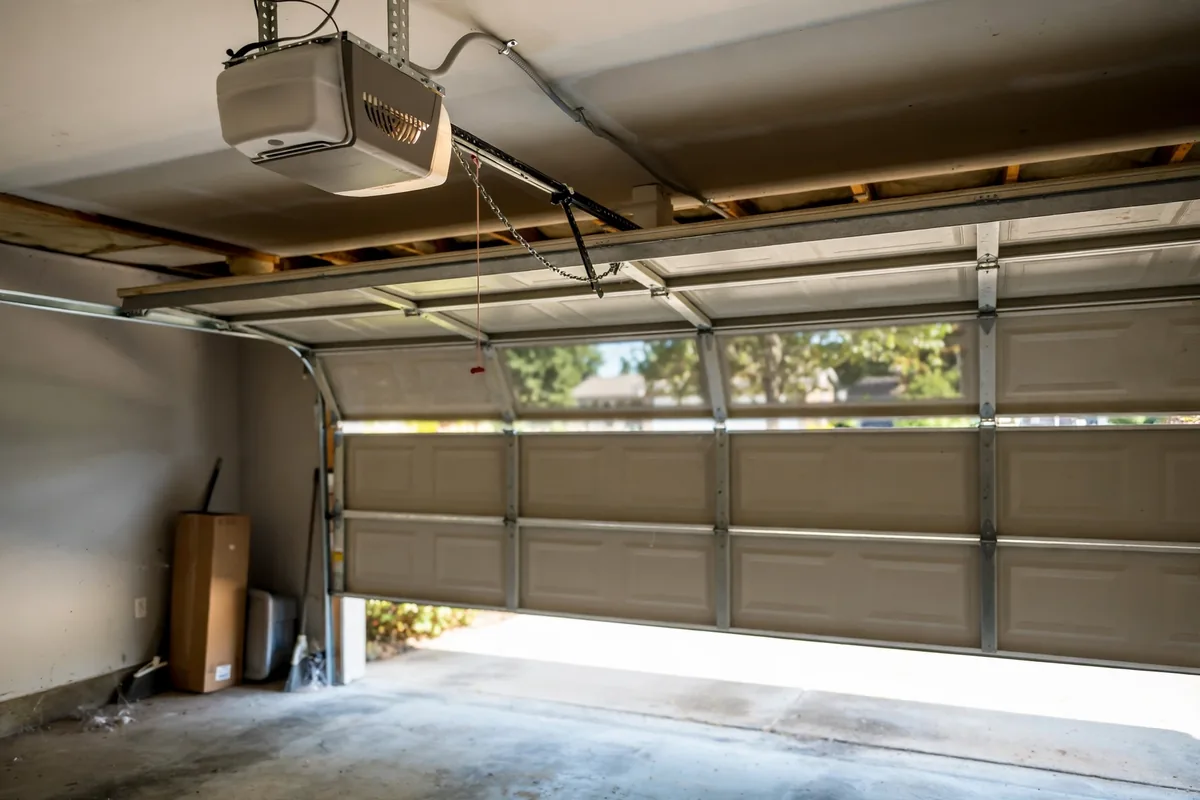
The line is clear: check and lubricate, but never wind. A pro sets tension, and you check the result with the balance test.
Never adjust tension yourself
Tension adjustment is pro-only work. A wound spring can break a wrist, and the winding bars are not a DIY tool.
- Never wind, adjust, or replace a spring yourself.
- A wound torsion spring holds hundreds of foot-pounds of energy.
- The winding step is where people get hurt.
- A pro sets the turns and checks the balance by hand.
The safe checks you can do
Your safe checks are lubrication, inspection, and the balance test. Everything else with a spring belongs to a pro.
- Lubricate spring coils twice a year with silicone spray.
- Inspect springs each spring and fall for rust and gaps.
- Run the balance test twice a year, in spring and fall.
- Call a pro when the door drops fast or feels heavy.
Example: Broken-spring checks: broken garage door spring guide. Full spring picture: garage door springs complete guide.
7. Extension spring tension
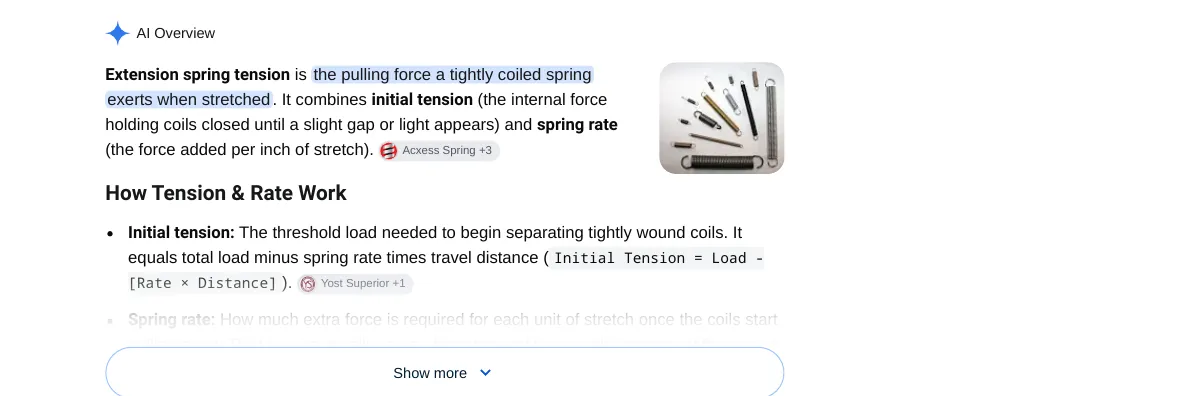
Extension springs work by stretch, not by twist. Their tension is checked by comparing the two sides, not by winding.
Extension tension is stretch
Extension spring tension is stretch, not twist. The spring pulls the door up as it contracts, one spring per side.
- Extension springs store tension by stretching, not twisting.
- The lift comes from the spring contracting as the door opens.
- Uneven stretch on the two sides makes the door hang crooked.
- A stretched spring that sags has lost its tension.
Checking extension tension
Checking extension tension is a look, not a touch. Compare the sides, check the pulleys, and leave the rest to a pro.
- Compare the two side springs: they should match in length.
- A longer spring on one side is the tired one.
- Pulleys must spin freely, or the tension is uneven.
- Only a pro replaces or re-tensions extension springs.
Watch: how a twisted spring lifts your door — torque, turns and the balance test
Unbolted shows on YouTube how the torsion spring above the door unwinds turn by turn as the cables wind onto the drums — and why a balanced door floats wherever you leave it.
- The spring is twisted about one turn per foot of door height — about 7.5 turns on a 7-foot door.
- As the door rolls onto the ceiling tracks, less of it hangs, and the spring’s pull falls in step.
- The opener only guides the door; spring adjustment and replacement is a job for a trained technician.
Video: Unbolted (Majid Khan Mohmand), YouTube. Checked 21 November 2026.
Garage Door Hub connects homeowners with trusted local garage door pros. Need a repair? Need a replacement? Start here. First, find out what it should cost. Then, price your exact job with our free calculator. Next, find a pro near you. Fast. No jargon. No guesswork. No surprise bills. Just clear prices, honest guides, and a local pro you can call today.
FAQ
What is the difference between spring tension and torque?
Tension is the stored force in the spring, and torque is the twisting force it applies to the shaft. A torsion spring’s torque equals its IPPT times the turns it is wound.
Why does my garage door feel heavy?
The springs have lost tension, or one has broken. A balanced door stays put at waist height. A door that drops fast needs a pro to check the springs.
How do I test my garage door spring tension?
With the door closed, disconnect the opener and lift the door to waist height by hand. A balanced door stays put. A door that drops fast or flies up is out of balance.
Can I adjust my garage door spring tension myself?
No. Only a pro adjusts spring tension. A wound torsion spring holds hundreds of foot-pounds of energy, and the winding step is where people get hurt.
What are the signs of low spring tension?
A door that feels heavy, drops fast, will not stay open, or hangs crooked has lost tension. The opener strains, stops, or reverses partway up the track.
Will a bigger opener fix a heavy garage door?
No. A bigger opener cannot fix weak springs. The springs do about 90% of the lifting, so an undersized spring makes any opener struggle and wear out early.
Sources
- ServiceAgent, accessed 20 Nov 2026 — torque balance, IPPT formula, worked example. Verified live, 20 Nov 2026.
- Seaside Garage Door Experts, updated 16 Oct 2026 — a 0.250 wire spring at 7.25 turns holds about 311 inch-pounds. Verified live, 20 Nov 2026.
- Garage Door Locator, 2026 — torsion vs extension comparison, lifespans. Verified live, 20 Nov 2026.
- Dan's Garage Door Services, 2026 — torsion springs store energy by twisting. Verified live, 20 Nov 2026.
- HomeGuide, 2026 — torsion pair $150–$350. Verified live, 20 Nov 2026.
- OnOtto, updated Aug 2026 — 7–12 years, 10,000 cycles standard. Verified live, 20 Nov 2026.
- Garage Door Hub Spring Tension Calculator 1510 — live calculator. Live 20 Nov 2026.
Last reviewed: 20 November 2026
Appendix — Related topics
You might have found this by these keywords — and if not, others might have: garage door spring tension, garage door spring torque, garage door feels heavy, extension spring tension, how to test garage door spring tension, garage door spring tension adjustment, what is IPPT garage door spring, garage door balance test, why is my garage door so heavy, garage door opener straining.