

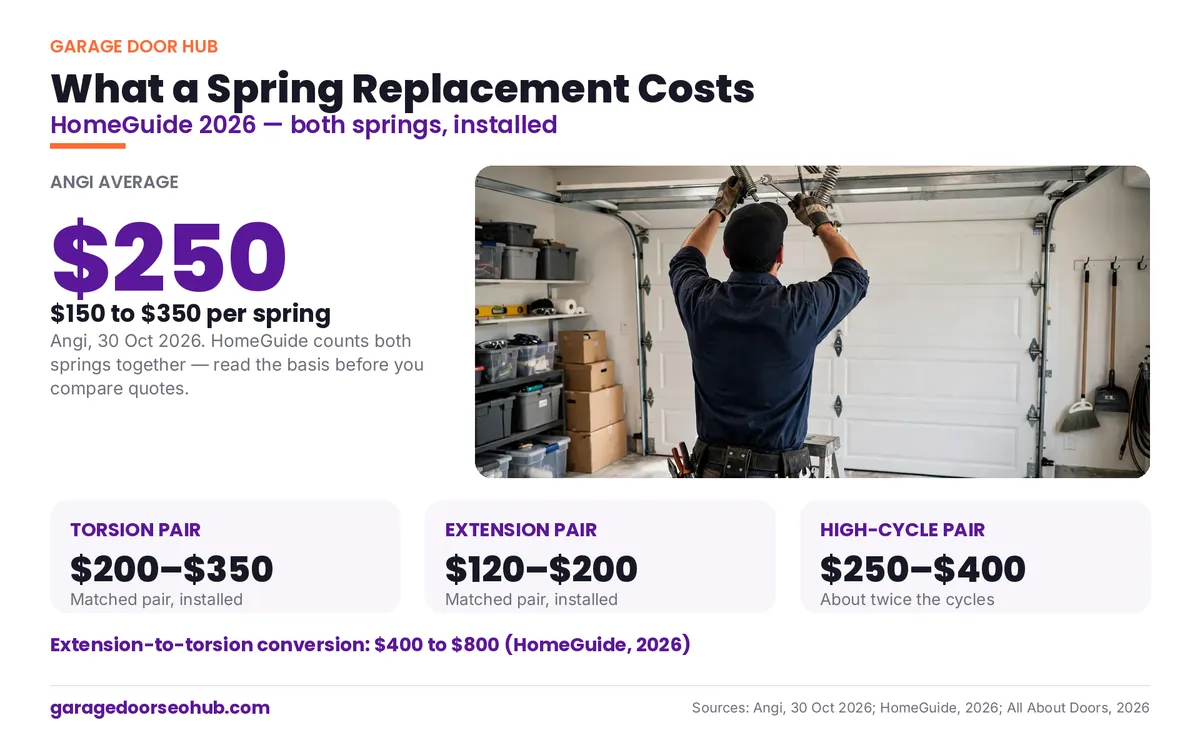
Angi puts the average garage door spring replacement at $250 in 2026. Most homeowners pay $150 to $350 per spring.
HomeGuide counts the same job differently, at $150 to $350 for both torsion springs together. That gap is why two quotes can look miles apart.
This guide clears up that confusion. It covers every spring question in one place, from type and size to cost, lifespan, and safe maintenance.
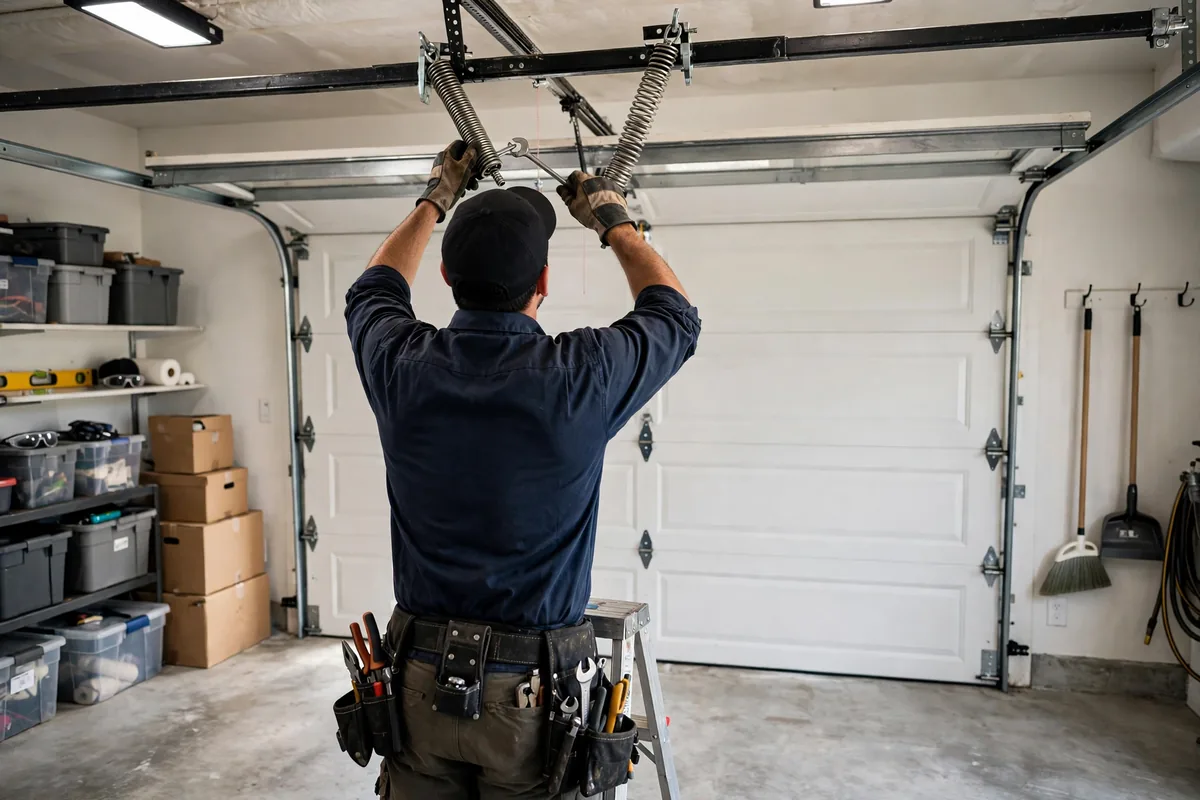
Garage door springs do about 90% of the lifting every time your door moves, and a standard set lasts about 10,000 cycles, or 7 to 10 years (OnOtto, Aug 2026). A torsion pair costs $200 to $350 installed, an extension pair $120 to $200 (HomeGuide, Oct 2026). Springs are pro-only work, never a DIY repair.
Garage Door Hub connects you with a trusted local pro. Get a clear price for your garage door repair or replacement first.
Price your spring job first with the free calculators below. They give you a number before you call anyone.
Spring Calculator — price a spring job by door size, weight and turns.
Spring Size Calculator — find the right wire size, length and turns for your door.
- Enter your door size, weight and material first.
- Note the spring size and the price, then read the key takeaways.
- Use the price in Section 5 to check any quote you get.
Key takeaways
- Springs do about 90% of the lifting; the opener only guides the door.
- Torsion springs last longer and fail safer than extension springs.
- Replace springs in pairs — both share the same age and wear.
- A standard spring lasts 10,000 cycles, about 7 to 10 years.
- Spring work is pro-only; lubrication and inspection are safe DIY.
Table of Contents
-
1. What garage door springs do
-
2. Torsion vs extension springs at a glance
-
3. How to tell if a spring is broken
-
4. Spring size, wire, length and turns
-
5. What a spring replacement costs
-
6. How long springs last
-
7. Tension, noise, safety and maintenance
- Watch: Garage door springs — lifespan, cost and what to choose
- FAQ

1. What garage door springs do
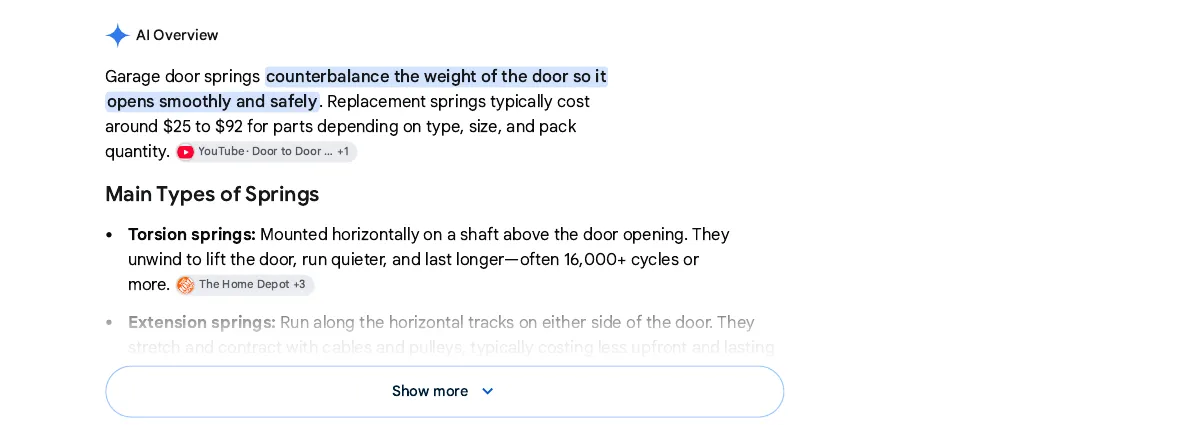
A garage door weighs 80 to 400 pounds, yet one hand can lift it. The springs make that possible by balancing the weight.
Springs do the lifting, not the opener
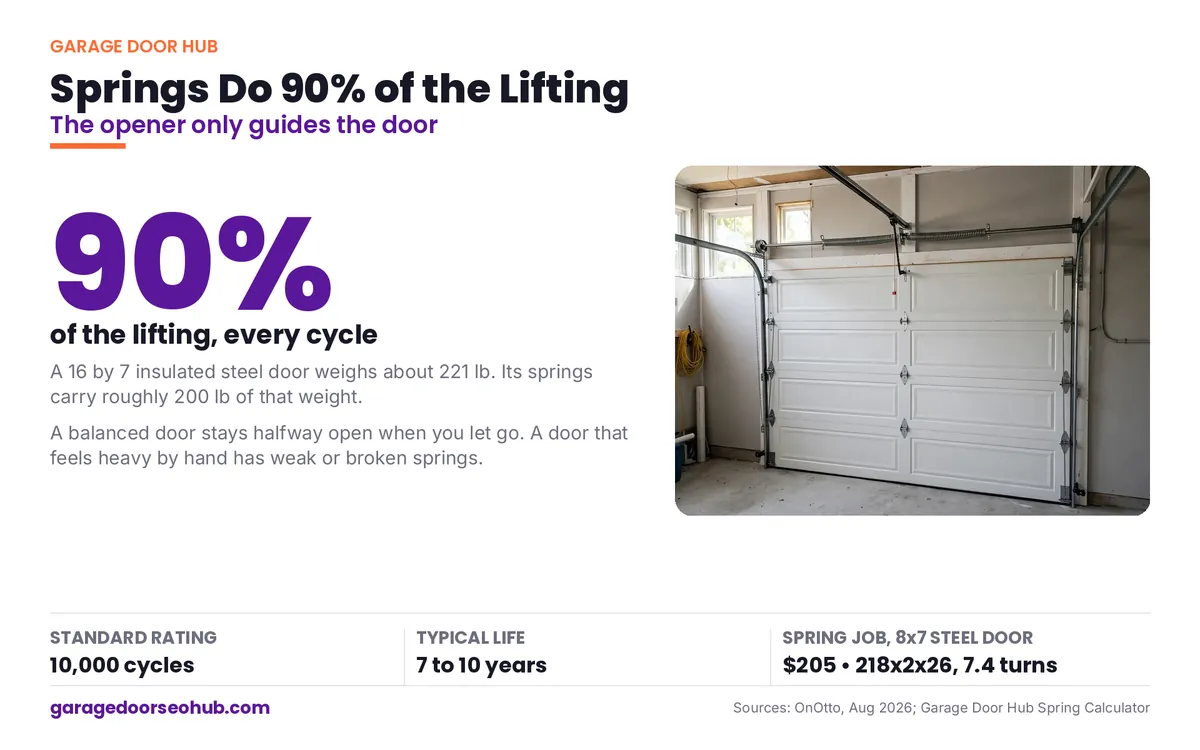
The opener motor only gives the last bit of force. The springs carry about 90% of the door weight on every cycle.
- A balanced door stays halfway open when you let go.
- A door that feels heavy by hand has weak or broken springs.
- An opener that strains is often fighting bad springs.
- Fix the springs first, before you blame the opener.
Example: A 16 by 7 insulated steel door weighs about 221 lb. Its springs carry roughly 200 lb of that, so the opener only handles the rest.
One cycle, and why it matters
One cycle is one full open and one full close. Springs are rated in cycles, not years, so use decides lifespan.
- Standard springs are rated for about 10,000 cycles.
- Four cycles a day burns through 10,000 cycles in about 7 years.
- Two cycles a day stretches the same springs past 13 years.
- Count your daily cycles before you guess a spring age.
2. Torsion vs extension springs at a glance
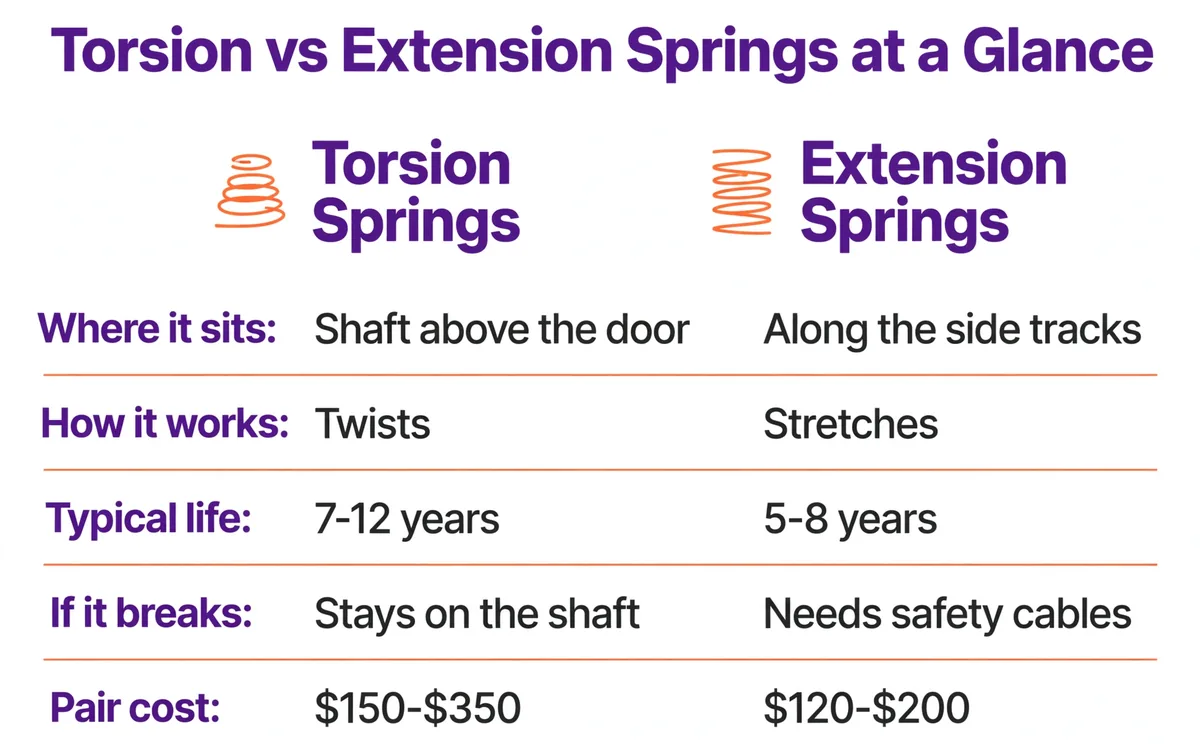
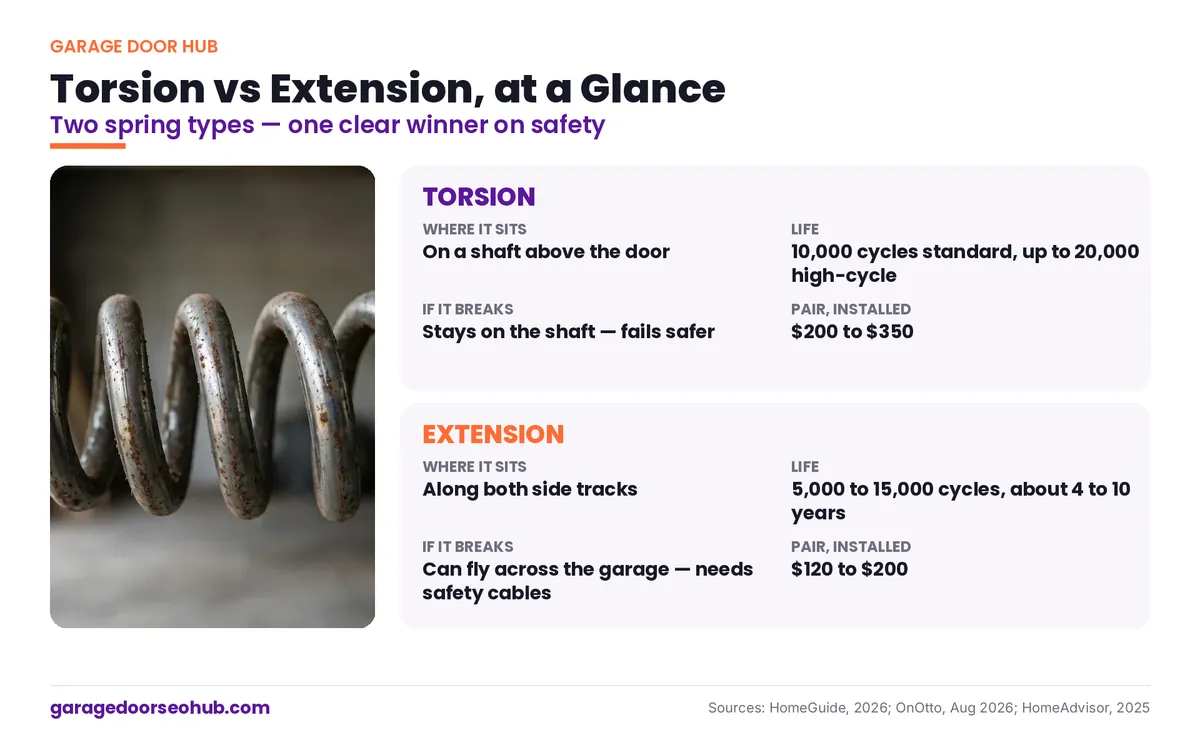
Every home door uses one of two spring types. Torsion springs twist above the door, while extension springs stretch along the tracks.
Torsion springs: the modern standard
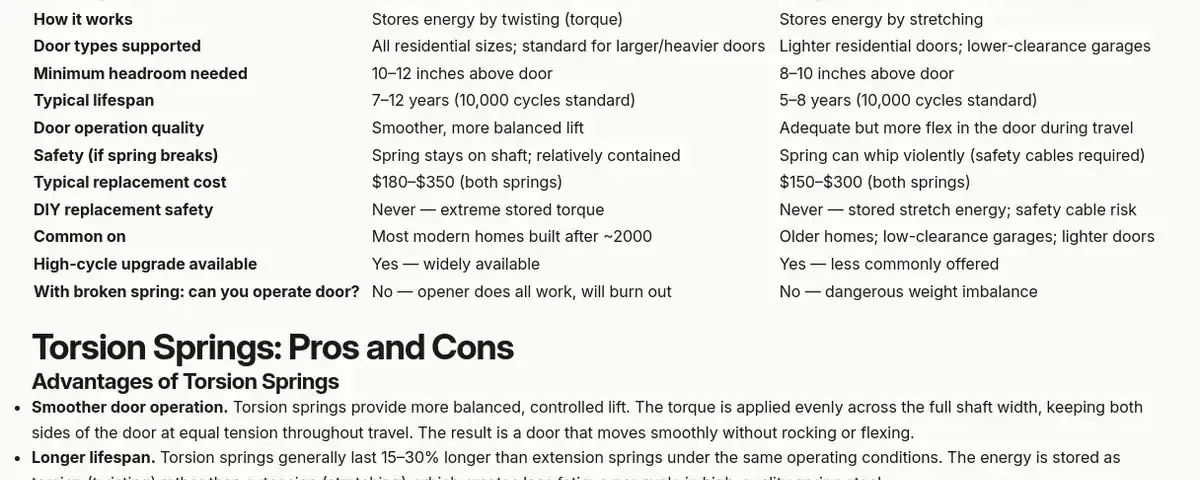
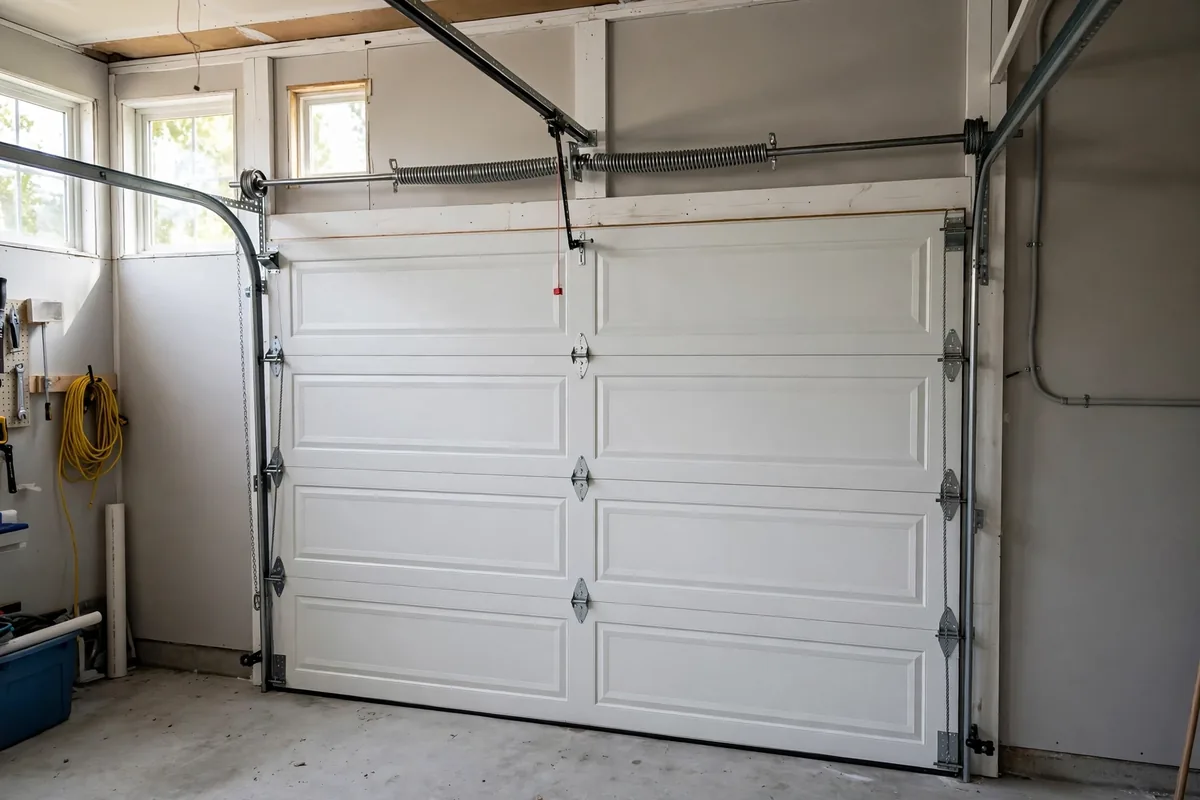
Torsion springs sit on a steel shaft above the door. They twist to store energy as the door closes, then unwind to lift it.
- Smoother and quieter than extension springs.
- Last longer: 10,000 cycles standard, up to 20,000 high-cycle.
- Stay on the shaft when they break, so they fail safer.
- Standard on most modern sectional doors.
Extension springs: older, cheaper, riskier
Extension springs run along the horizontal tracks, one per side. They stretch as the door closes and contract to lift it.
- Cheaper parts: $15 to $45 each, against $30 to $100 for torsion (HomeAdvisor, 2025).
- Shorter life: 5,000 to 15,000 cycles, about 4 to 10 years (HomeGuide, 2026).
- Can fly across the garage when they snap, unless safety cables hold them.
- Common on older doors and lighter single-panel doors.
Example: For the full comparison, see the torsion vs extension springs guide. It shows how to tell which type you have in 30 seconds.
3. How to tell if a spring is broken
A broken spring is the most common garage door failure. The signs are loud and clear, and the door tells you fast.
The loud bang and the gap
A single loud bang, like a gunshot from the garage, almost always means a torsion spring broke. A visible gap in the coil confirms it.
- Look for a gap of 2 to 3 inches in the torsion spring coil.
- Check for a loose cable hanging beside the door.
- Do not run the opener again; it can burn out the motor.
- Do not try to lift a door with a broken spring.
The slow signs before the snap
Most springs warn you before they snap. A door that feels heavy, drops fast, or will not stay open is telling you the springs are tired.
- The door feels much heavier when you lift it by hand.
- The door hangs crooked or drops fast when you let go.
- The opener strains, stops, or reverses partway up.
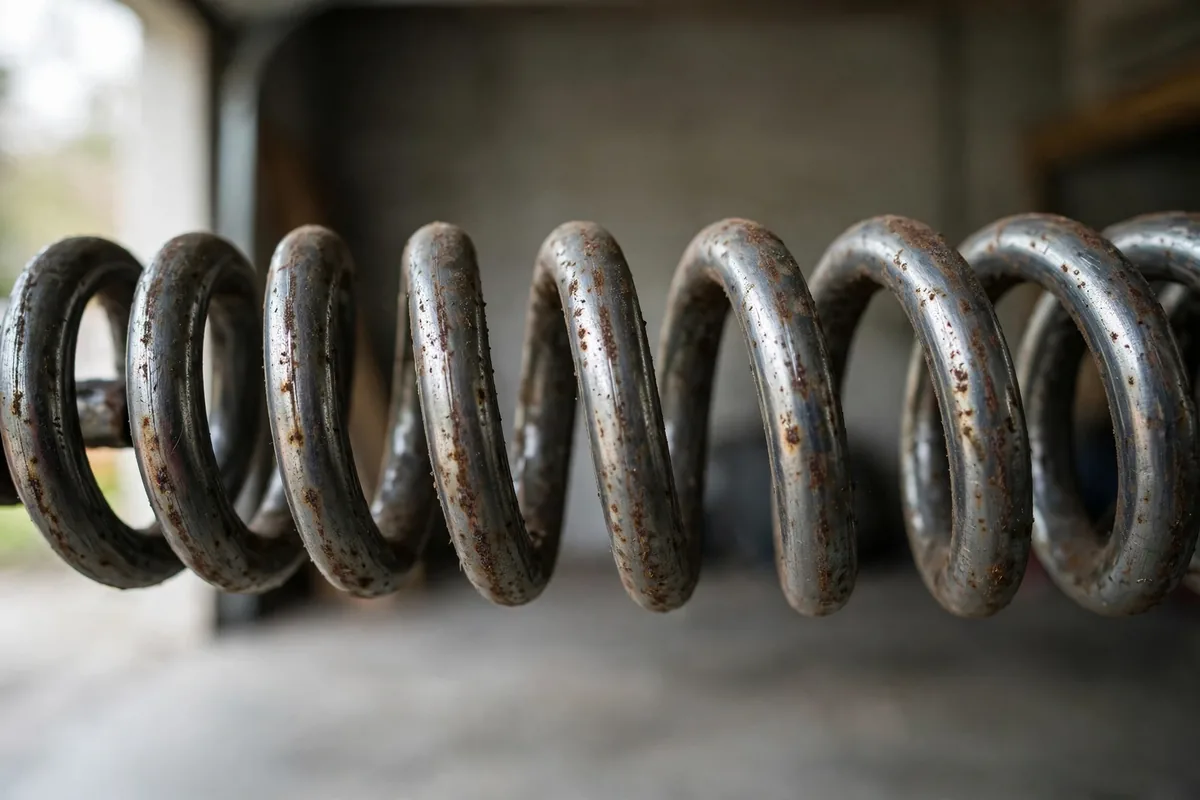
- Rust flakes or orange stains below the spring mean wear.
Example: The technical version lives in the broken garage door spring guide. It covers wire size, coil counts, the gap, and the balance test.
4. Spring size, wire, length and turns
A spring must match the door weight exactly. Too weak and the door feels heavy; too strong and it slams up and wears the opener.
Wire size decides the lift
Wire size is the thickness of the steel wire, in inches. Common home sizes run from 0.207 to 0.262 inches, and thicker wire lifts more.
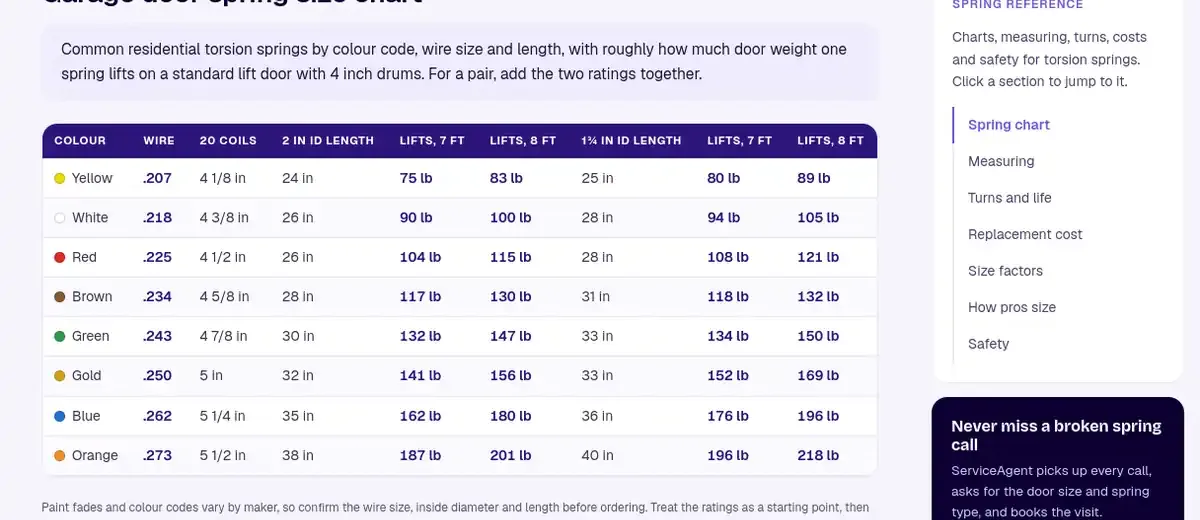
- A 0.207-inch wire lifts about 75 lb on a 7 ft door.
- A 0.218-inch wire lifts about 90 lb on a 7 ft door.
- Measure 20 coils end to end, then divide by 20.
- Color codes mark wire size: yellow 0.207, white 0.218, red 0.225.
Turns come from door height
Turns are set by door height and drum size, not by the spring. A 7 ft door on 4-inch drums needs about 7.4 turns.
- 7 ft door: about 7.4 turns; 8 ft door: about 8.4 turns.
- Add about 1 turn for each extra foot of height.
- IPPT is inch-pounds per turn, the spring’s strength per turn.
- Sizing is information; winding a spring is never DIY.
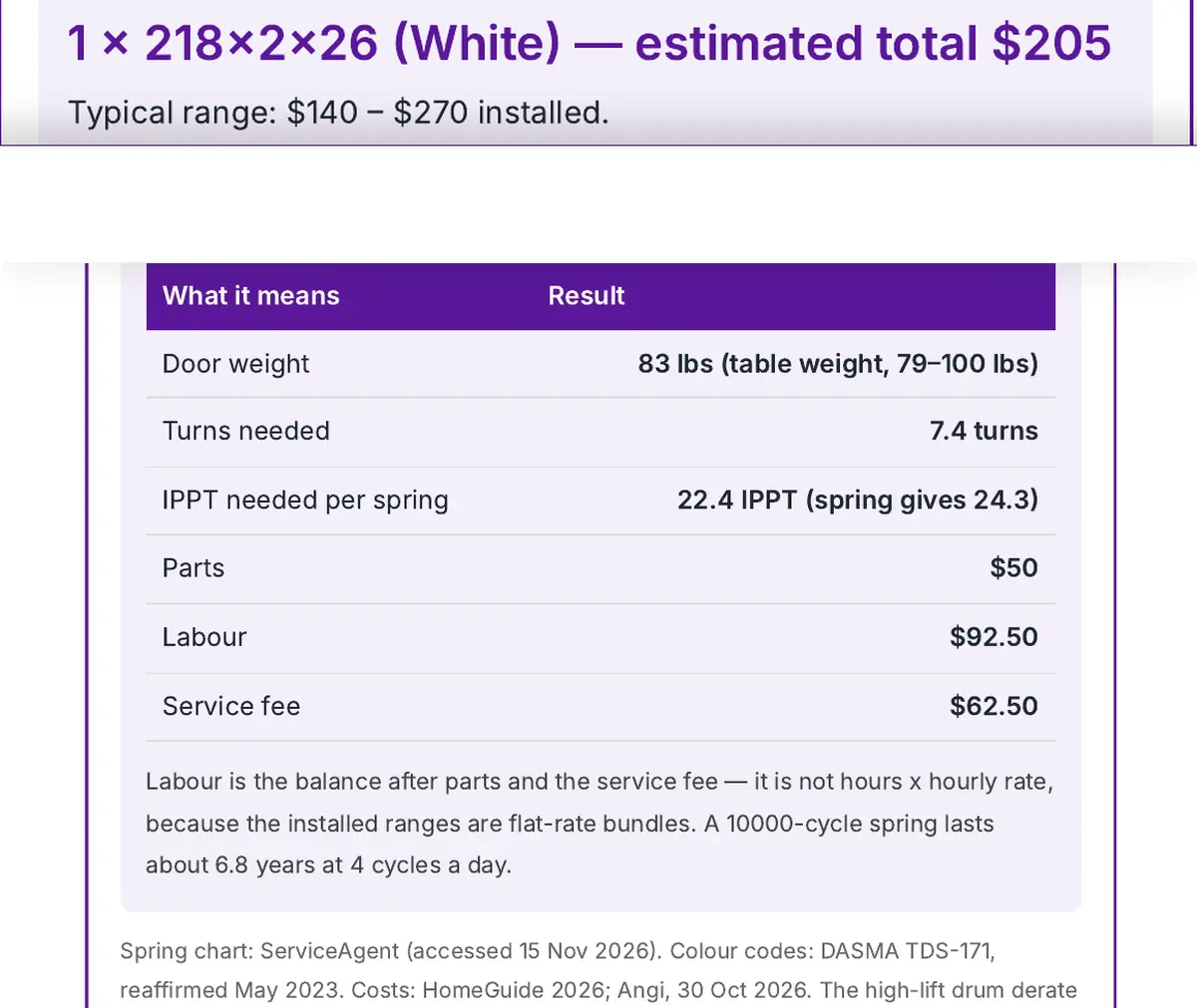
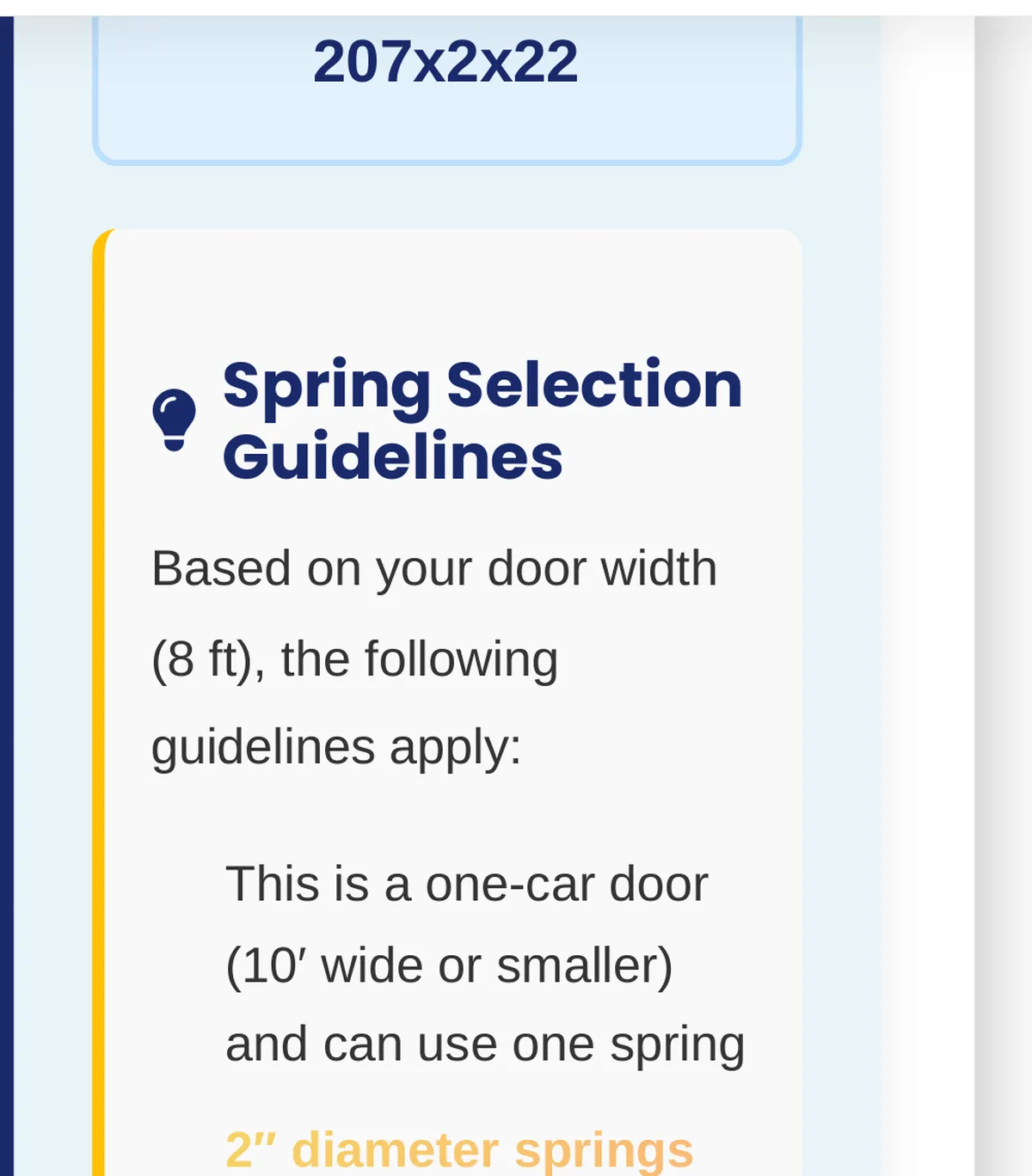
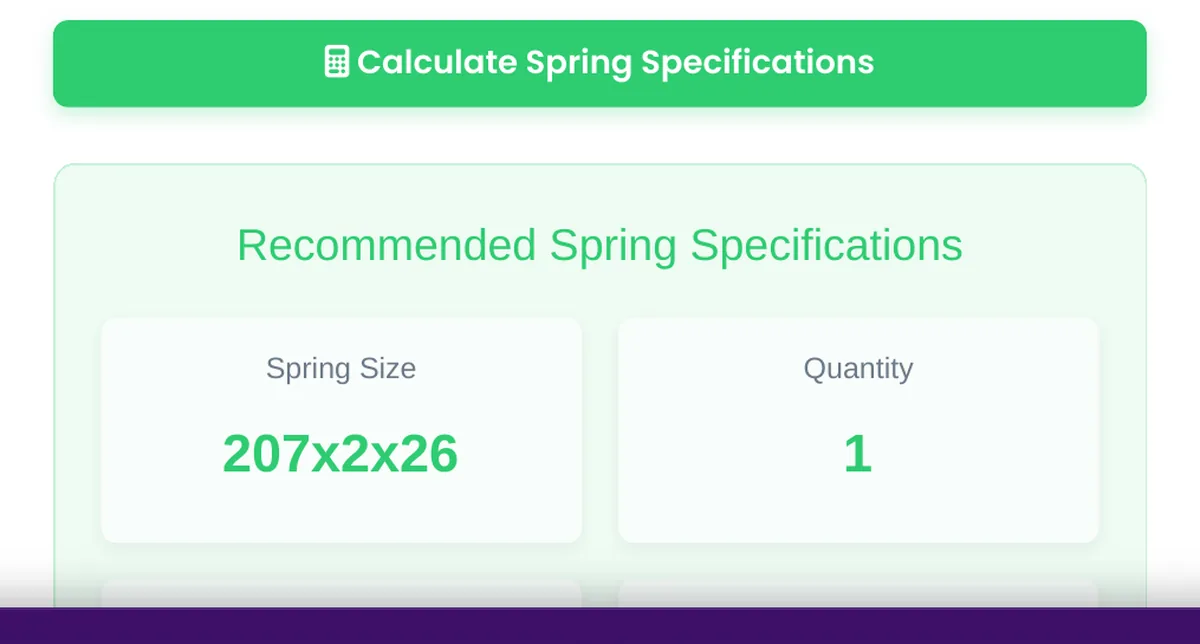
Example: Work it out with the Spring Size Calculator. An 8 by 7 steel door weighs 83 lb and needs one 218x2x26 spring, at 7.4 turns.
5. What a spring replacement costs
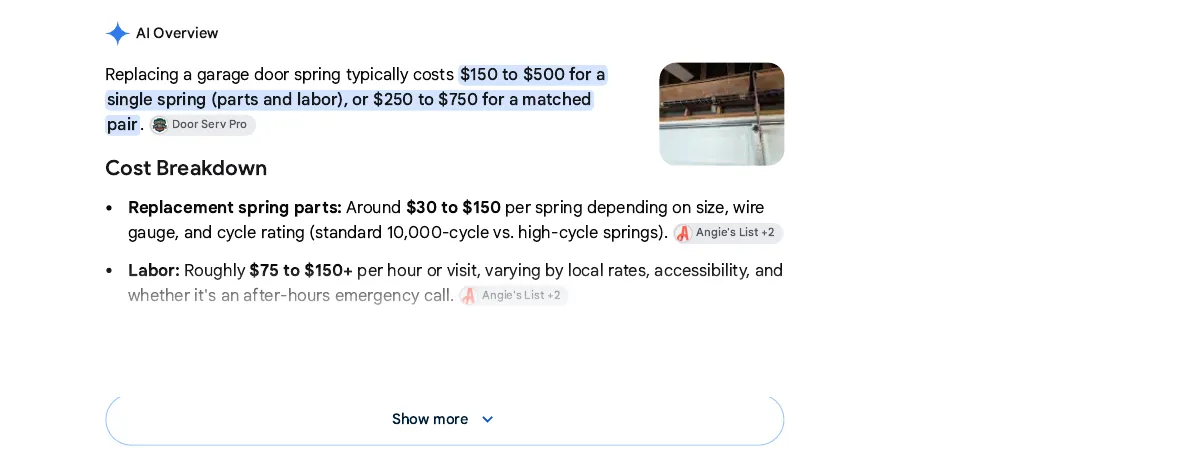
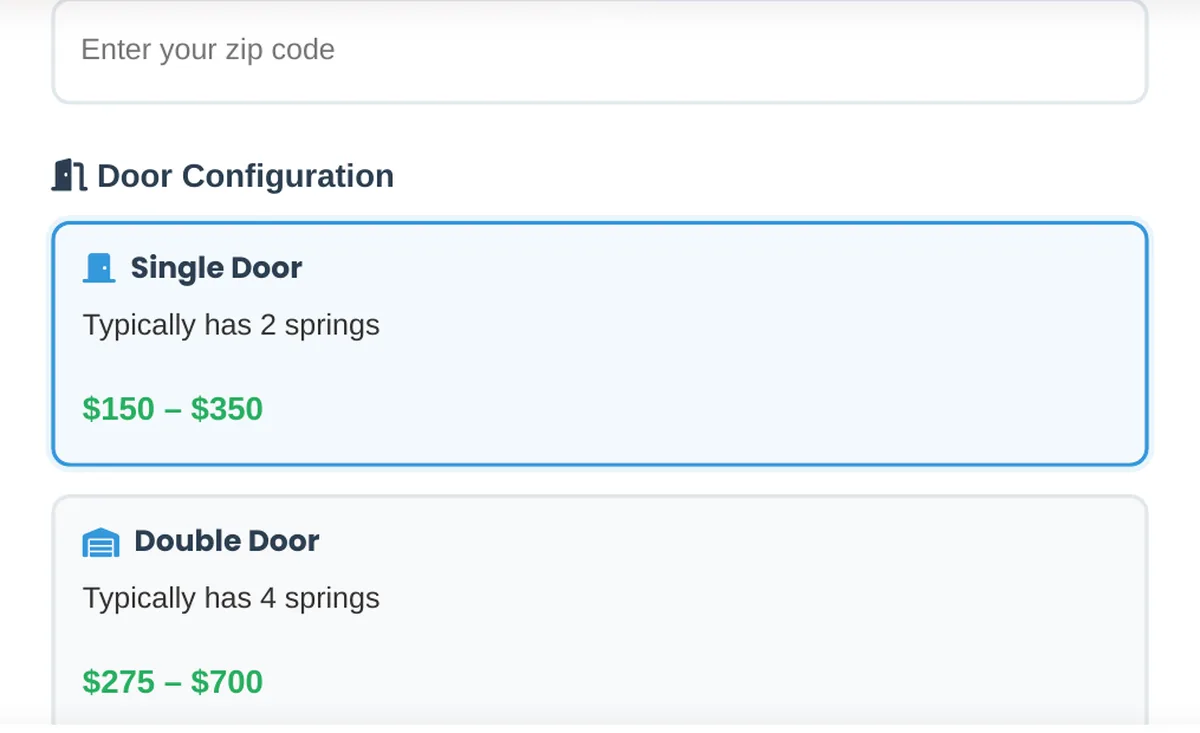
Spring prices look confusing because sources count them on different bases. Angi counts per spring, while HomeGuide counts both springs together.
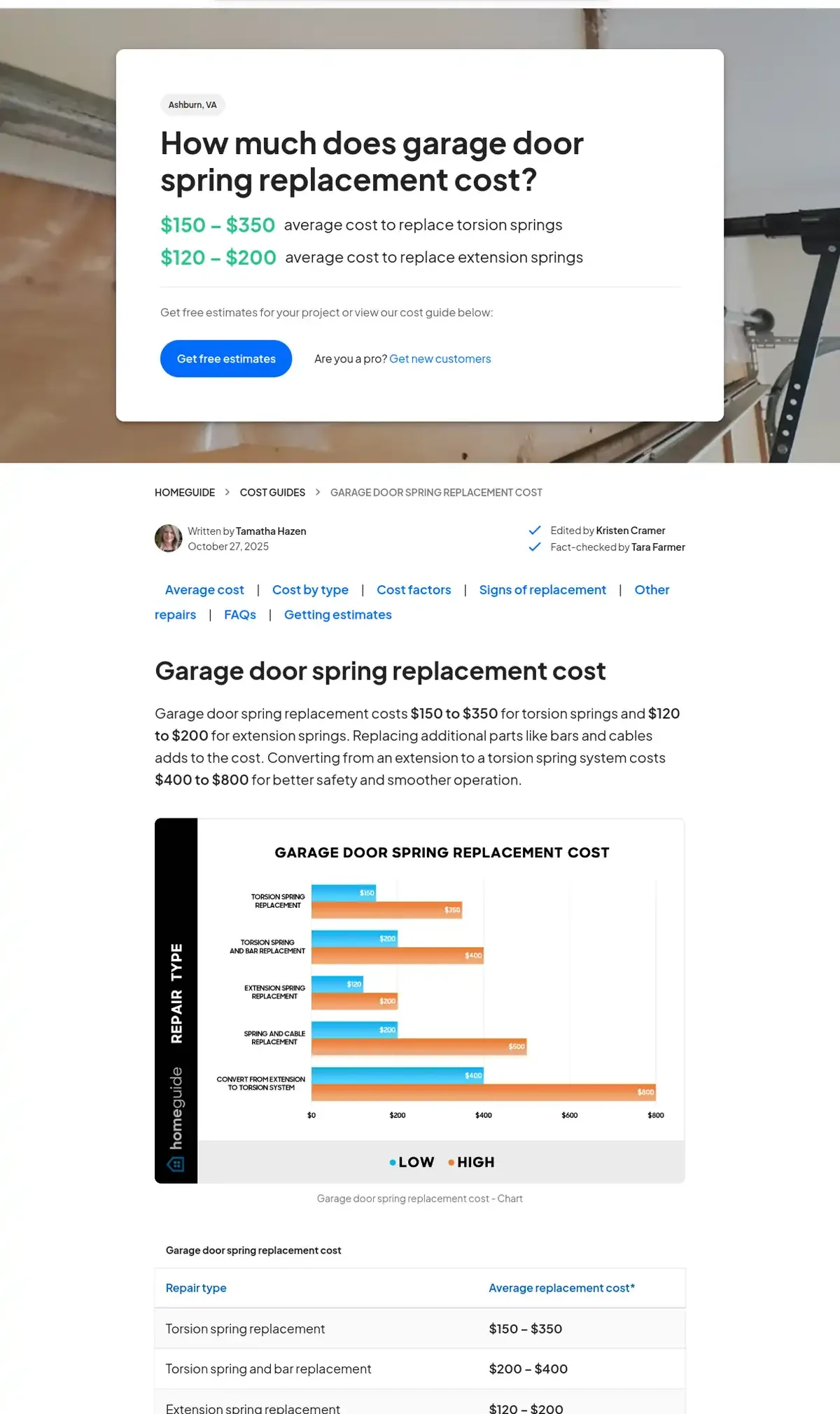
Torsion vs extension, single vs pair
Always replace springs in pairs. Both springs share the same age and wear, so a new spring beside an old one leaves the old one ready to snap.

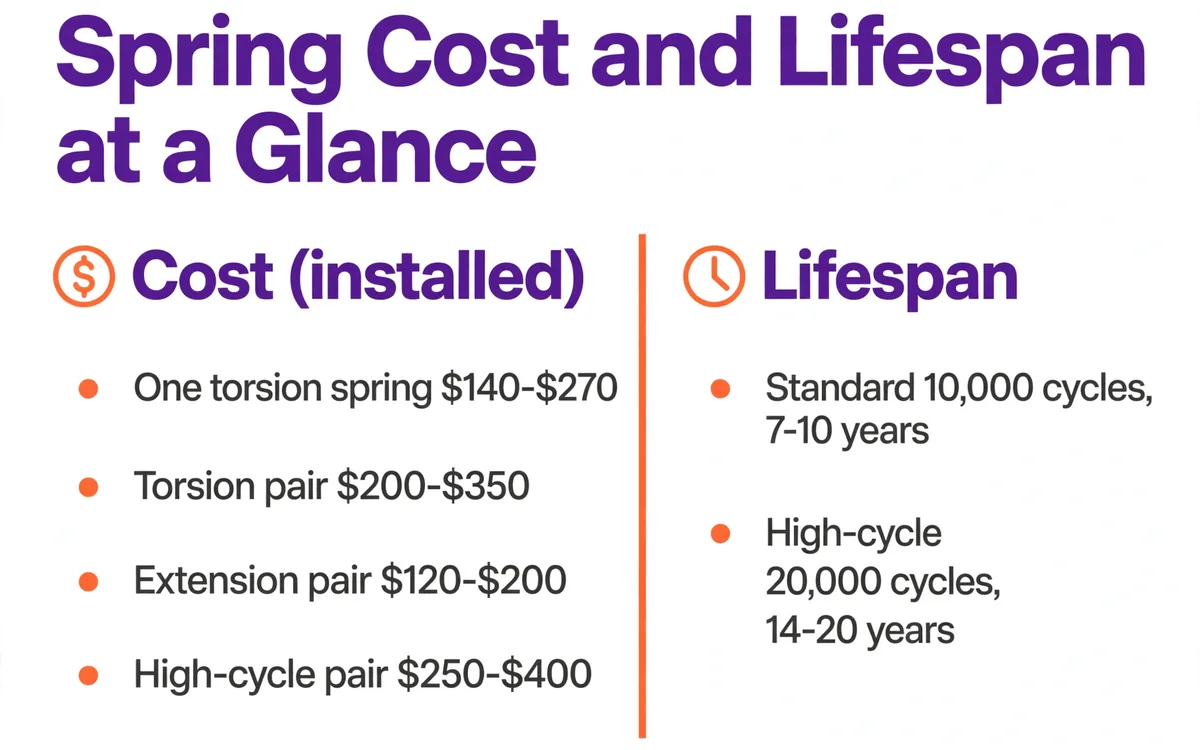
- One torsion spring: $140 to $270 installed (HomeGuide, 2026).
- Matched torsion pair: $200 to $350 installed (HomeGuide, 2026).
- Extension pair: $120 to $200 installed (HomeGuide, 2026).
- Angi (30 Oct 2026): $150 to $350 per spring, average $250.
High-cycle upgrade and conversion
A high-cycle spring costs more up front and lasts about twice as long. An extension-to-torsion conversion costs more again, but it buys safety.
- High-cycle torsion pair: about $250 to $400 (All About Doors, 2026).
- High-cycle springs are rated 20,000 to 25,000 cycles.
- Extension-to-torsion conversion: $400 to $800 (HomeGuide, 2026).
- Spring plus cable job: $200 to $500 (HomeGuide, 2026).
| Job | Price | Source + year |
|---|---|---|
| One torsion spring | $140–$270 | HomeGuide, 2026 |
| Matched torsion pair | $200–$350 | HomeGuide, 2026 |
| Extension pair | $120–$200 | HomeGuide, 2026 |
| High-cycle torsion pair | $250–$400 | All About Doors, 2026 |
| Spring + cable job | $200–$500 | HomeGuide, 2026 |
| Extension-to-torsion conversion | $400–$800 | HomeGuide, 2026 |
| Garage door repair, average | $265; most $155–$379 | Angi, 21 Oct 2026 |
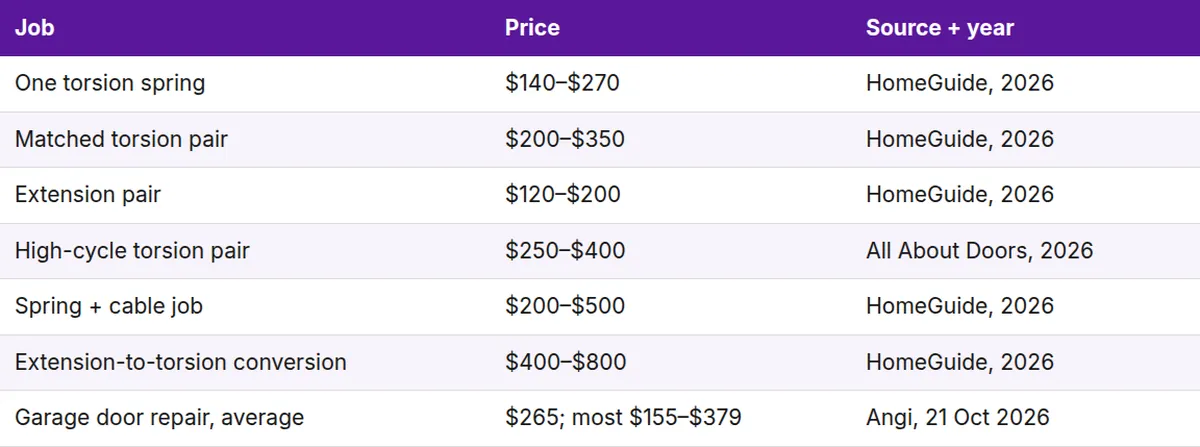
Read the basis before you compare quotes. Angi counts $150 to $350 per spring, while HomeGuide counts $150 to $350 for both torsion springs together. For the spring-only detail, see the spring replacement cost guide.
6. How long springs last
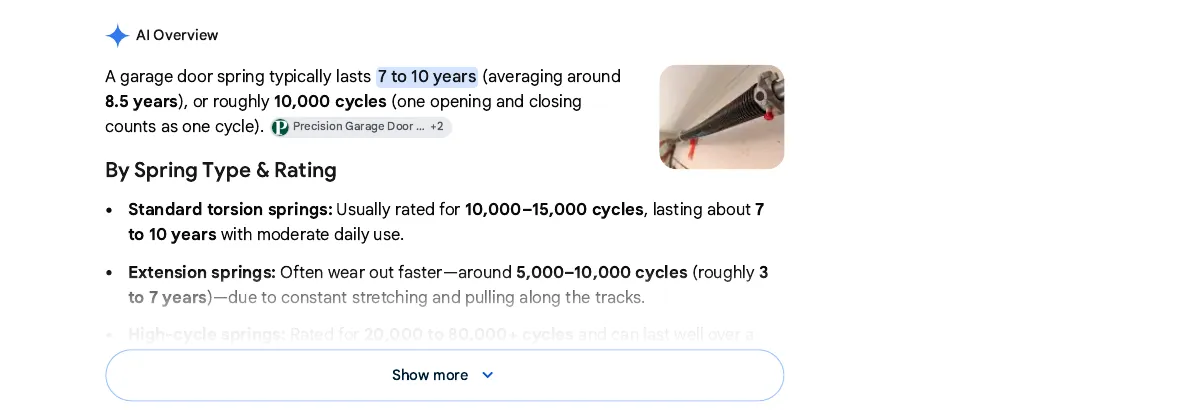
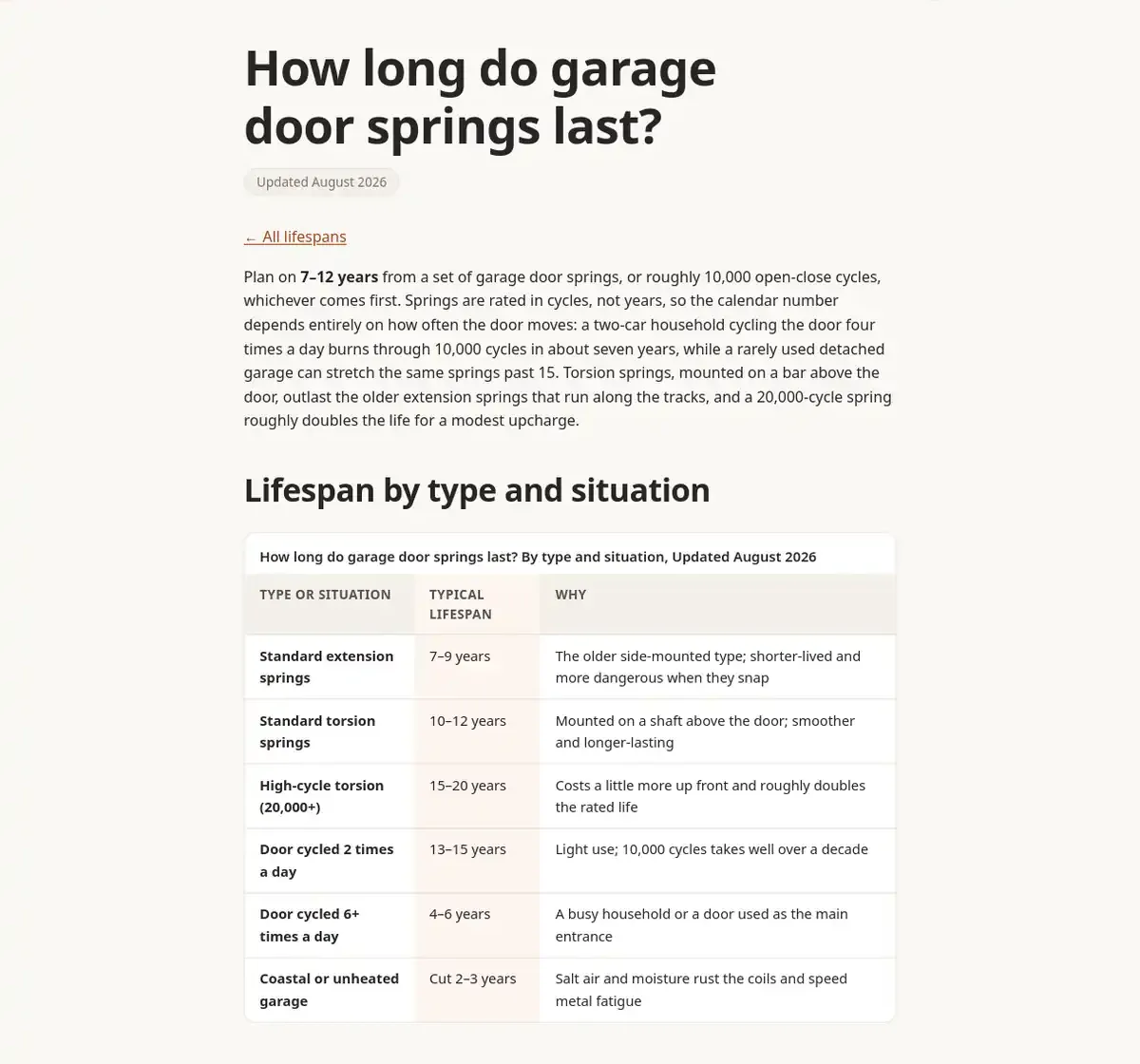
Springs wear out by cycles, not by calendar years. A busy family door can wear out a set in 5 years, while a quiet door can stretch past 13.
The 10,000-cycle standard
Most home springs are rated for about 10,000 cycles. At 4 cycles a day, that is about 7 years; at 2 a day, it is about 13 years.
- Standard torsion: 7 to 10 years at typical use (OnOtto, Aug 2026).
- Standard extension: 5 to 10 years, often shorter (All About Doors, 2026).
- High-cycle torsion: 14 to 20 years at 20,000 cycles or more.
- No spring lasts for ever; 25 years is the outer limit.
What shortens spring life
Rust, cold, heavy doors, and no lubrication all cut spring life. Local companies report their peak broken-spring weeks in late February and early March.
- Rust pits the wire and starts cracks at the pits.
- Cold stiffens grease and finishes off old springs.
- A heavy insulated or wood door works springs harder.
- No lubrication lets coils rub dry and wear faster.
Example: The full lifespan maths lives in the how long do garage door springs last guide. It shows the years for 2, 4, and 6 cycles a day.
7. Tension, noise, safety and maintenance
Three more spring topics matter every day: tension, noise, and care. Each one has its own guide in this cluster, linked below.
Tension and the balance test
Tension is the stored force in the spring, and torque is the twisting force it applies. A balanced door holds still at any height.
- Lift the door to waist height; it should stay put.
- A door that drops fast has lost tension.
- A door that flies up has too much tension.
- Only a pro adjusts tension; a wound spring can break a wrist.
Example: See the spring tension and torque guide for the balance test in full.
Noise, safety cables and upkeep
Squeaking springs are usually dry coils, and a light spray of silicone lubricant quiets them. A bang is different, and it means a spring broke.
- Lubricate spring coils twice a year with silicone spray.
- Extension springs must have safety cables threaded through them.
- Inspect springs each spring and fall for rust, gaps, and stretch.
- Replace springs before they snap, not after.
Example: Noise detail: noisy garage door spring guide. Safety cables and conversion: extension spring safety cable guide. Upkeep: spring maintenance guide.
Watch: Garage door springs — lifespan, cost and what to choose
A1 Garage Door Service’s Garage Authority Podcast explains why springs do the real lifting — not the opener — and how cycle ratings, sizing and lifespan decide what a spring costs.
- A matched torsion pair costs $200 to $350 installed; an extension pair costs $120 to $200.
- A standard spring lasts about 10,000 cycles, or 7 to 10 years — high-cycle springs last 14 to 20 years.
- Always replace springs in pairs, and never replace a spring yourself: spring work is pro-only.
Video: A1 Garage Door Service (Garage Authority Podcast), YouTube. Checked 21 November 2026.
Garage Door Hub connects homeowners with trusted local garage door pros. Need a repair? Need a replacement? Start here. First, find out what it should cost. Then, price your exact job with our free calculator. Next, find a pro near you. Fast. No jargon. No guesswork. No surprise bills. Just clear prices, honest guides, and a local pro you can call today.
FAQ
How much does it cost to replace garage door springs?
A matched torsion pair costs $200 to $350 installed, and an extension pair costs $120 to $200 (HomeGuide, 2026). Angi puts the average at $250, at $150 to $350 per spring (30 Oct 2026). Always replace springs in pairs.
How long do garage door springs last?
A standard spring lasts about 10,000 cycles, or 7 to 10 years at typical use (OnOtto, Aug 2026). High-cycle springs rated 20,000 cycles or more last 14 to 20 years. Heavy daily use shortens both.
Can I replace a garage door spring myself?
No. Springs hold hundreds of foot-pounds of stored energy, and a wound torsion spring can break a wrist or worse. Spring replacement, winding and tension adjustment are pro-only work. Lubrication and inspection are safe DIY.
Should I replace one spring or both?
Replace both. Both springs share the same age, cycles and wear, so the second spring is usually close behind the first. A pair also keeps the door balanced, so the opener does not strain.
What is the difference between torsion and extension springs?
Torsion springs twist on a shaft above the door and last longer, run quieter, and stay on the shaft when they break. Extension springs stretch along the side tracks, cost less, wear out faster, and need safety cables.
Why did my garage door spring break in winter?
Cold does not break a healthy spring; it finishes off an old one. Steel contracts, grease thickens, and old fatigue cracks grow in the cold. Local companies report their peak broken-spring weeks in late February and early March.
How do I know what size spring my door needs?
Size comes from door weight, height and drum size. An 8 by 7 steel door weighs 83 lb and needs one 218x2x26 spring at 7.4 turns. Use the Spring Size Calculator with your door size and weight, and ask a pro to confirm it.
Do extension springs need safety cables?
Yes. A safety cable threads through each extension spring and anchors at both ends, so a broken spring stays captive instead of flying across the garage. If your extension springs have no cables, ask a pro to fit them.
Sources
- Angi, updated 30 Oct 2026 — spring $150–$350 per spring, average $250. Verified live, 20 Nov 2026.
- Angi, 21 Oct 2026 — repair average $265, most $155–$379. Index, 20 Nov 2026.
- HomeGuide, 2026 — torsion pair $150–$350, extension pair $120–$200, conversion $400–$800. Verified live, 20 Nov 2026.
- GaragePlaybook / HomeGuide, reviewed 2 Oct 2026 — both torsion springs $150–$350, both extension $120–$200. Verified live, 20 Nov 2026.
- OnOtto, updated Aug 2026 — 7–12 years, 10,000 cycles standard, 20,000-cycle springs roughly double life. Verified live, 20 Nov 2026.
- All About Doors, 2026 — standard torsion 10,000 cycles, 7–10 years; high-cycle 20,000+, 14–20 years; high-cycle pair $250–$400. Verified live, 20 Nov 2026.
- Garage Door Locator, 2026 — torsion vs extension comparison, safety cable parts $20–$40. Verified live, 20 Nov 2026.
- ServiceAgent, accessed 20 Nov 2026 — turns by door height, wire size chart, IPPT formula. Verified live, 20 Nov 2026.
- Garage Door Hub Spring Calculator 2818 — live calculator, defaults 218x2x26, 83 lb, 7.4 turns, $205. Live 20 Nov 2026.
- HomeAdvisor, 2025 data — torsion parts $30–$100 each, extension parts $15–$45 each. Index, 20 Nov 2026.
Last reviewed: 20 November 2026
Appendix — Related topics
You might have found this by these keywords — and if not, others might have: garage door springs, garage door spring replacement cost, how long do garage door springs last, torsion vs extension springs, broken garage door spring, garage door spring size, how many turns garage door spring, high cycle garage door springs, garage door spring tension, extension spring safety cable, garage door spring noise, garage door spring maintenance.