

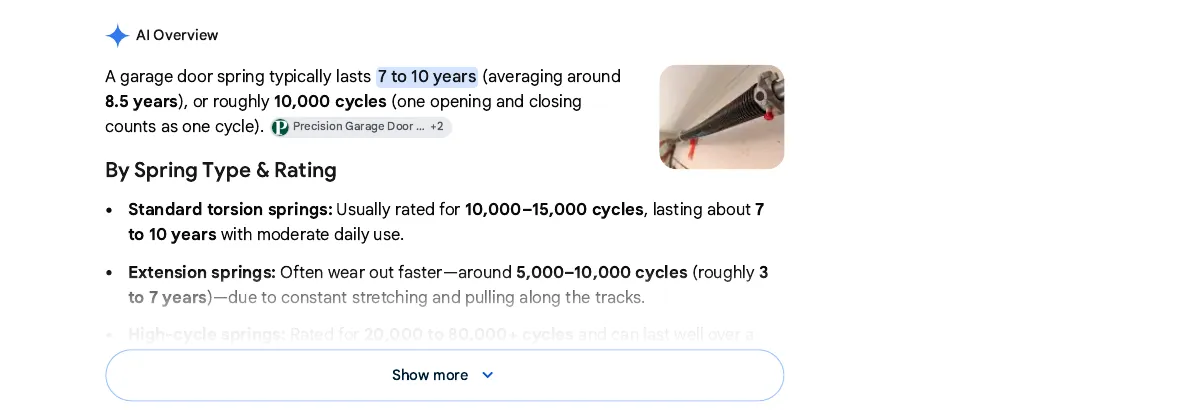
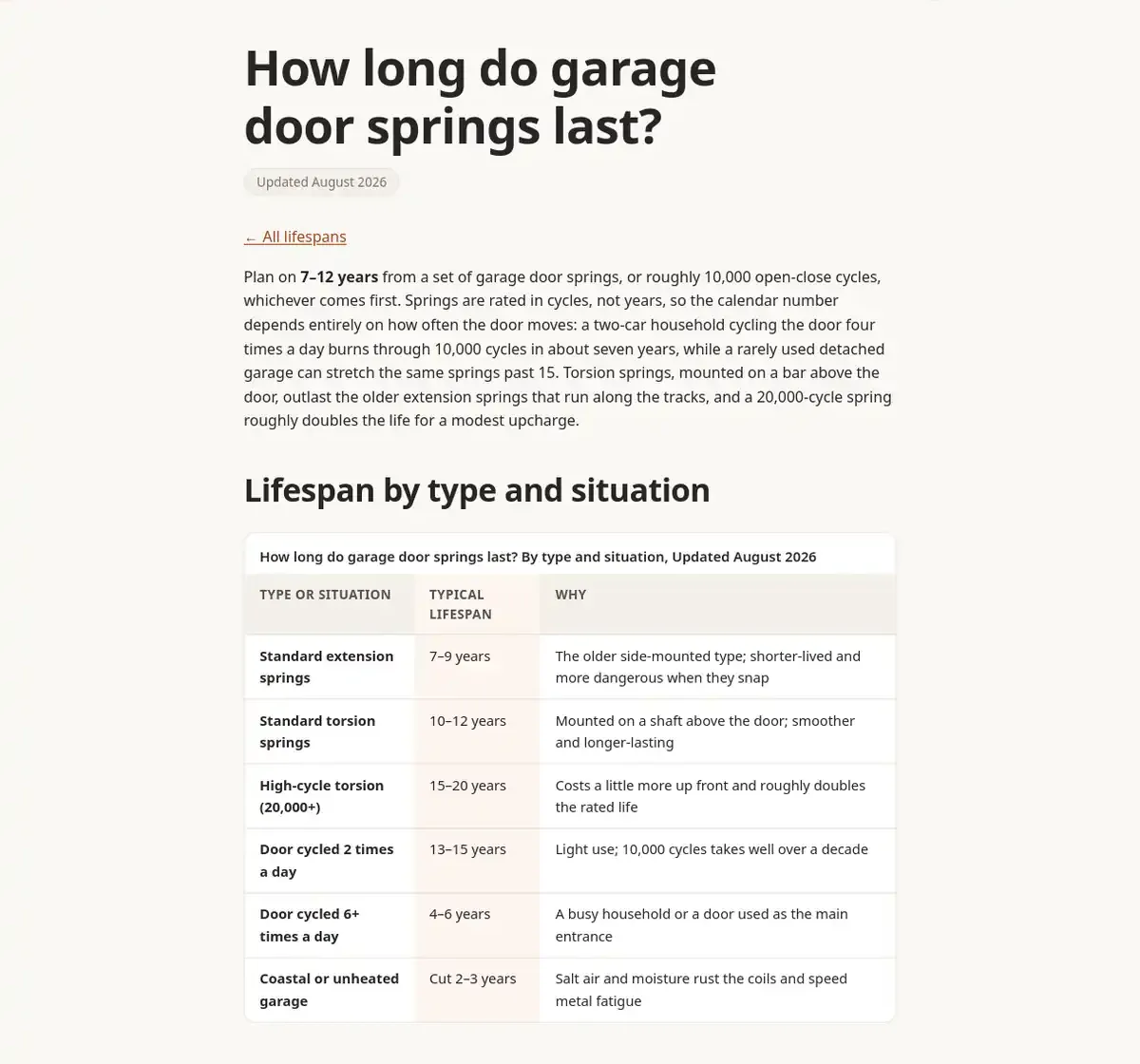
OnOtto puts a standard spring at 7 to 12 years, or about 10,000 cycles. A household that cycles the door four times a day burns through those cycles in about seven years.
The same springs in a quiet garage can stretch past 15 years. The calendar number depends entirely on how often the door moves.
This guide does the maths for your door: cycles per day, years of life, and what shortens both.
A standard garage door spring lasts about 10,000 cycles, or 7 to 10 years at typical use (OnOtto, Aug 2026). High-cycle springs rated 20,000 cycles or more last 14 to 20 years. At 4 cycles a day, a standard set lasts about 7 years; at 2 a day, about 13 years. Rust, cold, weight and heavy use shorten both.
Garage Door Hub connects you with a trusted local pro. Get a clear price for your garage door repair or replacement first.
Estimate your spring life first with the free Lifespan Calculator below. It works from your daily use, not from a guess.
Lifespan Calculator — estimate spring life from daily cycles and spring type.
- Enter how often you use the door each day.
- Note the estimated years left, then read the key takeaways.
- Use the years in Section 1 to plan a replacement.
Key takeaways
- A standard spring lasts 10,000 cycles, about 7 to 10 years.
- High-cycle springs last 14 to 20 years for a small premium.
- Daily cycles decide the years: 2 a day is 13 years, 4 a day is 7.
- Rust, cold, weight and no lubrication shorten spring life.
- Replace springs before they snap — plan it, do not wait for February.
Table of Contents
-
1. The 10,000-cycle standard
-
2. Standard vs high-cycle
-
3. What shortens spring life
-
4. Winter and the freeze peak
-
5. How to make springs last longer
-
6. When to replace
-
7. Lifespan by door and use
- Watch: how a spring’s 10,000 cycles turn into years
- FAQ
1. The 10,000-cycle standard
Most home springs are rated for about 10,000 cycles. That rating is the industry standard, and it translates to 7 to 10 years at typical use.
Cycles, not years
Springs are rated in cycles, not years. The calendar number comes from how often your door moves, not from the date it was fitted.
- One cycle is one full open and one full close.
- A standard spring is rated for about 10,000 cycles.
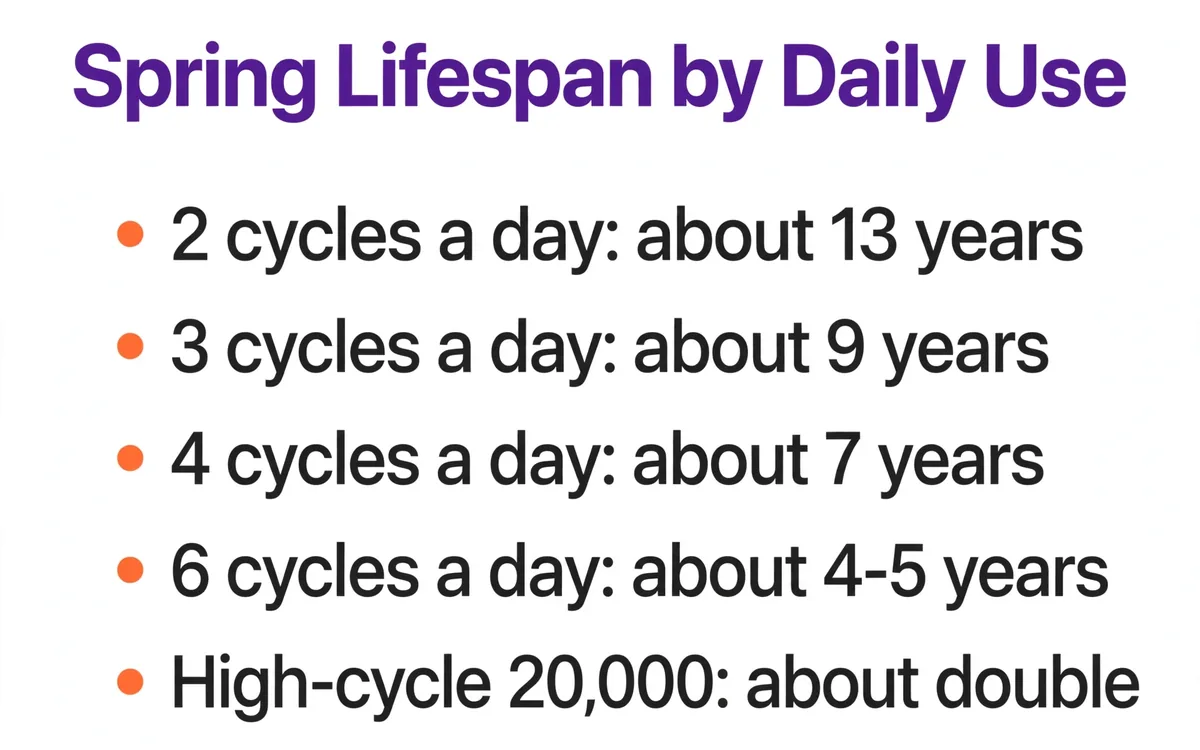
- At 2 cycles a day, 10,000 cycles lasts about 13 years.
- At 4 cycles a day, the same springs last about 7 years.
Years by daily use
Use decides the years. A door used as the main entrance cycles far more than a door on a quiet detached garage.
- 2 cycles a day: about 13 to 15 years from a standard set.
- 4 cycles a day: about 7 years from a standard set.
- 6 or more cycles a day: about 4 to 6 years.
- A busy family door can wear out a set in 5 years.
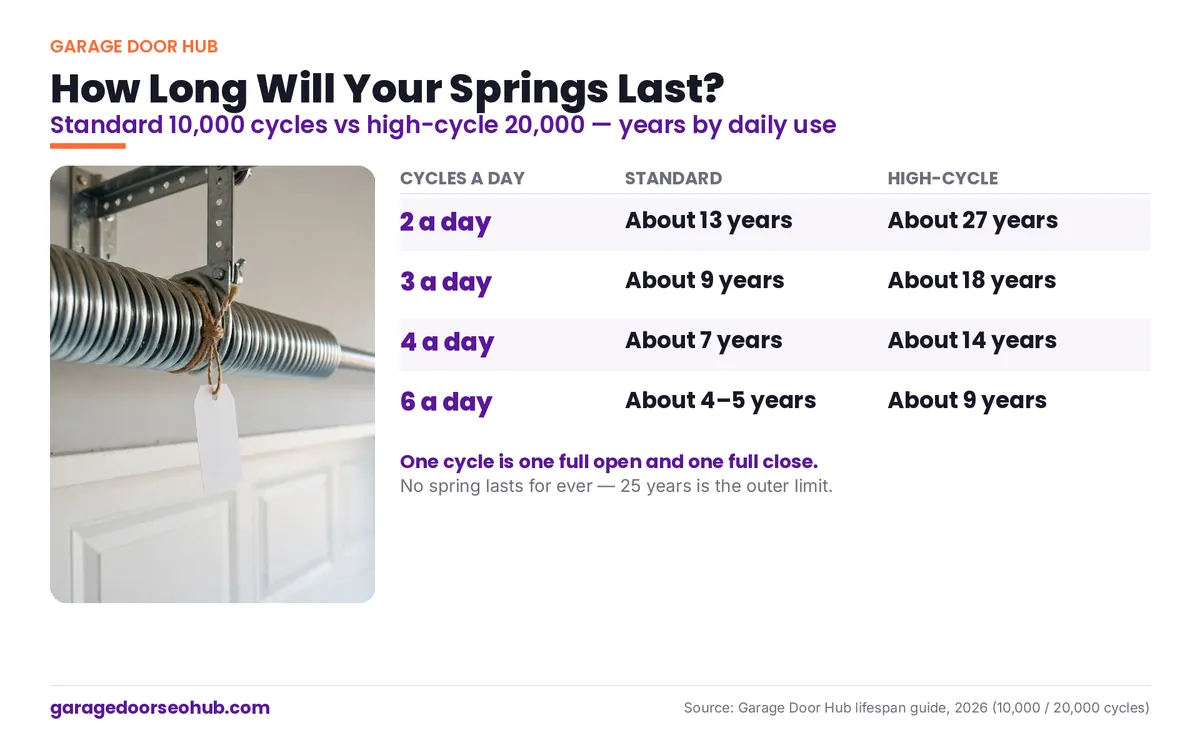
| Cycles per day | Standard 10,000 cycles | High-cycle 20,000 cycles |
|---|---|---|
| 2 per day | About 13 years | About 27 years |
| 3 per day | About 9 years | About 18 years |
| 4 per day | About 7 years | About 14 years |
| 6 per day | About 4–5 years | About 9 years |
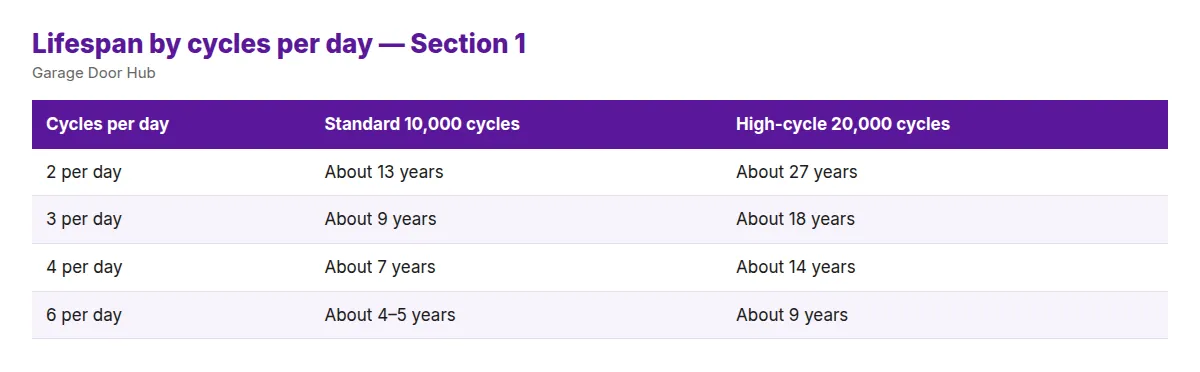
Years are 10,000 or 20,000 cycles divided by daily cycles times 365, rounded. No spring lasts for ever; 25 years is the outer limit (Garage Door Guide, 2026).
2. Standard vs high-cycle
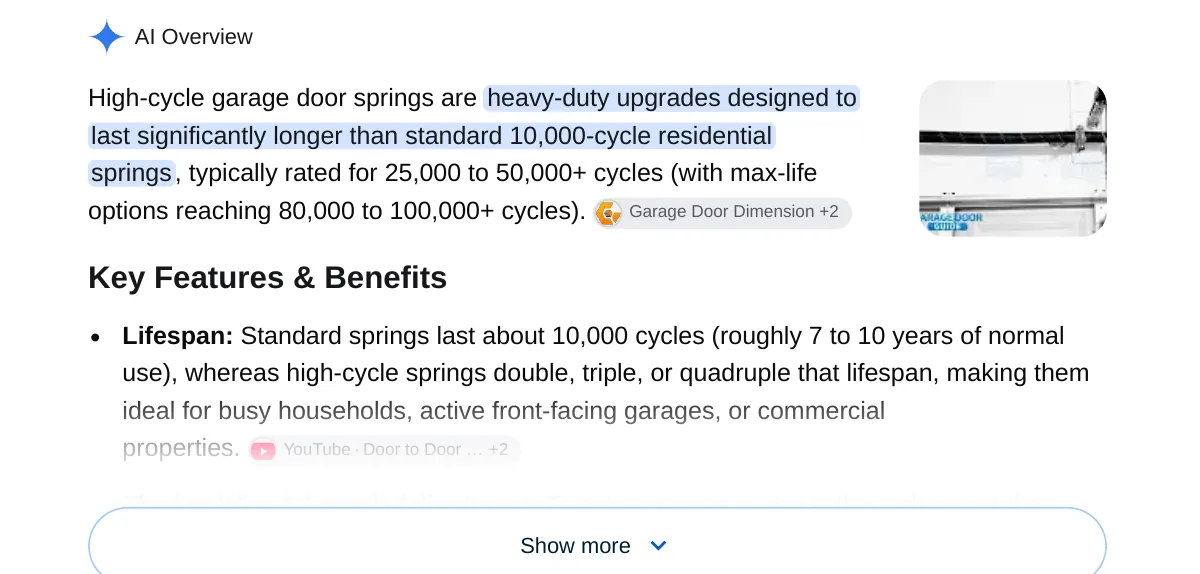
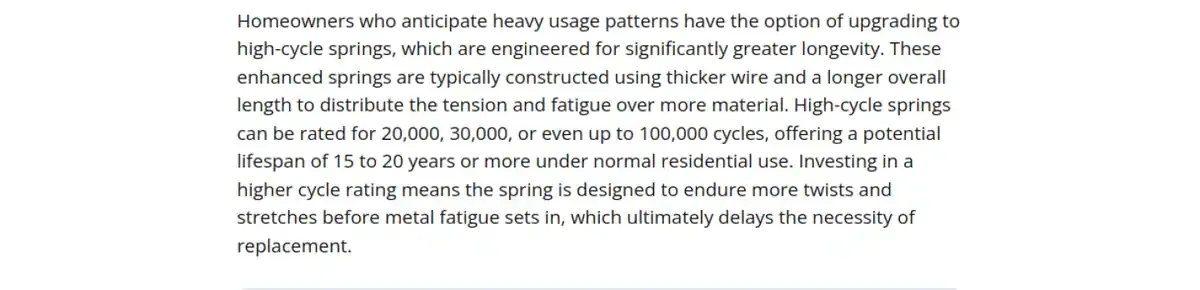
Standard springs are rated 10,000 cycles. High-cycle springs are rated 20,000 cycles or more, and they roughly double the life.
Lifespan by spring type
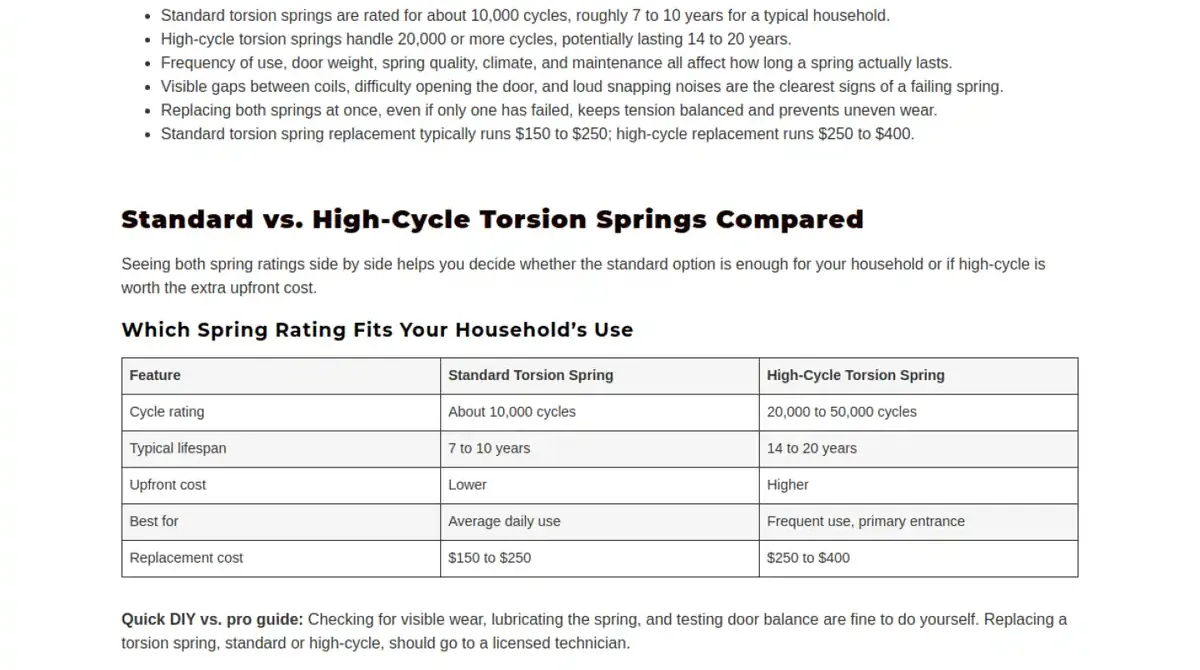
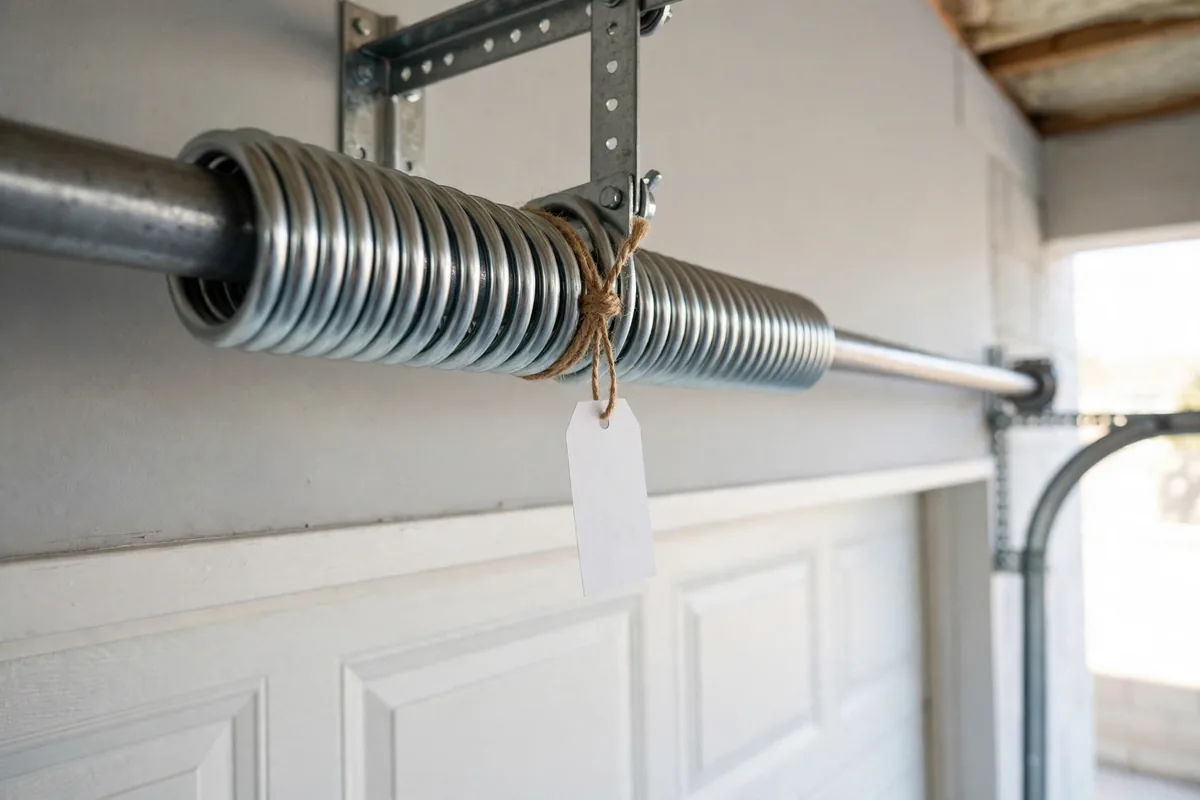
Torsion springs outlast extension springs at the same rating. High-cycle torsion is the longest-lived home spring you can buy.
- Standard torsion: 10,000 cycles, 7 to 10 years.
- High-cycle torsion: 20,000 cycles or more, 14 to 20 years.
- Standard extension: 5,000 to 10,000 cycles, 5 to 10 years.
- Extension high-cycle tops out at 25,000 cycles.
How high-cycle springs work
High-cycle springs carry the same load for more cycles. Thicker wire and more coils share the work, so the metal tires slower.
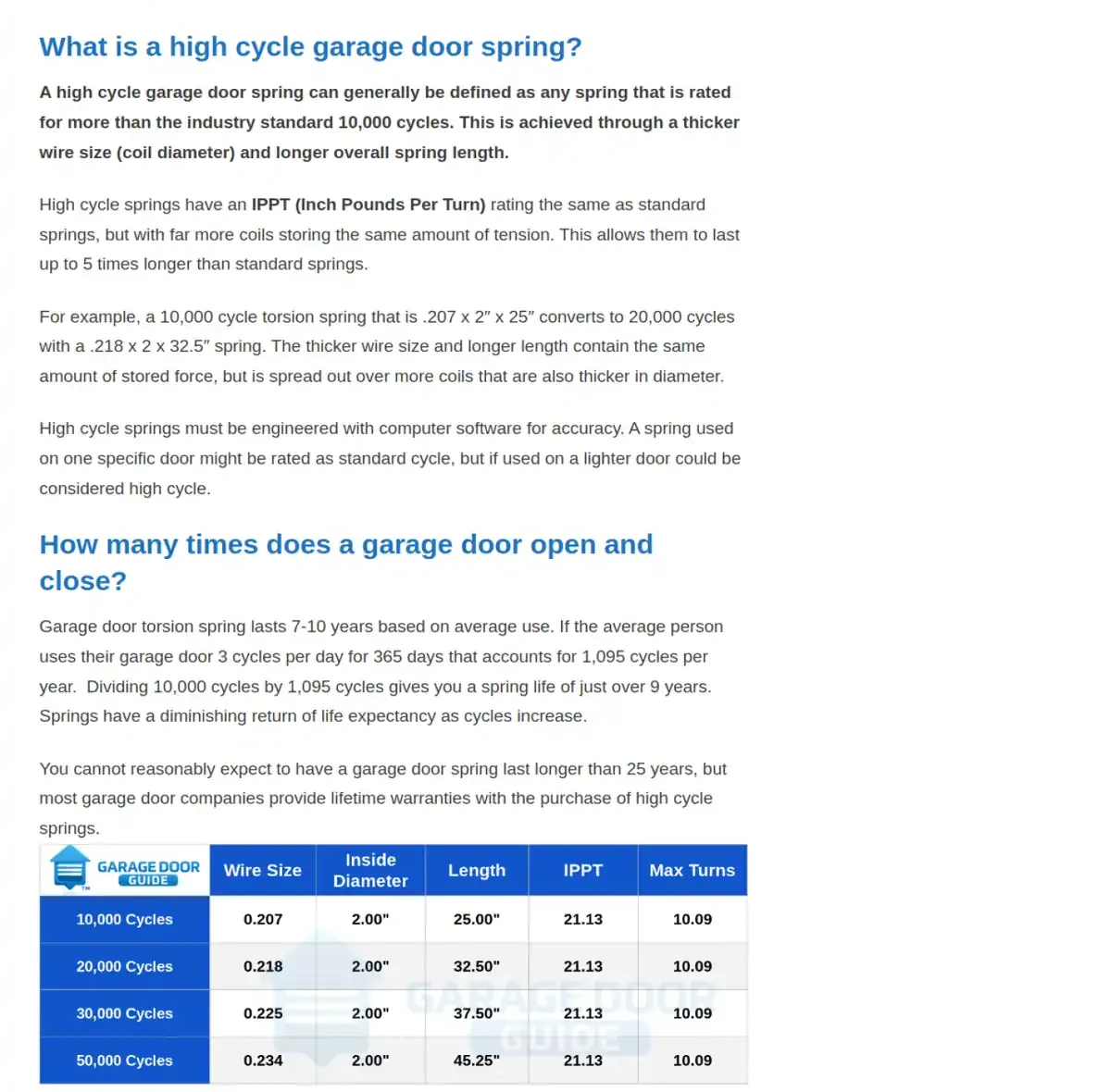
- High-cycle springs use thicker wire and a longer body.
- The same load spreads over more coils, so each coil works less.
- The premium is about $40 to $80 more per spring.
- A high-cycle pair costs about $250 to $400 installed.
3. What shortens spring life
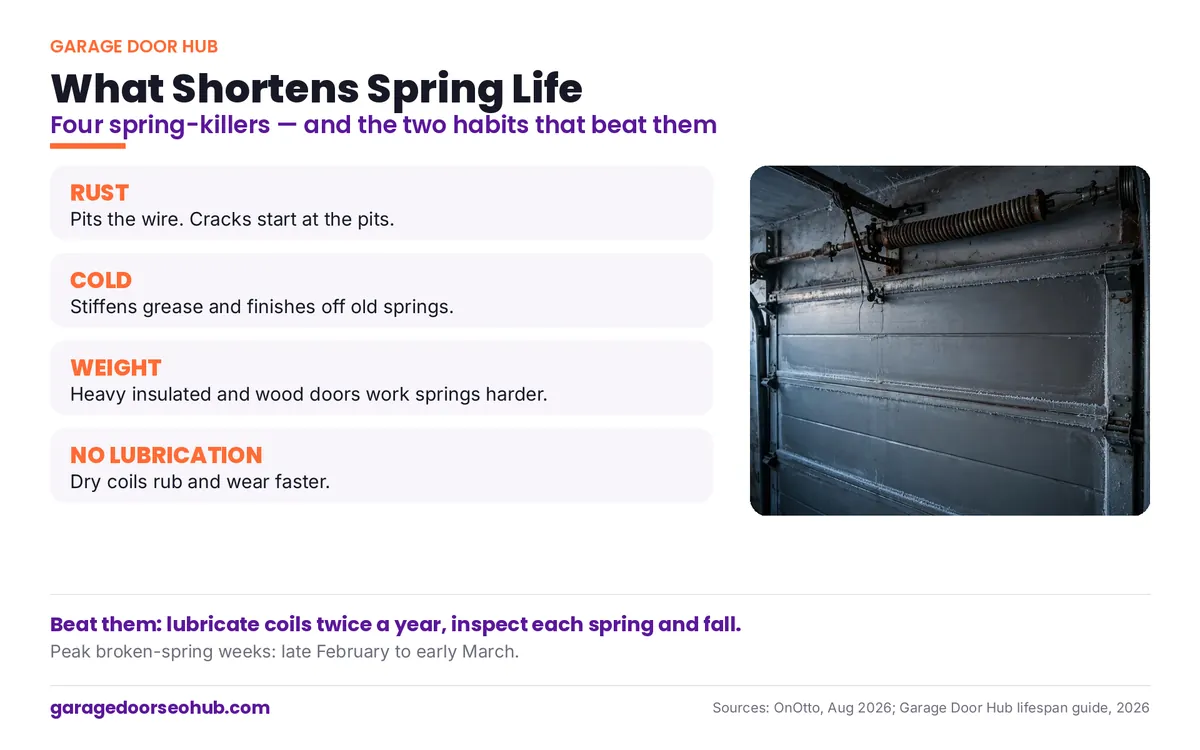
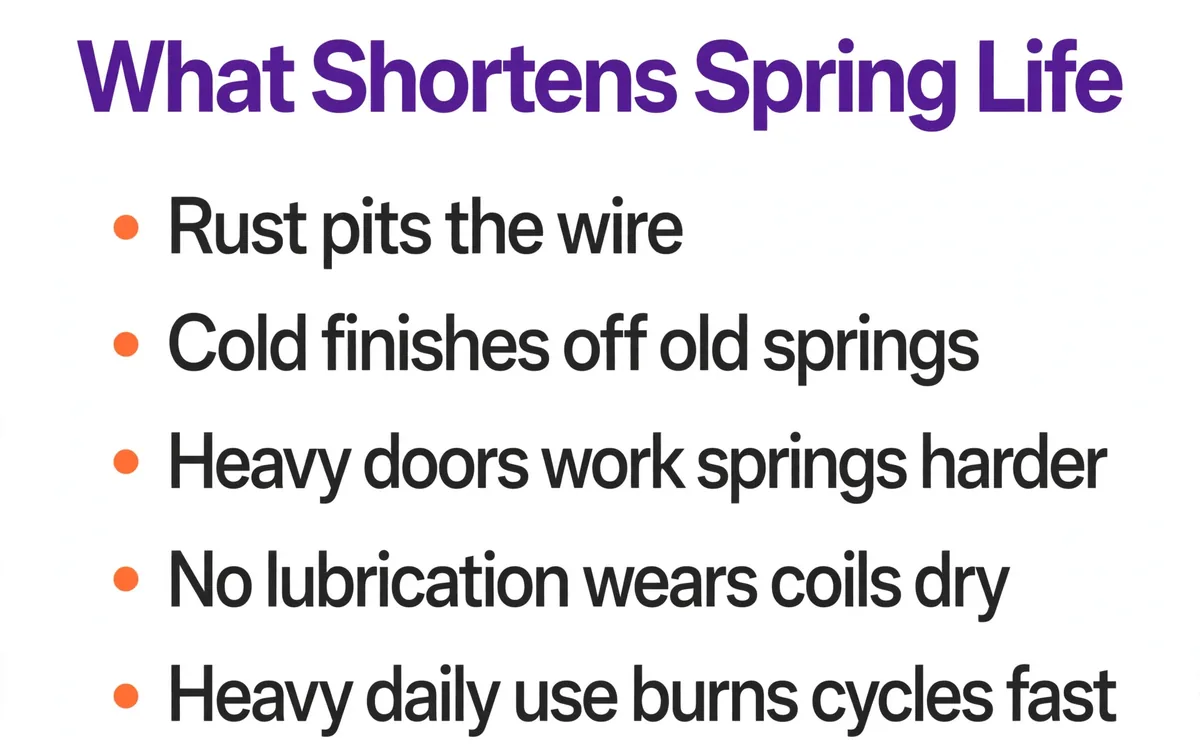
Four things cut spring life short: rust, weight, cold, and no lubrication. Each one is easy to check and cheap to fix.
Rust
Rust is the main killer of springs in damp garages. It pits the wire, and each pit is a weak point where a crack can start.
- Rust pits the wire, and cracks start at the pits.
- Wipe visible rust and keep the garage drains clear.
- Orange stains on the floor below the spring mean flaking rust.
- A rusty spring is a tired spring, even before it snaps.
Weight and neglect
Weight and neglect shorten life together. A heavy door with dry coils wears out far faster than a light door that is kept oiled.
- Heavy insulated and wood doors work springs harder.
- A door that gained weight from insulation needs stronger springs.
- No lubrication lets coils rub dry and wear faster.
- A door out of balance loads one spring more than the other.
4. Winter and the freeze peak
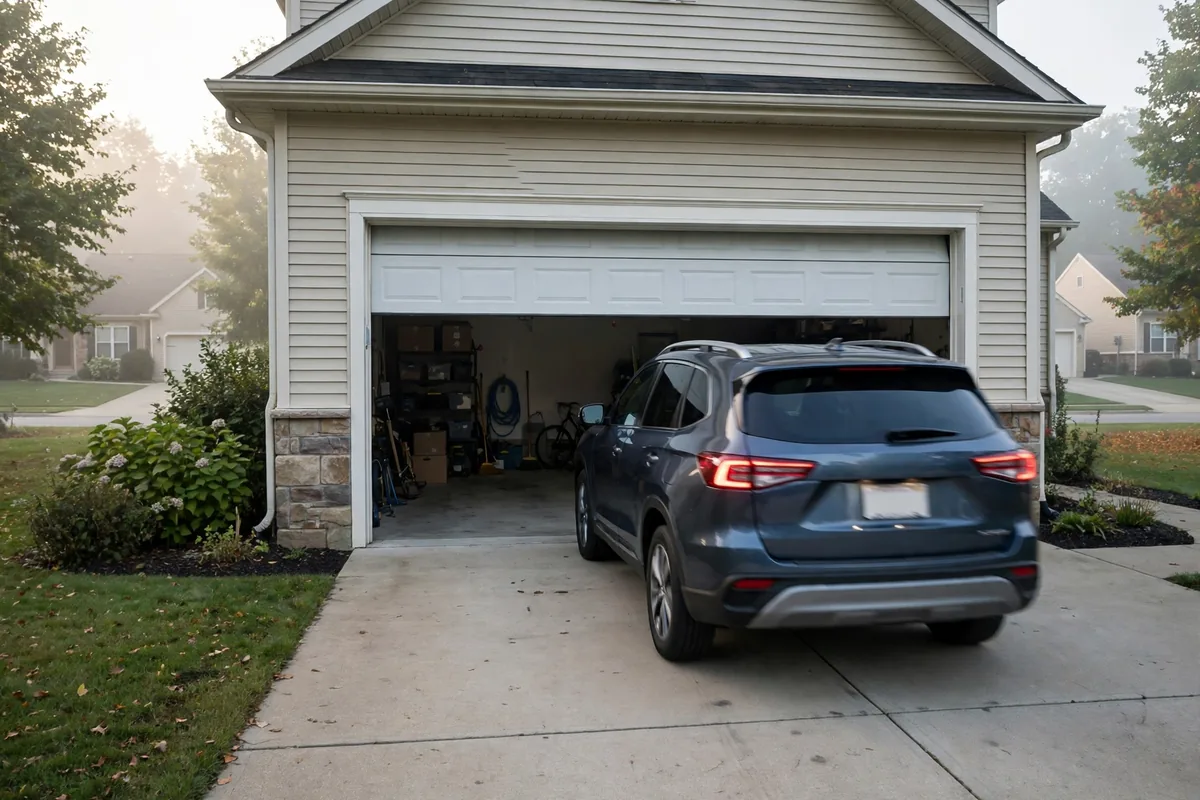
Springs break most in late winter. The cold does not create the weakness; it removes the cushion that was hiding it.
Why cold breaks old springs
Cold does not break a healthy spring; it finishes off an old one. The cold was the last push, not the cause.
- Cold contracts steel, so the fit against the shaft gets tighter.
- Grease thickens in cold, so the load on the spring rises.
- Cold lowers the fracture toughness of hardened steel.
- Old fatigue cracks grow faster in the cold.
The February to March peak
Local companies report their busiest broken-spring weeks in late February and early March. The peak is local reporting only, not a national dataset.
- Local companies report peak broken-spring weeks in late February and early March.
- The peak follows a dozen or more freeze-thaw crossings of 32°F.
- No national dataset for this peak was found.
- Check springs in fall, not after the first hard freeze.
Example: Winter detail: winter garage door problems guide. It covers frozen seals, cold springs, and the fall checklist.
5. How to make springs last longer
Two habits add years to a spring: lubrication and inspection. Both are safe DIY, and both take minutes.
Lubrication twice a year
Lubrication is the cheapest life-extender for springs. Silicone spray on the coils twice a year keeps them quiet and slow to wear.
- Spray silicone lubricant on the coils twice a year.
- Lubricate hinges and roller bearings at the same time.
- Never use WD-40; it is a solvent, not a lubricant.
- Wipe away excess so it does not drip on the floor.
Inspection twice a year
Inspection catches a tired spring before it snaps. Five minutes twice a year is enough to spot rust, gaps, and stretch.
- Inspect springs each spring and fall for rust, gaps, and stretch.
- Tighten loose hinge and track bolts you can see.
- Run the balance test twice a year, in spring and fall.
- Note the install date, so you know when 10,000 cycles is near.
Example: Upkeep in full: garage door spring maintenance guide.
6. When to replace
A spring near the end of its cycles is a planned job, not an emergency. Replace it on your schedule, not at 2 a.m. in February.

Signs the end is near
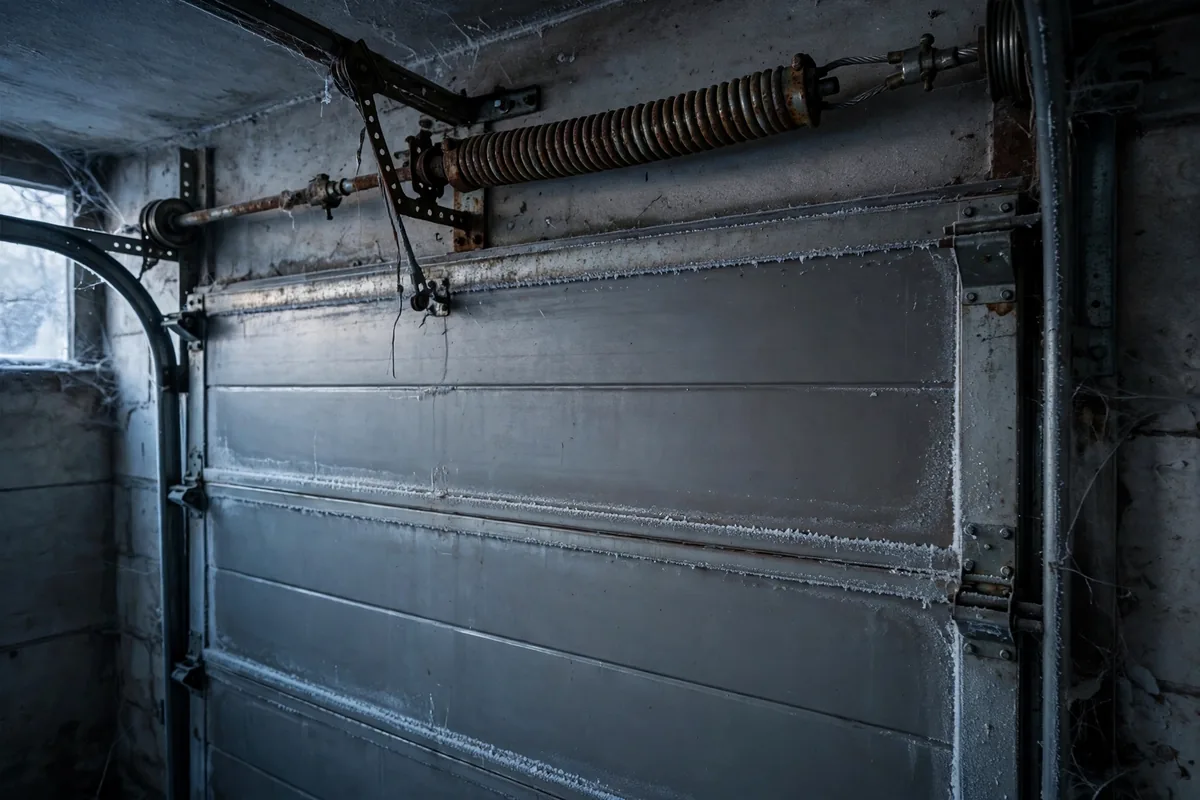
A failing spring gives warnings before it snaps. Check for them in fall, not after the first hard freeze of the year.
- A loud bang means a spring has already snapped.
- A gap in the coil means the spring is broken.
- A door that feels heavy or will not stay open is tired.
- Rust flakes below the spring mean the wire is wearing thin.
Replace before it snaps
Replace springs before they snap, not after. A planned pair costs the same as an emergency pair, without the after-hours premium.
- Replace springs in pairs, before they snap, not after.
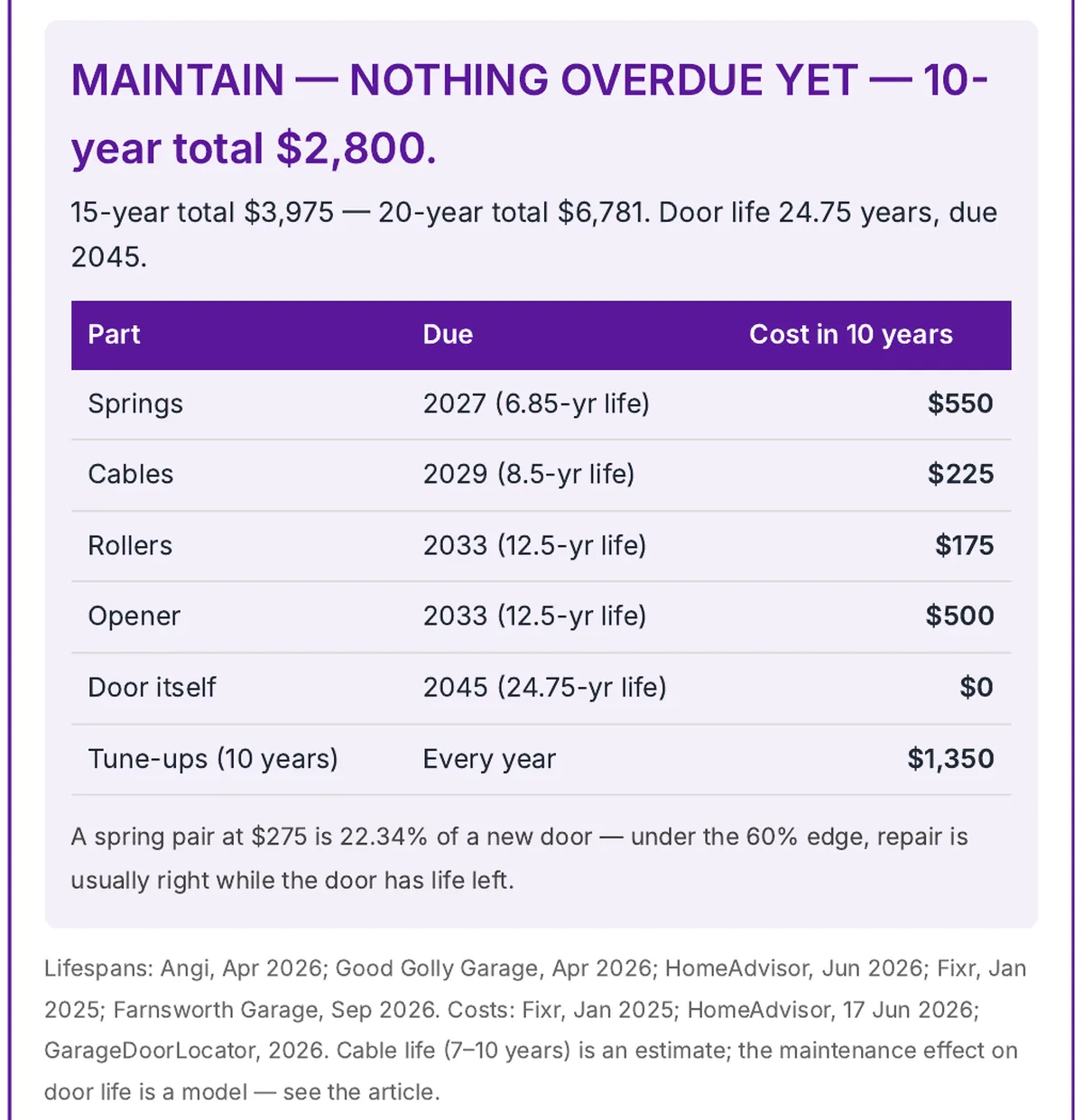
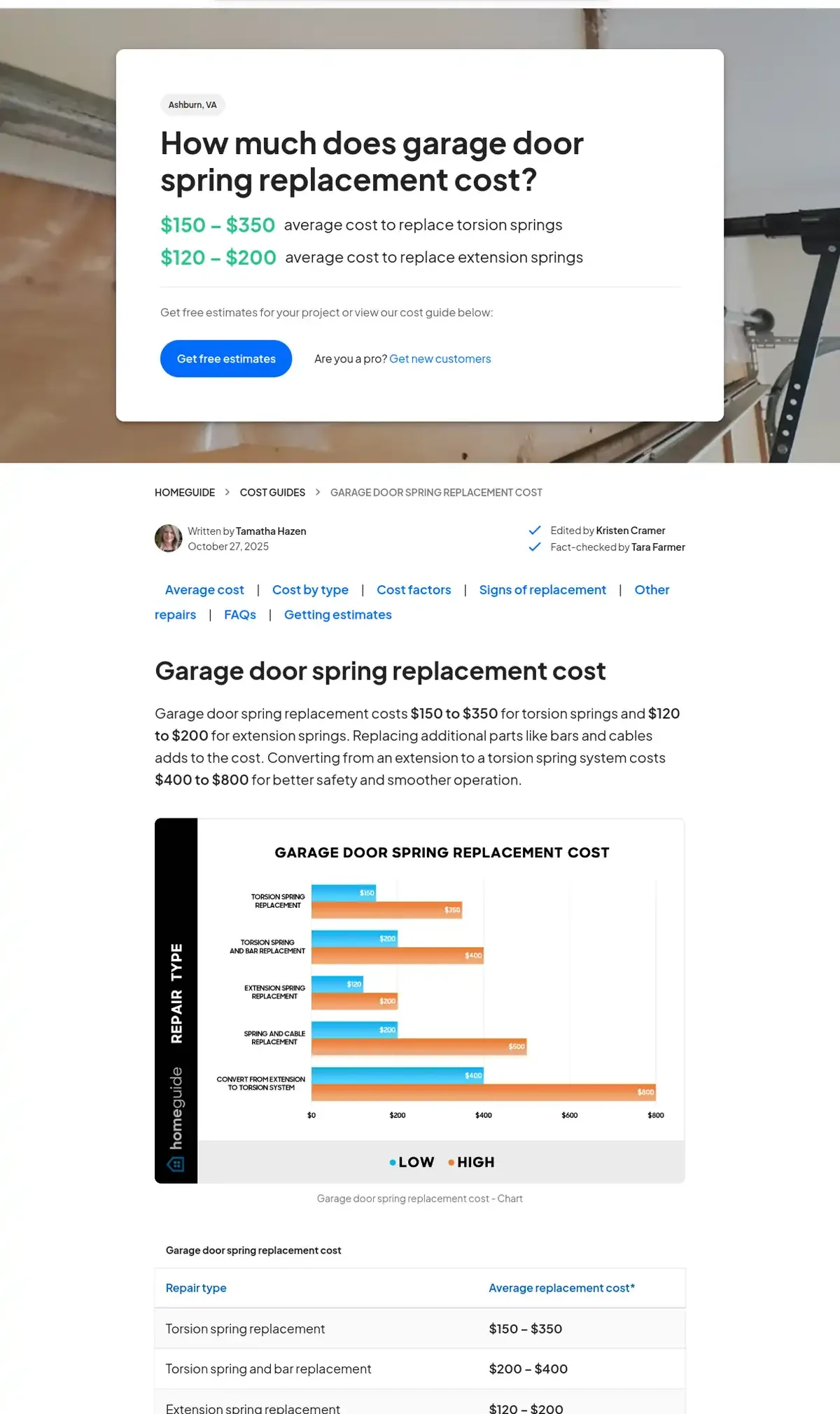
- A torsion pair costs $150 to $350 installed (HomeGuide, 2026).
- A high-cycle pair costs about $250 to $400 installed.
- A spring past 10,000 cycles is near the end, even without signs.
Example: Costs in full: garage door spring replacement cost guide. Full spring picture: garage door springs complete guide.
7. Lifespan by door and use
Lifespan is not one number for every door. Door weight and daily use together decide how long a set lasts.
Lifespan by door type
Door type decides how hard the springs work. A light single steel door is easy on springs; a heavy wood door is not.
- Single steel doors are light, so springs last longest.
- Double insulated doors are heavy, so springs work harder.
- Wood doors are the heaviest, and their springs wear fastest.
- A door that gained insulation needs stronger springs.
Lifespan by use pattern
Use pattern matters more than door type. A busy entrance door can wear out springs in half the time of a quiet one.
- A garage used as the main entrance cycles far more.
- A detached garage used weekly barely cycles at all.
- Count your cycles for a week, then do the maths.
- The Lifespan Calculator works from your daily cycles.
Watch: how a spring’s 10,000 cycles turn into years
Unbolted shows on YouTube why the spring, not the motor, lifts your door — and how the 10,000-cycle rating turns into years depending on how often the door moves.
- A standard spring is rated for about 10,000 cycles — one open and one close.
- At two cycles a day that is more than 13 years; at four cycles a day it is about seven.
- A balanced door stays put halfway; spring adjustment and replacement is a job for a trained technician.
Video: Unbolted (Majid Khan Mohmand), YouTube. Checked 21 November 2026.
Garage Door Hub connects homeowners with trusted local garage door pros. Need a repair? Need a replacement? Start here. First, find out what it should cost. Then, price your exact job with our free calculator. Next, find a pro near you. Fast. No jargon. No guesswork. No surprise bills. Just clear prices, honest guides, and a local pro you can call today.
FAQ
How long do garage door springs last?
A standard spring lasts about 10,000 cycles, or 7 to 10 years at typical use (OnOtto, Aug 2026). High-cycle springs rated 20,000 cycles or more last 14 to 20 years.
What is a cycle on a garage door spring?
One cycle is one full open and one full close. At 4 cycles a day, 10,000 cycles lasts about 7 years. At 2 cycles a day, the same springs last about 13 years.
Are high-cycle springs worth the extra cost?
Yes. High-cycle springs are rated 20,000 to 25,000 cycles and cost about $40 to $80 more per spring. They last about twice as long, so they pay on a busy door.
What shortens the life of garage door springs?
Rust, cold, heavy doors, no lubrication, and heavy daily use all shorten spring life. Local companies report their peak broken-spring weeks in late February and early March.
How can I make my garage door springs last longer?
Lubricate the coils twice a year with silicone spray, inspect for rust and gaps each spring and fall, and replace springs before they snap. Winding and tension work stay pro-only.
What are the signs a spring is near the end of its life?
A loud bang, a gap in the coil, a door that feels heavy, and a door that will not stay open are the signs. A spring past 10,000 cycles is near the end even without signs.
Sources
- OnOtto, updated Aug 2026 — 7–12 years, 10,000 cycles standard, 20,000-cycle springs roughly double life. Verified live, 20 Nov 2026.
- All About Doors, 2026 — standard torsion 10,000 cycles, 7–10 years; high-cycle 20,000+, 14–20 years; high-cycle pair $250–$400. Verified live, 20 Nov 2026.
- EngineerFix, 2026 — 10,000 cycles standard, high-cycle 20,000–100,000 cycles. Verified live, 20 Nov 2026.
- Garage Door Guide, 2026 — high-cycle springs use thicker wire and longer length; 25 years outer limit. Verified live, 20 Nov 2026.
- HomeGuide, 2026 — torsion pair $150–$350, extension pair $120–$200. Verified live, 20 Nov 2026.
- Angi, updated 30 Oct 2026 — spring $150–$350 per spring, average $250. Verified live, 20 Nov 2026.
- Garage Door Hub Lifespan Calculator 3821 — live calculator. Live 20 Nov 2026.
Last reviewed: 20 November 2026
Appendix — Related topics
You might have found this by these keywords — and if not, others might have: how long do garage door springs last, high cycle garage door springs, how long do torsion springs last, how long do extension springs last, garage door spring lifespan 10,000 cycles, how many cycles do garage door springs last, what shortens garage door spring life, how to make garage door springs last longer, signs a garage door spring is wearing out, garage door spring lifespan by cycles.