

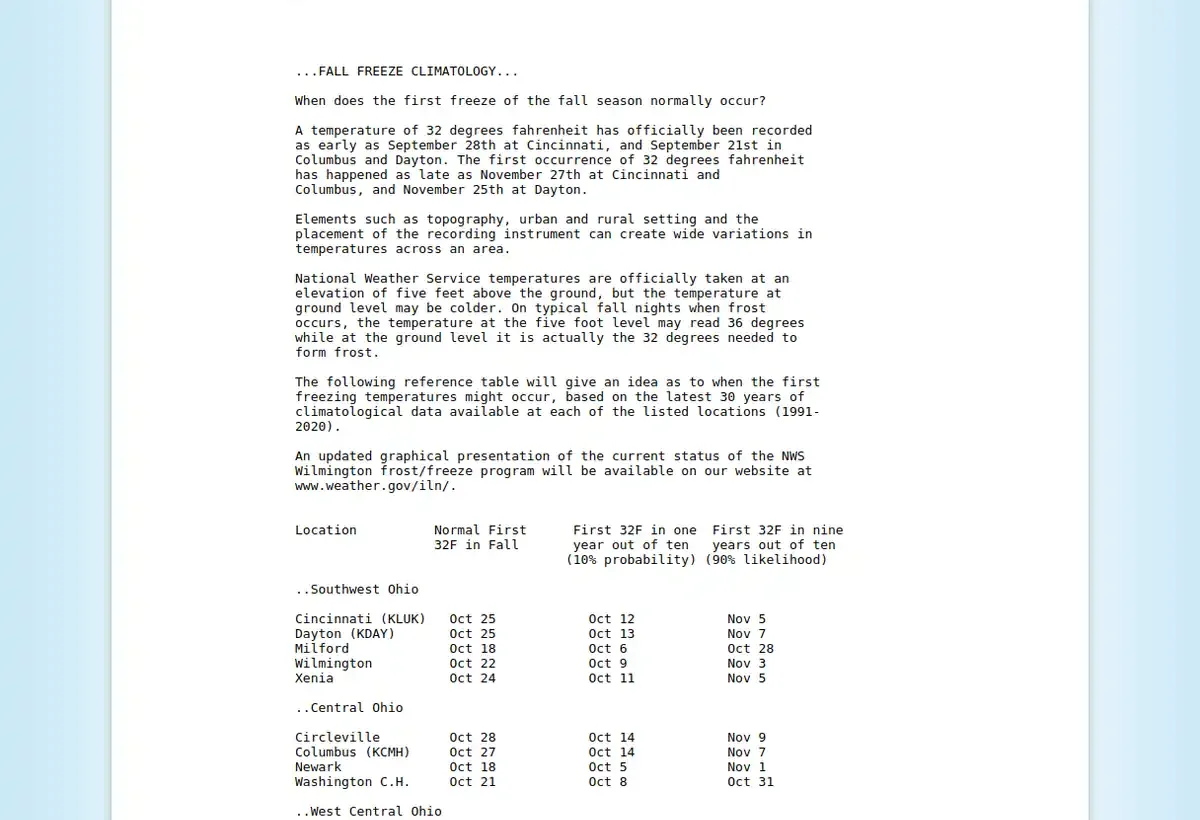
The National Weather Service recorded Cincinnati’s first freeze on 8 November 2026. The low reached 31°F, a full 17 days later than normal.
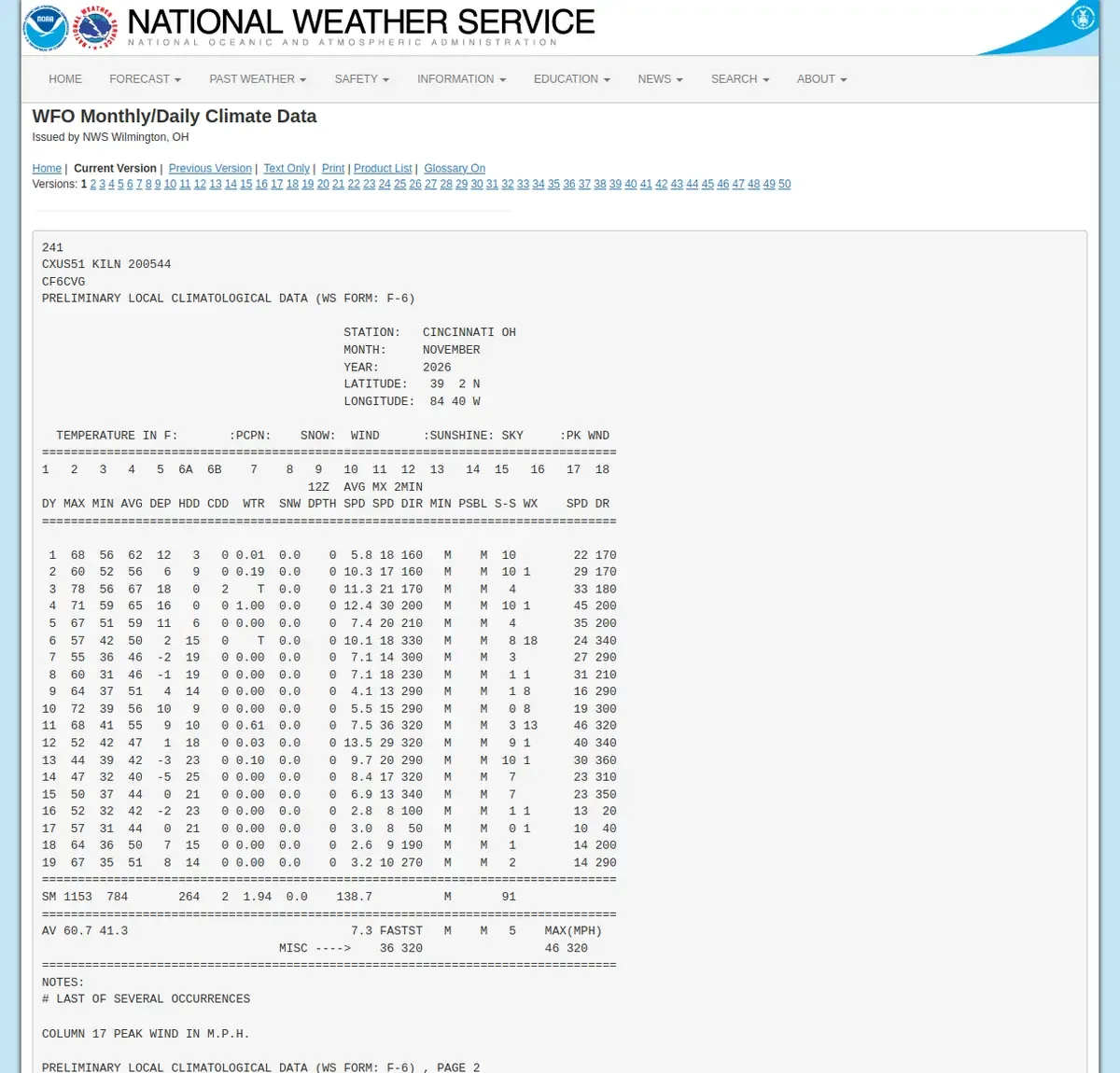
That late freeze gave homeowners three extra weeks. It also means the first hard freeze is still to come this year.
The forecast for 23 to 25 November shows lows of 29°F, 31°F and 36°F. Those are forecast lows only, from weather.com, checked 20 November 2026 at 11:45 AM EST.
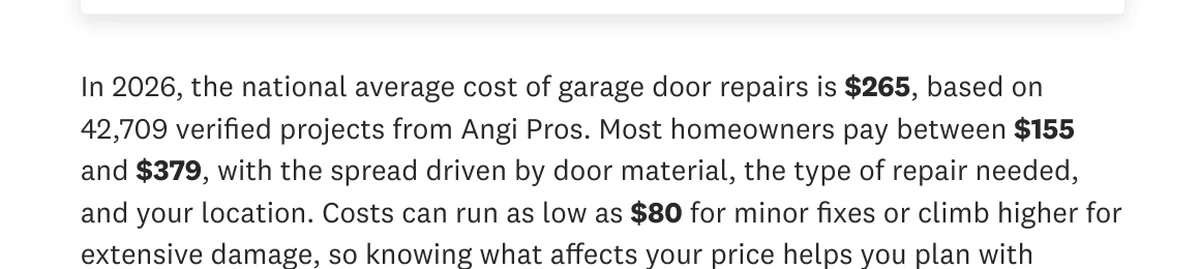
Winter garage door problems start with a frozen seal, a tired spring, or a cold opener. Cincinnati’s first freeze came on 8 November 2026, at 31°F (National Weather Service, 2026). Angi puts the average garage door repair at $265 (21 Oct 2026). This guide shows what to check, what to fix safely, and when to call a pro.
Garage Door Hub connects you with a trusted local pro. Get a clear price for your garage door repair or replacement first.
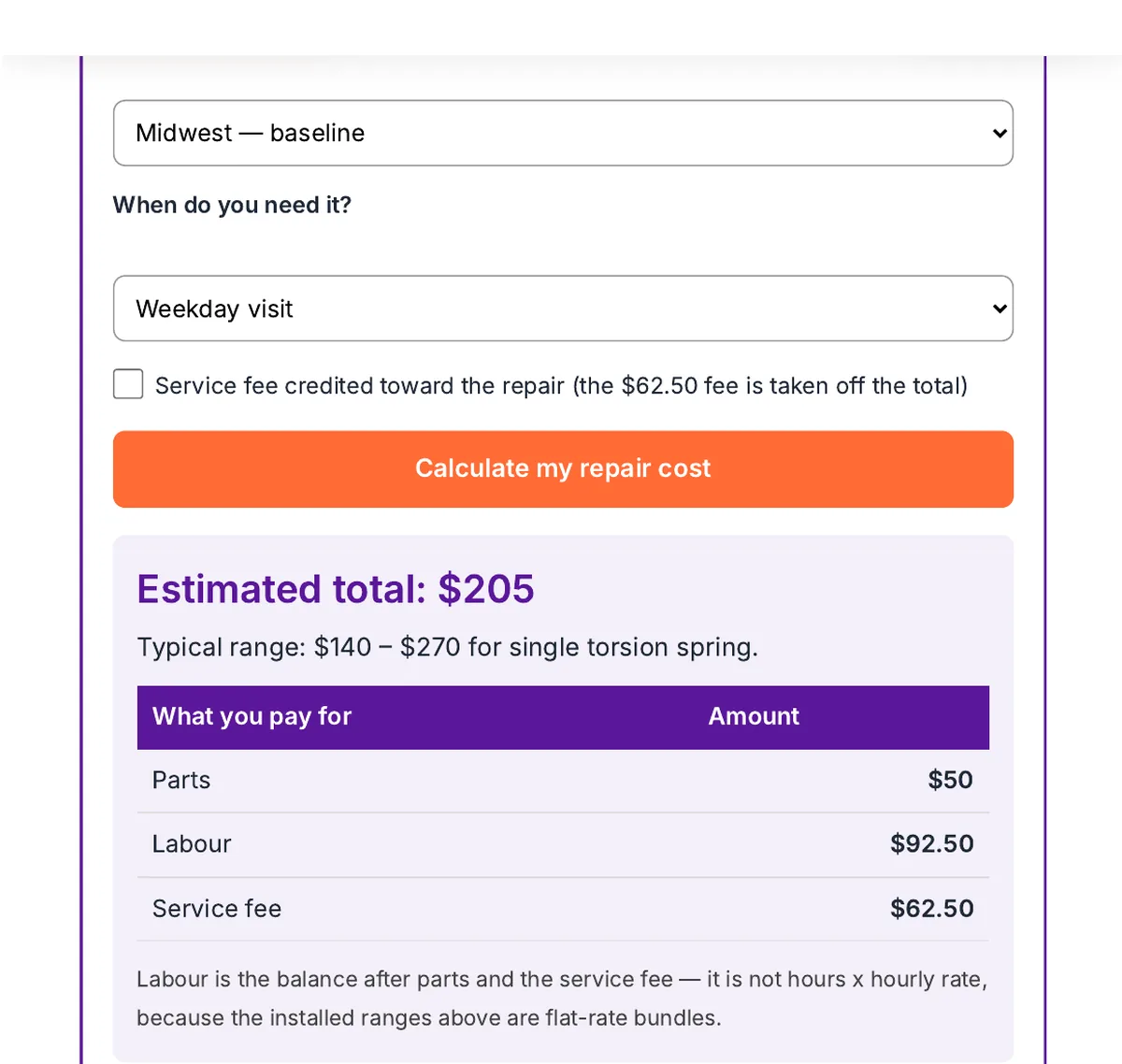
Price your job first with the free calculators below. They give you a number before you call anyone.
Repair Cost Calculator — price any winter repair, from a seal to a spring.
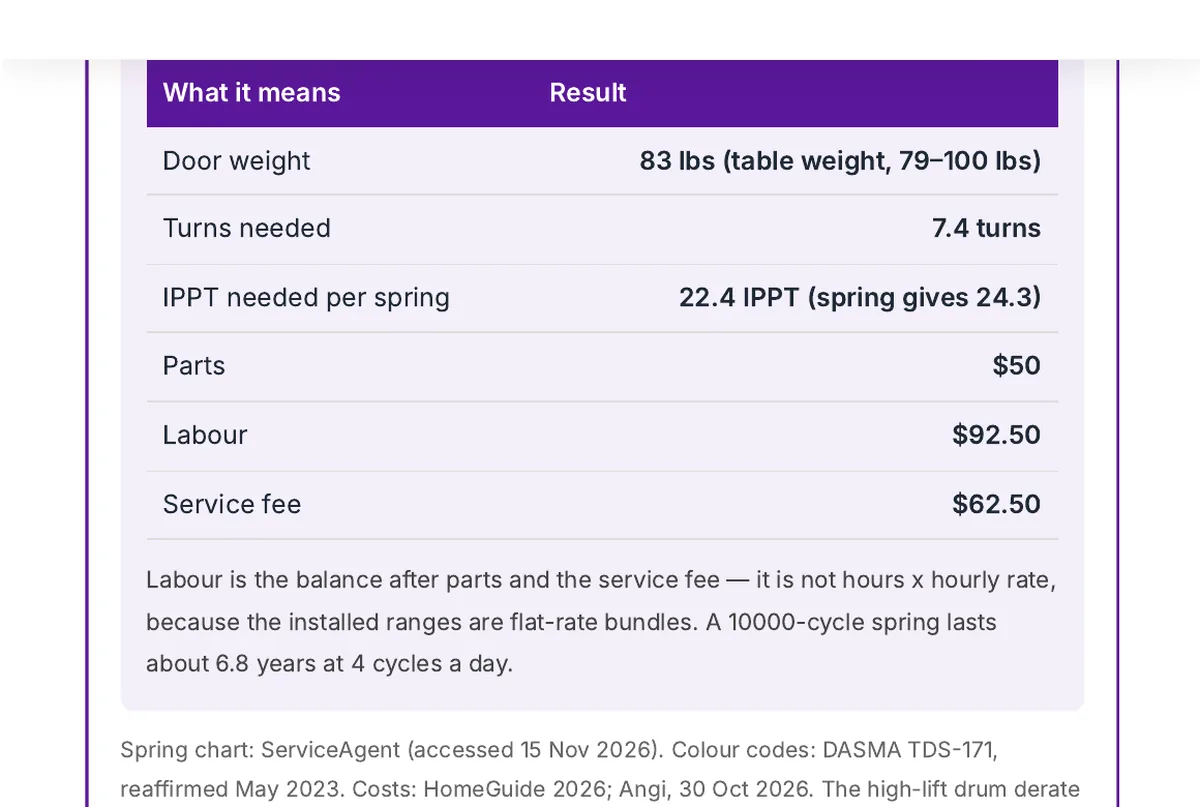
Spring Calculator — price a spring job by size, weight and turns.
- Enter your door size and the part that failed.
- Note the price, then read the key takeaways and Section 1.
- Use the price in Section 6 to check any quote you get.
Key takeaways
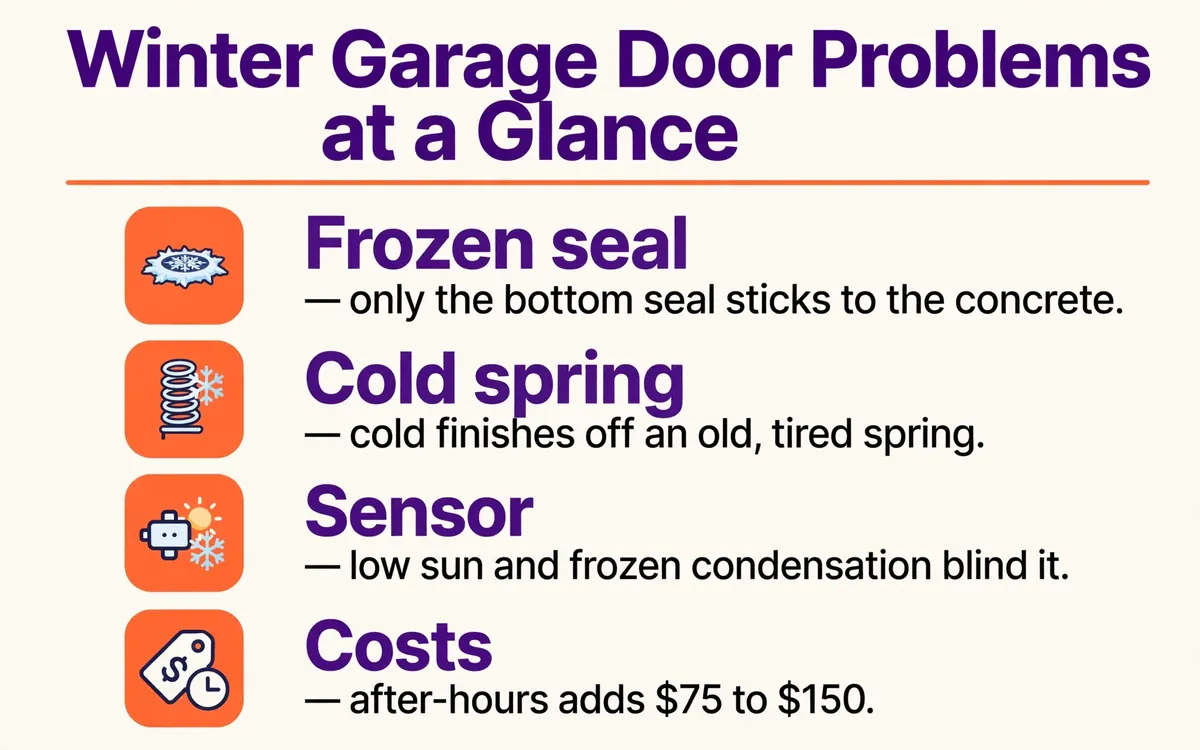
- A frozen door is usually only the bottom seal stuck to the concrete.
- Never force a frozen door with the opener, and never use hot water.
- Cold does not break a healthy spring; it finishes off an old one.
- Sensors fail in winter from low sun and frozen condensation on the lens.
- After-hours winter repairs cost $75 to $150 more than weekday jobs.
Table of Contents
-
1. Frozen door — why it freezes shut
-
2. How to free a frozen door safely
-
3. Cold springs — why they snap, signs, cost
-
4. Opener, sensors and remotes in cold
-
5. Other winter problems — track, seals, ice, rust, insulation
- 6. What winter repairs cost
-
7. Winter checklist — one fall weekend + monthly checks
- Watch: How cold weather wears out a garage door
- FAQ
1. Frozen door — why it freezes shut
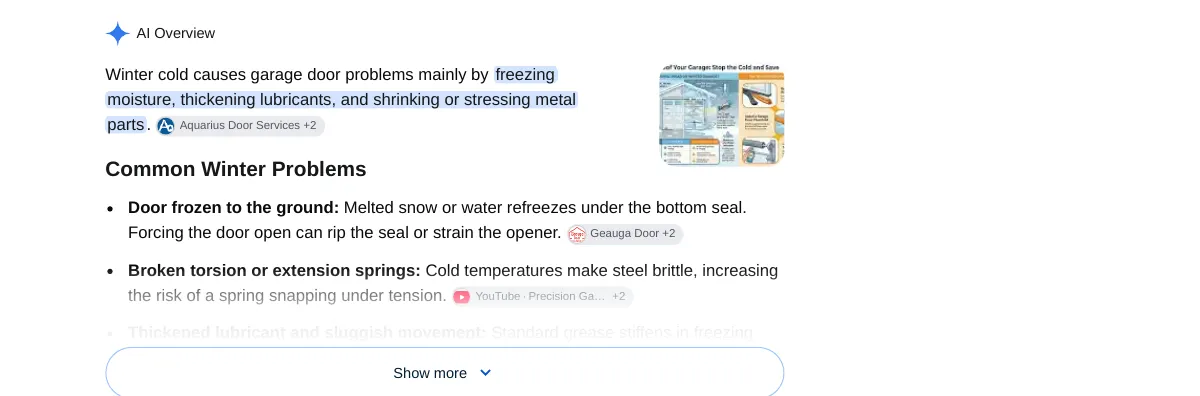
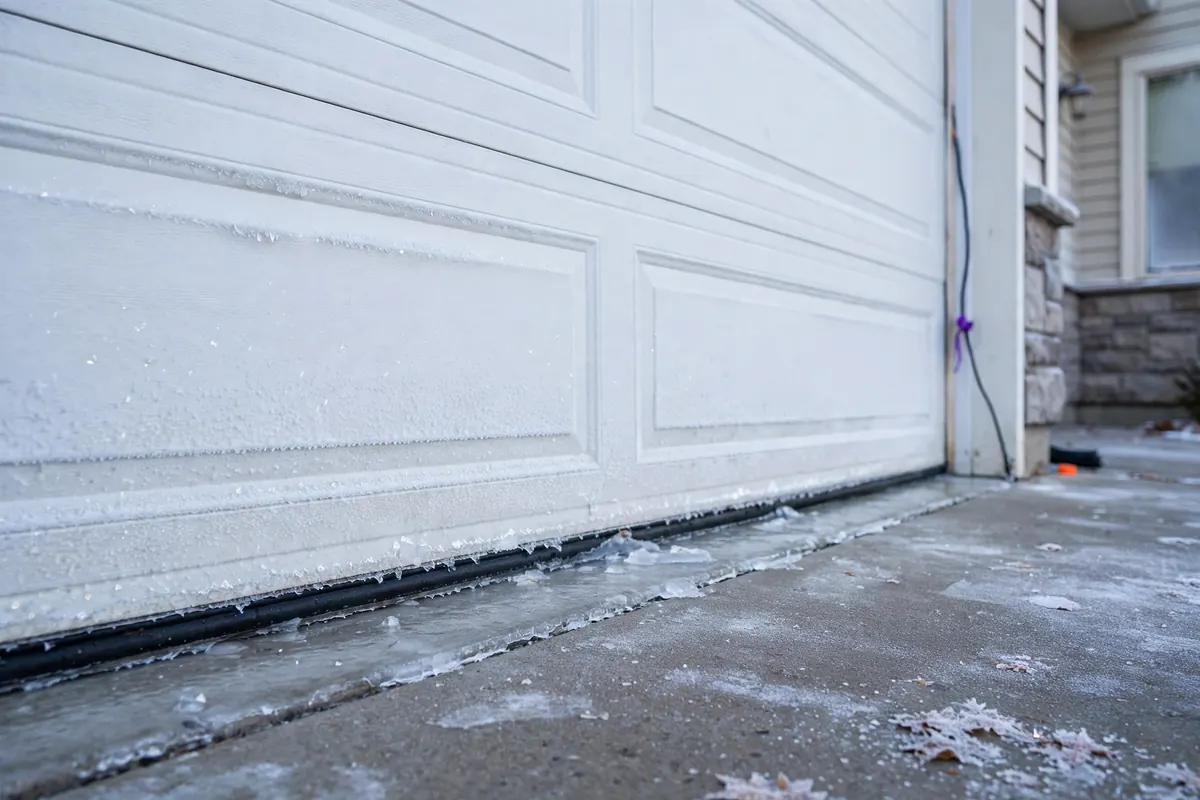
A frozen garage door is rarely frozen solid. Only the bottom seal sticks to the concrete, and a thin line of ice can hold it down.
Why water gets under the seal
Water gets under the bottom seal and freezes it to the concrete overnight. Rain, slush, a downspout, or a dipping slab can all put water there.
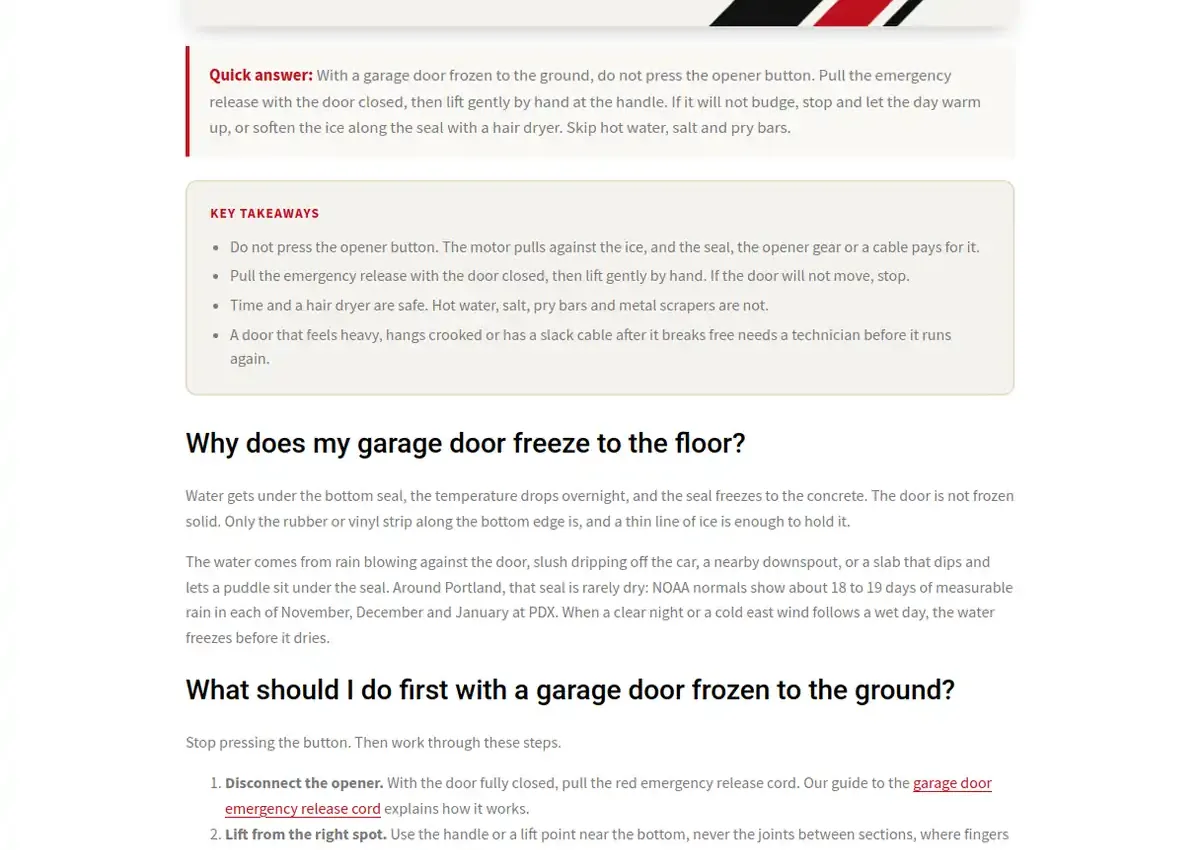
- Rain and slush drip off the car and pool at the door line.
- A downspout that points at the garage sends water under the seal.
- A slab that dips lets a puddle sit right under the seal.
- A concrete slab holds cold long after the air warms up again.
- Freeze and thaw cycles refreeze the seal dozens of times each winter.
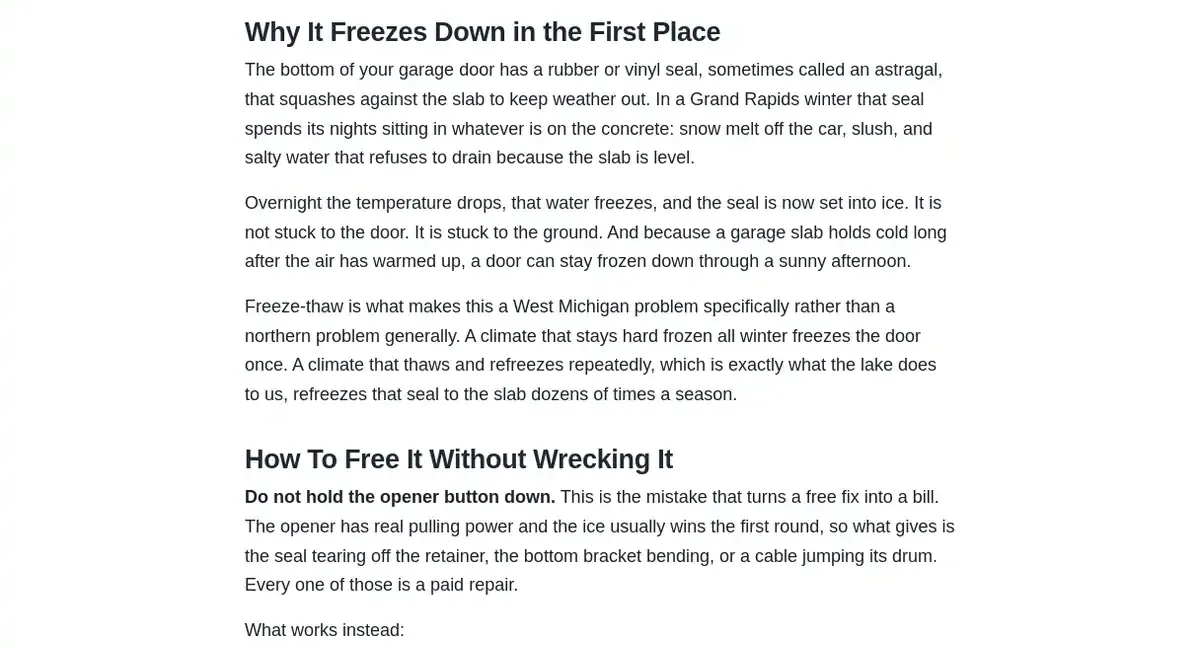
Example: In Grand Rapids, snowmelt and salty slush sit on a level slab and freeze overnight. The door can stay frozen down through a sunny afternoon.
Signs your door is frozen, not broken
A frozen door looks stuck, but the parts are usually fine. The seal is the bond, not the spring or the opener, and the signs below tell them apart.
- The door does not move at all, but you hear no bang or snap.
- The bottom edge looks stuck while the top of the door moves slightly.
- You can see ice or a wet line along the bottom seal.
- The door worked fine the day before, when the night stayed above freezing.
If the door still will not open once the seal is free, the garage door won’t open guide covers the other causes.
2. How to free a frozen door safely
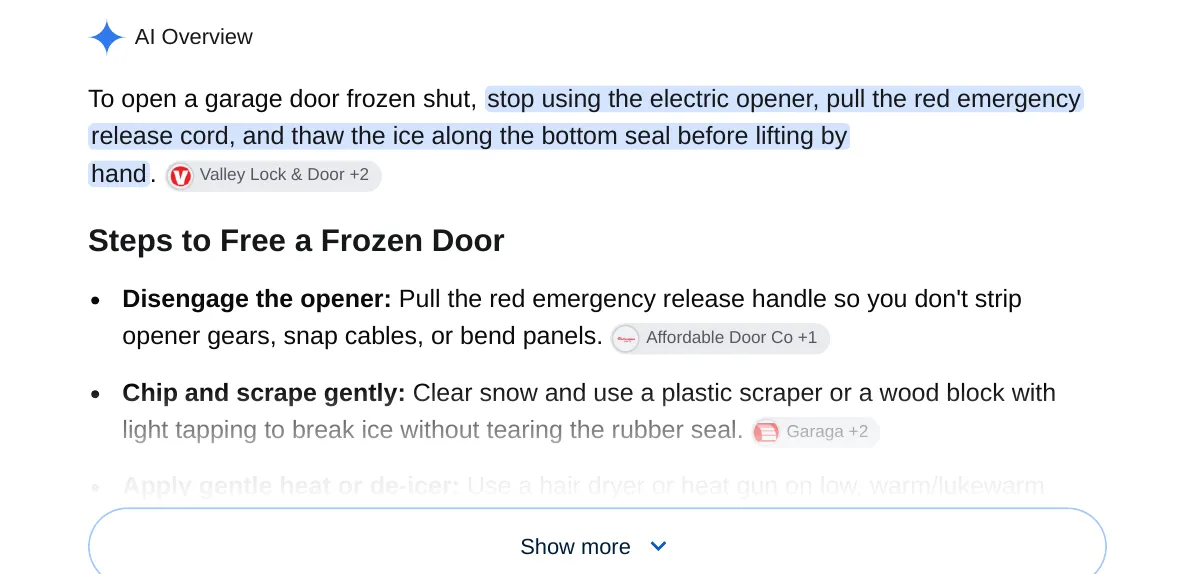
Freeing a frozen door is a gentle job, not a strong one. The goal is to melt the bond at the seal, not to pull the door free by force.
What to do first
Stop pressing the opener button after the first try. One more press can tear the seal, strip the drive gear, or pull a cable off its drum.
- Press the opener once, then stop and look at the bottom seal.
- Pull the red release cord with the door closed, to free the opener.
- Try to lift the door gently by hand, at the handle, not the joints.
- If it will not budge, stop there and warm the seal line instead.
The steps, in order
Work through these steps in order, and stop at any step that does not work. A door that still will not move needs a pro, not more force.
- Press the opener once, then stop. Do not press it again.
- Pull the red release cord with the door fully closed.
- Lift gently by hand at the handle, never at the joints.
- Warm the seal line with a hair dryer, kept moving all the time.
- Tap the seal with a plastic scraper or a rubber mallet.
- Clear the ice ridge, reconnect the opener, and watch one full cycle.
- Dry the threshold right away, or the water will refreeze tonight.
- Run the 2×4 reversal test before you trust the opener again.
- If the door feels heavy or hangs crooked, stop and call a pro.
What never to do
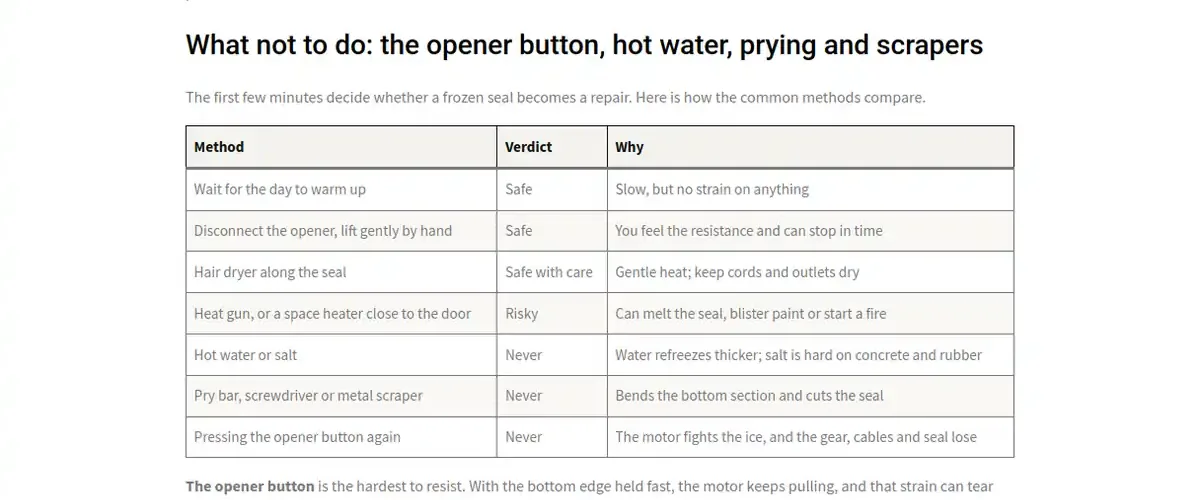
Some quick fixes make a frozen door worse, and a few can break it. Hot water, a pry bar, and a metal scraper all belong on the never list.
- Never force the door with the opener, or keep pressing the button.
- Never pour hot water on the seal; it refreezes thicker, and boiling water can crack cold concrete.
- Never use a torch or open flame near the seal. A heat gun close to the seal is risky: it can melt the seal or blister paint.
- Never pry with a pry bar, a screwdriver, or a metal scraper.
- Never put salt or ice melt on the seal; it harms rubber and concrete.
- Never turn up the force setting to push through the ice.
- Never use WD-40 on the seal; it dries out rubber over time.
Example: Larry Myers rates hot water and salt as never: the water refreezes thicker, and salt is hard on concrete and rubber. Warm water is a different question, and sources disagree on it.
3. Cold springs — why they snap, signs, cost
Cold weather breaks springs, but it rarely starts the damage. A spring that snaps in January was usually most of the way to the end of its life already.
Why cold finishes off an old spring
Cold does not create the weakness in a spring. It removes the cushion that was hiding it, and the next cold cycle finishes the job.
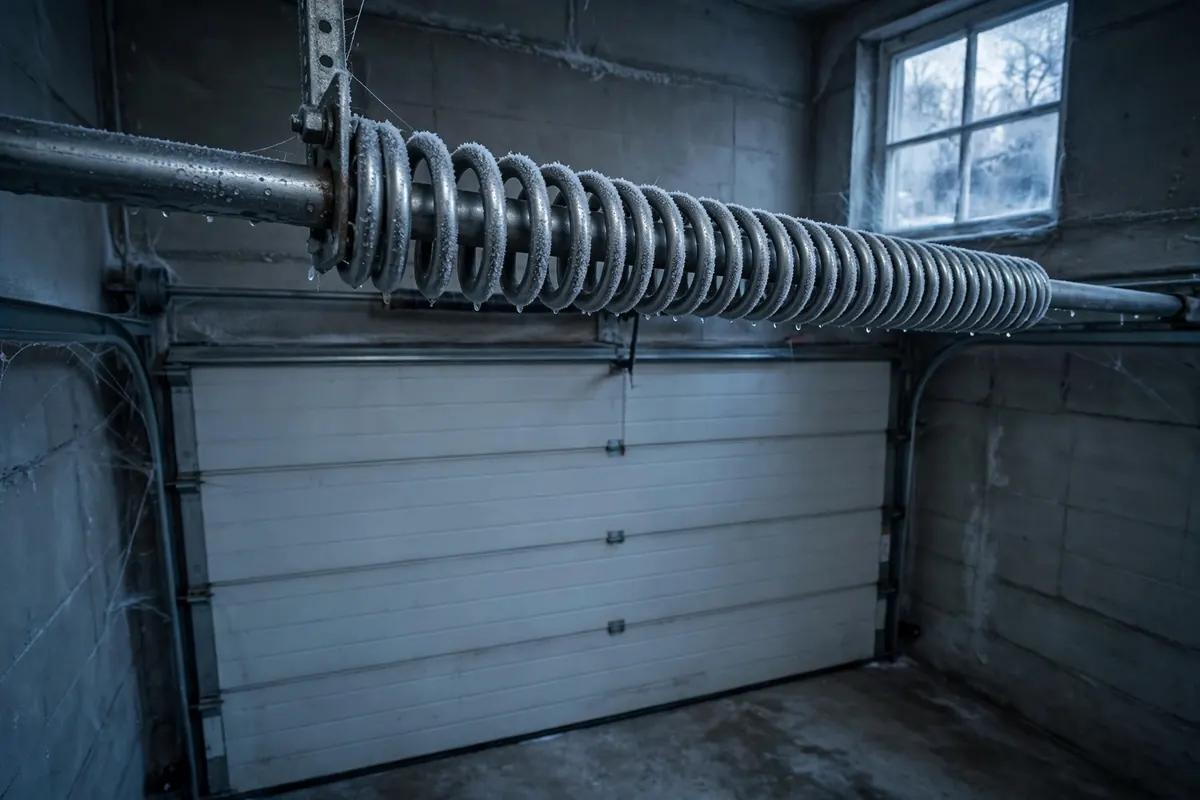
- Steel contracts in cold, so the fit against the shaft gets tighter.
- Grease thickens in cold, so the load on the spring rises.
- Cold lowers the fracture toughness of hardened steel, so small cracks grow.
- Rust pits and old fatigue cracks act as weak points in the wire.
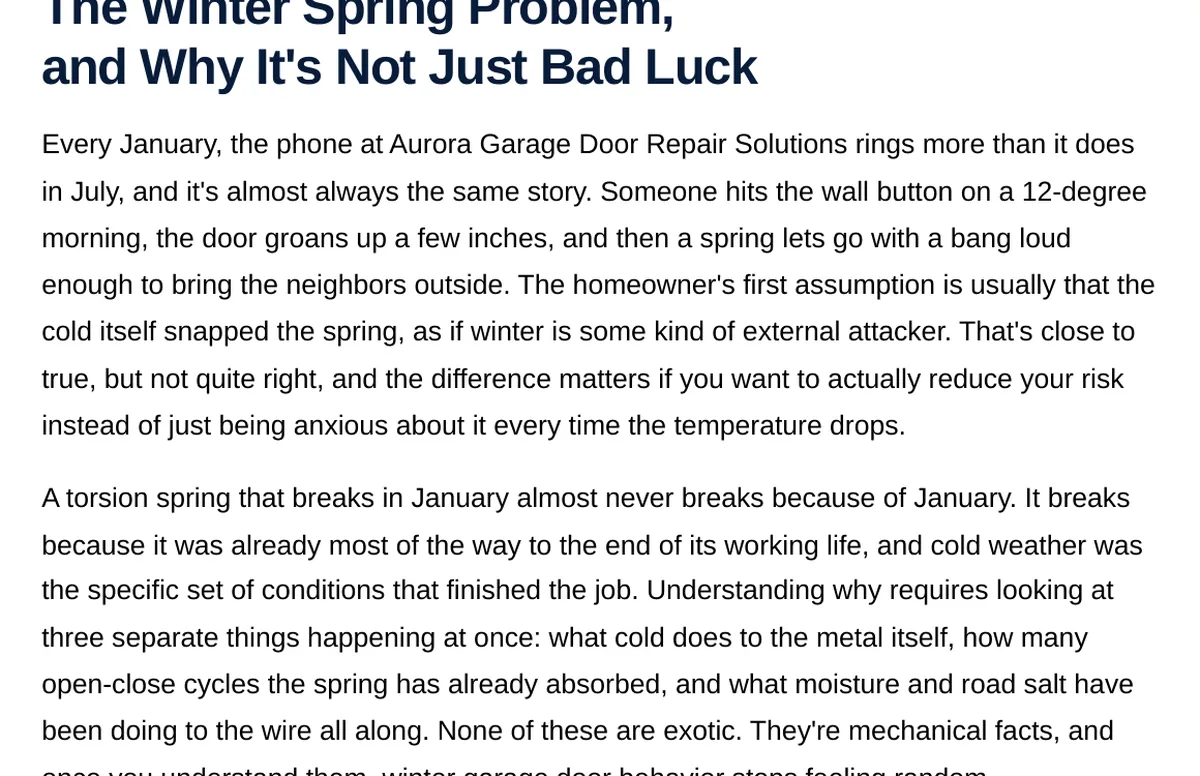
Example: Aurora Garage Door Repairs puts it plainly: a torsion spring that breaks in January almost never breaks because of January. The cold was the last push, not the cause.
Signs a spring is about to snap
A failing spring gives warnings before it snaps. Check for them in fall, not after the first hard freeze of the year.
- A loud bang, like a gunshot, means a spring has already snapped.
- A visible gap in a torsion spring coil means the spring is broken.
- The door hangs crooked, drops fast, or will not stay open alone.
- The opener strains, stops, or reverses partway up the track.
- Rust on the springs, or a door that feels much heavier by hand.
For the full signs list and what a pro does next, see the broken garage door spring guide. Springs are pro-only work, never a DIY repair.
What a spring replacement costs in 2026
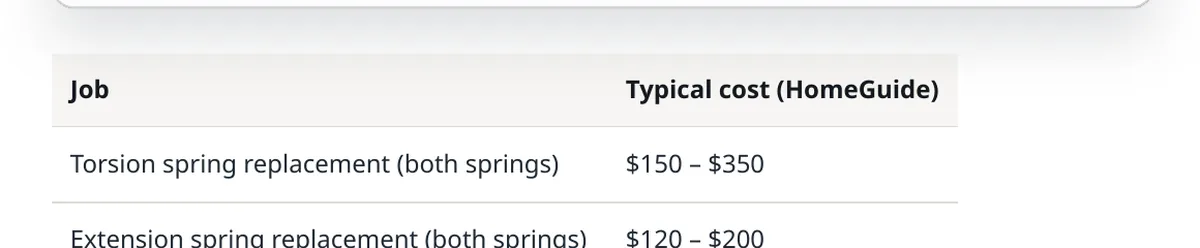
Spring prices look confusing because sources count them on different bases. Angi counts per spring, while HomeGuide counts both springs together, so read the basis first.
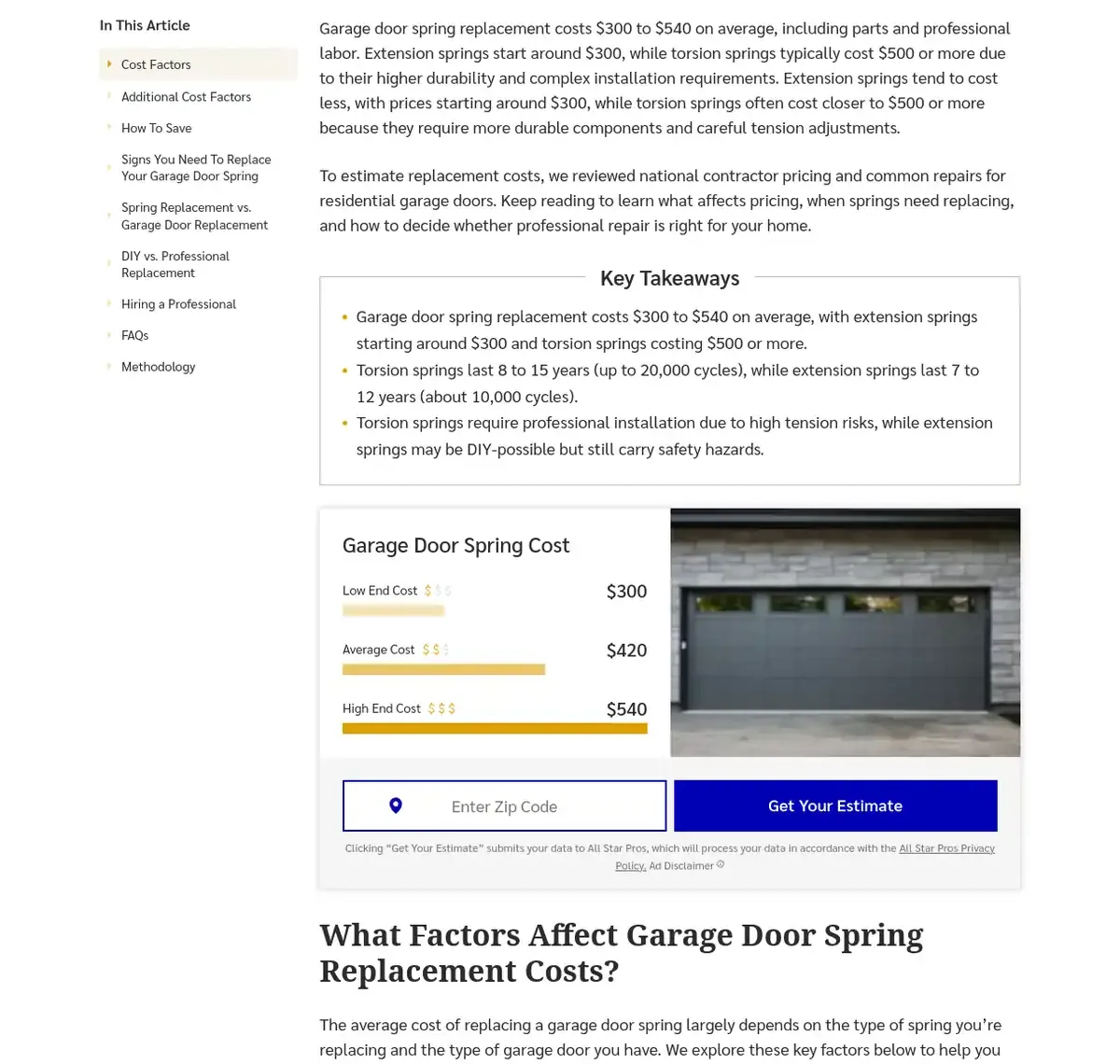
- Angi (30 Oct 2026): $150 to $350 per spring, average $250, up to $500.
- HomeGuide via GaragePlaybook (2 Oct 2026): both torsion springs, $150 to $350.
- HomeGuide via GaragePlaybook (2 Oct 2026): both extension springs, $120 to $200.
- This Old House (Mar 2026): $300 to $540 installed, average $420.
- Replace springs in pairs, since both share the same age and wear.

4. Opener, sensors and remotes in cold
Cold makes the whole door stiffer, and the opener feels it first. Grease thickens, rollers drag, and a frozen seal adds drag, so the opener works harder than in summer.
Why the opener strains and reverses
The opener motor only gives the last bit of force. The spring does about 90% of the lifting, so a weak spring makes the opener look broken.
- Cold grease and stiff rollers add resistance, so the door moves slowly.
- The opener may hum but not move, or reverse halfway through a cycle.
- A frozen bottom seal can hold the door while the motor pulls hard.
- Do not turn up the force setting; find the resistance first instead.
Example: The Wright Door Co. warns against raising the force setting to push through resistance. It can stop the door from reversing when it should, and it can hide a failing spring.
Sensors: sun glare and frozen condensation
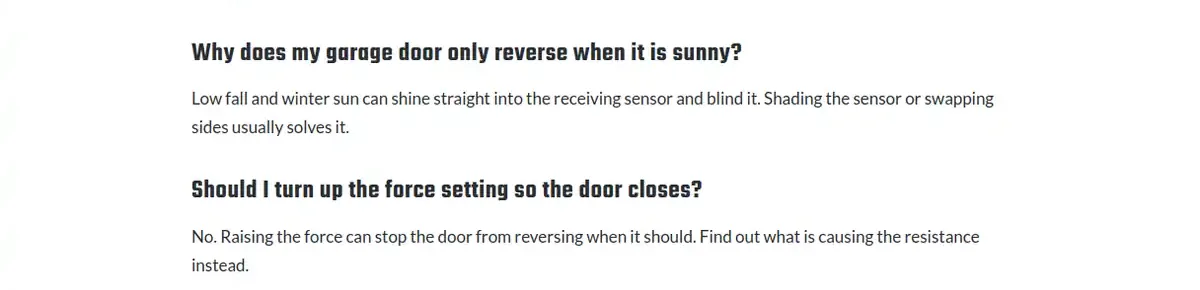
Winter sensors fail in two ways, and both look like a broken opener. Low sun blinds the receiver, and frozen condensation blurs the lens.
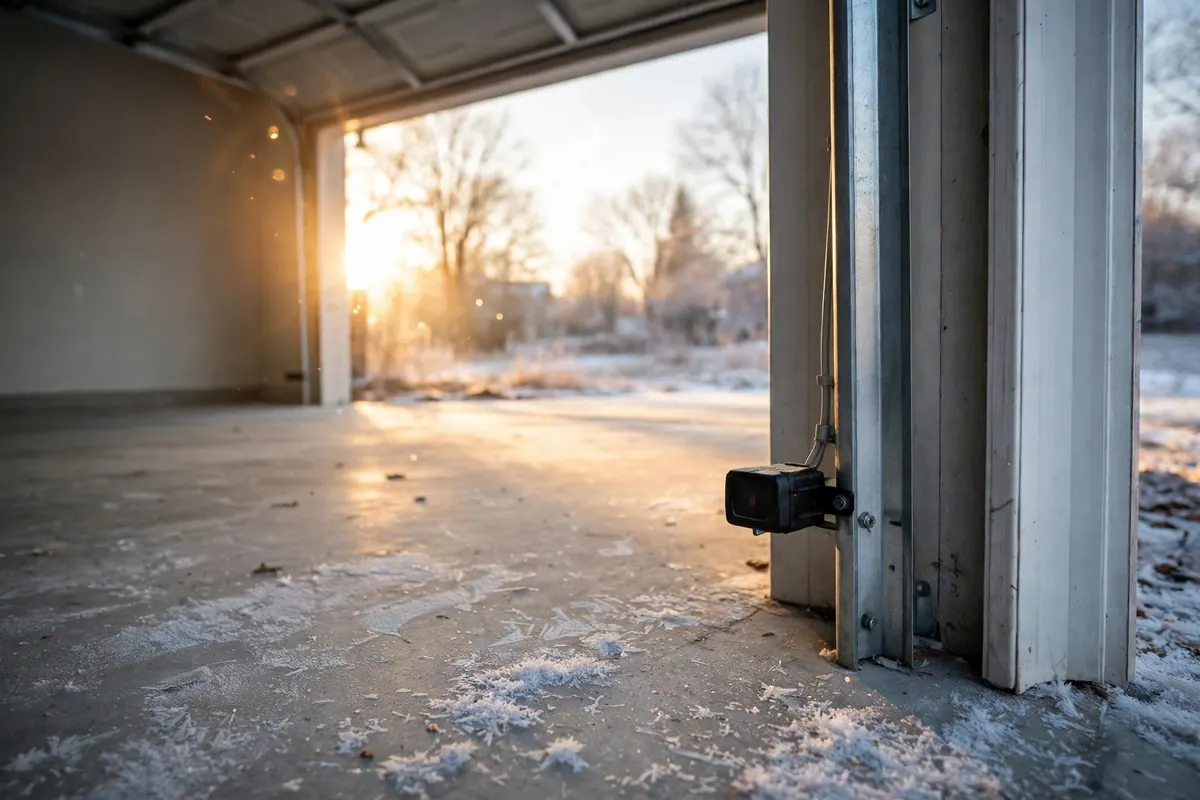
- Low winter sun shines straight into the receiving sensor and blinds it.
- Shade the receiver, or swap the two sensors side to side.
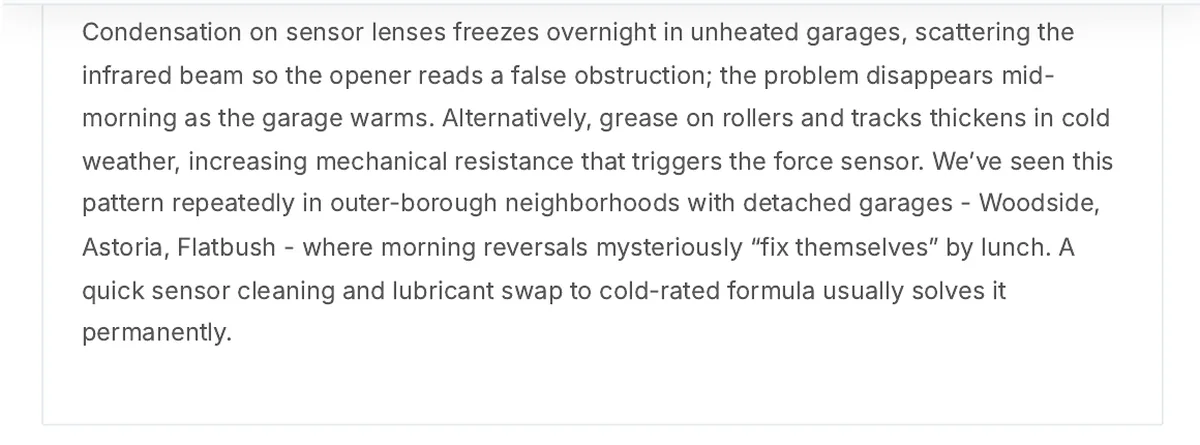
- Condensation on the lens freezes overnight in an unheated garage.
- Wipe both lenses with a soft, dry cloth, and check both LEDs are steady.
Example: In one New York case, the door reversed on cold mornings and worked again by mid-morning. The fix was a lens wipe, once the garage had warmed up.
For the full sensor checks, see the garage door reverses guide. It covers limits, force settings, and the auto-reverse test.
Remotes and batteries in cold
Cold cuts battery power, so a remote that worked in October can fail in January. Batteries that seem charged may still fail to give enough voltage in the cold.
- Replace remote batteries once a year, in October, before the cold arrives.
- Lithium batteries hold up better in cold than alkaline batteries do.
- Test the opener battery backup by cutting power and running the door.
- Replace a backup battery if it is over two years old, or feels sluggish.
5. Other winter problems — track, seals, ice, rust, insulation
Winter hits more than the seal and the spring. Tracks tighten, seals crack, and ice blocks the track.
Track, rollers and ice
Metal contracts when the temperature drops below freezing. Tracks, rollers and springs all tighten up, and a tight track can bind or push a door out of line.
- Freeze and thaw can shift a track, so a door wedges at an angle.
- Do not just pop a roller back in; check the track mounting first.
- Clear ice from the track with a plastic scraper or a soft cloth.
- Wipe tracks with a rag; keep them clean and dry, never greased.
Seals and weatherstripping
Seals keep cold air, water and pests out, and winter shows their age fast. A seal that looks fine in summer can crack, split, or flatten by January.
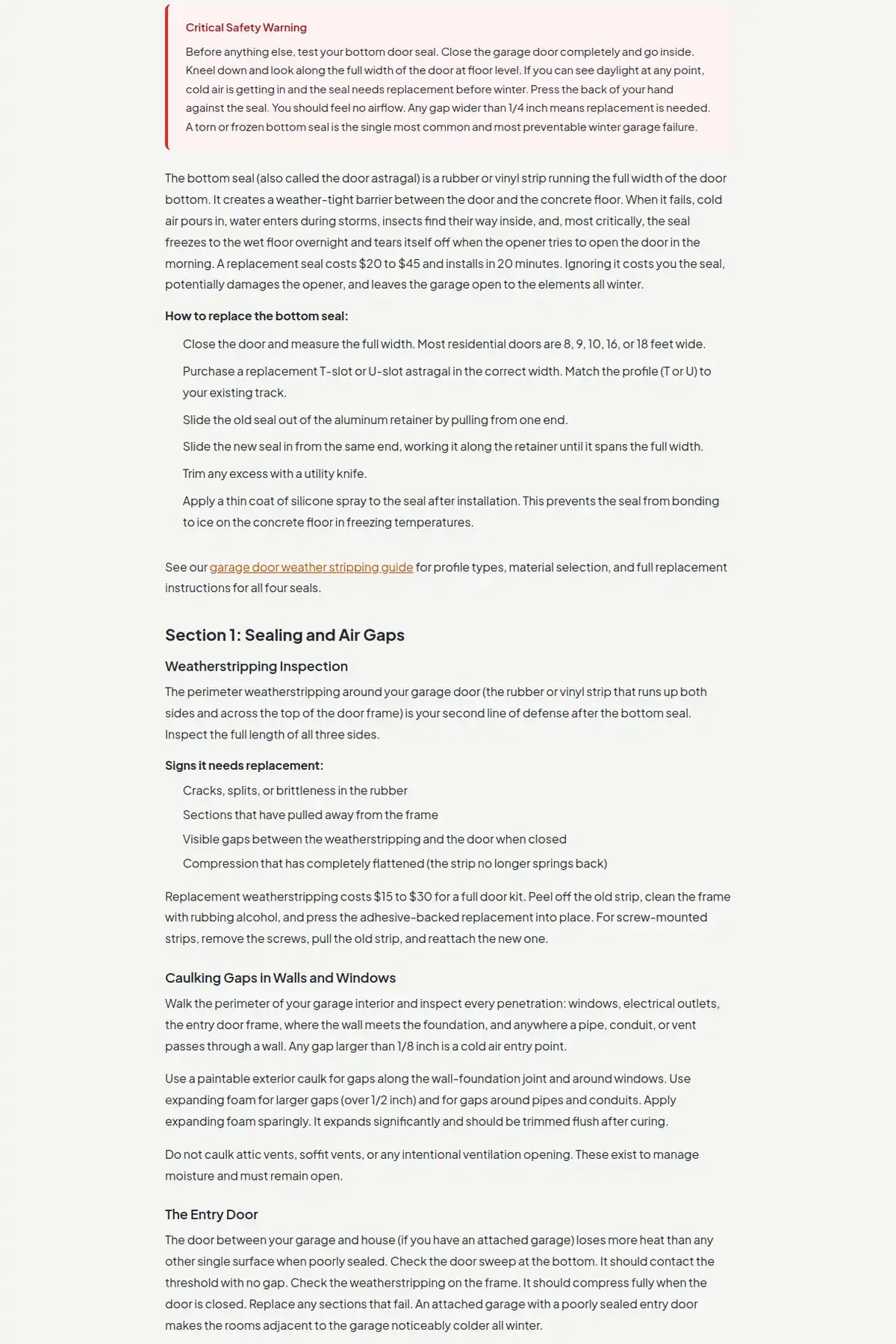
- Cracks, splits, or brittle rubber mean the seal needs replacing now.
- A gap wider than a quarter inch under the door means replace the seal.
- A bottom seal costs $20 to $45 (The Garage Guide, Mar 2026).
- A weatherstrip kit for a full door costs $15 to $30 (The Garage Guide, Mar 2026).
Rust, condensation and insulation
Freeze and thaw cycles cause condensation, and salt arrives on the car. The salt drips off in the garage, and it corrodes the bottom rollers, hinges and track.
- Rust pits spring wire, so wipe visible rust and keep drains clear.
- Orange stains on the floor below the spring mean flaking rust inside.
- An uninsulated steel door has an R-value of about 0 to 2.
- A foam-board kit can reach R-8, and a new insulated door reaches R-12 to R-18.
- Adding insulation makes the door heavier, so check the balance after a kit.
For insulation and R-value in full, see the garage door insulation and R-value guide. It covers what R-value you need for an attached garage.
6. What winter repairs cost
Winter prices vary by job, by source, and by time of day. The table keeps sources separate, so you can see why quotes differ.
| Job | Price | Source + year |
|---|---|---|
| Garage door repair, average | $265 average; most $155–$379 | Angi, 21 Oct 2026 |
| Single torsion spring | $150–$350 per spring; average $250 | Angi, 30 Oct 2026 |
| Both torsion springs | $150–$350 for both springs | HomeGuide via GaragePlaybook, 2 Oct 2026 |
| Both extension springs | $120–$200 for both springs | HomeGuide via GaragePlaybook, 2 Oct 2026 |
| Spring replacement (Homewyse) | $300–$540; average $420 | This Old House, Mar 2026 |
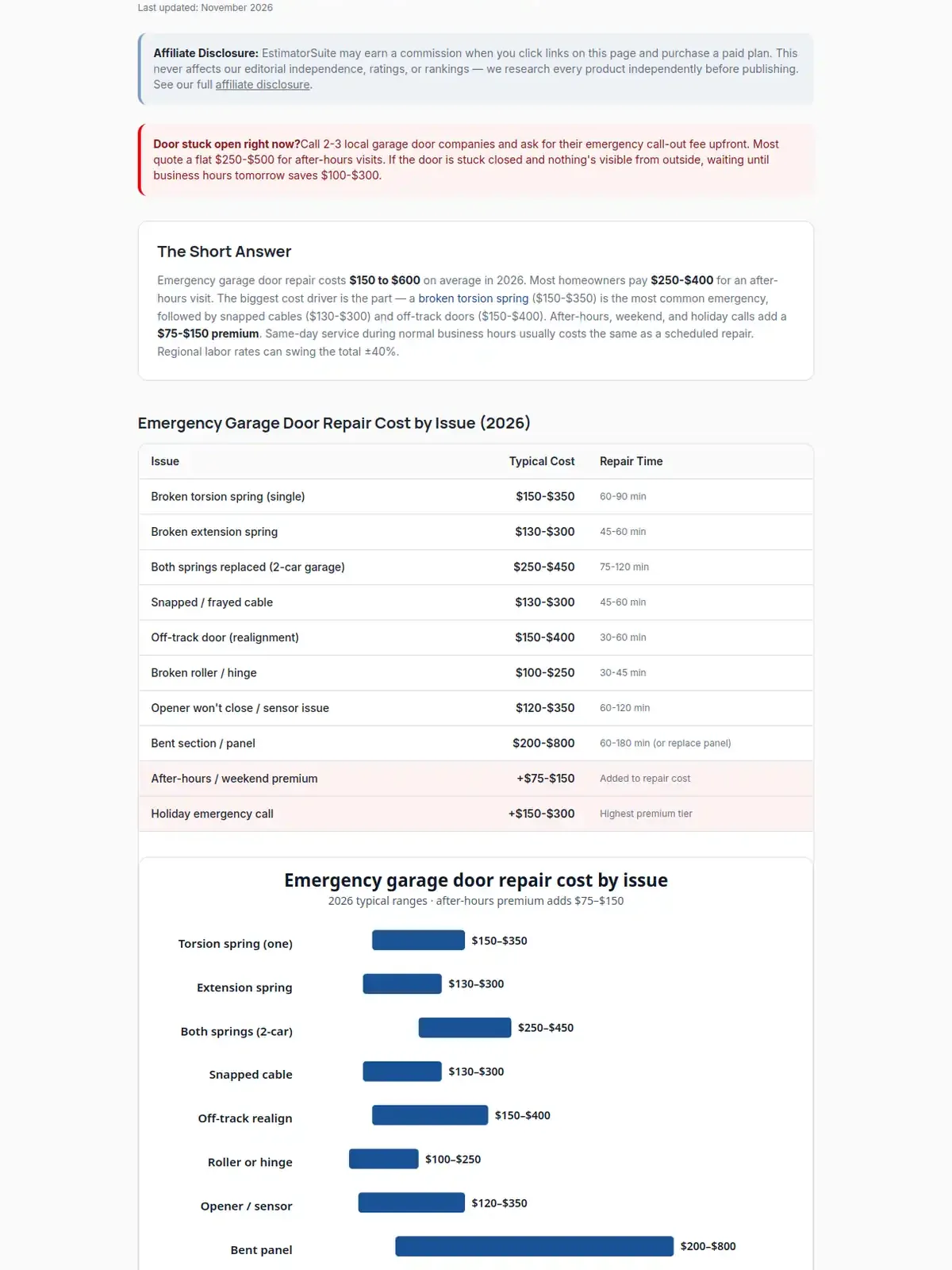
| Cable repair | $130–$300 | EstimatorSuite, Nov 2026 |
| Off-track realignment | $150–$400 | EstimatorSuite, Nov 2026 |
| Roller or hinge job | $100–$250 | EstimatorSuite, Nov 2026 |
| Opener or sensor job | $120–$350 | EstimatorSuite, Nov 2026 |
| Bent panel | $200–$800 | EstimatorSuite, Nov 2026 |
| Bottom seal replacement | $20–$45 | The Garage Guide, Mar 2026 |
| Weatherstrip kit, full door | $15–$30 | The Garage Guide, Mar 2026 |
| Emergency repair, total | $150–$600; most after-hours $250–$400 | EstimatorSuite, Nov 2026 |
| After-hours premium | +$75–$150; holiday +$150–$300 | EstimatorSuite, Nov 2026 |
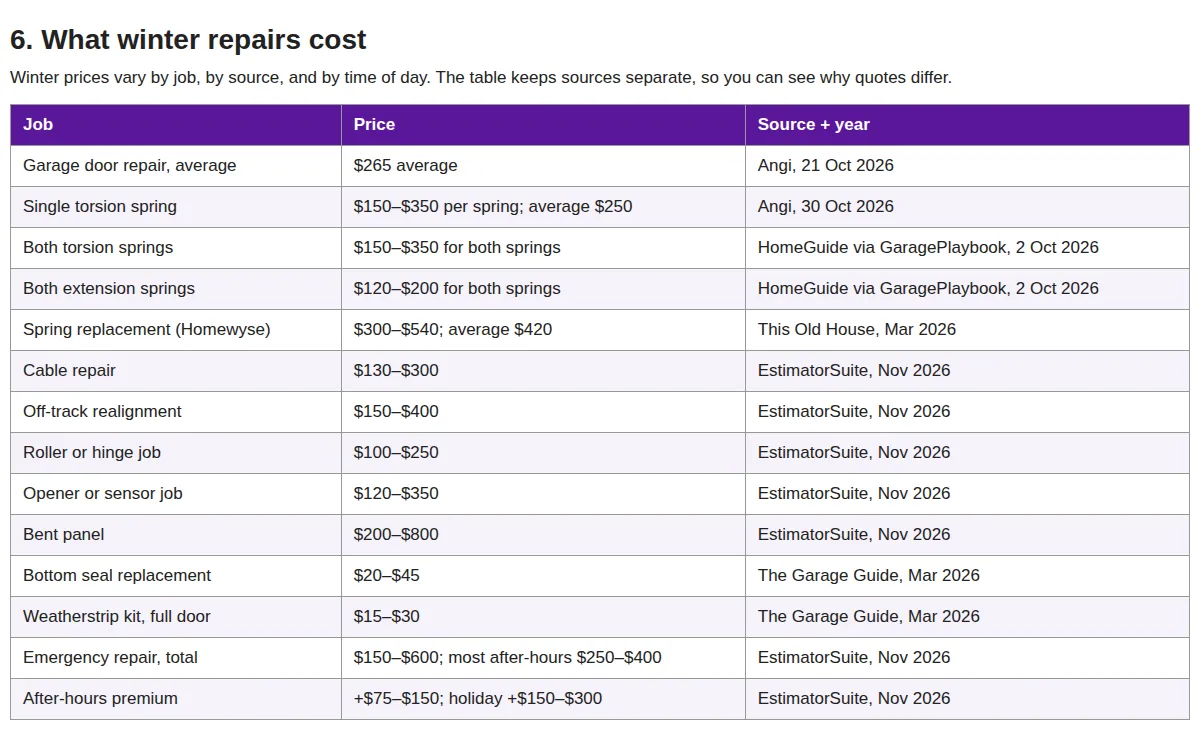
Read the spring rows with care. Angi counts $150 to $350 per spring, while HomeGuide counts $150 to $350 for both springs.
The after-hours premium is a flat fee on top of the repair, not a percentage. Waiting till morning saves $100 to $300 if the door is shut and secure.
For the full emergency guide, see the emergency garage door repair cost guide. It covers what counts as an emergency, and what to do while you wait.
7. Winter checklist — one fall weekend + monthly checks
One fall weekend of checks can stop most winter garage door problems. The whole job takes three to five hours, and the materials cost $50 to $200.
The one fall weekend
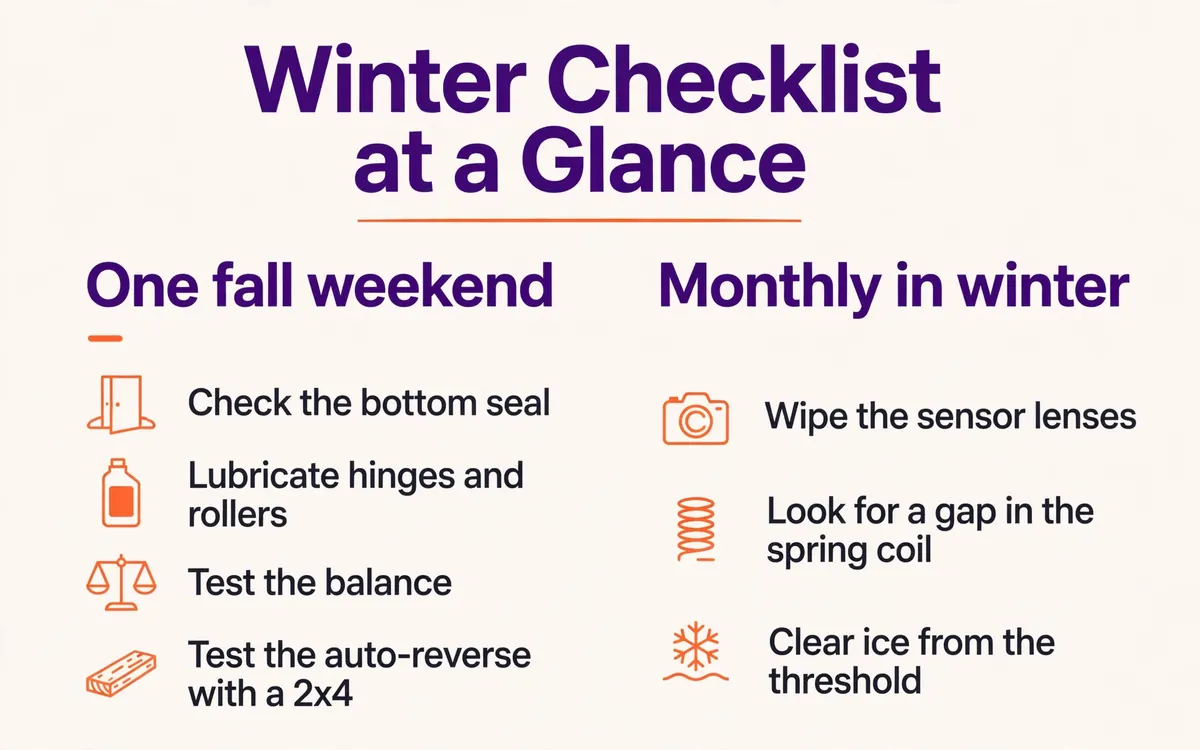
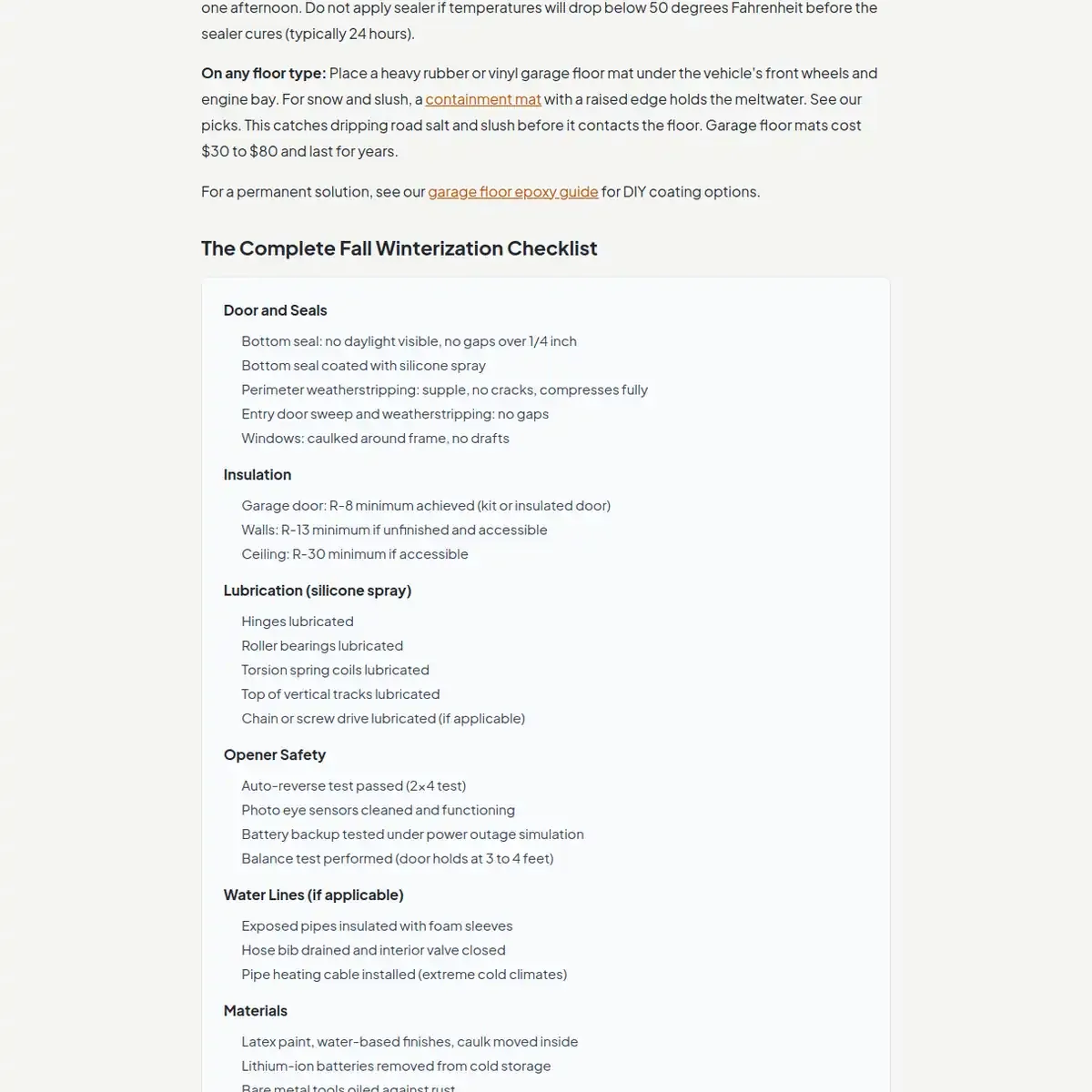
Do this checklist once, before the first freeze of the year. It takes one weekend, and it covers the seal, the springs, the sensors, and the opener.
- Test the bottom seal for daylight or a gap wider than a quarter inch.
- Spray silicone on the new seal, so ice struggles to bond to it.
- Check the weatherstripping on all three sides of the door frame.
- Caulk any gaps wider than an eighth of an inch around the frame.
- Lubricate hinges, roller bearings and spring coils with silicone spray.
- Run the balance test: lift the door to three or four feet, and it should hold.
- Run the 2×4 auto-reverse test; the door must reverse within two seconds.
- Test the battery backup, and replace a battery over two years old.
Monthly checks in winter
Winter checks take five minutes a month, and they catch the failures that a fall checklist cannot see. Do them on the first weekend of each month.
- Wipe the safety sensor lenses with a soft, dry cloth.
- Look for a gap in the torsion spring coil, or rust flakes below it.
- Check extension springs for stretch, sag, or a visible gap.
- Tighten any loose hinge or track bolts you can see.
- Clear snow and slush from the threshold before dark each night.
Before the next freeze
The next freeze is the test of your fall work. Cincinnati’s forecast for 23 to 25 November shows lows of 29°F, 31°F and 36°F, but those are forecast lows only.
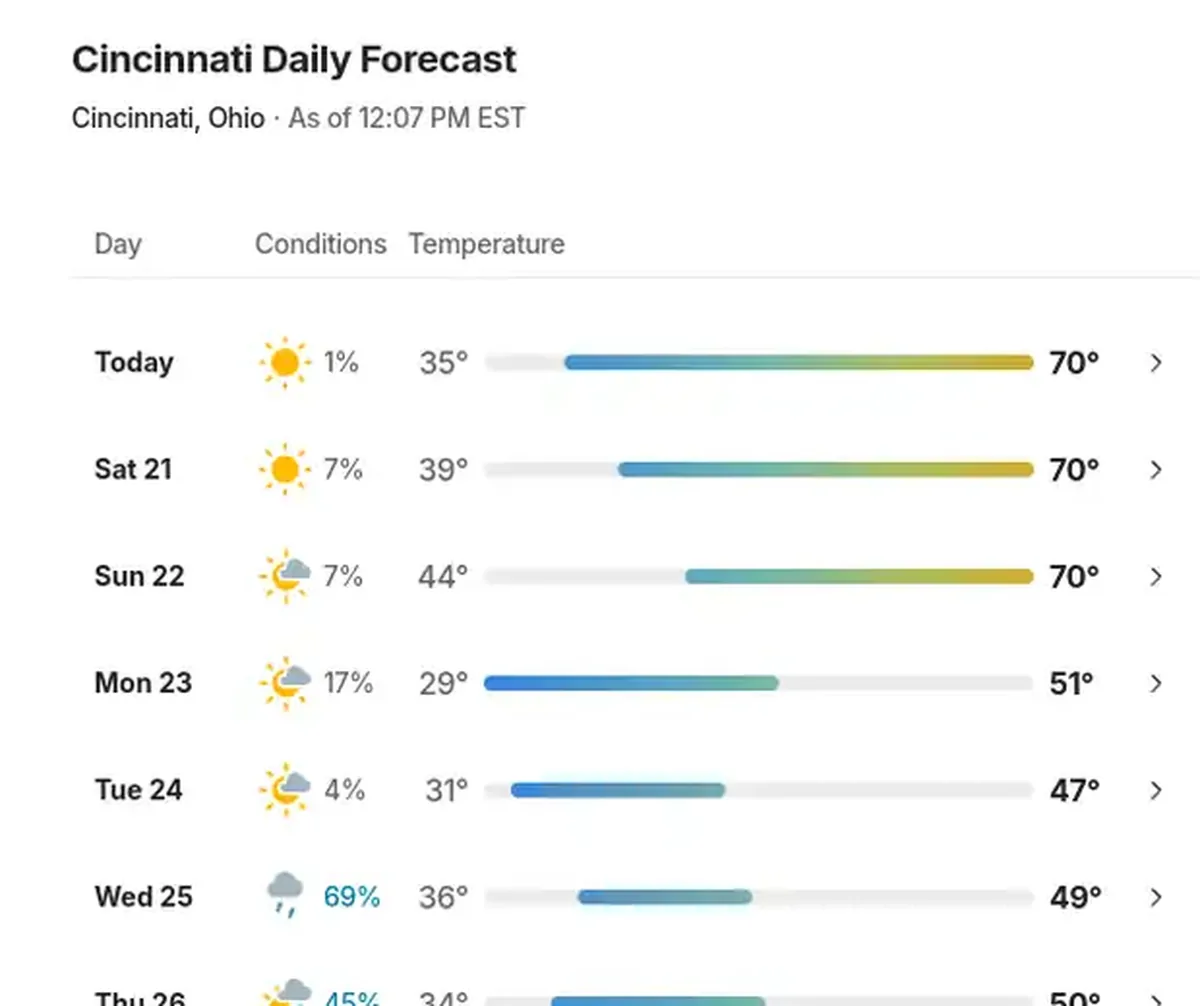
- Check the forecast again on the day, since forecasts change fast.
- Clear the threshold and dry it before the night turns cold.
- Knock snow and slush off the car before you pull into the garage.
- Point downspouts away from the door, so water cannot pool there.
For the full year-round schedule, see the garage door maintenance complete guide. It covers the monthly and seasonal checks in one place.
For the full repair guide, see the garage door repair guide. It covers costs, problems, and when to call a pro.
Example: The Garage Guide puts the fall weekend at three to five hours, with materials at $50 to $200. That one weekend covers the seal, the balance, the reverse test, and the battery.
Watch: How cold weather wears out a garage door
A1 Garage Door Service’s Garage Authority Podcast explains how heat, cold and moisture affect a garage door on YouTube, from frozen doors to cold springs, and the seasonal checks homeowners can do safely.
- A frozen door is usually just the bottom seal stuck to the slab — work it free gently and never force the door.
- Cold finishes off an old spring, so a door that will not move in winter may have a snapped spring — call a pro.
- Book a tune-up in the fall, then run the monthly checks through winter.
Video: A1 Garage Door Service, YouTube. Checked 21 November 2026.
Garage Door Hub connects homeowners with trusted local garage door pros. Need a repair? Need a replacement? Start here. First, find out what it should cost. Then, price your exact job with our free calculator. Next, find a pro near you. Fast. No jargon. No guesswork. No surprise bills. Just clear prices, honest guides, and a local pro you can call today.
FAQ
Why does my garage door freeze shut at night but work by afternoon?
A concrete slab holds cold long after the air warms up, so the seal stays frozen down through a sunny afternoon. The bond is only at the bottom seal, and it thaws as the slab warms.
Can warm water free a frozen garage door?
Several sources allow warm water, never boiling water, poured along the threshold and dried at once. Larry Myers says skip hot water entirely, so warm water is not universally safe.
Why do garage door springs break most in February and March?
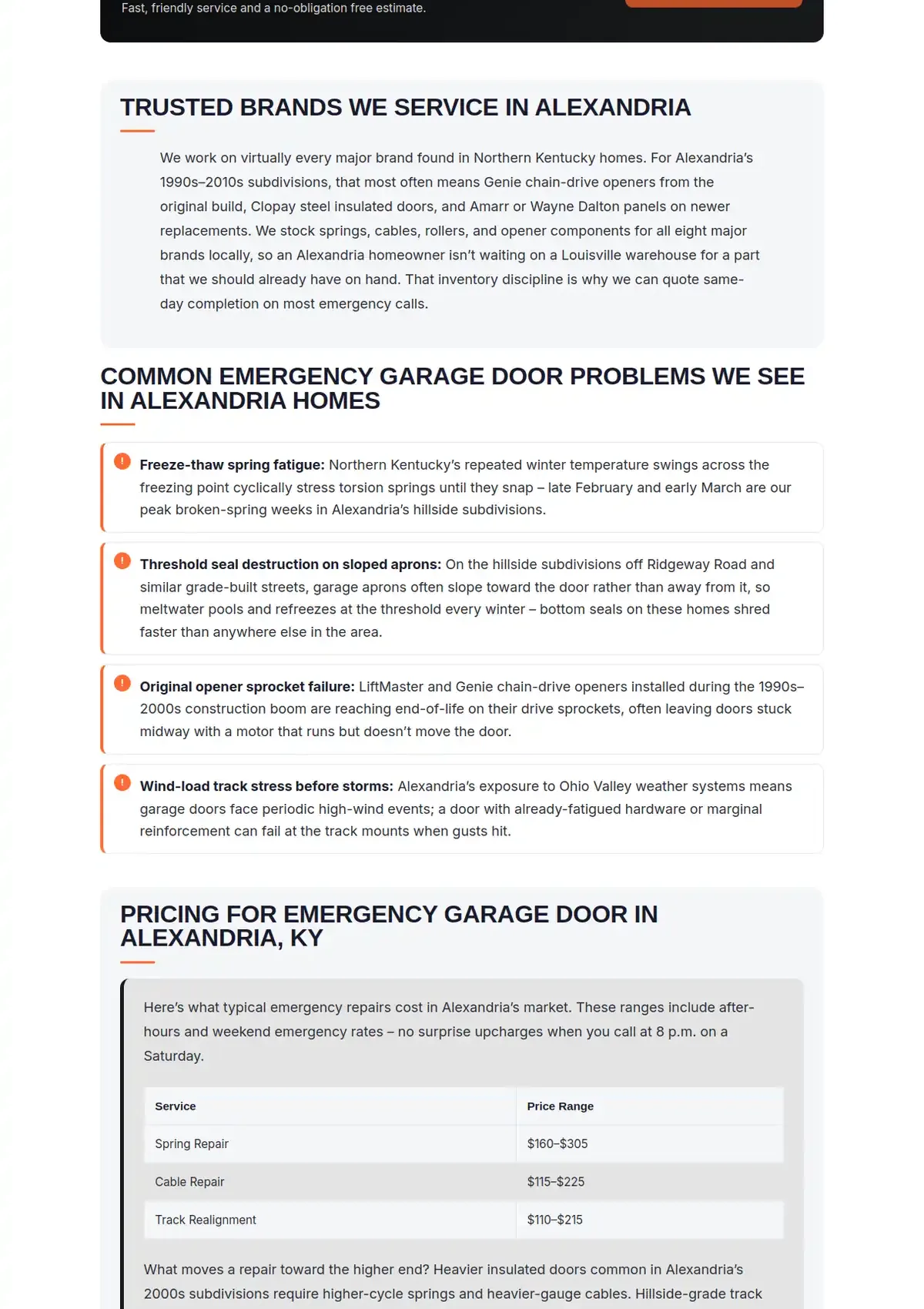
Local companies report their peak broken-spring weeks in late February and early March, after a dozen or more freeze-thaw crossings of 32°F. No national dataset for this peak was found.
Why does my garage door reverse on cold mornings and work later in the day?
Condensation on the sensor lens freezes overnight in an unheated garage, and the ice blurs the signal. The door reads a false obstruction in the morning, then works by mid-morning once the garage warms.
How much extra does an after-hours winter repair cost?
After-hours and weekend calls add $75 to $150, and holiday calls add $150 to $300 (EstimatorSuite, Nov 2026). Most after-hours visits total $250 to $400, on top of the repair itself.
Sources
- National Weather Service, Cincinnati Nov 2026 climatological data (F-6) — first frost 7 Nov 2026 (36°F), first freeze 8 Nov 2026 (31°F). Index, 20 Nov 2026.
- National Weather Service Wilmington, fall frost/freeze normals — normal first 32°F: 25 Oct (1991–2020). Verified live, 20 Nov 2026.
- weather.com, Cincinnati 10-day forecast — 23 Nov low 29°F, 24 Nov low 31°F, 25 Nov low 36°F. FORECAST ONLY as of 20 Nov 2026, 11:45 AM EST. Verified live, 20 Nov 2026.
- YallSnow, 8 Nov 2026 — first freeze 17 days late, tied 15th-latest in 154 falls. Index, 20 Nov 2026.
- Larry Myers, 21 Sep 2026 — frozen door: only the seal freezes, safe freeing, never hot water/salt/pry bar. Verified live, 20 Nov 2026.
- Aurora Garage Door Repairs, Aug 2026 — cold finishes off an old spring; do not crank the force setting. Verified live, 20 Nov 2026.
- The Wright Door Co., 9 Nov 2026 — reversal, low winter sun, force setting, limits. Verified live, 20 Nov 2026.
- The Garage Guide, Mar 2026 — winterize checklist, seal $20–$45, kit $15–$30, R-values, battery −20–40%, 2×4 test. Verified live, 20 Nov 2026.
- Angi, updated 30 Oct 2026 — spring $150–$350 per spring, average $250. Verified live, 20 Nov 2026.
- Angi, 21 Oct 2026 — repair average $265; most $155–$379, based on 42,709 verified projects. Verified live, 20 Nov 2026 (range confirmed in the body paragraph via browser-PDF capture, 22:18 PKT).
- GaragePlaybook / HomeGuide, reviewed 2 Oct 2026 — both torsion springs $150–$350, both extension $120–$200. Verified live, 20 Nov 2026.
- This Old House, Mar 2026 — spring $300–$540, average $420 (Homewyse). Index, 20 Nov 2026.
- EstimatorSuite, Nov 2026 — emergency $150–$600, after-hours +$75–$150, holiday +$150–$300. Verified live, 20 Nov 2026.
- Apex Garage Door Service, Greater Cincinnati — late Feb–early Mar peak spring weeks; local emergency $110–$305. Verified live, 20 Nov 2026.
- Coastal Garage Door Repair NY — frozen condensation, reverses on cold mornings, fine by mid-morning. Index, 20 Nov 2026.
- Garage Doors of Grand Rapids — slab holds cold, door stays frozen through a sunny afternoon. Index, 20 Nov 2026.
Last reviewed: 20 November 2026
Appendix — Related topics
You might have found this by these keywords — and if not, others might have:
winter garage door problems, garage door frozen shut, garage door won’t open in cold, frozen garage door, garage door spring cold weather, garage door maintenance winter, garage door frozen to ground, garage door cold weather problems, winterize garage door, garage door ice.