

Garage Door Locator puts safety cable parts at $20 to $40, and calls a broken extension spring without one a projectile. That is the whole case in one line.
An extension spring holds real energy at head height, unrestrained. When it snaps, it can fly across the garage and break a windshield.
This guide shows how the cable stops that, how to check yours, and when a full torsion conversion is worth the money.
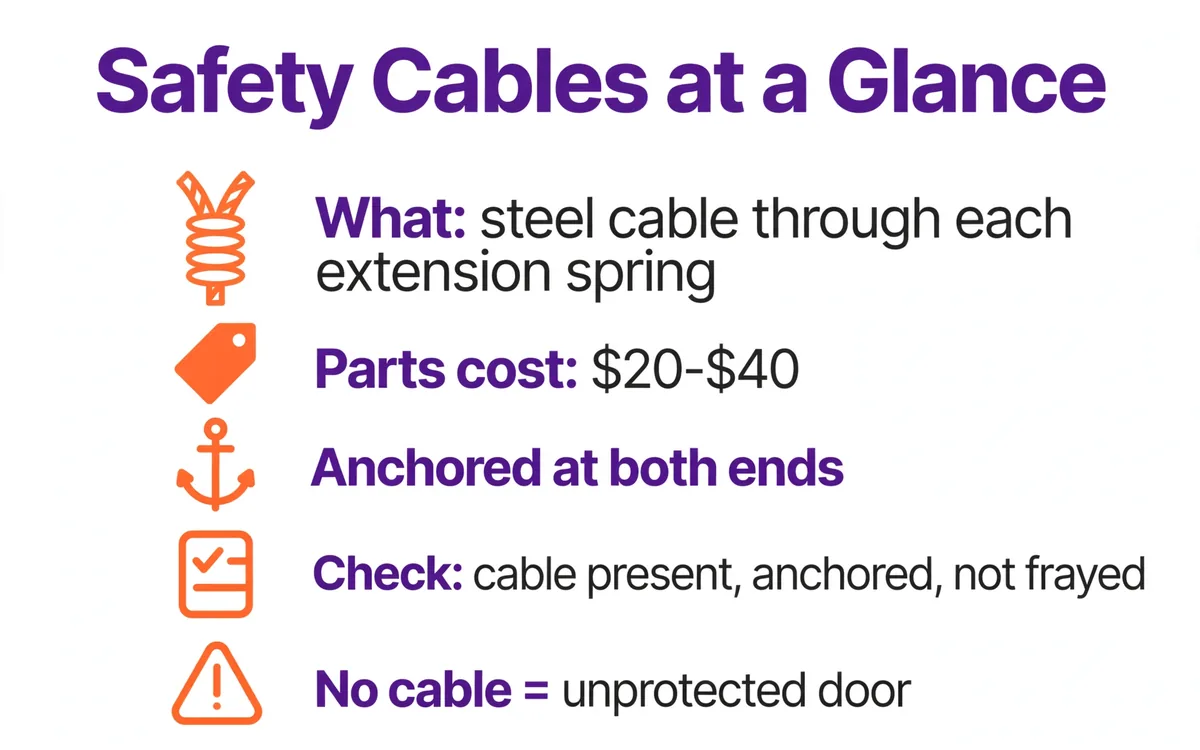
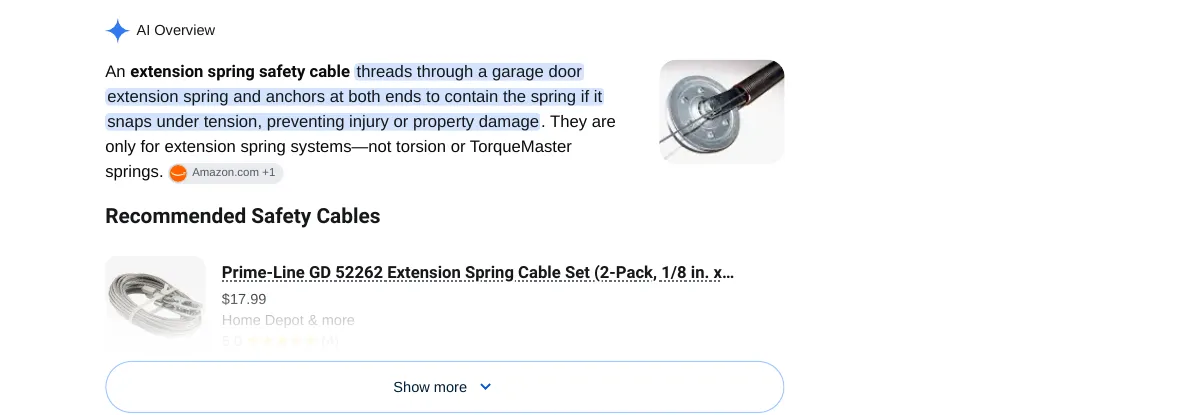
An extension spring safety cable is a steel wire threaded through the spring and anchored at both ends, so a broken spring stays captive instead of flying across the garage. Cable parts cost $20 to $40 (Garage Door Locator, 2026). Converting extension springs to torsion costs $400 to $800 (HomeGuide, 2026) and buys safety, smoother travel, and longer spring life.
Garage Door Hub connects you with a trusted local pro. Get a clear price for your garage door repair or replacement first.
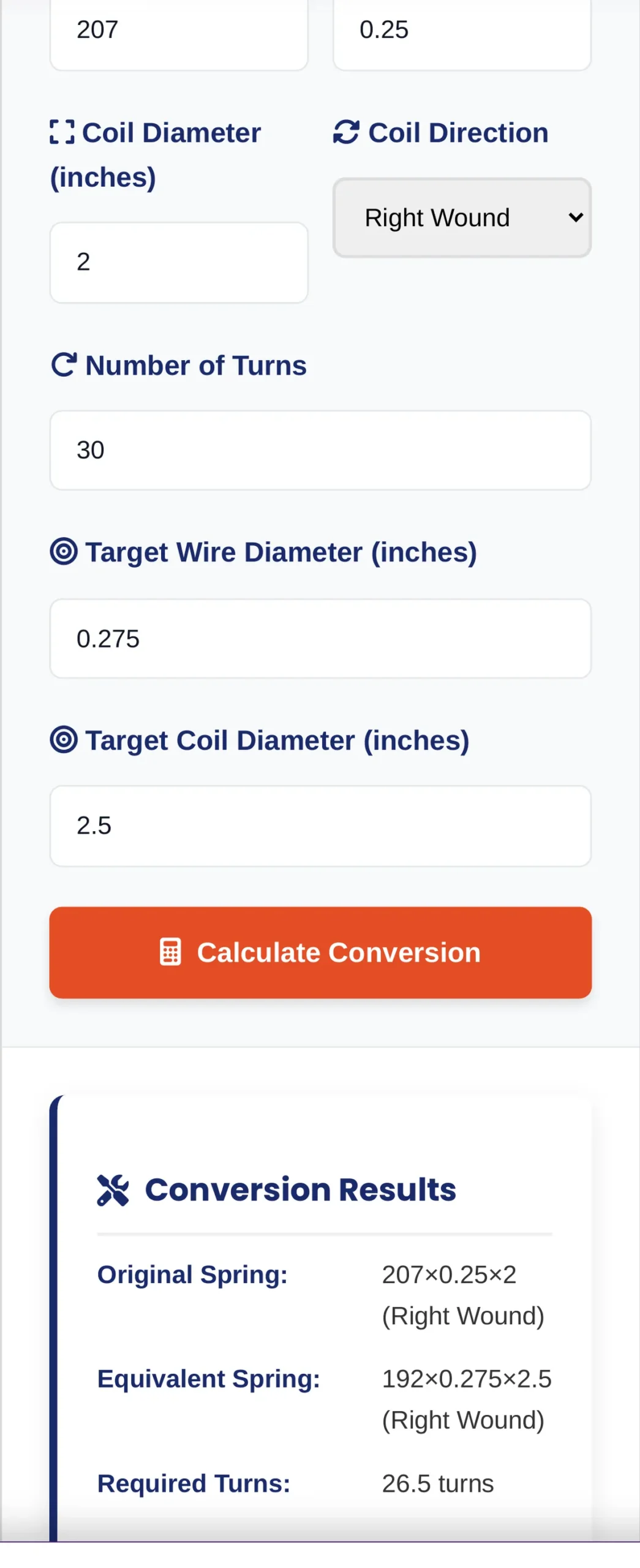
Work out your conversion first with the free Conversion Calculator below. It shows what a torsion system would look like on your door.
Conversion Calculator — work out an extension-to-torsion conversion for your door.
- Enter your door size and current spring type first.
- Note the conversion result, then read the key takeaways.
- Use the price in Section 5 to check any quote you get.
Key takeaways
- A safety cable holds a broken extension spring captive — it costs $20 to $40 in parts.
- Check for a cable through each spring, anchored at both ends.
- No cable or a frayed cable needs a pro at the next visit.
- Conversion to torsion costs $400 to $800 and buys safety and life.
- Conversion needs 10 to 12 inches of headroom and a door worth keeping.
Table of Contents
-
1. Why safety cables matter
-
2. Safety cables, explained
-
3. When yours needs attention
-
4. Conversion to torsion
-
5. Cost, and when it pays
-
6. The decision
-
7. The cost of doing nothing
- Video: Extension Springs: Safety Cables and Conversion to Torsion (Coming Soon)
- FAQ

1. Why safety cables matter
Safety cables exist for one reason: an extension spring can fly. The cable is cheap, simple, and it has been standard practice for decades.
Why extension springs are risky
Extension springs are the risky type when they break. They sit at head height, stretched tight, with nothing to hold them if they snap.
- Extension springs stretch along the side tracks, at head height.
- They hold real energy in that stretch, unrestrained.
- A torsion spring stays on its shaft when it breaks.
- An extension spring has no shaft to hold it.
What happens when one snaps
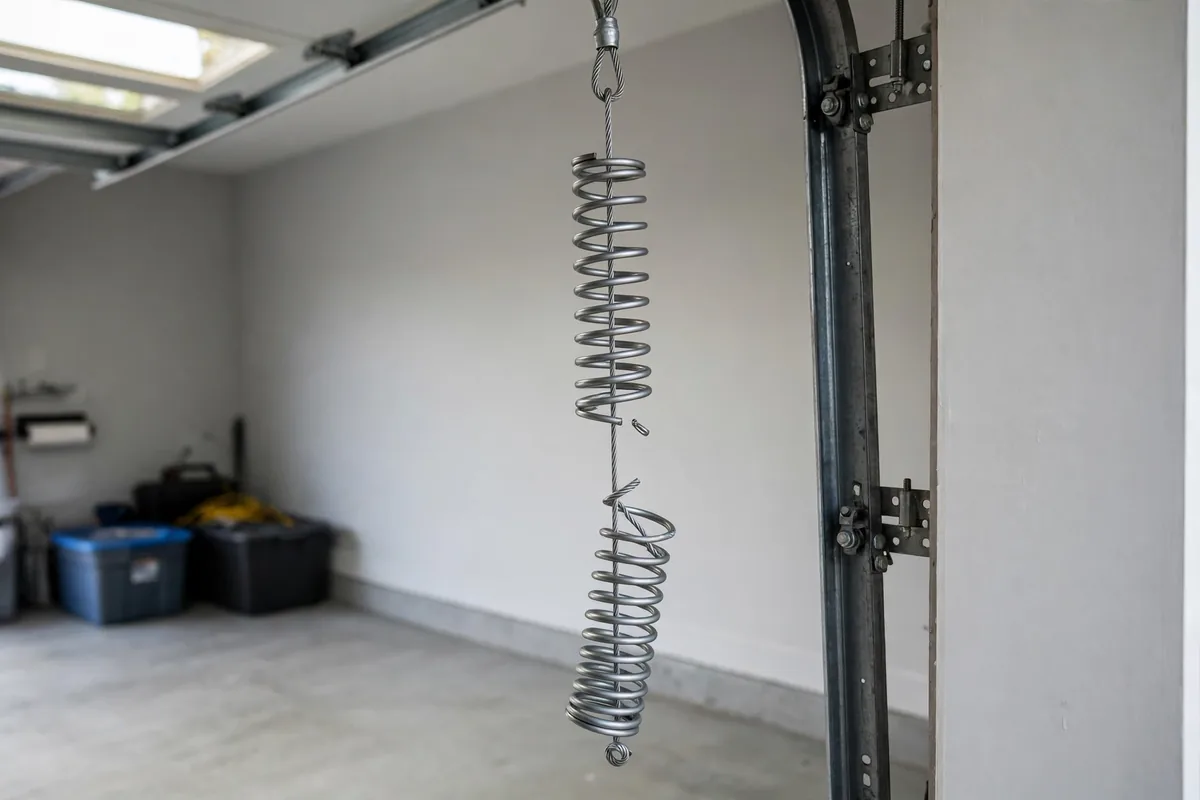
When an extension spring snaps, the stored energy has nowhere to go. The spring becomes a projectile, and the garage is the target.
- A broken extension spring can fly across the garage.
- It can break a car windshield or dent a door panel.
- It can injure anyone standing nearby when it snaps.
- The risk is real, and the fix costs $20 to $40 in parts.
2. Safety cables, explained
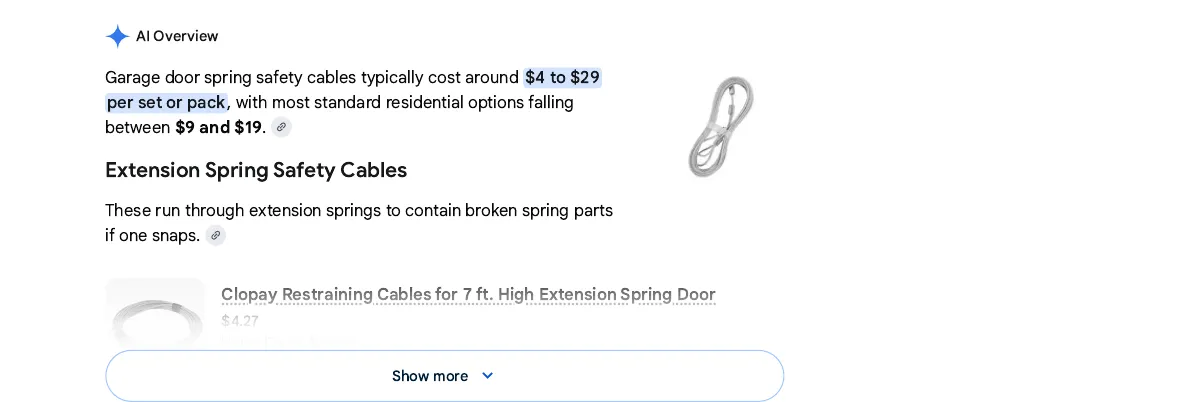
A safety cable is the cheapest safety device on a garage door. It costs $20 to $40 in parts, and a pro fits it during any service call.
What a safety cable is
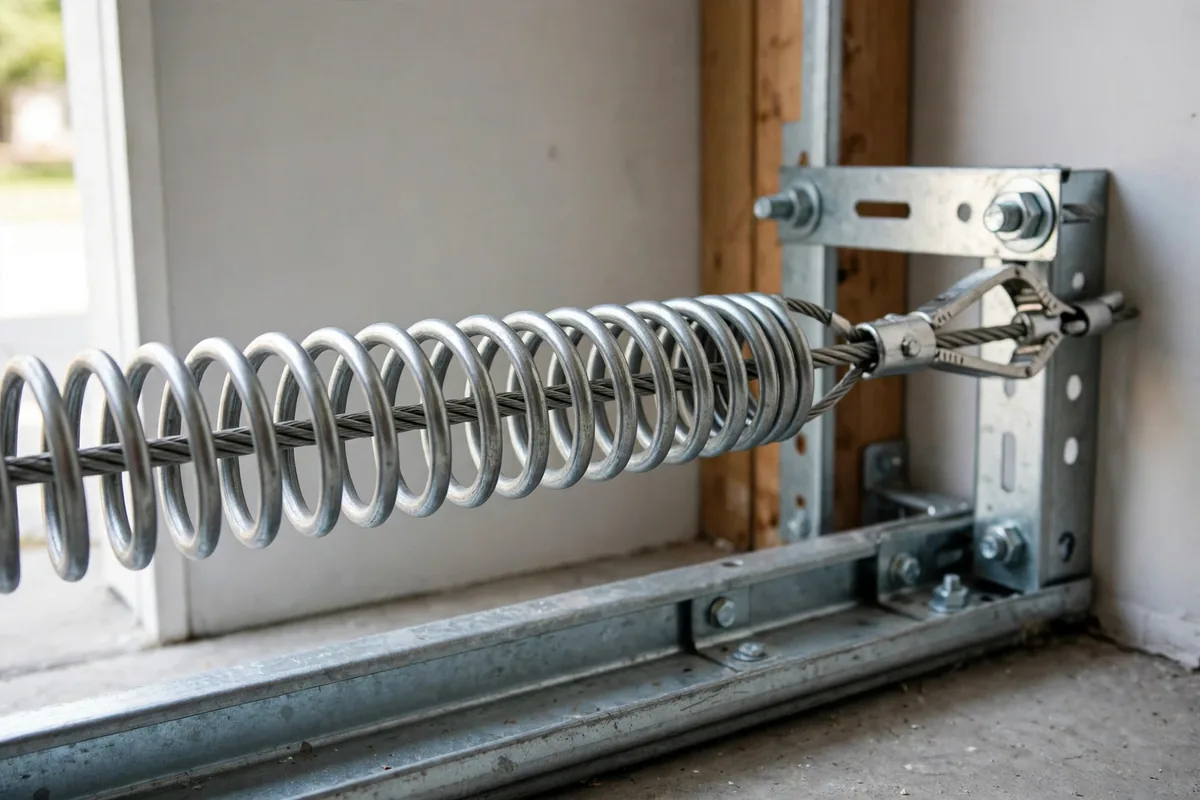
A safety cable is a steel wire through the middle of the spring. It is anchored at both ends, so a broken spring stays put.
- A steel cable threads through the center of each spring.
- It anchors at both ends, to the track bracket and the wall.
- A break leaves the halves captive on the cable, going nowhere.
- The cable does nothing until the spring breaks, then it saves the day.
How to check yours
Checking takes seconds and needs no tools. Look for the cable, then check both anchors and the cable itself.
- Close the door and stand inside the garage.
- Look along each side track for the extension spring.
- Look for a steel cable running through the middle of the spring.
- Check that the cable is anchored at both ends, not loose or frayed.
- Look for a steel cable running through each side spring.
- Check both ends: the cable must be anchored, not loose.
- A frayed cable needs replacing at the next visit.
- No cable at all means the door is unprotected.
3. When yours needs attention
Most extension doors built before safety cables were standard have none. A pro adds them in minutes, during a normal service visit.
No cable, frayed cable, loose anchor
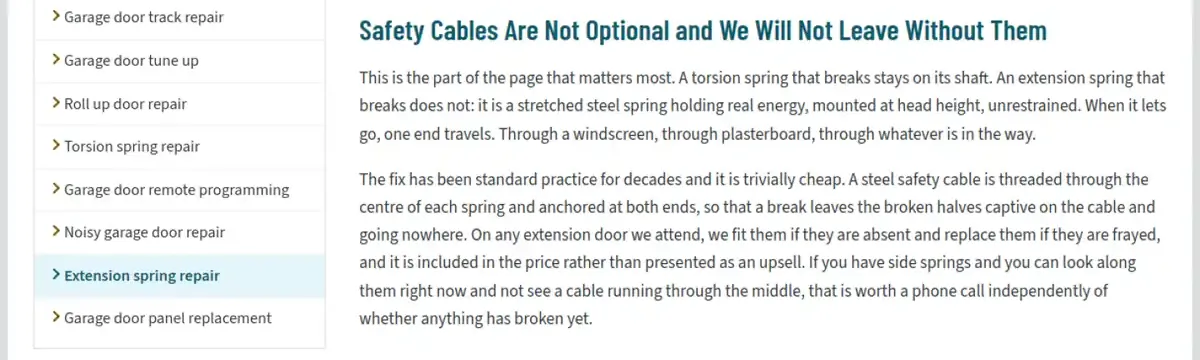
Three states need a pro: no cable, a frayed cable, or a loose anchor. All three leave the door unprotected when a spring snaps.
- No cable fitted: ask a pro to fit one at the next visit.
- Frayed cable: replace it at the same visit as the springs.
- Loose anchor: the cable cannot hold a break if it is loose.
- A pro fits cables as part of an extension pair, $120 to $200.
Fitting a cable is a pro job
Fitting a cable is a pro job, because the spring is under tension while it is fitted. The cable itself is cheap; the safe fitting is the skill.
- Cables are fitted during any extension spring service.
- The cost is small next to the spring job itself.
- Some pros include cables in the pair price, not as an extra.
- Never fit a cable yourself while the spring is under tension.
4. Conversion to torsion
Converting to torsion is the long-term answer for an extension door. It replaces the risky system with the safer one.
What a conversion installs
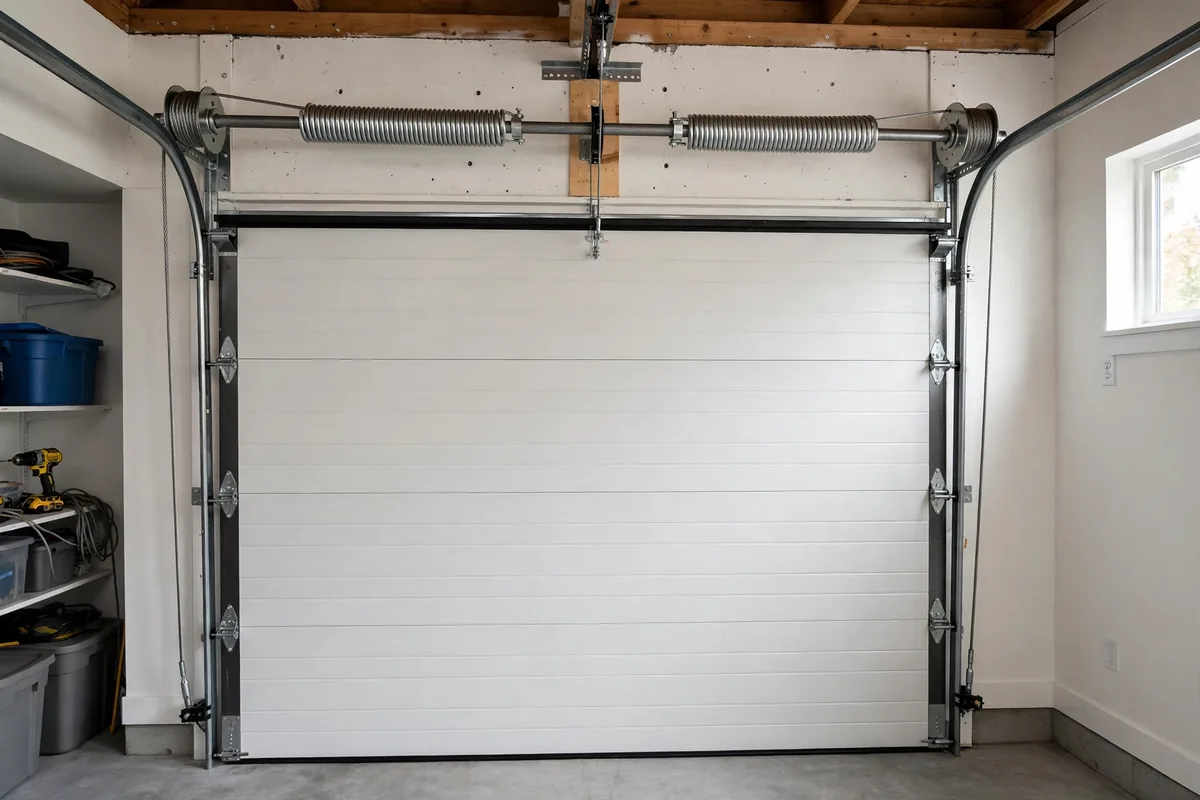
A conversion swaps the whole spring system. The side springs come out, and a torsion shaft, drums and springs go in above the door.
- Remove the extension system and fit a torsion system.
- New shaft, cable drums, end bearing plates, and center bracket.
- New torsion springs, sized to the door weight.
- The old side springs, pulleys and cables come out.
What you gain
A conversion buys safety first, then smoothness and life. The door runs quieter, and the springs last years longer.
- Torsion springs stay on the shaft when they break.
- The door lifts smoother and more evenly from the center.
- Torsion springs last longer: 7 to 12 years against 5 to 8.
- No safety cables are needed, because nothing can fly.
5. Cost, and when it pays
Conversion costs more than a simple spring swap. It pays when the door is in good shape and you plan to keep it for years.
What a conversion costs
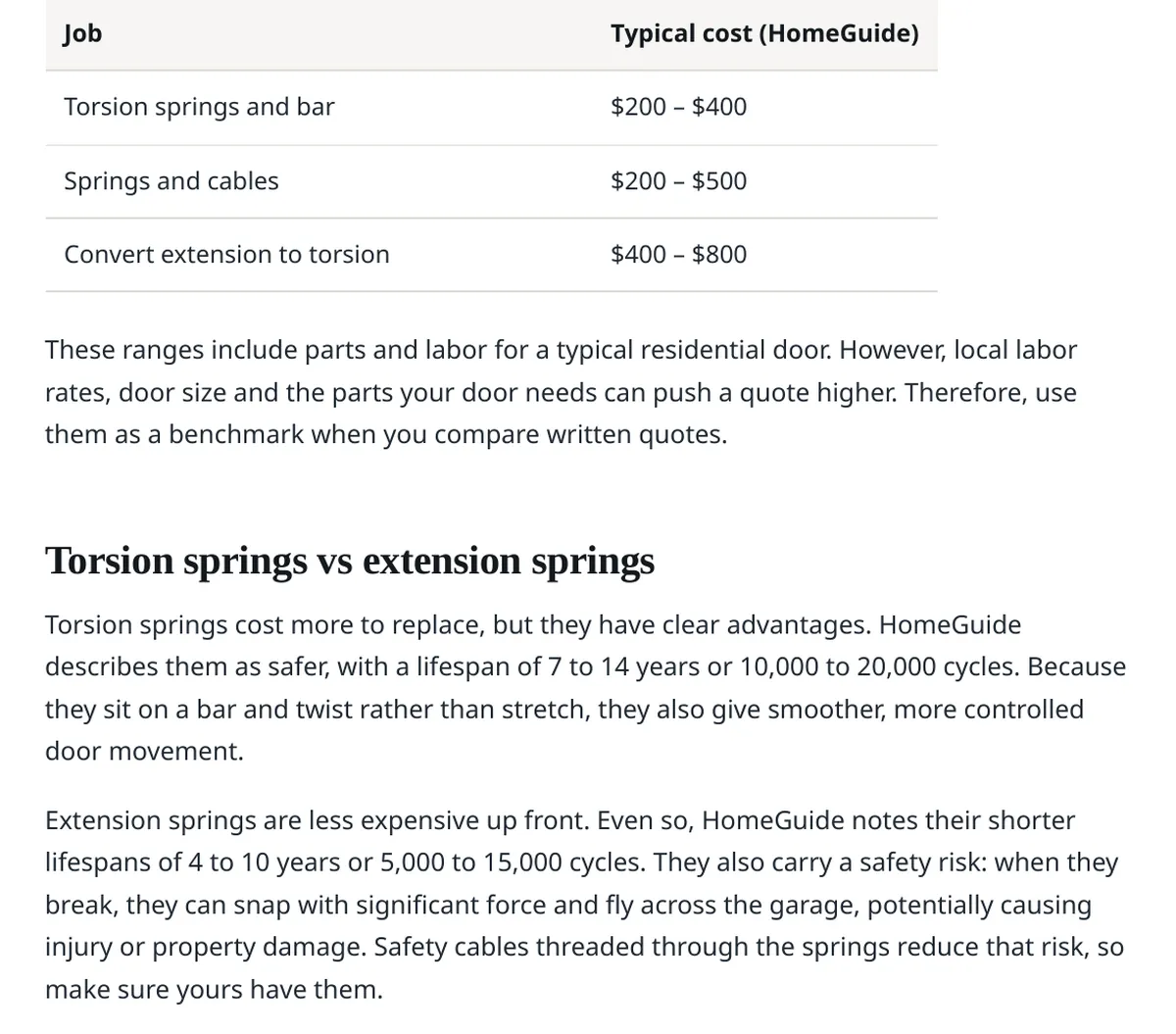
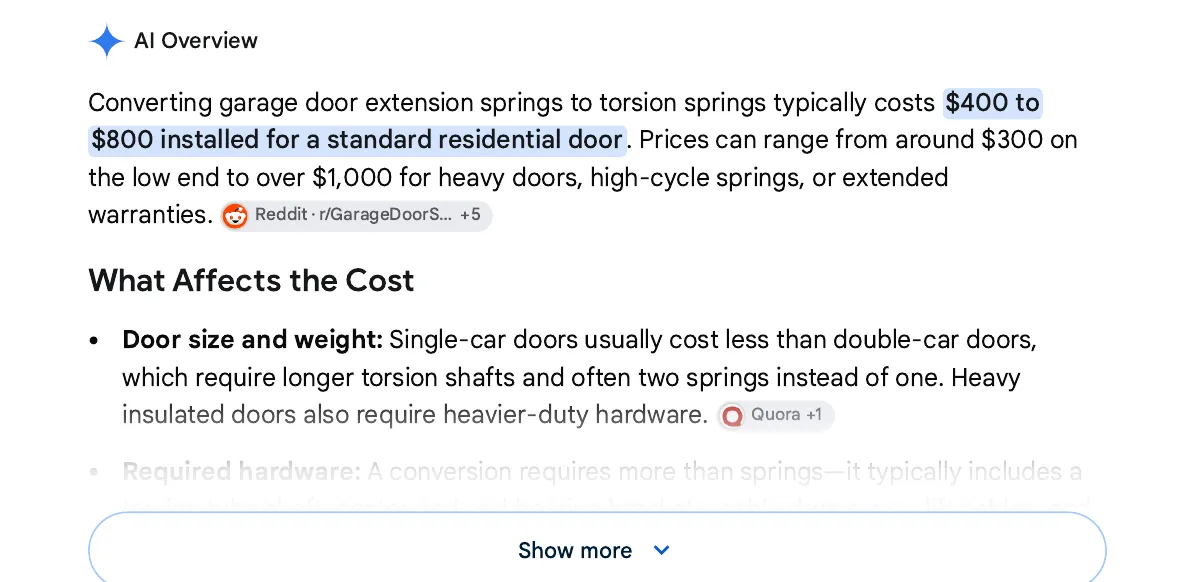
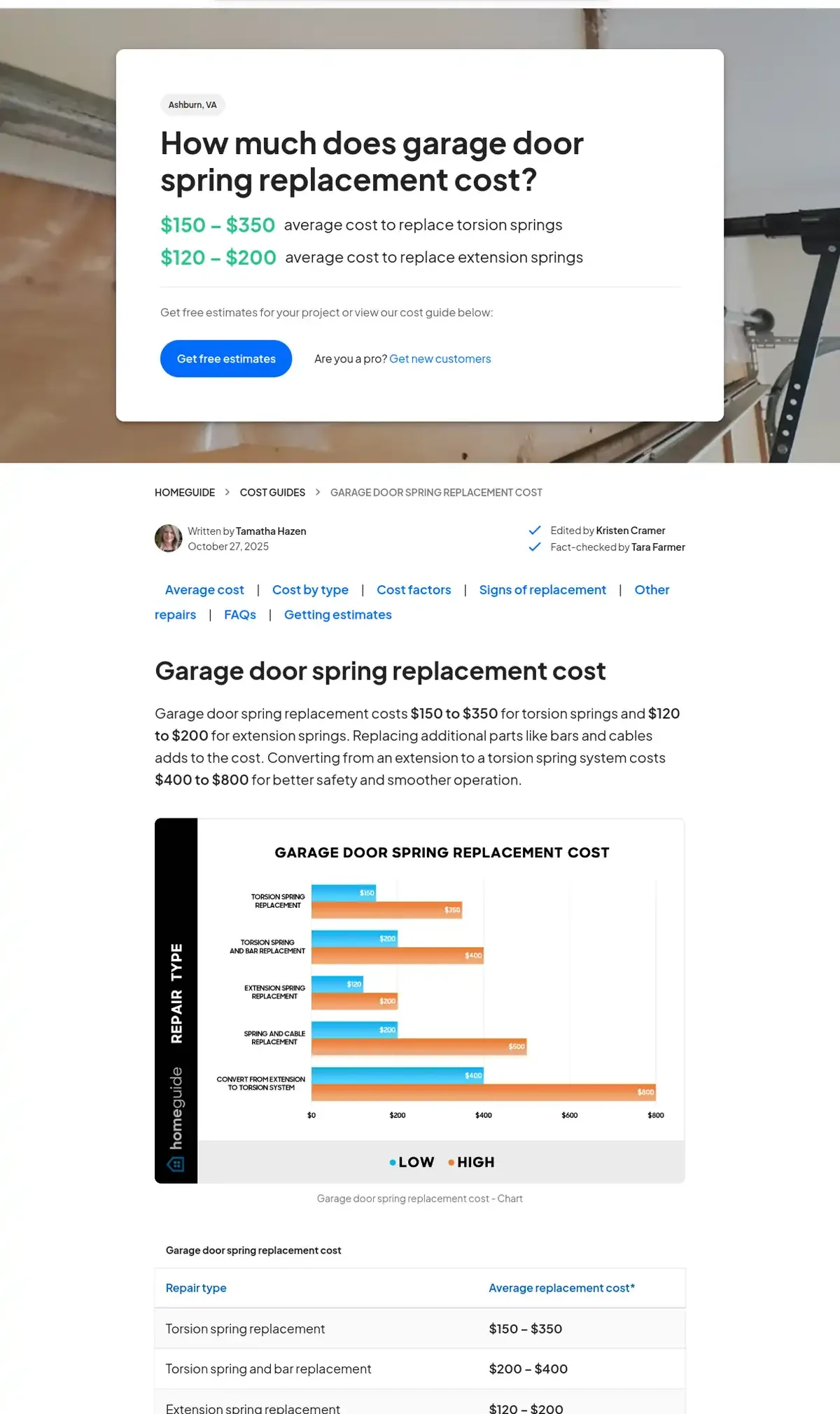
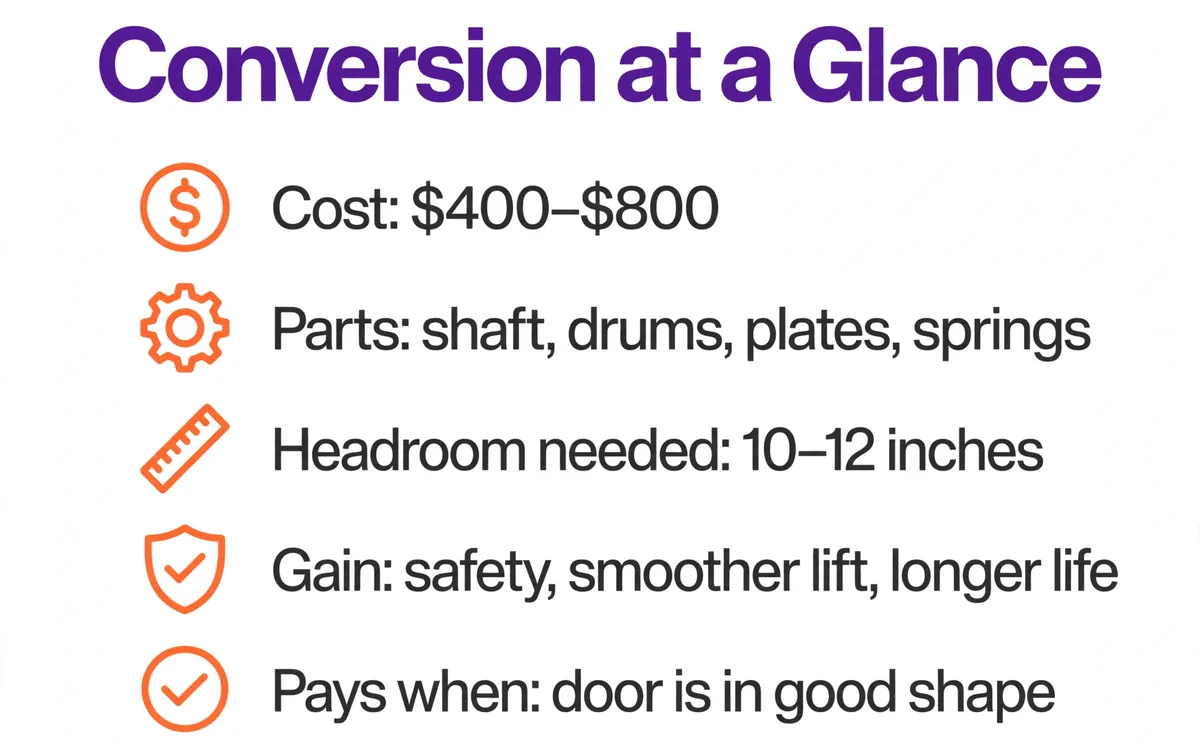
A conversion costs $400 to $800 (HomeGuide, 2026). It is about three times the price of a like-for-like extension pair.
- HomeGuide (2026): $400 to $800 for a conversion.
- Local prices run higher, up to $600 to $1,100 in some markets.
- The price covers the shaft, drums, plates and springs.
- Like-for-like extension replacement is $120 to $200 a pair.
When conversion pays
A conversion pays when the door is worth keeping. It does not pay on a door that is rusted out or due for replacement anyway.
- The door is in good shape and you plan to keep it for years.
- The door is heavy, double, or insulated, and extension strains.
- You want the safety gain and the longer spring life.
- The garage has 10 to 12 inches of headroom above the door.
6. The decision
Most extension doors need cables, not a conversion. Convert when the door is worth keeping and the headroom allows it.

Like-for-like vs conversion
The choice is between a cheap like-for-like swap and a dearer conversion. Safety cables make the cheap option safe enough for most doors.
- A like-for-like extension pair costs $120 to $200 installed.
- Add safety cables if they are missing or frayed.
- A conversion costs $400 to $800 and buys safety and life.
- A new door usually comes with a torsion system already.
When not to convert
Conversion is not always possible. Low headroom and a door in poor shape both rule it out, and a new door may be the better buy.
- Low headroom under 10 inches may rule out a conversion.
- A door in poor shape is better replaced than converted.
- Ask a pro to measure the headroom before you decide.
- Get both quotes: a pair with cables, and a conversion.
Example: Costs in full: garage door spring replacement cost guide. Which type you have: torsion vs extension springs guide. Full spring picture: garage door springs complete guide.
7. The cost of doing nothing
Doing nothing about an extension door has a price. The cable is cheap, the conversion can wait, but the risk cannot.
The cost of no cable
Doing nothing is the dearest option. A flying spring costs far more than the cable that would have held it.
- A broken spring without a cable can break a windshield.
- It can dent a car panel or a door section.
- It can injure anyone standing nearby when it snaps.
- A $20 to $40 cable prevents all three.
What to do while you wait
Delaying a conversion is fine, but delaying safety cables is not. Fit the cables now and plan the conversion later.
- A conversion deferred is a risk carried, not a saving.
- Fit cables now, even if a conversion waits for next year.
- Budget the conversion when the door is due for new springs.
- Safety first, then smoothness, then lifespan.
Video: Extension Springs: Safety Cables and Conversion to Torsion (Coming Soon)
A 60 to 120 second video for this guide is coming soon. It will cover why safety cables matter, how to check yours, what a conversion installs, costs, and when it pays. No video is embedded here yet.
Garage Door Hub connects homeowners with trusted local garage door pros. Need a repair? Need a replacement? Start here. First, find out what it should cost. Then, price your exact job with our free calculator. Next, find a pro near you. Fast. No jargon. No guesswork. No surprise bills. Just clear prices, honest guides, and a local pro you can call today.
FAQ
What is an extension spring safety cable?
A safety cable is a steel wire threaded through the center of each extension spring and anchored at both ends. If the spring snaps, the cable holds the broken halves captive instead of letting them fly.
Do extension springs need safety cables?
Yes. Without a cable, a broken extension spring can fly across the garage with enough force to break a windshield or injure a person. Safety cables are the standard fix, and they cost $20 to $40 in parts.
How much does it cost to convert extension springs to torsion?
Converting extension springs to torsion costs $400 to $800 (HomeGuide, 2026). The conversion buys safety, smoother travel, and a longer spring life. It makes sense when the door is in good shape and you plan to keep it.
What parts does a torsion conversion need?
A new shaft, cable drums, end bearing plates, a center bracket and torsion springs. The job also needs 10 to 12 inches of headroom above the door, which not every older garage has.
Can I convert extension springs to torsion myself?
No. The conversion changes the whole spring system and sets the turns on a wound torsion spring. It is pro-only work, like every spring job.
How do I check if my extension springs have safety cables?
Check for a steel cable running through the middle of each spring, anchored at both ends. No cable, a frayed cable, or a cable that hangs loose all need a pro.
Sources
- Garage Door Locator, 2026 — safety cable parts $20–$40, torsion vs extension safety. Verified live, 20 Nov 2026.
- HomeGuide, 2026 — conversion $400–$800, torsion pair $150–$350, extension pair $120–$200. Verified live, 20 Nov 2026.
- GaragePlaybook / HomeGuide, reviewed 2 Oct 2026 — safety cables reduce the risk when extension springs break. Verified live, 20 Nov 2026.
- Garage Door Repair Near Me Seattle, 2026 — cables fitted if absent, replaced if frayed; conversion $359–$509 locally. Verified live, 20 Nov 2026.
- Garage Door Pros WA, 2026 — conversion $600–$1,100 locally. Verified live, 20 Nov 2026.
- Angi, updated 30 Oct 2026 — spring $150–$350 per spring, average $250. Verified live, 20 Nov 2026.
- Garage Door Hub Conversion Calculator 1396 — live calculator. Live 20 Nov 2026.
Last reviewed: 20 November 2026
Appendix — Related topics
You might have found this by these keywords — and if not, others might have: extension spring safety cable, convert extension springs to torsion cost, garage door spring safety cable cost, extension spring safety cable conversion, what is an extension spring safety cable, do extension springs need safety cables, how much does it cost to convert extension springs to torsion, what parts does a torsion conversion need, can I convert extension springs to torsion myself, how do I check if my extension springs have safety cables, torsion vs extension springs, garage door spring replacement cost, broken garage door spring signs, how long do garage door springs last.