

Garage Door Locator puts a torsion pair at $180 to $350 and an extension pair at $150 to $300. The $50 gap is small, but the safety gap is not.
A torsion spring stays on its shaft when it breaks. An extension spring can fly across the garage unless a safety cable holds it.
This guide shows you which type you have, what each one costs, and which one fits your door.
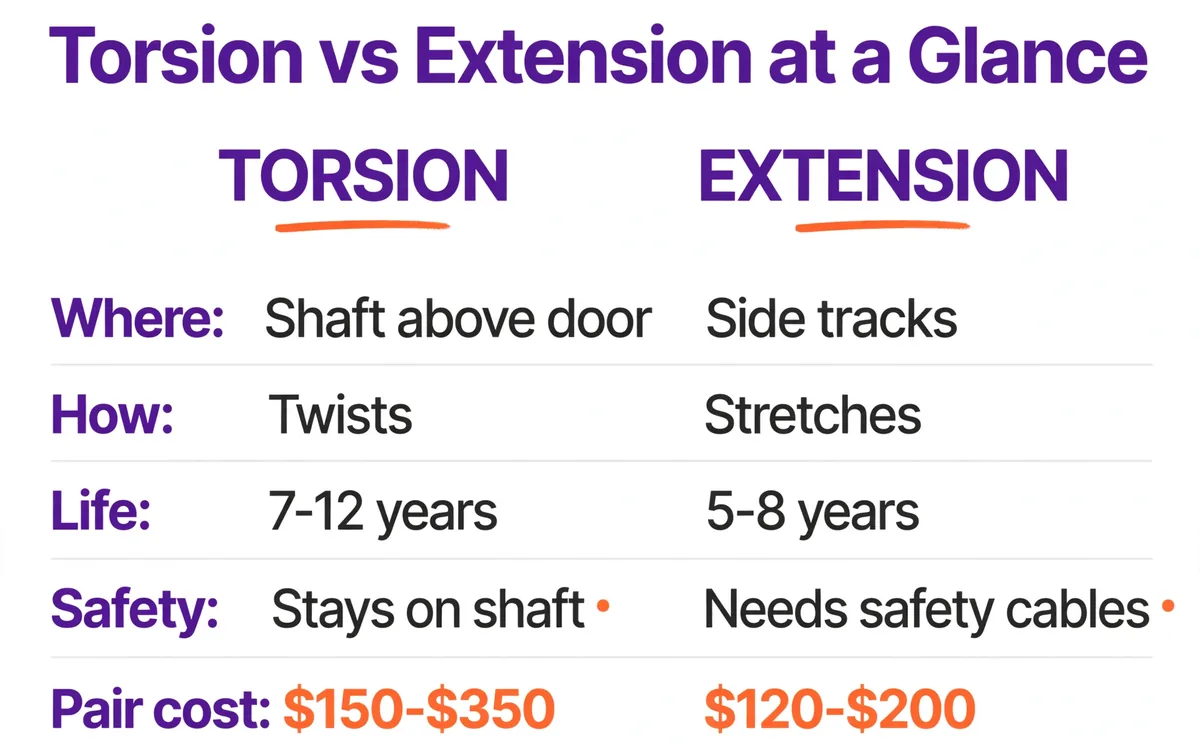
Torsion springs twist on a shaft above the door and last 7 to 12 years; extension springs stretch along the side tracks and last 5 to 8 years (Garage Door Locator, 2026). Torsion is safer and smoother, extension is cheaper. Look above the door: a coil on a shaft means torsion, side coils mean extension.
Garage Door Hub connects you with a trusted local pro. Get a clear price for your garage door repair or replacement first.
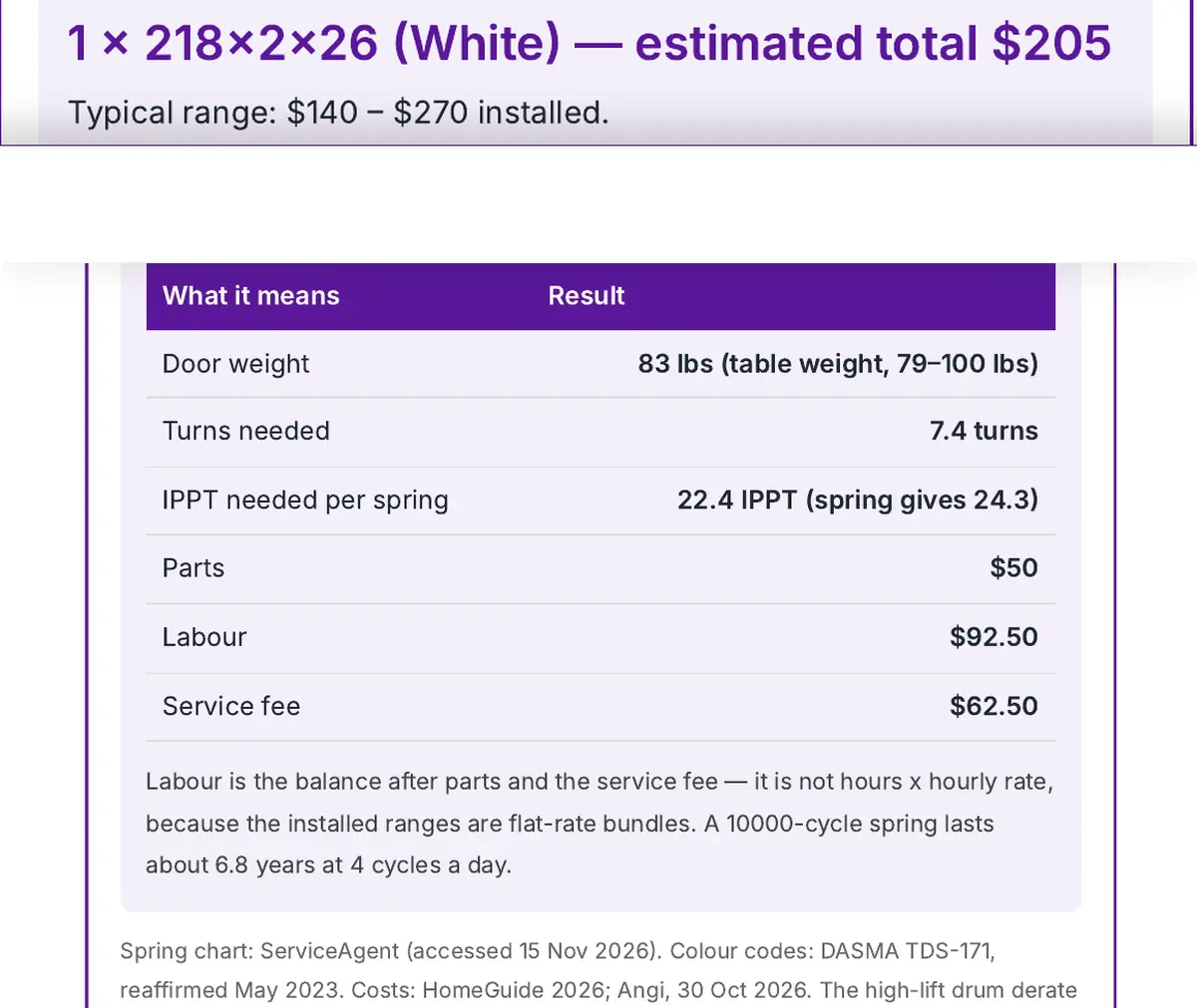
Price your spring job first with the free Spring Calculator below. It gives you a number before you call anyone.
Spring Calculator — price a spring job by door size, weight and turns.
- Pick your spring type from the check in Section 2.
- Enter your door size, weight and material.
- Note the spring size and the price, then read the key takeaways.
Key takeaways
- Look above the door: a coil on a shaft means torsion, side coils mean extension.
- Torsion lasts longer, runs smoother, and fails safer than extension.
- Extension costs less up front but needs safety cables.
- Heavy and double doors need torsion springs.
- Spring replacement and conversion are pro-only work.
Table of Contents
-
1. The two spring types, in plain words
-
2. How to tell which you have in 30 seconds
-
3. Torsion vs extension: side by side
-
4. Cost and lifespan difference
-
5. Which type fits your door
-
6. What to do when your type fails
-
7. Replace like for like, or switch type
- Video: Torsion vs Extension Springs: Which Do You Have? (Coming Soon)
- FAQ
1. The two spring types, in plain words
Every home door uses one of two spring types. The difference is where the spring sits and how it stores energy.
Torsion springs twist
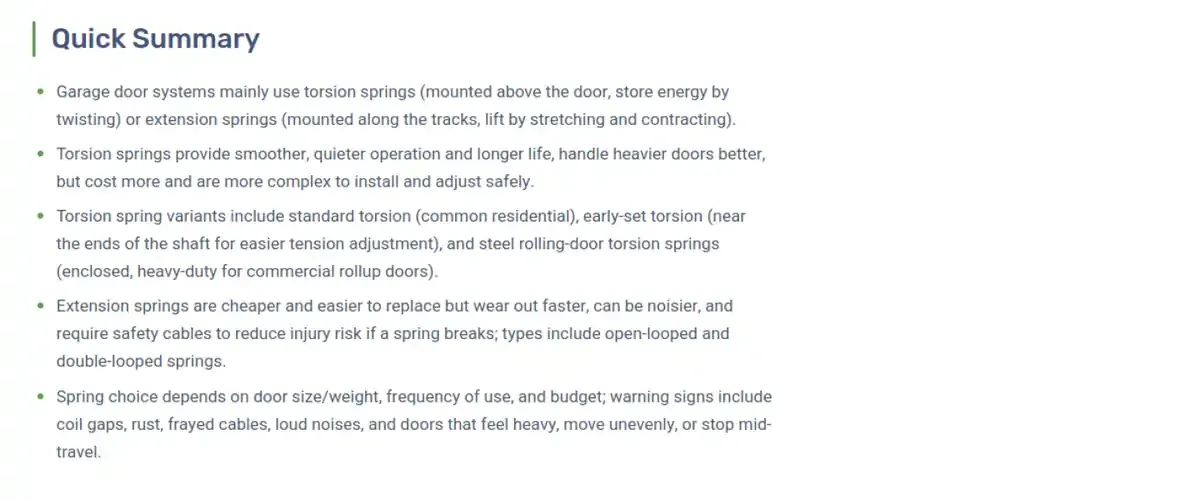
Torsion springs sit on a shaft above the door opening. They work by twisting, not by stretching, and they lift the door from the center.
- One or two thick coils on a steel shaft above the door.
- The spring twists to store energy as the door closes.
- It unwinds to lift the door, evenly across its width.
- Standard on most modern sectional doors.
Extension springs stretch
Extension springs run along the horizontal tracks on each side. They work by stretching, and they store energy in that stretch.
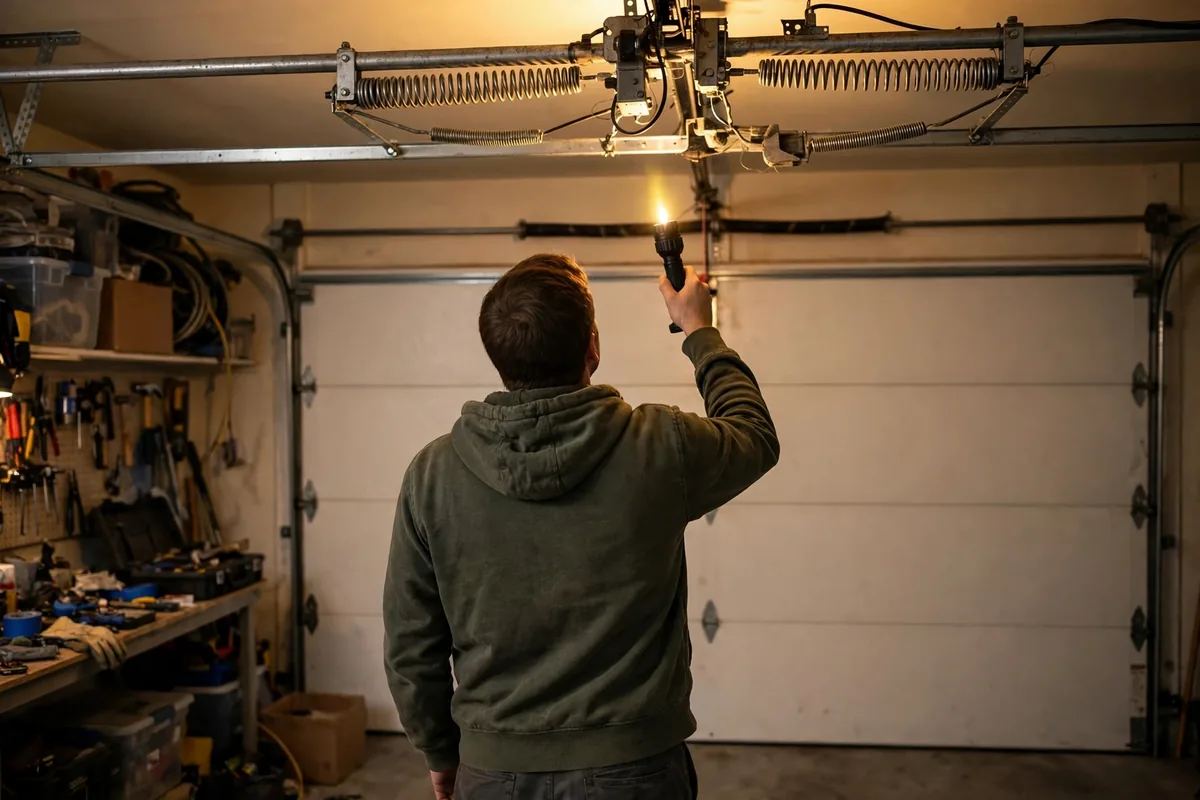
- One long coil along each horizontal track, left and right.
- The spring stretches as the door closes, then contracts to lift.
- It pulls from the sides, so the lift is less even.
- Common on older doors and lighter single-panel doors.
2. How to tell which you have in 30 seconds
The check is visual and fast. Look in two places, above the door and along the tracks, and the answer is plain.
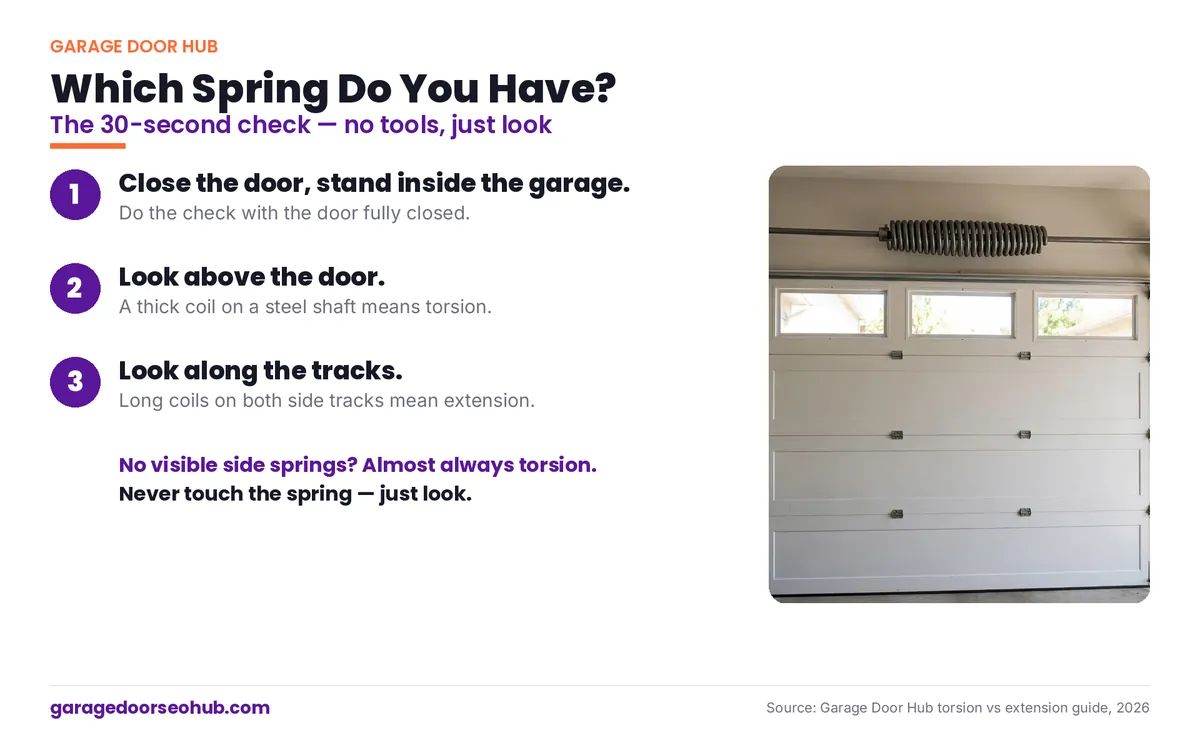
The 30-second check
You can tell the type in 30 seconds, from inside the garage, with the door closed. No tools are needed, and you never touch the spring.
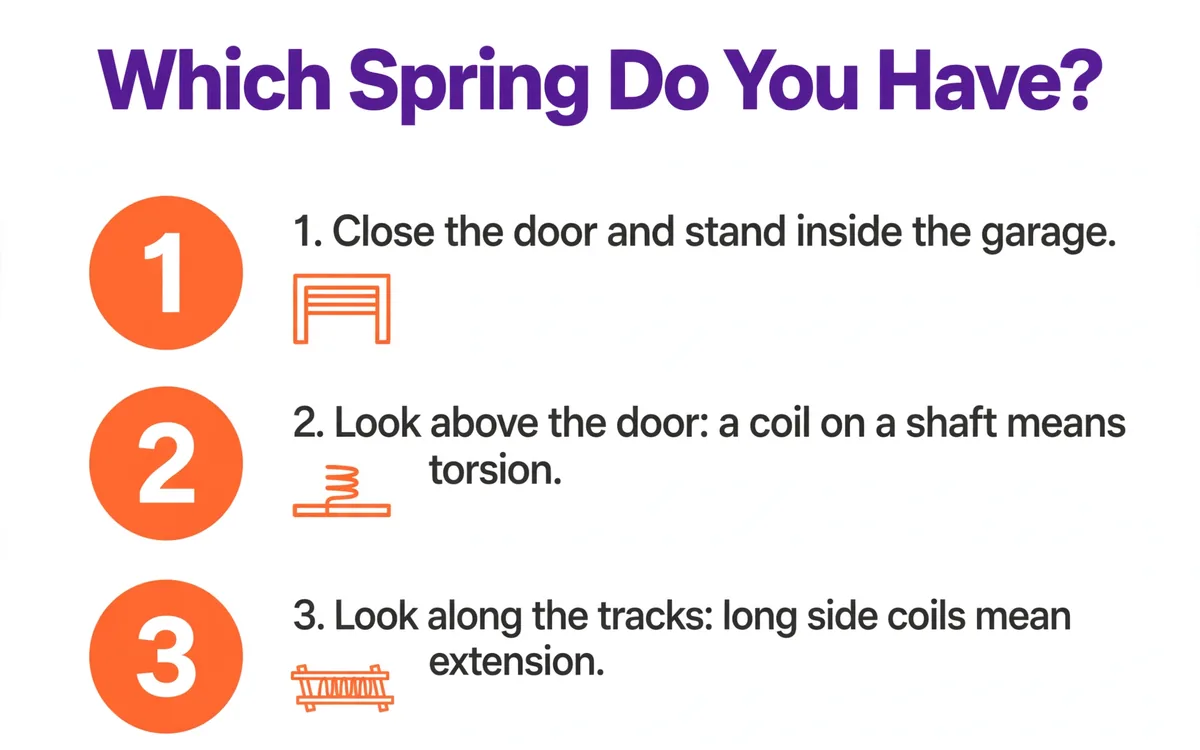
- Close the door fully and stand inside the garage.
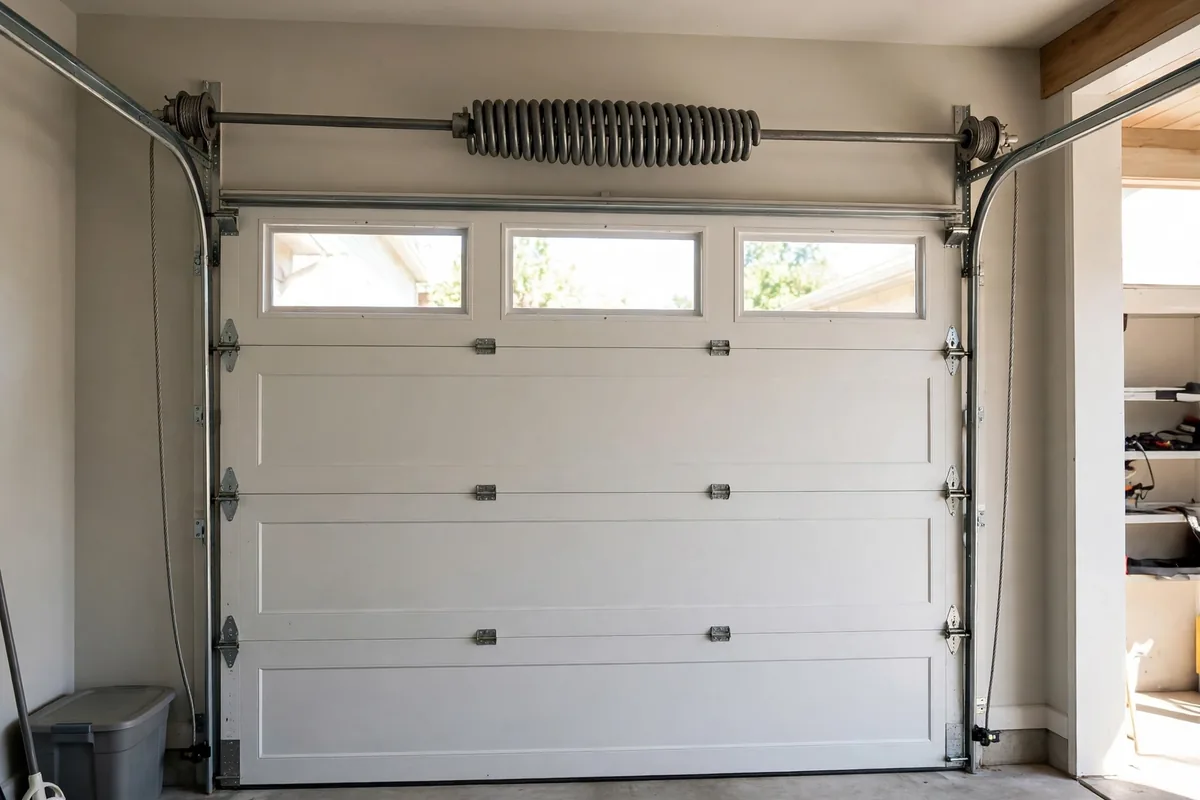
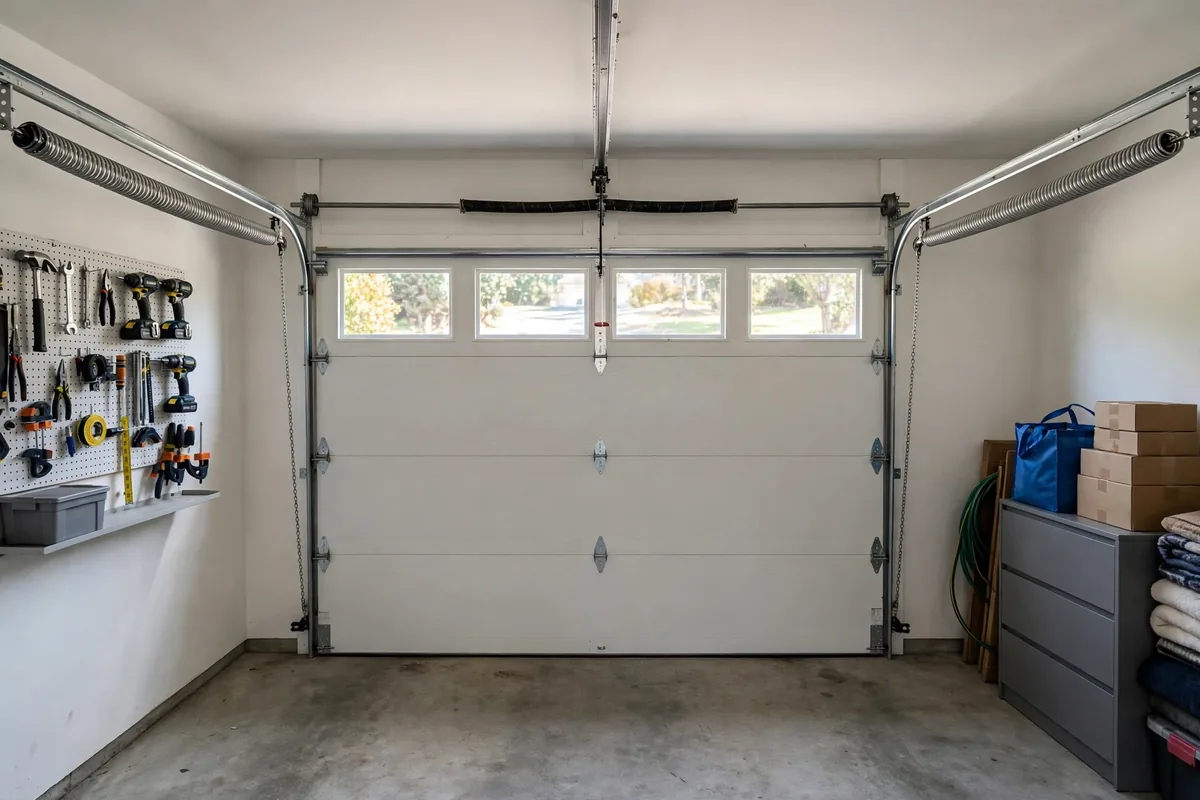
- Look above the door for a coil on a steel shaft.
- If you see one, you have torsion springs.
- If you see long coils along both side tracks, you have extension springs.
- Note the type, then use the Spring Calculator to price a job.
- Close the door fully and stand inside the garage.
- Look above the door: a coil on a shaft means torsion.
- Look along the tracks: long side coils mean extension.
- Do not touch the spring; just look at it.
What each type looks like
Torsion springs are thick and centred above the door. Extension springs are thinner, longer, and sit along the tracks.
- Torsion springs are hard to miss: a thick coil, a shaft, and two drums.
- Extension springs sit at head height along the tracks.
- A door with no visible side springs is almost always torsion.
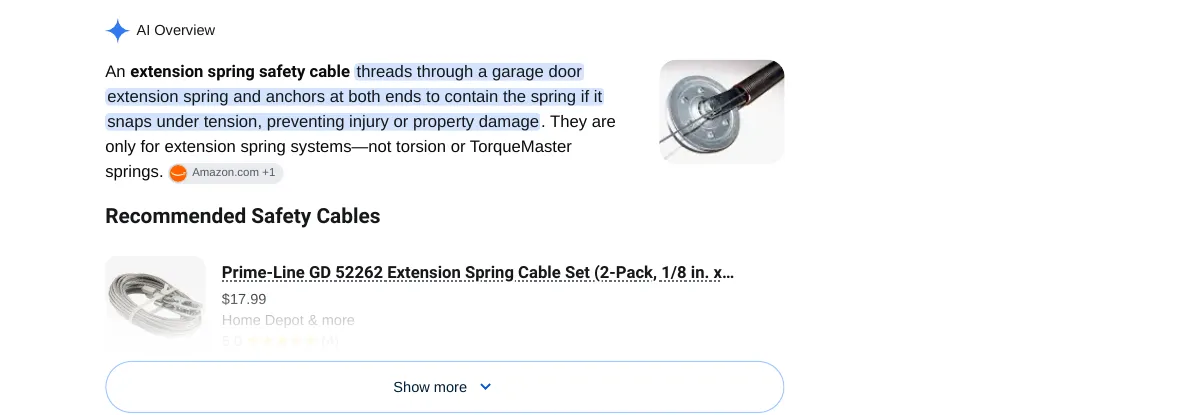
- If you see a cable through the side coil, that is a safety cable.
3. Torsion vs extension: side by side
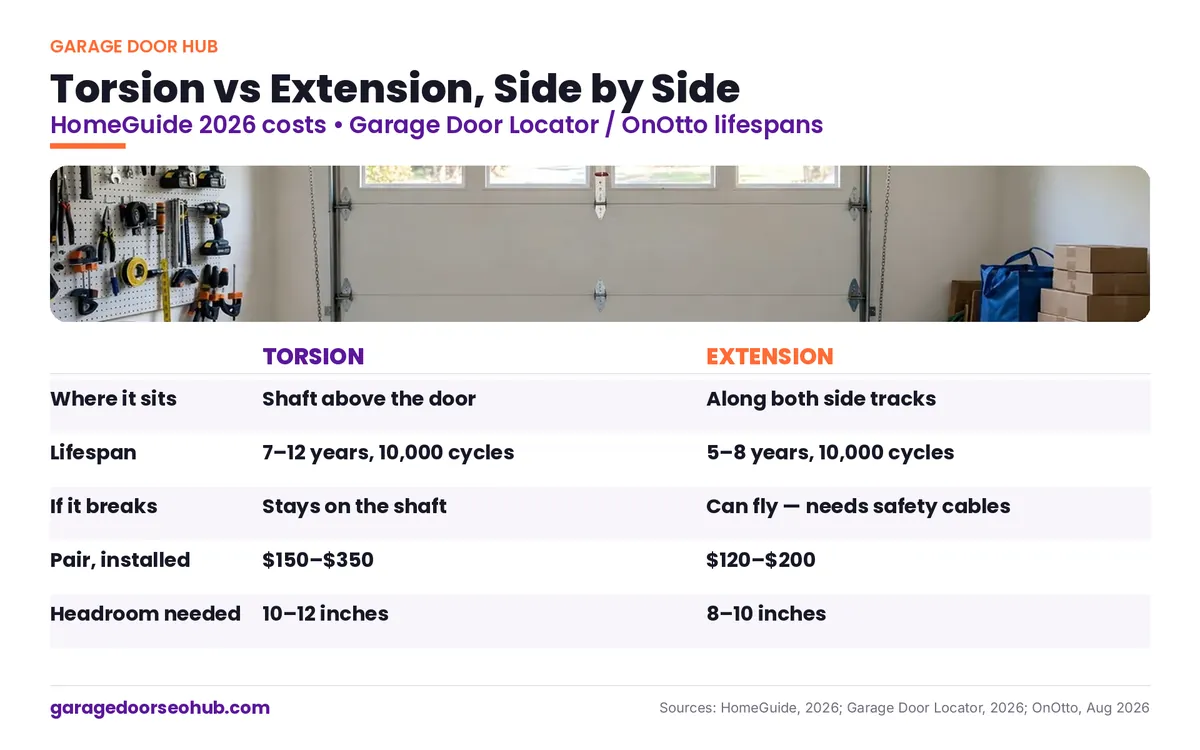
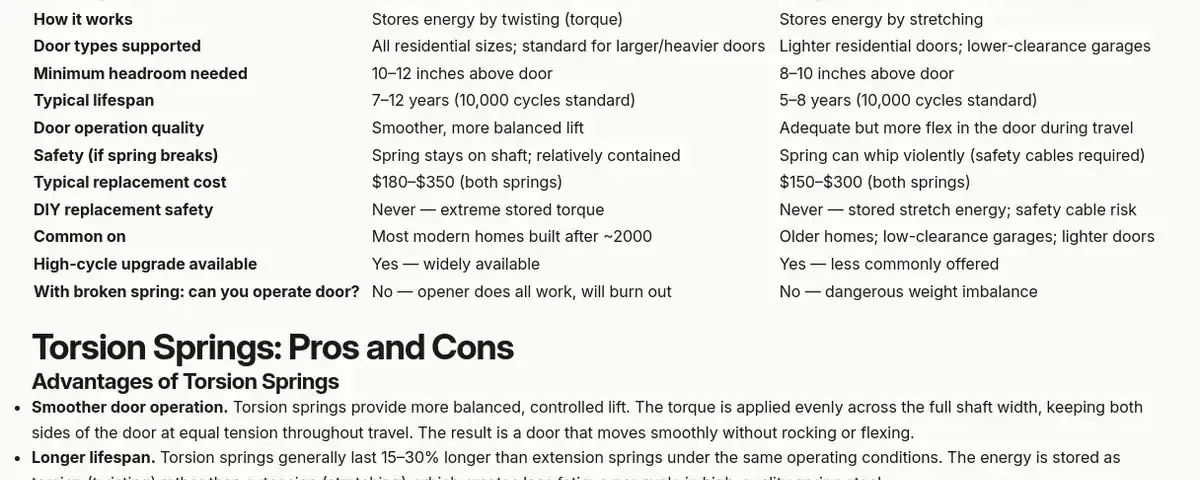
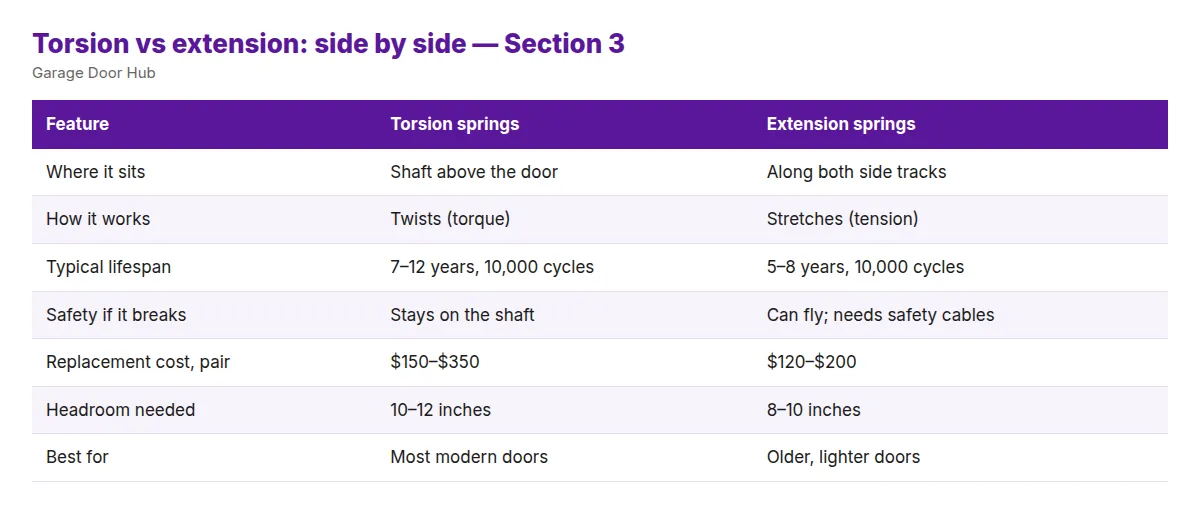
Put side by side, torsion wins on safety, smoothness, and life. Extension wins on price and on fitting low-headroom garages.
How they lift
Torsion springs lift from the center, so the door rises evenly. Extension springs pull from the sides, so the door can flex as it moves.
- Torsion: smoother, quieter, more balanced lift.
- Extension: more flex in the door as it travels.
- Torsion: better for heavy and double doors.
- Extension: fine for light doors, but noisier.
Safety and space
Safety is the biggest real difference. A broken torsion spring unwinds in place, while a broken extension spring becomes a projectile.
- Torsion stays on the shaft when it breaks.
- Extension can fly across the garage when it snaps.
- Safety cables catch a broken extension spring.
- Torsion needs 10 to 12 inches of headroom; extension needs 8 to 10.
| Feature | Torsion springs | Extension springs |
|---|---|---|
| Where it sits | Shaft above the door | Along both side tracks |
| How it works | Twists (torque) | Stretches (tension) |
| Typical lifespan | 7–12 years, 10,000 cycles | 5–8 years, 10,000 cycles |
| Safety if it breaks | Stays on the shaft | Can fly; needs safety cables |
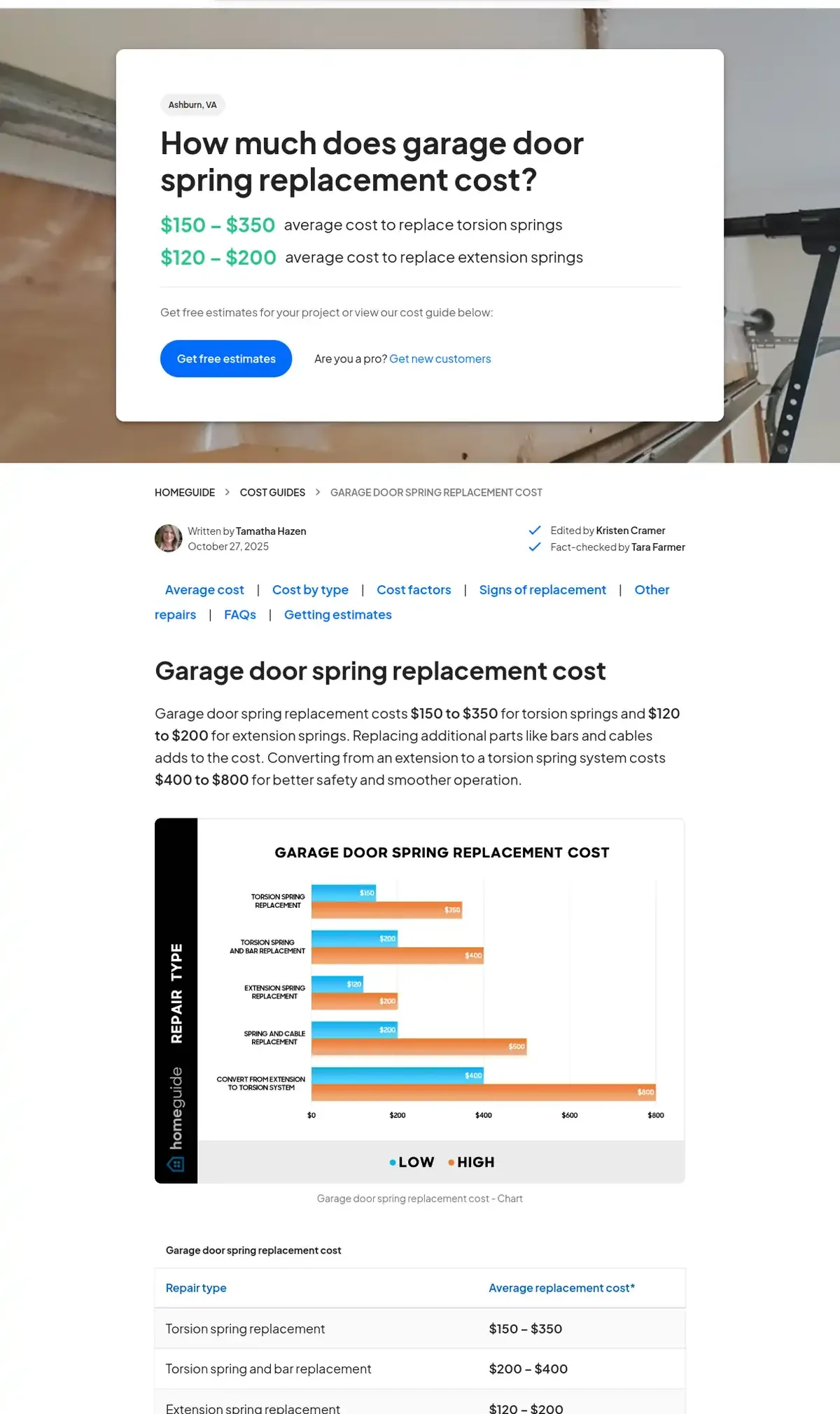
| Replacement cost, pair | $150–$350 | $120–$200 |
| Headroom needed | 10–12 inches | 8–10 inches |
| Best for | Most modern doors | Older, lighter doors |
Costs are HomeGuide 2026, both springs installed. Lifespans are Garage Door Locator and OnOtto, 2026.
4. Cost and lifespan difference
The price gap between the two types is small. The lifespan gap matters more, because a torsion pair can outlive an extension pair by years.
What each type costs
Extension springs cost less to buy and fit. Torsion springs cost more up front, but they last longer, so the long-run cost is close.
- Torsion pair: $150 to $350 installed (HomeGuide, 2026).
- Extension pair: $120 to $200 installed (HomeGuide, 2026).
- Torsion parts cost $30 to $100 each; extension $15 to $45 (HomeAdvisor, 2025).
- Labor is most of the bill on either type.
How long each type lasts
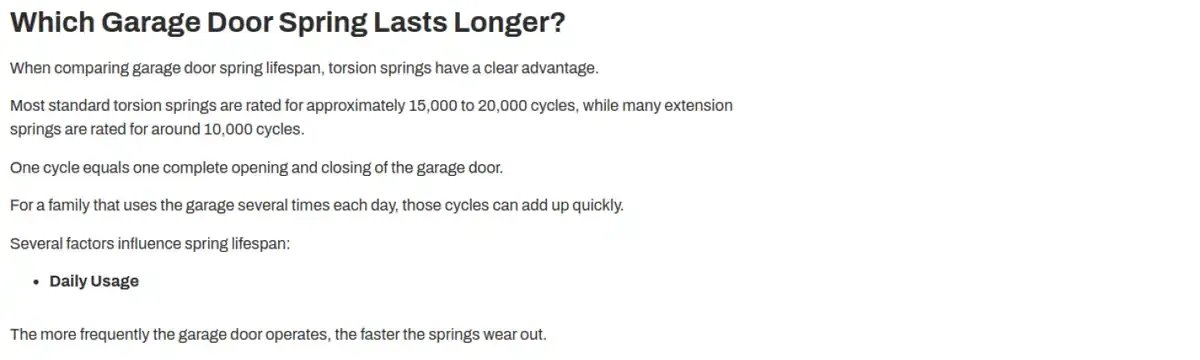
Both types are rated for about 10,000 cycles as standard. Torsion springs reach that rating more reliably, so they usually last longer in years.

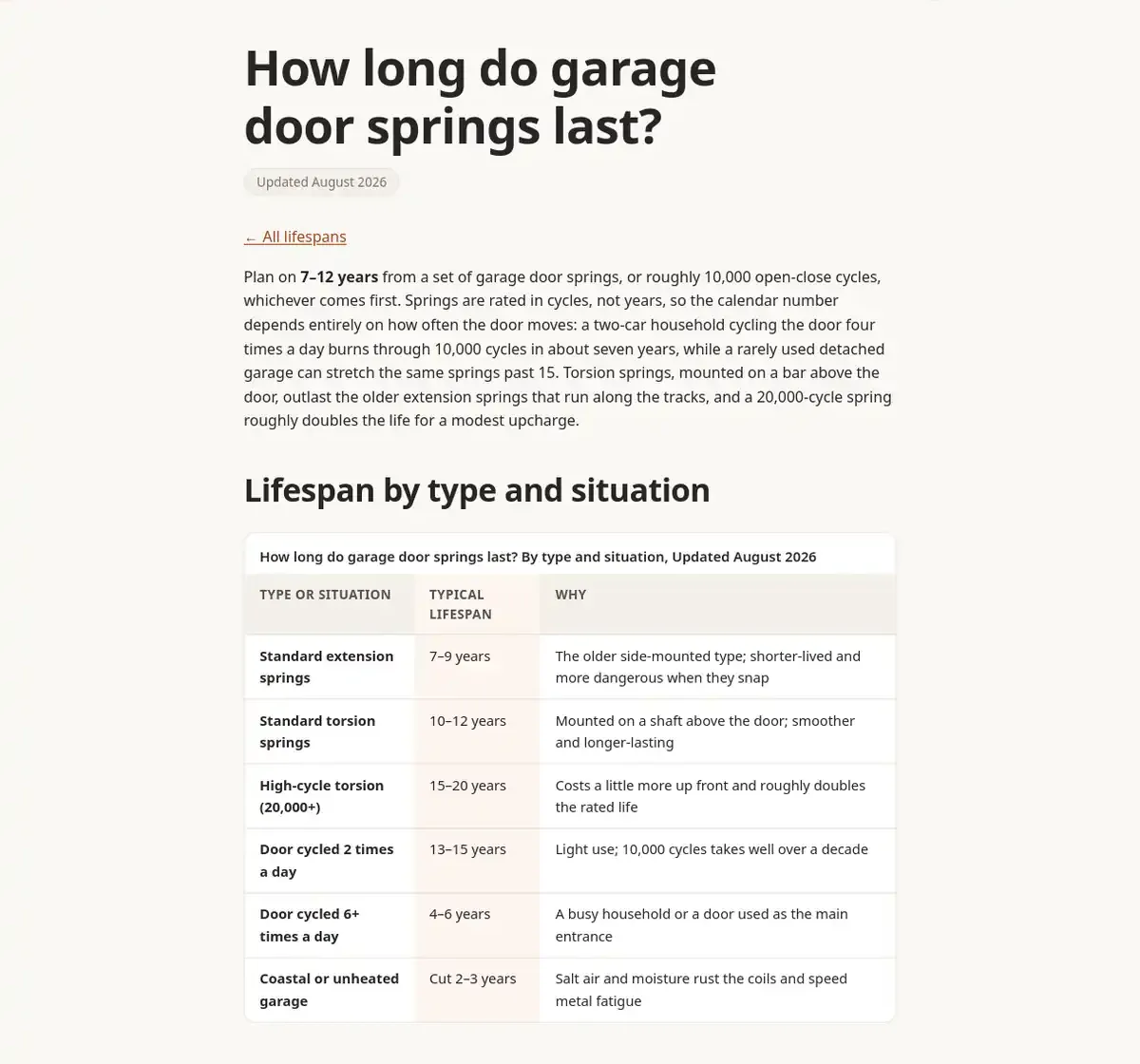
- Standard torsion: 10,000 cycles, about 7 to 12 years.
- Standard extension: 10,000 cycles, about 5 to 8 years.
- High-cycle torsion: 20,000 cycles, about 14 to 20 years.
- At 4 cycles a day, 10,000 cycles lasts about 7 years.
5. Which type fits your door
Door weight and headroom decide the type, not taste. A heavy door needs torsion, while a low garage may only fit extension.
Heavy or double doors
Heavy doors need torsion springs. Extension springs cannot balance a wide insulated door or a wood door without straining.
- Double doors and insulated steel need torsion springs.
- Wood and glass doors are too heavy for extension springs.
- Torsion lifts evenly, so a wide door stays level.
- Ask a pro to check the weight before you pick a type.
Low headroom or older doors
Low headroom is the main reason extension springs still exist. If your garage has little space above the door, extension may be the only fit.
- Extension springs fit garages with only 8 to 10 inches of headroom.
- Torsion needs 10 to 12 inches above the door.
- Older single-panel tilt-up doors often have extension springs.
- If the door works well, there is no need to change type.
6. What to do when your type fails
Both types fail in the end, but they fail differently. Torsion fails in place, while extension needs a cable to fail safely. For the full spring picture, see the garage door springs complete guide.
When torsion breaks
A broken torsion spring is loud but contained. The door becomes too heavy to lift safely, so leave it shut and call a pro.
- A torsion spring that breaks unwinds on its shaft.
- The door will feel very heavy, and the opener may strain.
- Do not run the opener again, and do not lift the door.
- Call a pro; the job is a matched pair, $150 to $350.
When extension breaks
A broken extension spring is the dangerous one. Safety cables are the fix, and a torsion conversion is the long-term answer.
- A broken extension spring can fly, unless a safety cable holds it.
- Check for a cable threaded through each spring.
- If no cable is fitted, ask a pro to fit one at the next visit.
- A conversion to torsion costs $400 to $800 (HomeGuide, 2026).
Example: Safety cables in full: extension spring safety cable and conversion guide. Broken-spring signs: broken garage door spring guide.
7. Replace like for like, or switch type
When a spring fails, you have two choices: replace the same type, or switch to the other type. The door and the budget decide.
Replace like for like
Most spring jobs replace like for like. The same type goes back in, and the door keeps its setup.
- A like-for-like swap is cheaper and faster than a conversion.
- The door keeps the same hardware, drums and track layout.
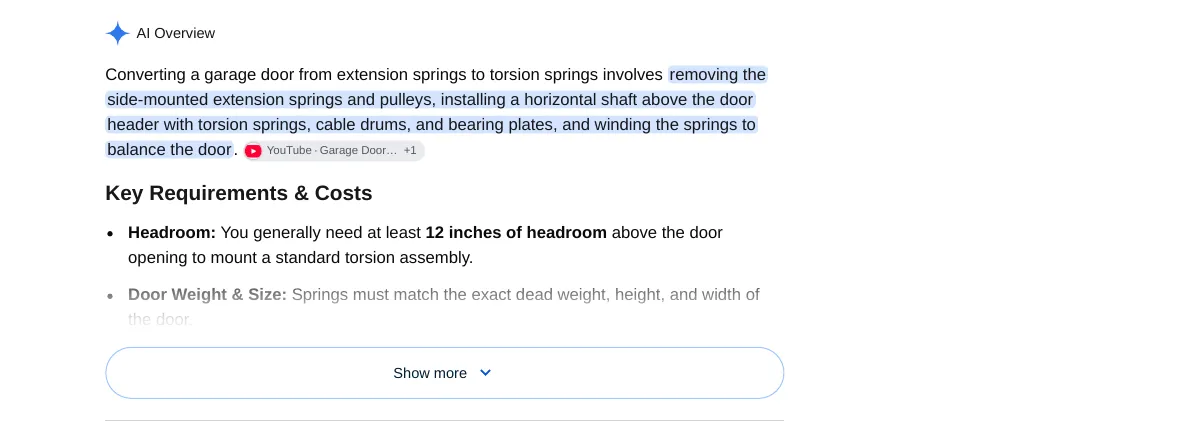
- A conversion needs new shaft, drums, plates and springs.
- Stay like-for-like when the door is old or the budget is tight.
Switch type when it pays
Switching type is a bigger job with a bigger payoff. It makes sense when the door is heavy or the old system is unsafe.
- Switch type when the door is heavy, double, or insulated.
- Switch when extension springs have no safety cables and the door is worth keeping.
- A conversion costs $400 to $800 (HomeGuide, 2026).
- Ask a pro to measure headroom before you decide to switch.
Example: Conversion in full: extension spring safety cable and conversion guide.
Video: Torsion vs Extension Springs: Which Do You Have? (Coming Soon)
A 60 to 120 second video for this guide is coming soon. It will cover the two spring types, the 30-second check, the side-by-side comparison, costs, and which type fits your door. No video is embedded here yet.
Garage Door Hub connects homeowners with trusted local garage door pros. Need a repair? Need a replacement? Start here. First, find out what it should cost. Then, price your exact job with our free calculator. Next, find a pro near you. Fast. No jargon. No guesswork. No surprise bills. Just clear prices, honest guides, and a local pro you can call today.
FAQ
How can I tell if I have torsion or extension springs?
Open the door and look above it. A thick coil on a steel shaft above the door is torsion. Two long coils along the side tracks are extension springs.
Which spring type is safer, torsion or extension?
Yes, torsion springs are safer. They stay on the shaft when they break. Extension springs can fly across the garage, so they need safety cables threaded through them.
Which spring type costs more?
Torsion springs cost more up front. A torsion pair costs $200 to $350 installed, against $120 to $200 for an extension pair (HomeGuide, 2026). Torsion lasts longer, so it costs less over 15 years.
How much headroom does each spring type need?
Torsion springs need 10 to 12 inches of headroom above the door. Extension springs need less, about 8 to 10 inches. A low-headroom garage may only fit extension springs.
Can I convert extension springs to torsion springs?
Yes, it costs $400 to $800 (HomeGuide, 2026). The conversion buys safety, smoother travel, and a longer spring life. It makes sense when the door is in good shape and you plan to keep it.
Can I replace either spring type myself?
No. Both store hundreds of foot-pounds of energy, and a wound torsion spring can break a wrist or worse. Spring replacement, winding and tension adjustment are pro-only work.
Sources
- Garage Door Locator, 2026 — torsion vs extension comparison, costs, lifespans, safety cable parts $20–$40. Verified live, 20 Nov 2026.
- Dan's Garage Door Services, 2026 — torsion vs extension explained, pros and cons. Verified live, 20 Nov 2026.
- HomeGuide, 2026 — torsion pair $150–$350, extension pair $120–$200, conversion $400–$800. Verified live, 20 Nov 2026.
- Mojo Garage Doors, 2026 — torsion 15,000–20,000 cycles, extension about 10,000 cycles. Verified live, 20 Nov 2026.
- Angi, updated 30 Oct 2026 — spring $150–$350 per spring, average $250. Verified live, 20 Nov 2026.
- OnOtto, updated Aug 2026 — 7–12 years, 10,000 cycles standard, 20,000-cycle springs roughly double life. Verified live, 20 Nov 2026.
- HomeAdvisor, 2025 data — torsion parts $30–$100 each, extension parts $15–$45 each. Index, 20 Nov 2026.
Last reviewed: 20 November 2026
Appendix — Related topics
You might have found this by these keywords — and if not, others might have: torsion vs extension spring, extension spring safety cable, convert extension to torsion springs, torsion springs vs extension springs, how can I tell if I have torsion or extension springs, which spring type is safer, torsion or extension, which spring type costs more, how much headroom does each spring type need, can I convert extension springs to torsion springs, can I replace a garage door spring myself, torsion spring lifespan, extension spring lifespan.