

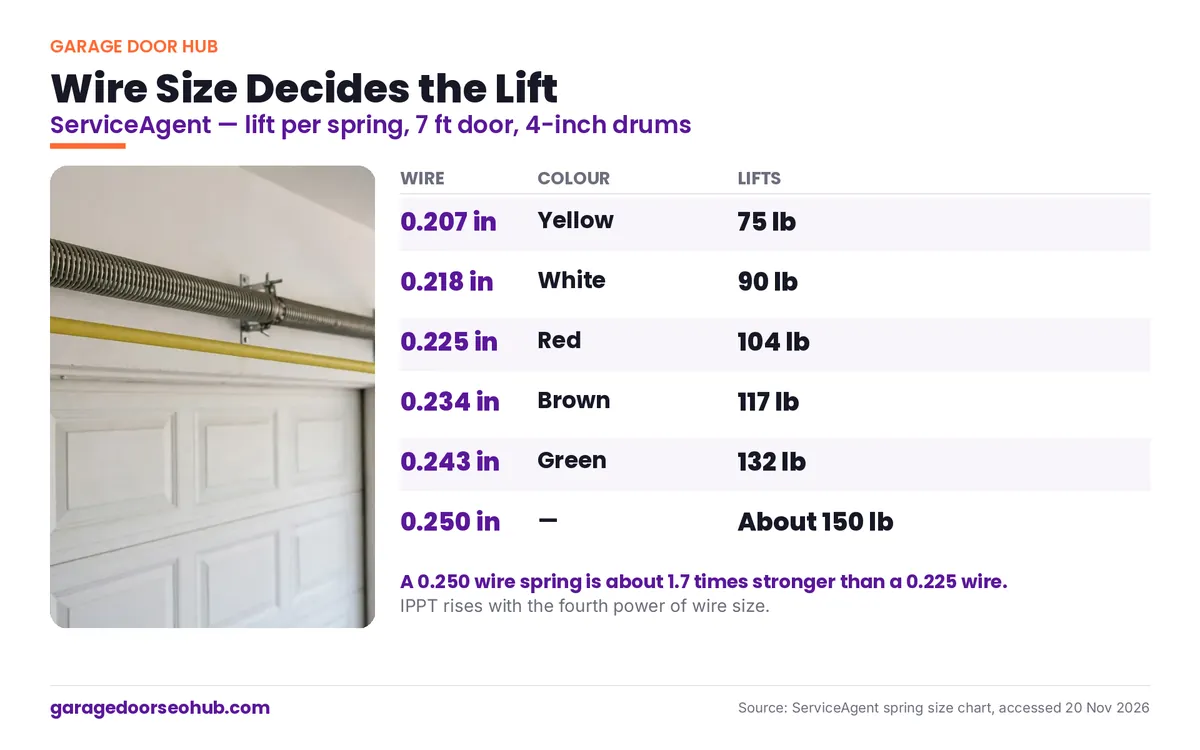
ServiceAgent shows a 200 lb door needs about 27 IPPT per spring, and a 0.250 wire spring is roughly 1.7 times stronger than a 0.225 wire spring.
That fourth-power rule is why one wire step up changes everything. Pick the wrong wire, and the door stays heavy or slams up.
This guide explains the four numbers that size a spring: wire, inside diameter, length, and turns.
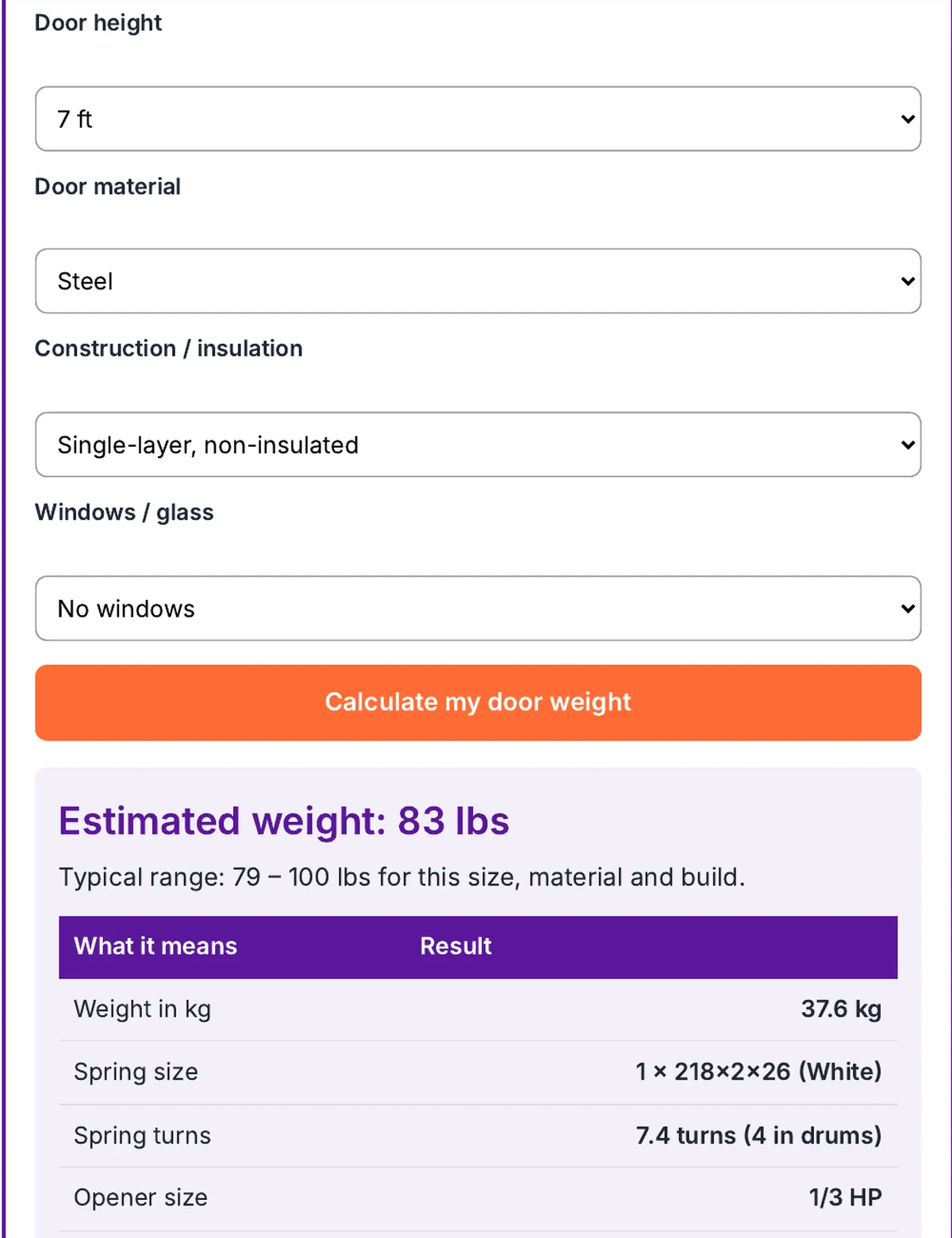
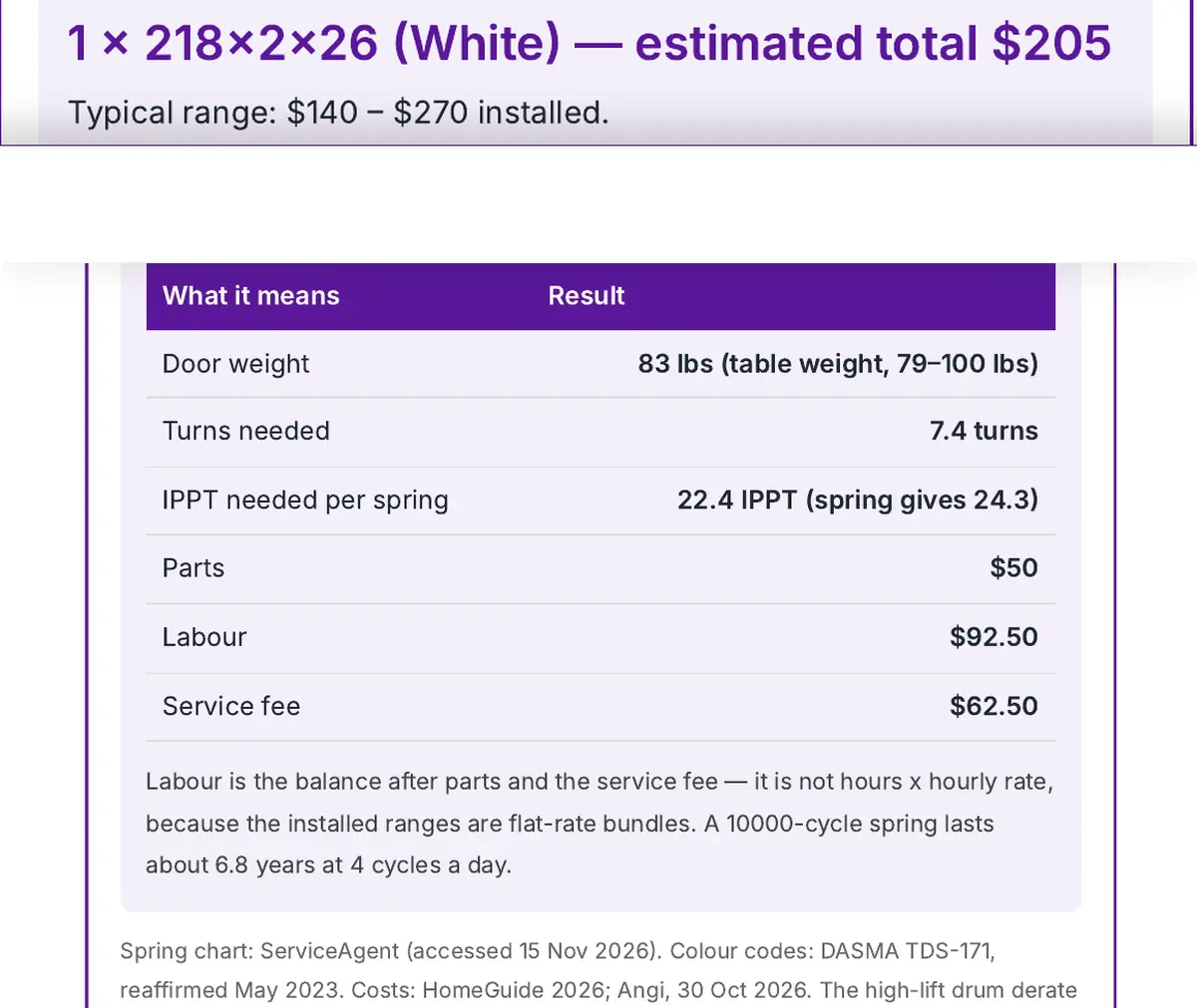
Garage door spring size comes from door weight, height and drum size. An 8 by 7 steel door weighs 83 lb and needs one 218x2x26 spring — 0.218-inch wire, 2-inch inside diameter, 26 inches long — at 7.4 turns. IPPT is inch-pounds per turn, the spring’s strength. Sizing is information; winding is never DIY.
Garage Door Hub connects you with a trusted local pro. Get a clear price for your garage door repair or replacement first.
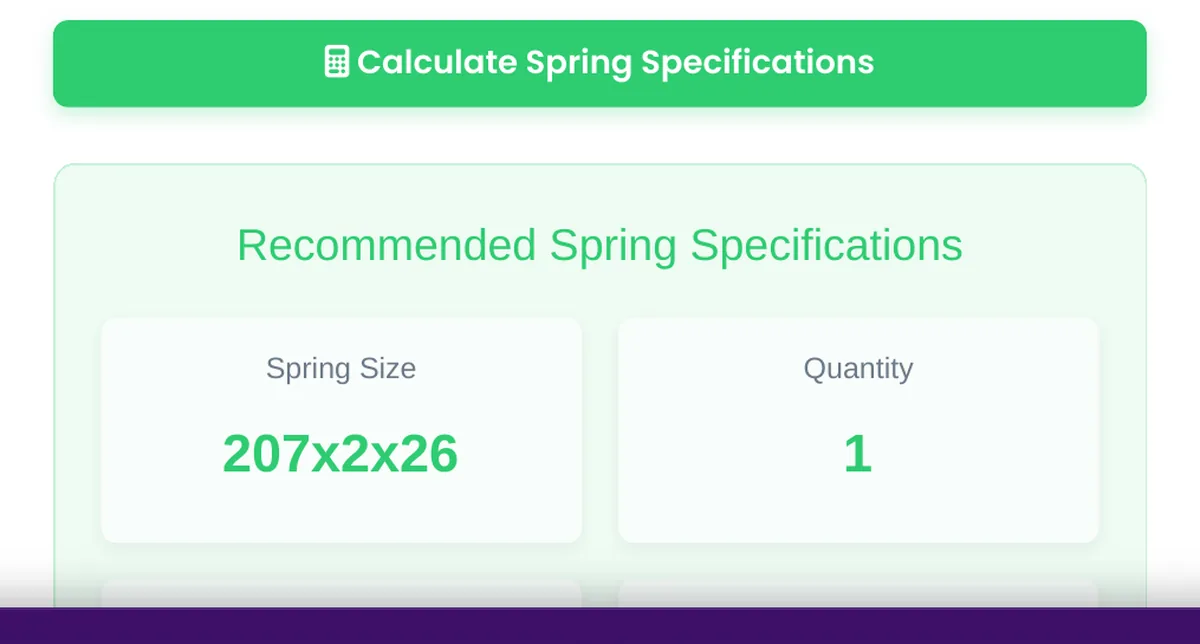
Size your spring first with the free Spring Size Calculator below. It gives you the wire, length and turns for your door.
Spring Size Calculator — find the right wire size, length and turns for your door.
Torsion Spring Calculator — check the torsion spring size and torque for your door.
- Enter your door size, weight and material first.
- Note the wire size, length and turns, then read the key takeaways.
- Use the size in Section 5 to check any quote you get.
Key takeaways
- Spring size comes from door weight, height and drum size.
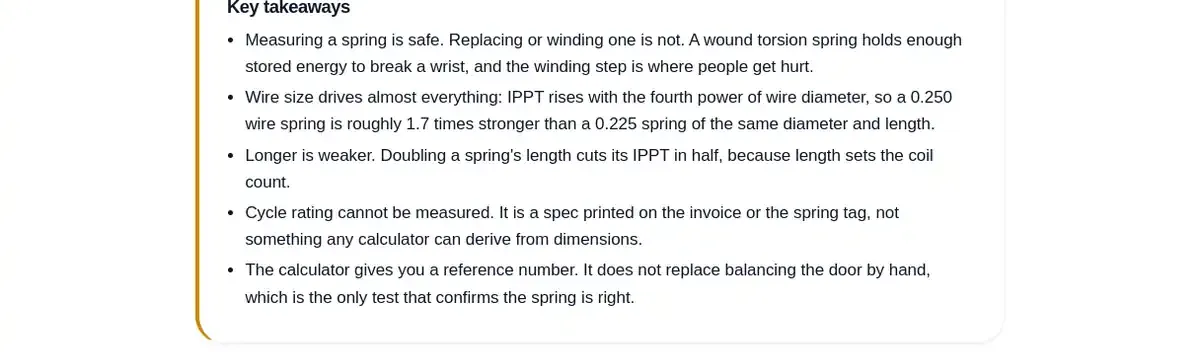
- Wire size decides lift: IPPT rises with the fourth power of wire.
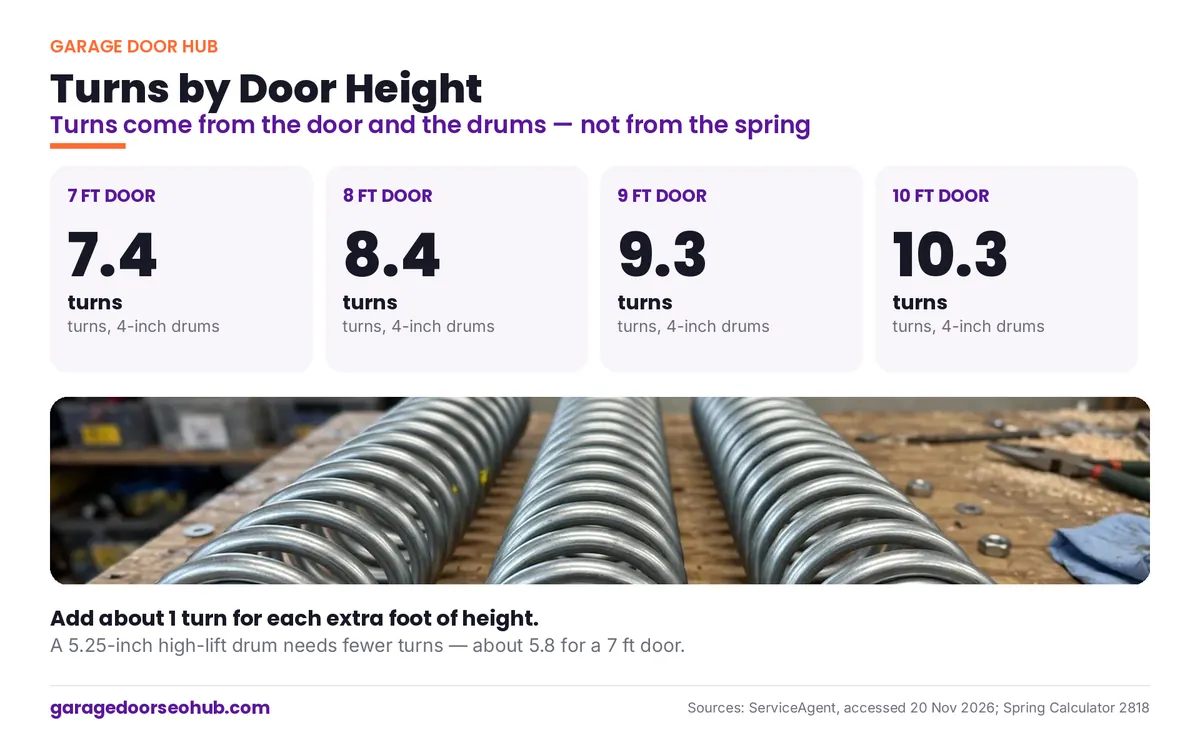
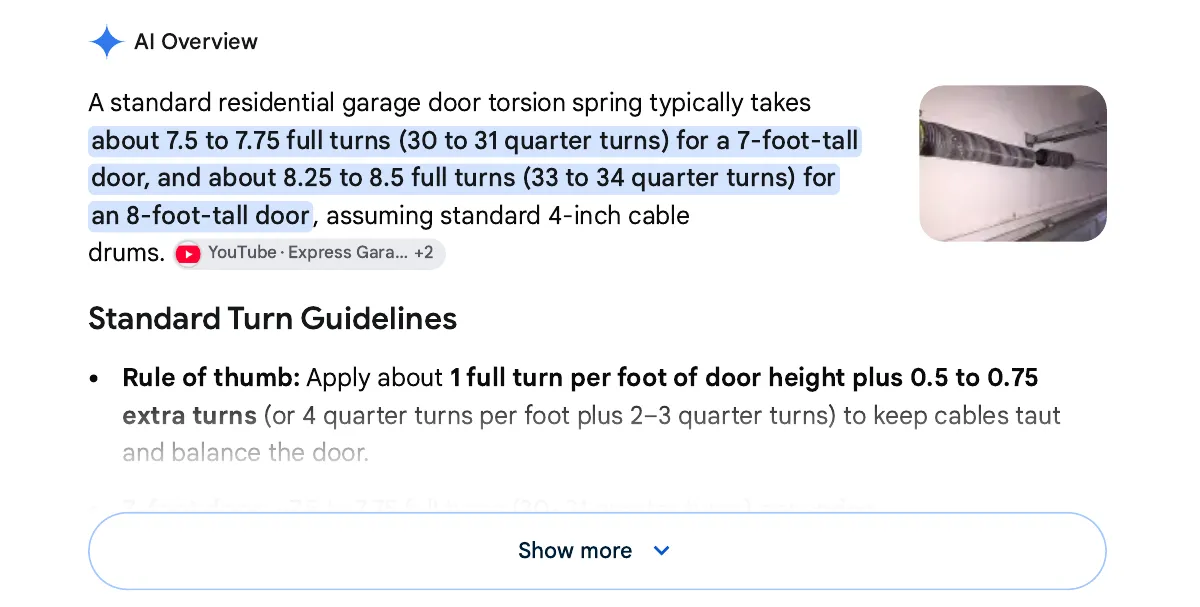
- A 7 ft door needs about 7.4 turns on 4-inch drums.
- Measure with the door closed; never touch a wound spring.
- Winding a spring is never DIY — a pro winds and balances it.
Table of Contents
-
1. Why spring size matters
-
2. The four numbers: wire, diameter, length
-
3. IPPT: the number that links spring to door
-
4. Turns by door height
-
5. From numbers to a spring
-
6. The safety line
-
7. Extension spring sizing
- Watch: how to measure a torsion spring — wire, diameter, length and wind
- FAQ
1. Why spring size matters
A spring must match the door weight exactly. Four numbers decide the match: wire, inside diameter, length, and turns.
Door weight comes first
Spring size starts with door weight, not with the old spring. The spring must balance the real weight of the door.
- Width, height, material and insulation set the weight.
- An 8 by 7 steel door weighs 83 lb; a 16 by 7 insulated door weighs 221 lb.
- Windows add about 15 lb; wood adds the most weight.
- Use the Weight Calculator if you do not know the weight.
What a wrong size does
A wrong-size spring is worse than an old spring. It fights the opener on every cycle and fails early.
- A spring that is too weak leaves the door heavy.
- A spring that is too strong slams the door up.
- A wrong spring wears out the opener and the spring itself.
- The balance test is the final check, done by hand.
2. The four numbers: wire, diameter, length
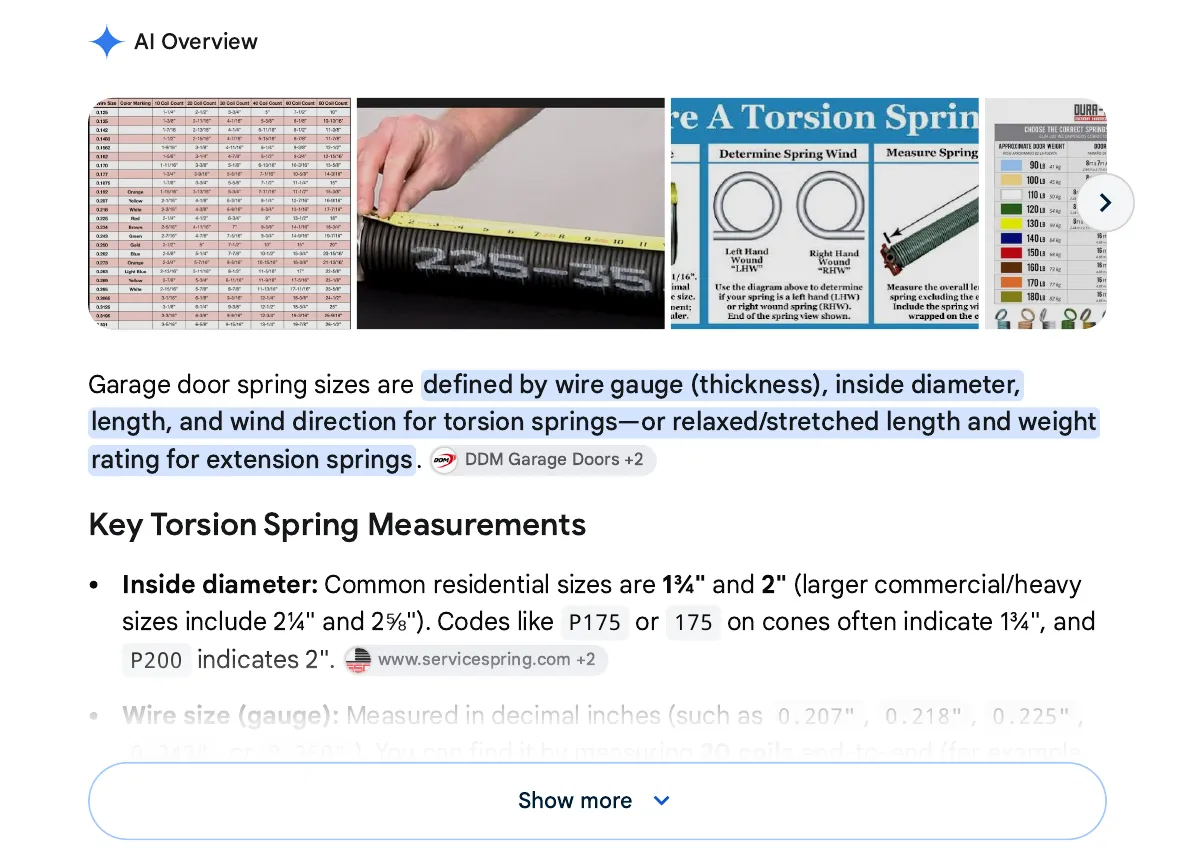
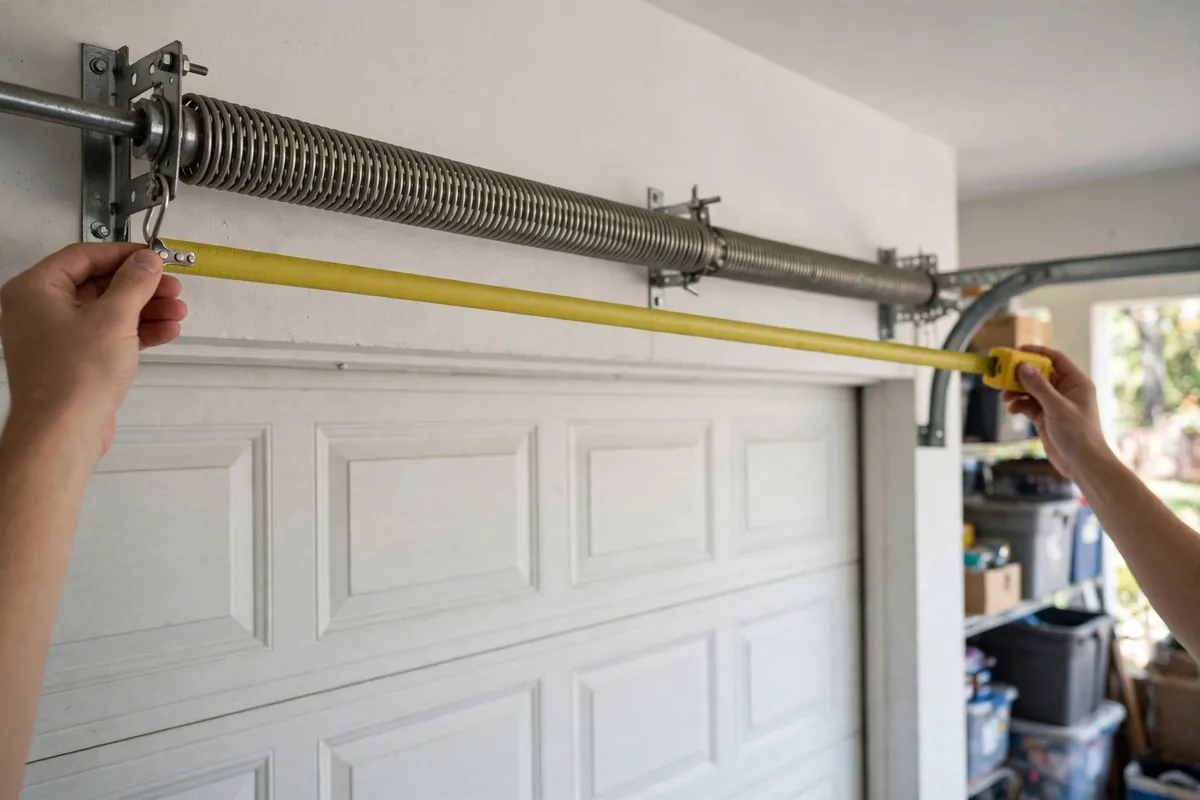
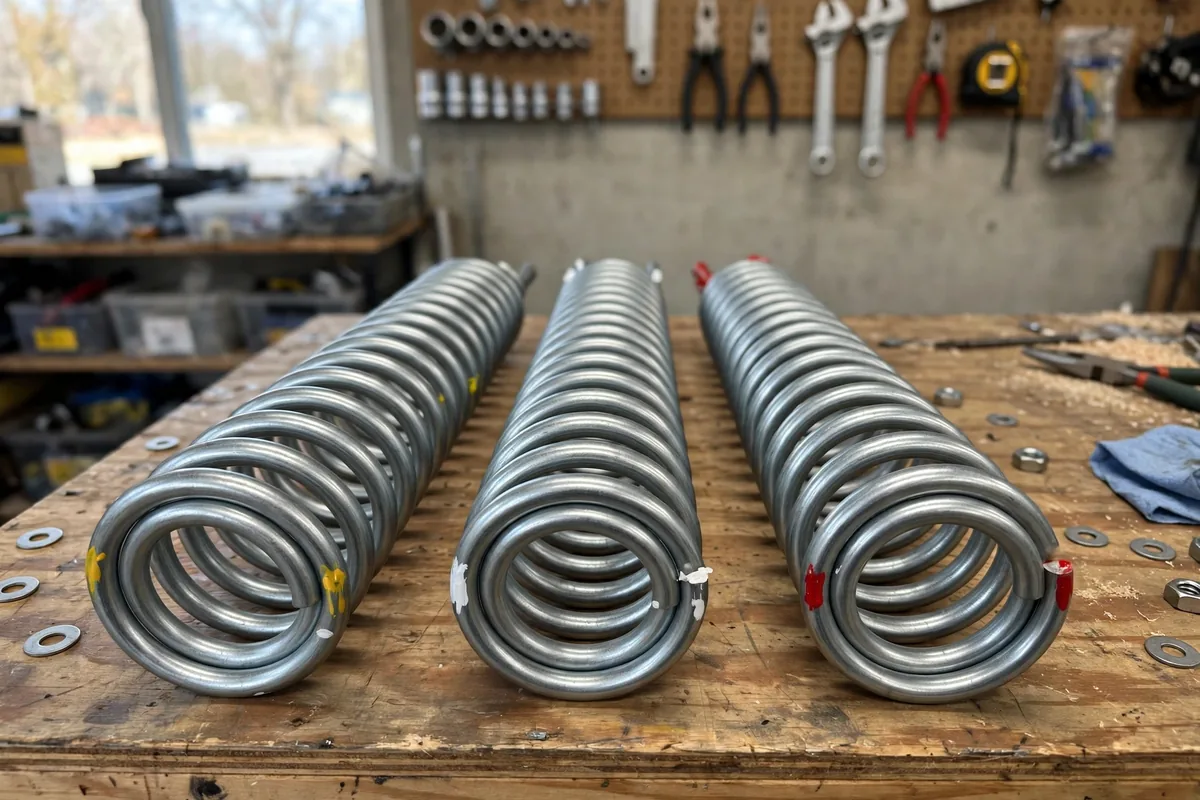
Four numbers size a torsion spring. Wire and inside diameter set the strength; length sets the coils and the cycle life.
Wire size
Wire size is the thickness of the steel wire, in inches. Thicker wire lifts more weight per turn, and IPPT rises fast with wire size.
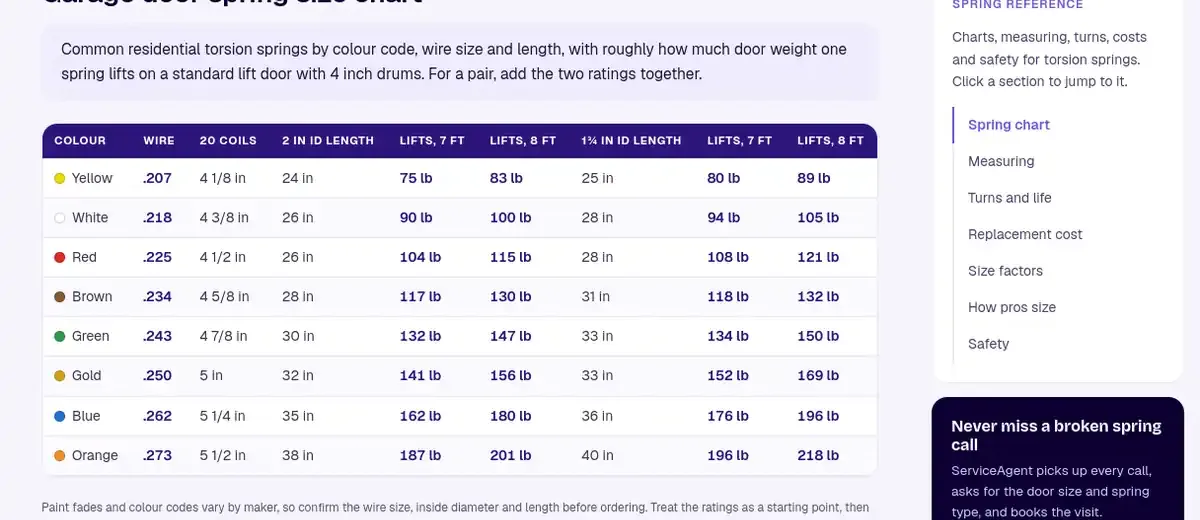
- Measure 20 coils end to end, then divide by 20.
- 20 coils at 4 3/8 inches means 0.218-inch wire.
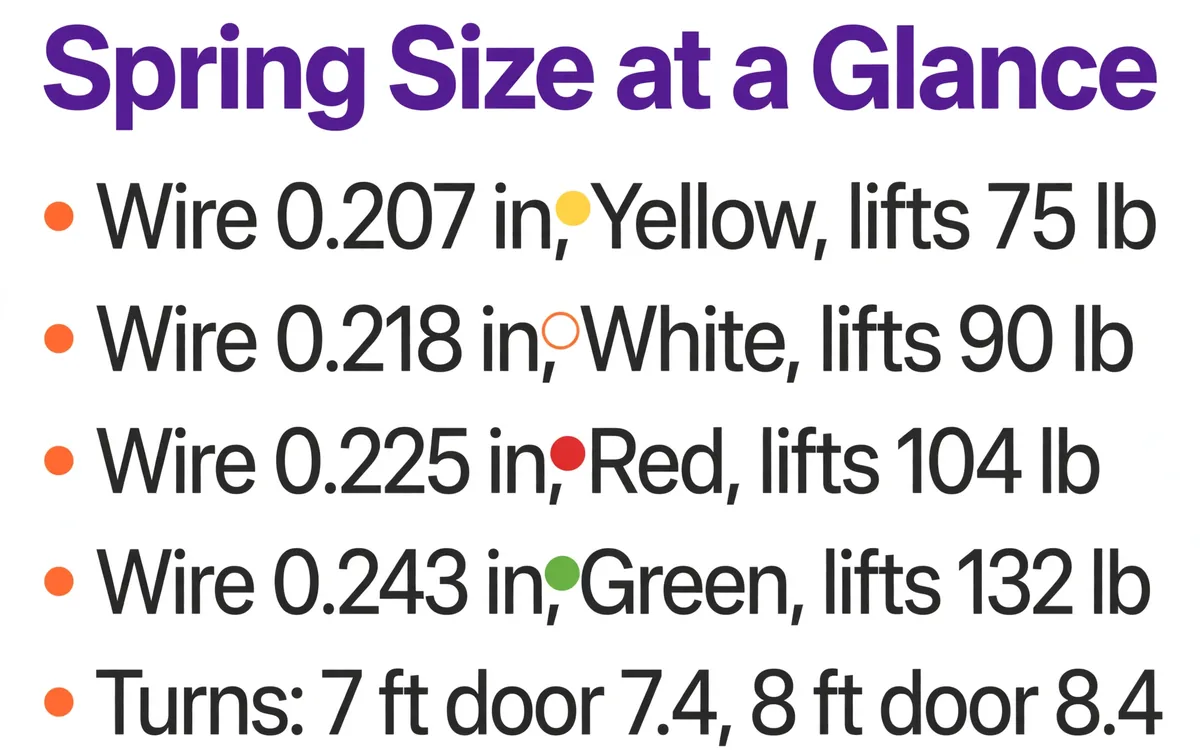
- Color codes: yellow 0.207, white 0.218, red 0.225.
- Common sizes: 0.218, 0.225, 0.234, 0.243, 0.250, 0.262.
Inside diameter and length
Inside diameter is the open center of the coil. It must match the shaft and the cones, or the spring will not fit.
- Measure across the open center of the coil.
- Most homes use 1.75 or 2 inches inside diameter.
- The code is stamped on the winding cone on most springs.
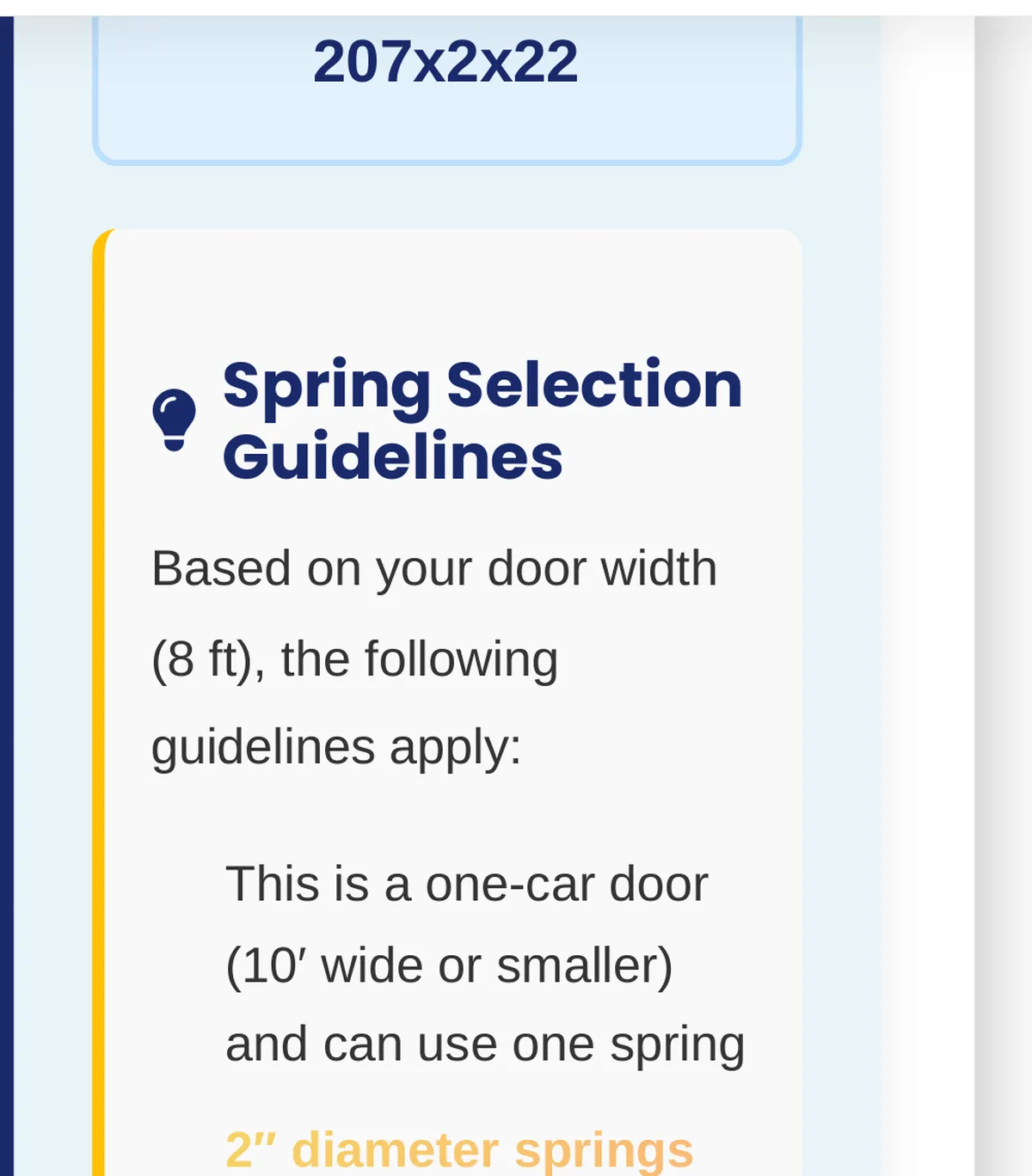
- A 218x2x26 spring is 0.218 wire, 2-inch ID, 26 inches long.
| Wire | Color | Lifts, 7 ft door | Typical length |
|---|---|---|---|
| 0.207 in | Yellow | 75 lb | 24–25 in |
| 0.218 in | White | 90 lb | 26–28 in |
| 0.225 in | Red | 104 lb | 26–30 in |
| 0.234 in | Brown | 117 lb | 28–32 in |
| 0.243 in | Green | 132 lb | 30–34 in |
| 0.250 in | — | About 150 lb | 34–36 in |
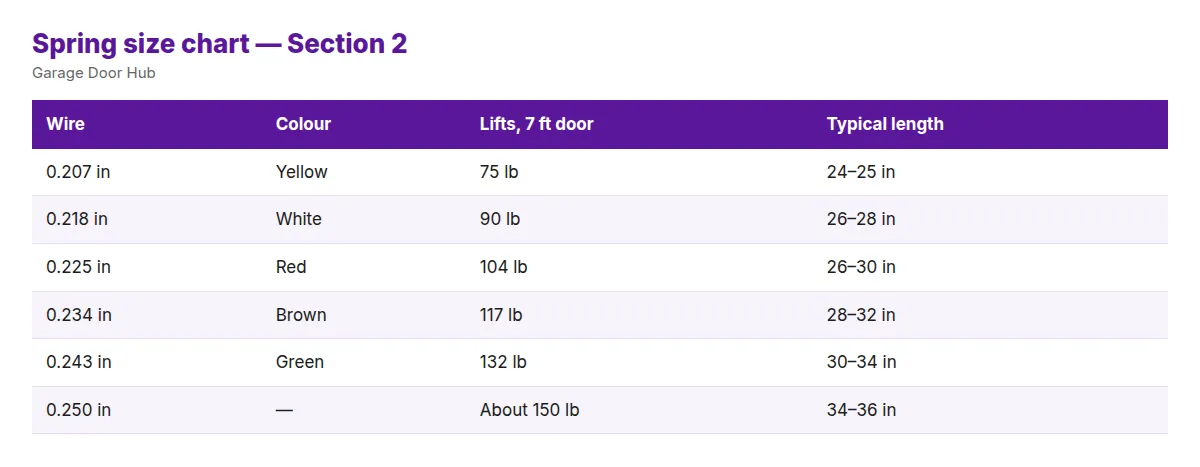
Lift figures are per spring, on a 7 ft door with 4-inch drums (ServiceAgent, accessed 20 Nov 2026). A pair adds the two ratings together.
3. IPPT: the number that links spring to door
IPPT is the number that links the spring to the door. It turns a wire size into a lift, and a lift into a door weight.
What IPPT means
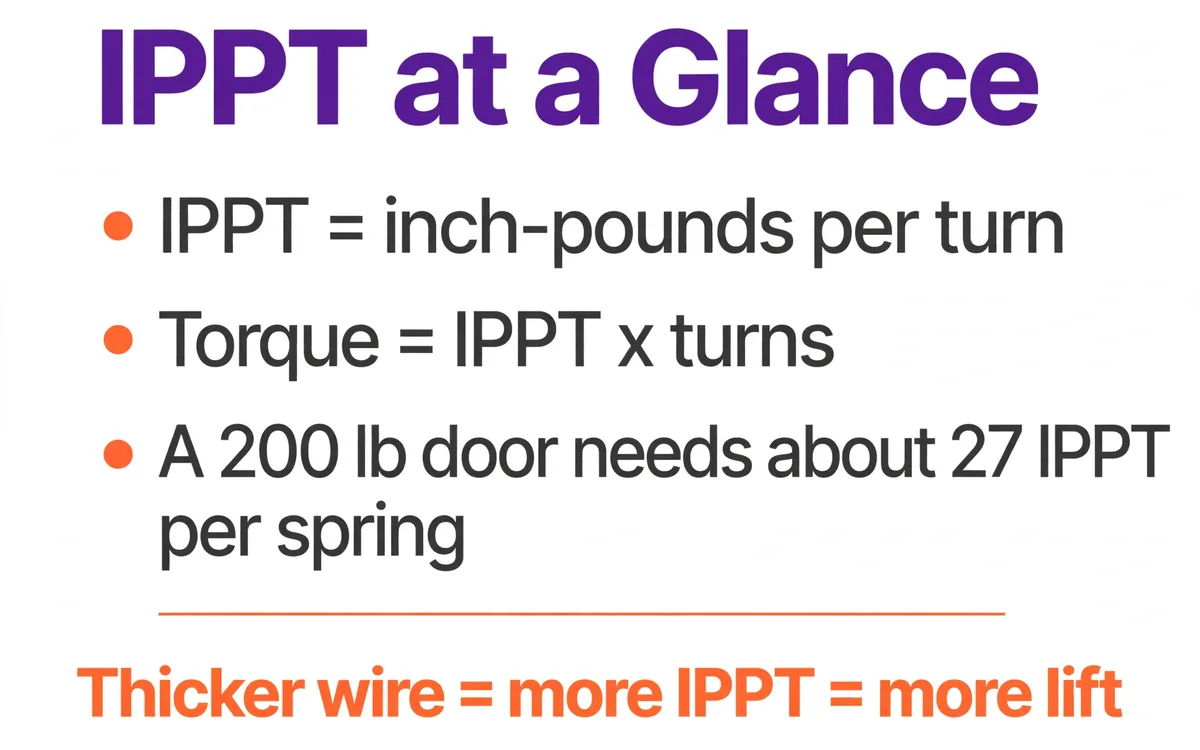
IPPT tells you how strong a spring is. It is the torque the spring gives for each full turn it is wound.
- IPPT is inch-pounds per turn, the torque per turn.
- A 200 lb door on 4-inch drums needs about 27 IPPT per spring.
- Torque equals IPPT times turns, for each spring.
- The spring’s IPPT must meet or beat the door’s need.
Wire size drives IPPT
Wire size drives IPPT more than any other number. One step up in wire can lift the same door for twice as many cycles.
- IPPT rises with the fourth power of wire diameter.
- A 0.250 wire spring is about 1.7 times stronger than a 0.225 wire.
- Longer springs spread the same force over more coils.
- More coils at the same IPPT means more cycles of life.
Example: Worked example: a 200 lb door, 7 ft tall, 4-inch drums, two springs. Door torque is 400 lb-in, so each spring needs 26.9 IPPT at 7.43 turns (ServiceAgent, 2026).
4. Turns by door height
Turns are set by the door and the drums. The spring is wound to that count, and the count is the same for any spring on the door.
Turns by door height
Turns come from door height and drum size, not from the spring. A taller door winds more cable, so it needs more turns.
- 7 ft door: about 7.4 turns on 4-inch drums.
- 8 ft door: about 8.4 turns.
- 9 ft door: about 9.3 turns; 10 ft door: about 10.3 turns.
- Add about 1 turn for each extra foot of height.
Drums change the turns
Drum size changes the turns. Bigger drums wind more cable per turn, so they need fewer turns but a stronger spring.
- A 5.25-inch high-lift drum needs fewer turns, about 5.8 for a 7 ft door.
- Fewer turns means more torque per turn, so a heavier wire is needed.
- Standard 4-inch drums are the home default.
- A count far from 7.4 turns on a 7 ft door is a reason to recheck.
| Door height | Turns, 4-inch drums | Typical wire size |
|---|---|---|
| 7 ft | 7.4 turns | 0.207–0.225 in |
| 8 ft | 8.4 turns | 0.207–0.225 in |
| 9 ft | 9.3 turns | 0.225–0.243 in |
| 10 ft | 10.3 turns | 0.225–0.250 in |
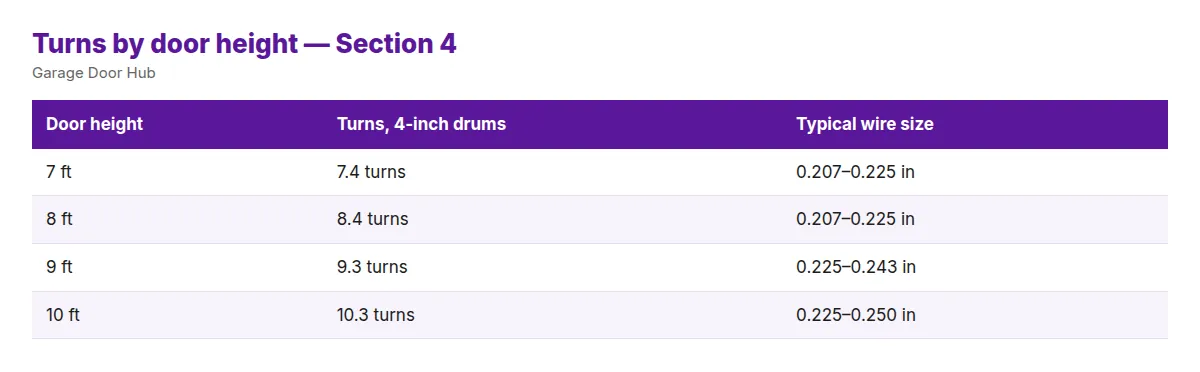
Turns figures are ServiceAgent, accessed 20 Nov 2026, and the Garage Door Hub Spring Calculator 2818.
5. From numbers to a spring
Numbers become a spring code when you run them through the calculator. The code is wire, inside diameter and length, in that order.
Use the calculator
The Spring Size Calculator does the maths for you. Enter the door, and it gives the spring size, turns and price.
- Enter door size, weight and material in the calculator.
- It returns wire size, length, turns and number of springs.
- An 8 by 7 steel door needs one 218x2x26 spring at 7.4 turns.
- The result is a size to check, not a fitting job.
High-cycle sizing
High-cycle springs carry the same load for more cycles. They do it with thicker wire and a longer spring body.
- High-cycle springs use thicker wire and a longer body.
- The same IPPT spread over more coils means more cycles.
- A 10,000-cycle spring can become a 20,000-cycle spring this way.
- High-cycle springs must be engineered, not guessed.
Example: Run your door through the calculators in the tool box above, then ask a pro to confirm the size before any work starts. The hand balance test is the final word.
6. The safety line
The safety line is simple: measure and check, but never wind. The winding step is where people get hurt.
Measuring safely
Measuring a spring is safe; winding or replacing one is not. Measure with the door closed, and keep your hands off the cones.
- Measure with the door closed, and never touch a wound spring.
- Measure one spring of a matched pair; both should match.
- Write down wire, inside diameter and length before you call.
- A pro confirms the size with a hand balance test.
Winding is never DIY
Sizing is information; winding is never DIY. A wound torsion spring holds enough stored energy to break a wrist.
- Never wind a torsion spring yourself, even with bars.
- Never fit a spring by wire size alone, without the turns.
- Never mix two different springs on one door.
- If the door feels heavy after a job, call the pro back.
Example: Full spring picture: garage door springs complete guide. Broken-spring checks: broken garage door spring guide.
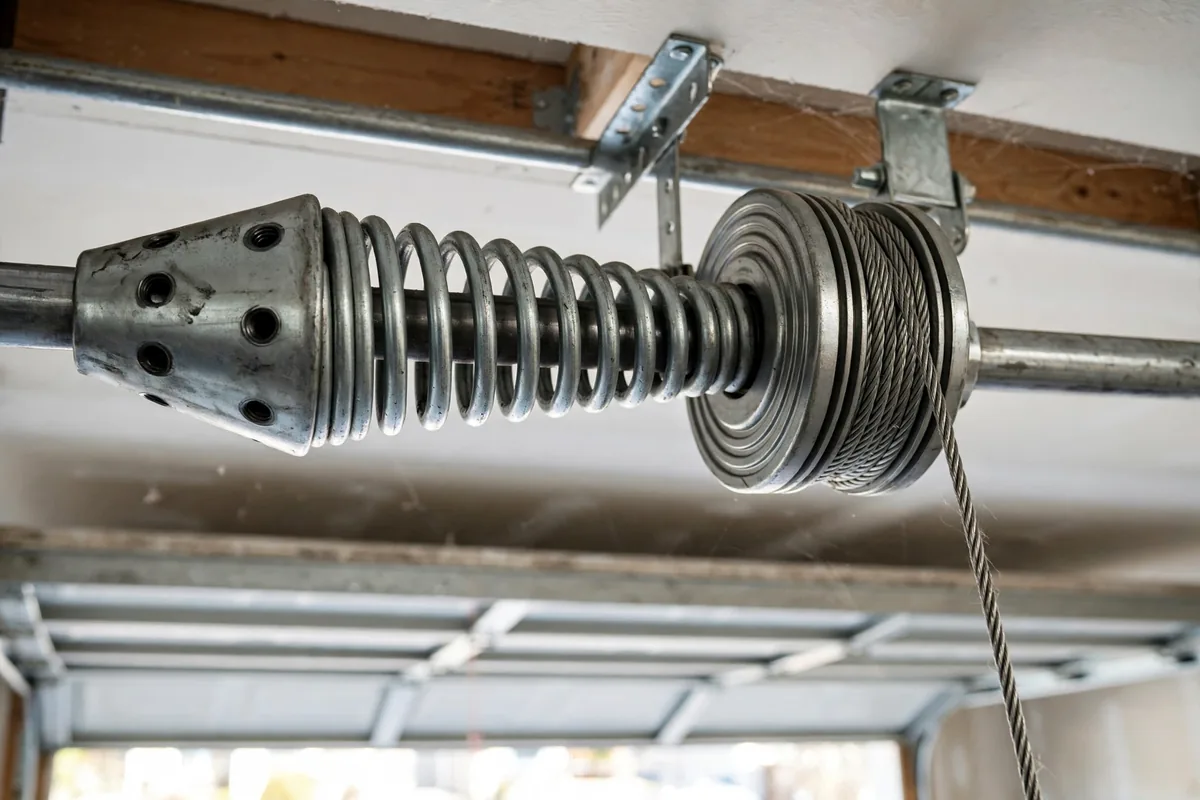
7. Extension spring sizing
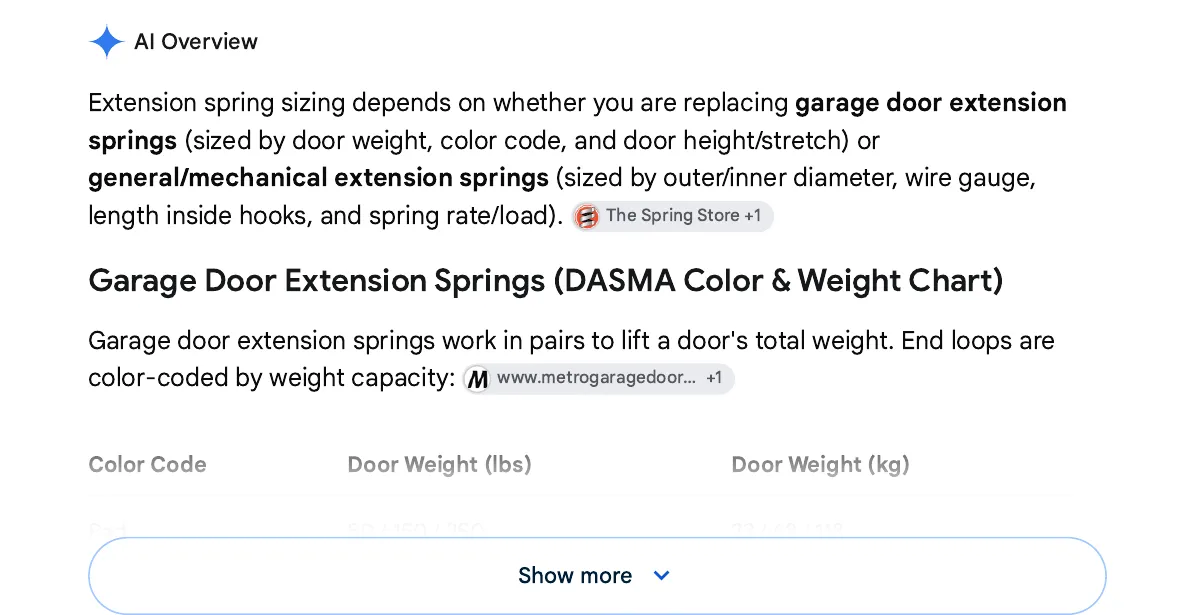
Extension springs do not use IPPT or turns. They size by weight rating and stretched length, and both sides must match.
Extension springs size by weight and stretch
Extension springs size differently from torsion springs. They are rated by the weight they lift and the length they stretch.
- Extension springs are sized by weight and stretched length, not IPPT.
- The spring must stretch the right length when the door closes.
- A stretched spring that is too long sags and lifts weakly.
- Color codes mark extension spring weight ratings too.
Matching a pair
Extension springs always work in pairs, one per side. Both must match in size and rating, or the door pulls unevenly.
- Measure the stretched length with the door closed.
- Match the weight rating to the door, one spring per side.
- Both sides must match, or the door will hang crooked.
- A pro confirms the size with a hand balance test.
Watch: how to measure a torsion spring — wire, diameter, length and wind
Victor at Express Garage Doors shows the four measurements on YouTube: read the size painted on the spring, measure the inside diameter, find the wind direction, and count 20 coils for the wire size. Measuring is the safe check; winding is never DIY.
- Wire size comes from 20 coils: measure 20 coils end to end, then divide by 20.
- Length is the relaxed coil end to end, not counting the cones — add both broken pieces together.
- Right-hand wind coils clockwise from the winding cone; left-hand wind coils counterclockwise.
Video: Express Garage Doors Inc, YouTube. Checked 21 November 2026.
Garage Door Hub connects homeowners with trusted local garage door pros. Need a repair? Need a replacement? Start here. First, find out what it should cost. Then, price your exact job with our free calculator. Next, find a pro near you. Fast. No jargon. No guesswork. No surprise bills. Just clear prices, honest guides, and a local pro you can call today.
FAQ
How do I find the right spring size for my garage door?
Measure the wire size, inside diameter and length of the old spring, or use your door weight, height and drum size. An 8 by 7 steel door weighs 83 lb and needs one 218x2x26 spring at 7.4 turns.
What is IPPT on a garage door spring?
IPPT is inch-pounds per turn: the torque one spring gives for each full turn it is wound. A 200 lb door on 4-inch drums needs about 27 IPPT per spring with two springs.
How many turns does a garage door spring need?
A 7 ft door needs about 7.4 turns, an 8 ft door about 8.4 turns, and a 9 ft door about 9.3 turns. Turns come from door height and drum size, not from the spring.
How do I measure garage door spring wire size?
Measure 20 coils end to end, then divide by 20. If 20 coils measure 4 3/8 inches, the wire is 0.218 inches. Color codes help too: yellow is 0.207, white is 0.218.
Can I size a spring myself and fit it myself?
No. Sizing is information you can check, but winding a spring is never DIY. A wound torsion spring holds hundreds of foot-pounds of energy. A pro winds and balances the spring.
What are the most common garage door spring wire sizes?
The most common residential wire sizes are 0.218, 0.225, 0.234, 0.243, 0.250 and 0.262 inches. Thicker wire lifts more weight per turn, so heavy doors need thicker wire.
Sources
- ServiceAgent, accessed 20 Nov 2026 — turns by door height, wire size chart, IPPT formula, worked example. Verified live, 20 Nov 2026.
- Seaside Garage Door Experts, updated 16 Oct 2026 — IPPT rises with the fourth power of wire diameter; measuring is safe, winding is not. Verified live, 20 Nov 2026.
- Garage Door Hub Spring Calculator 2818 — live calculator, defaults 218x2x26, 83 lb, 7.4 turns, $205. Live 20 Nov 2026.
- Garage Door Hub Spring Size Calculator 1346 — live calculator, 218x2x26 result for an 8×7 steel door. Live 20 Nov 2026.
- Garage Door Hub Torsion Spring Calculator 1569 — live calculator. Live 20 Nov 2026.
Last reviewed: 20 November 2026
Appendix — Related topics
You might have found this by these keywords — and if not, others might have: garage door spring size, how many turns garage door spring, extension spring size chart, how do I find the right spring size for my garage door, what is IPPT on a garage door spring, how many turns does a garage door spring need, how do I measure garage door spring wire size, can I size a garage door spring myself, what are the most common garage door spring wire sizes, garage door spring wire size, garage door spring inside diameter, spring size calculator, torsion spring calculator.