

EngineerFix, writing in 2026, states it plainly: a garage door can be fatal, and the danger comes from the immense weight and the powerful spring and cable systems that hold it.
A torsion spring on a typical two-car door can hold about the same energy as a car moving at 15 mph, focused into a small point in a split second (The Unexplored Road, 2026).
This guide is the homeowner safety version. It explains why springs and cables are dangerous, what a pro does, and what you must never touch — without the technical tables, which live in the Springs cluster.
Garage door spring danger comes from stored energy: a torsion spring holds 100 to 200 pounds of force and releases it at once if it breaks or slips (EngineerFix, 2026). Springs and cables are pro-only work, never a DIY repair. Look for a gap in the spring coil, a crooked door, or frayed cables — then stop using the door and call a pro.
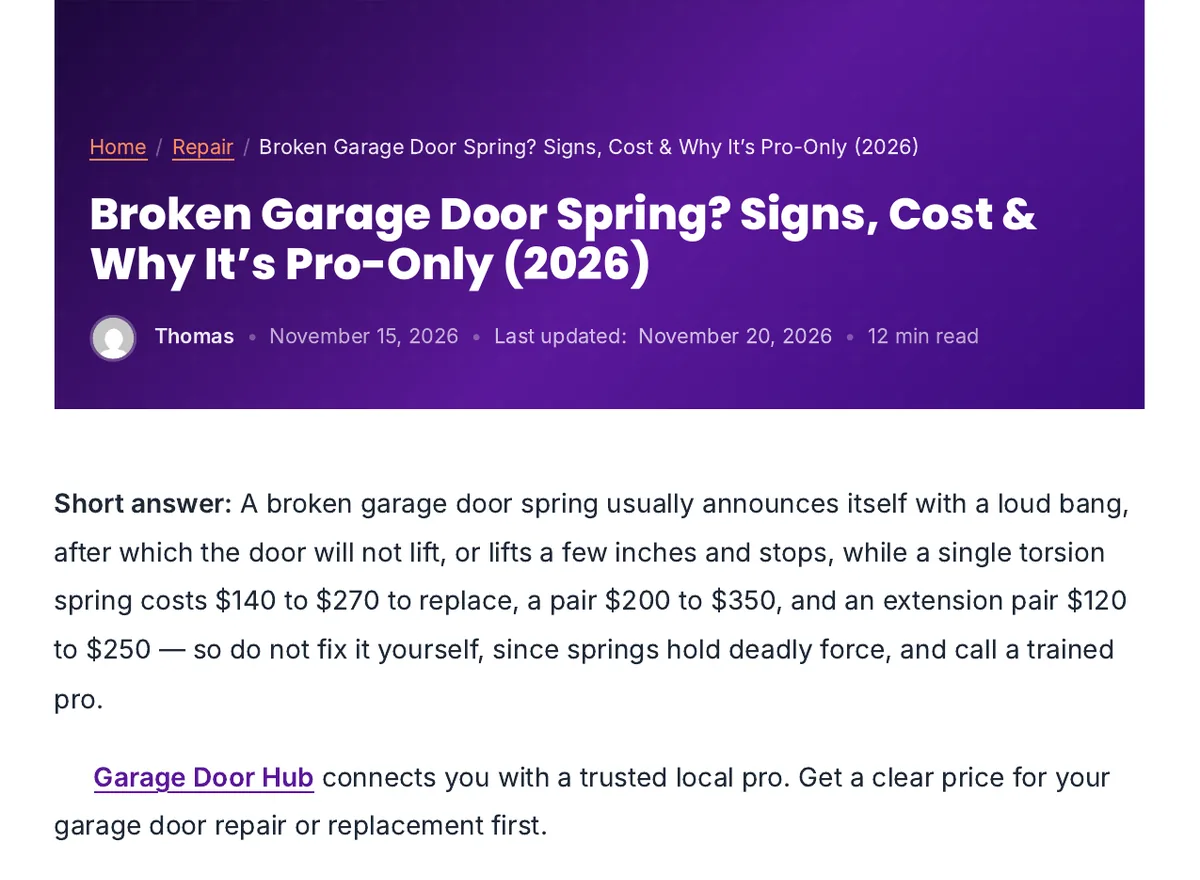
Garage Door Hub connects you with a trusted local pro. Get a clear price for your garage door repair or replacement first.
Price your job first with the free calculators below. They give you a number before you call anyone.
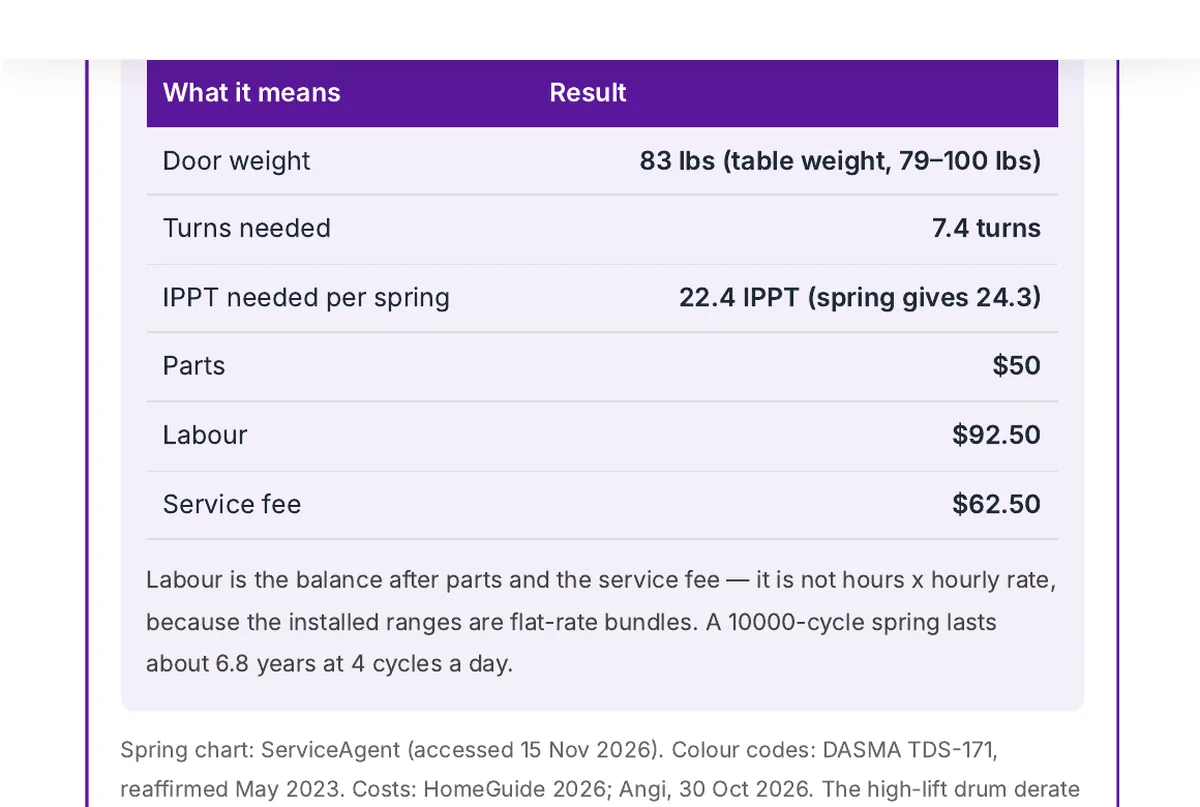
Spring Calculator — price a spring job by size, weight and turns.
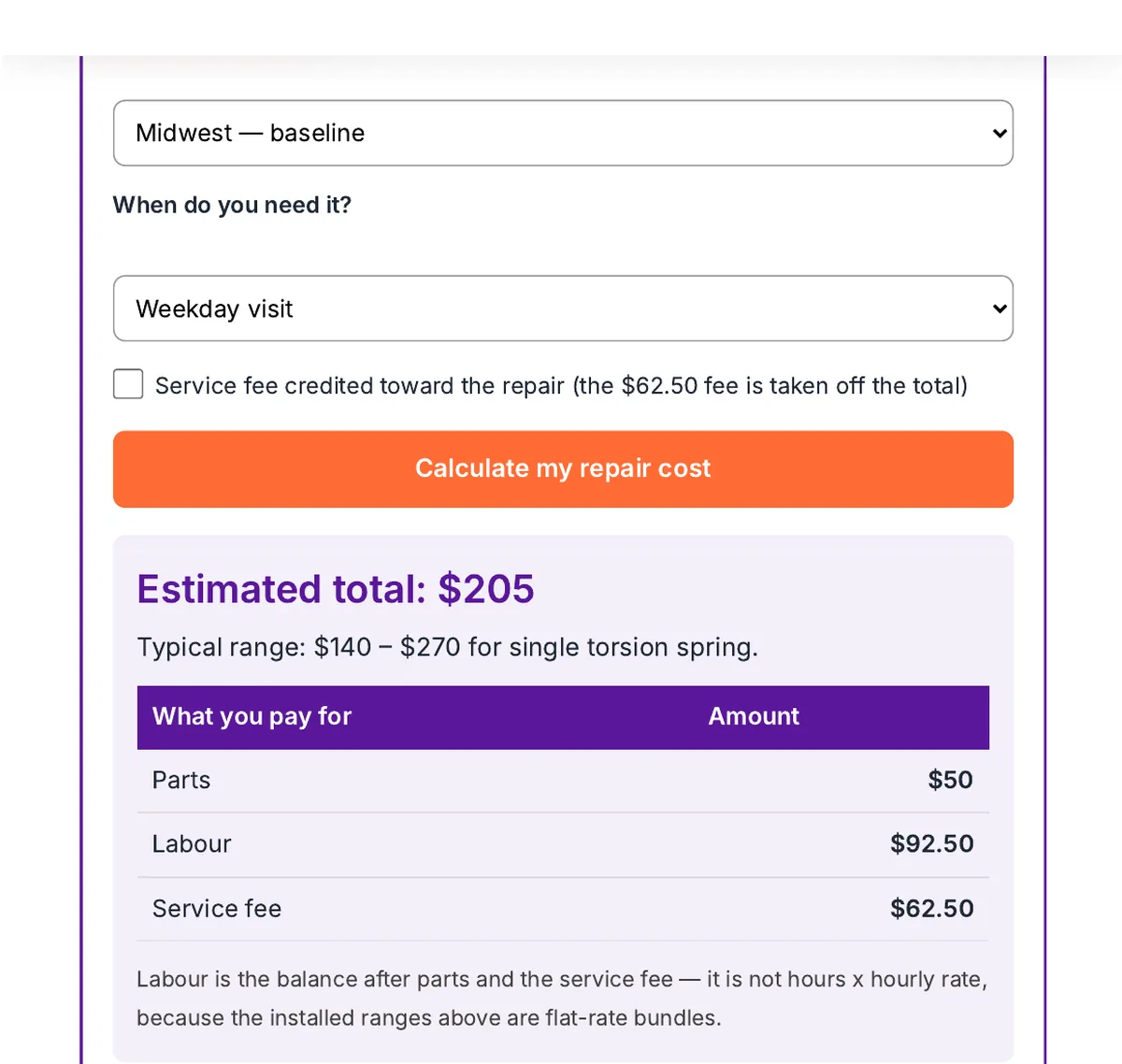
Repair Cost Calculator — price a cable or spring repair before you call.
- Enter your door size and the part involved.
- Note the price, then read the key takeaways and Section 1.
- Use the price to check any quote you get.
Key takeaways
- A torsion spring holds 100 to 200 pounds of force — enough to kill.
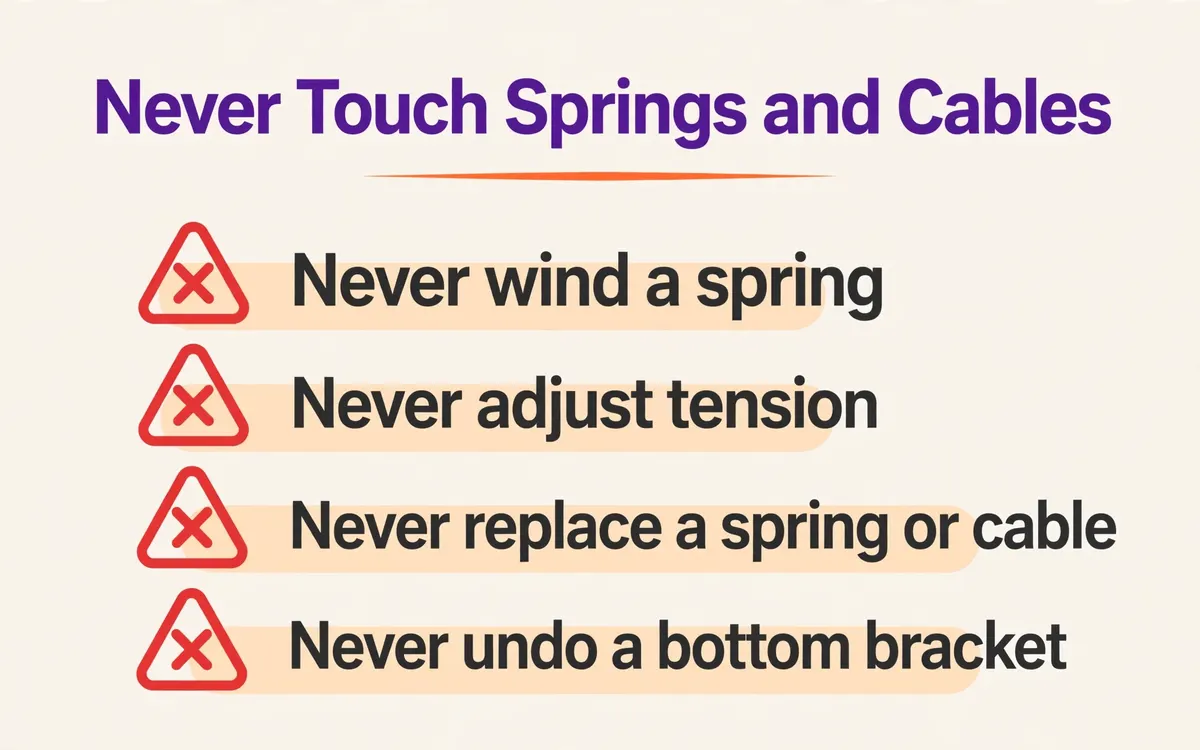
- Never wind, unwind or replace a spring yourself, ever.
- Never undo a bottom bracket with the door down.
- A gap in the spring coil, a crooked door, or frayed cables mean stop and call a pro.
- A spring pair costs $200 to $350 installed — a cheap price for a dangerous job.
Table of Contents
-
1. Why springs are the most dangerous part
-
2. Torsion springs: what they are, what goes wrong
-
3. Extension springs and safety cables
-
4. Cables: the part that whips
-
5. What a pro does that you cannot
-
6. What you can safely do yourself
- Watch: The red bolt warning — why springs and cables are pro-only
- FAQ
1. Why springs are the most dangerous part
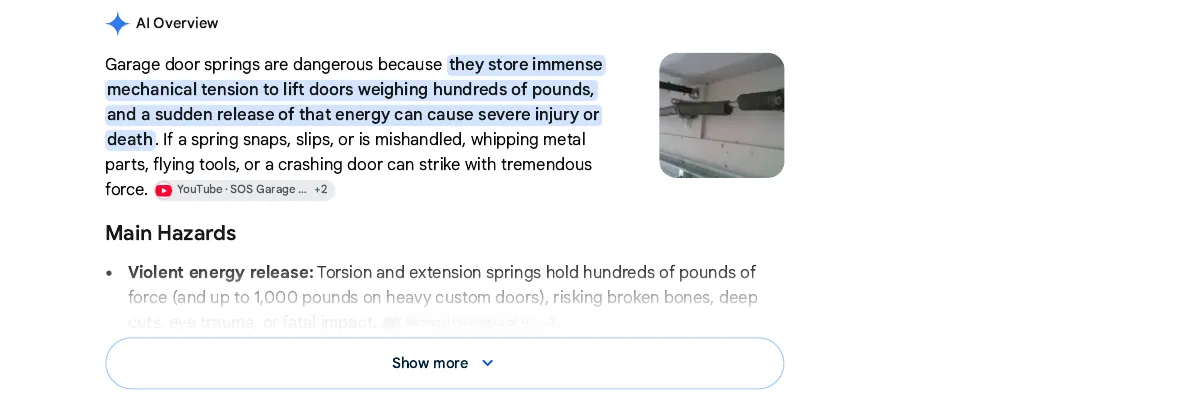
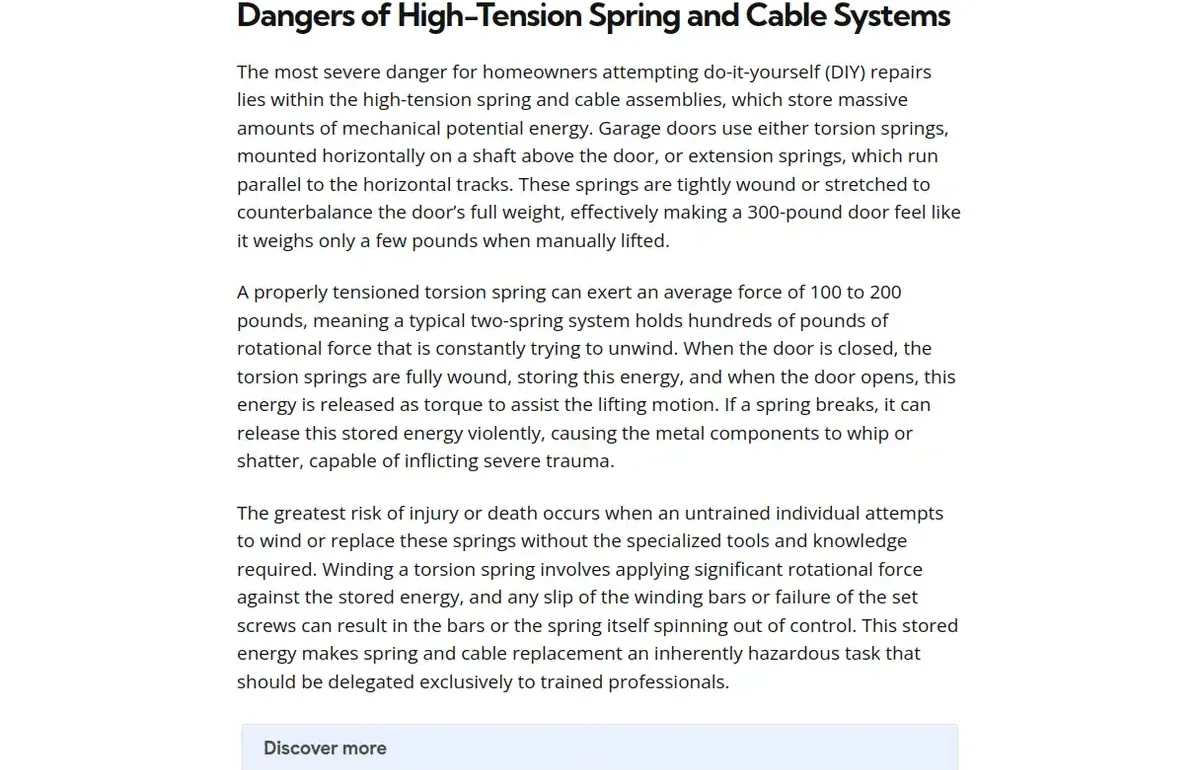
Springs counterbalance the door’s full weight, so a 300-pound door feels light by hand. That lightness is stored energy, and it is what makes a spring the most dangerous part a homeowner can touch.
Stored energy, in plain terms
A torsion spring is wound tight to hold the door’s weight, and it stays wound for years. When it breaks, or when a winding bar slips, that energy releases in a split second, focused on one small point.
- A torsion spring holds 100 to 200 pounds of force (EngineerFix, 2026).
- A two-spring system holds hundreds of pounds of force.
- A broken spring can whip, shatter, or throw metal fragments.
- The force is comparable to a car moving at 15 mph (The Unexplored Road, 2026).
Doors weigh 150 to 500 pounds
Doors commonly weigh 150 to 400 pounds, and a double wood or insulated steel door can weigh 250 to 500 pounds or more (EngineerFix, 2026). If the springs fail, that weight drops without warning.
- A single steel door weighs about 88 to 150 pounds.
- A double insulated door weighs 200 to 350 pounds.
- A double wood door can weigh 400 to 650 pounds.
- The springs make all of that weight feel like a few pounds.
The injuries DIY attempts cause
Emergency rooms see the same injuries again and again: winding bar slips that break hands and faces, wrong tools that slip under torque, springs that fracture while being wound, and cables that snap and whip.
- Winding bar slips: broken hands, facial injuries, eye trauma.
- Wrong tools: a screwdriver is not a winding bar, and it slips.
- Spring breaks during adjustment: metal fragments at high speed.
- Cable failures: a snapped cable can cause severe lacerations.
Example: A winding bar is a steel rod placed in the spring cone to control rotation. When it slips, the cone spins violently — and a human body has no defense against force that sudden and that localised.
2. Torsion springs: what they are, what goes wrong
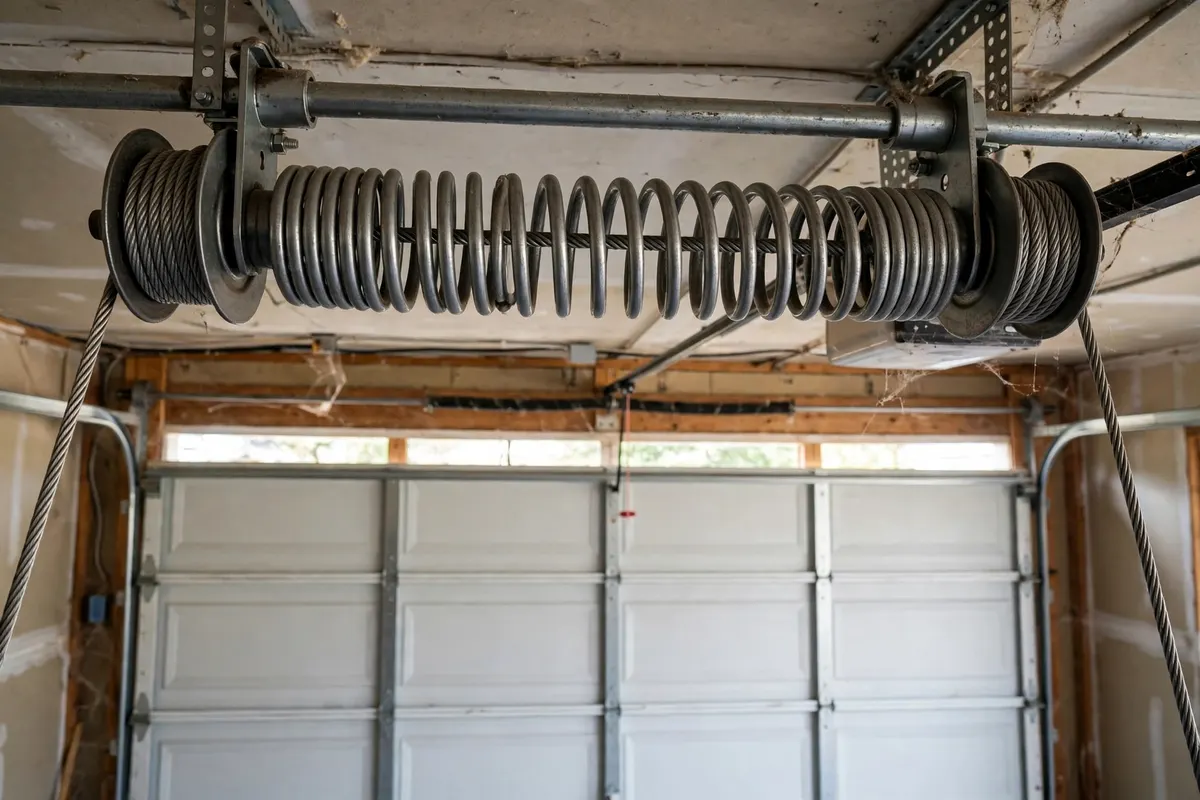
Torsion springs sit on a shaft above the opening, wound to a set tension. They are the most common type in modern garages, and the most dangerous to touch without training.
How a torsion spring works
The spring twists as the door closes, storing energy, and unwinds as the door opens, giving that energy back as lift. A standard spring is wound with roughly 30 to 40 turns of tension (The Unexplored Road, 2026).
- The spring sits on a shaft above the door opening.
- It twists to store energy as the door closes.
- It unwinds to lift the door as it opens.
- It lasts about 10,000 cycles — 7 to 10 years at 4 cycles a day.
Signs a torsion spring is failing
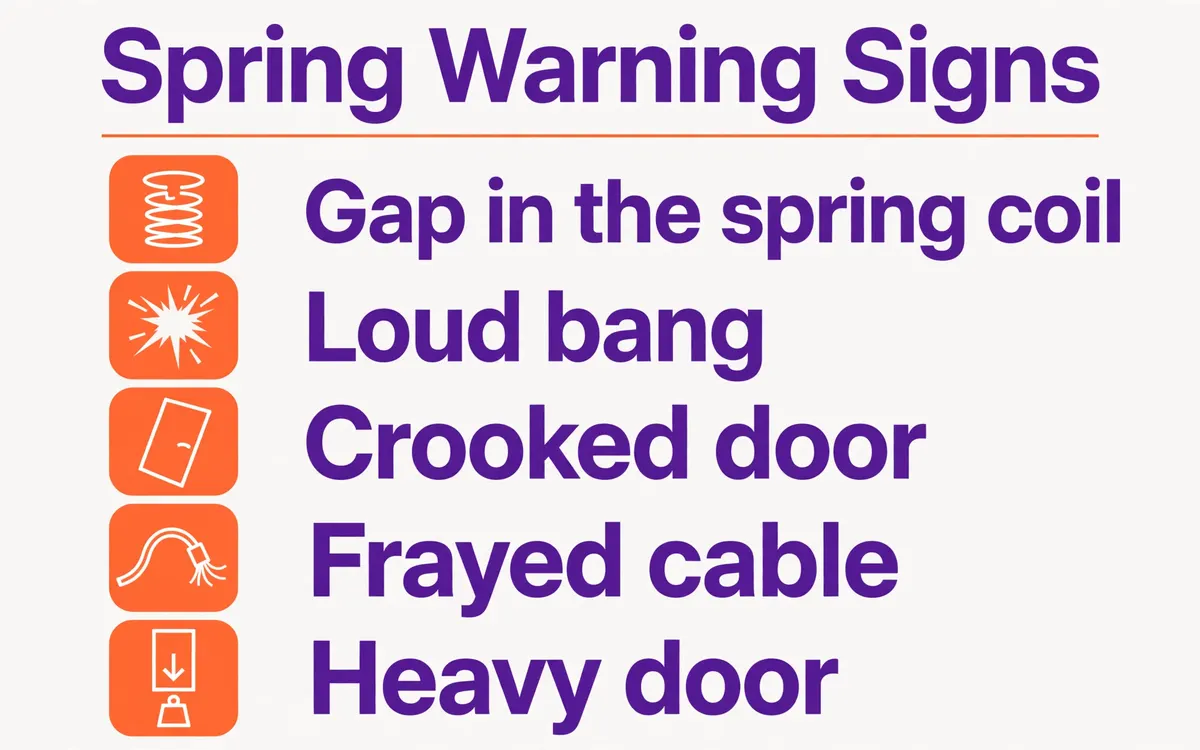
A failing spring gives warnings before it snaps. Check for them in autumn, not after the first hard freeze, and stop using the door if you see any of them.
- A visible gap in the spring coil means it is broken.
- A loud bang, like a gunshot, means it has snapped.
- The door hangs crooked, drops fast, or will not stay open.
- Rust on the spring, or a door that feels much heavier.
Full signs and costs are in broken garage door spring signs and cost. Technical depth — size, wire, turns — lives in the Springs cluster, not here.
Never wind or unwind a torsion spring
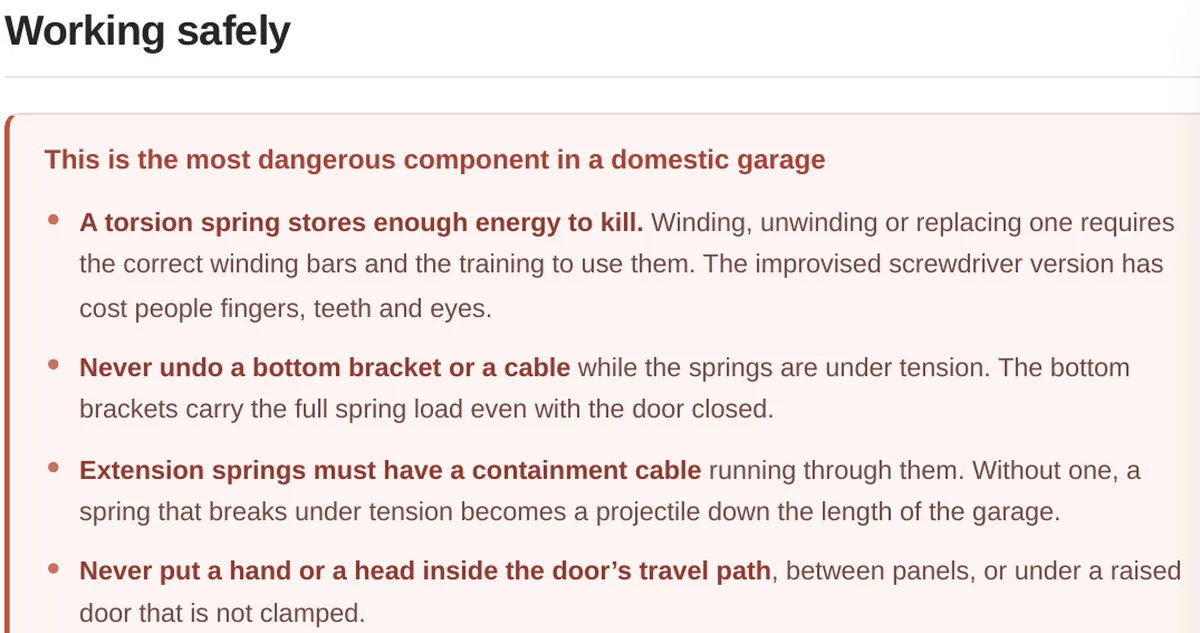
Winding a torsion spring means applying strong rotational force against stored energy, and any slip of the winding bars or failure of the set screws can let the spring spin out of control. This is the single most dangerous DIY job in the home.
- Never wind, unwind, or adjust a torsion spring yourself.
- Never use a screwdriver, socket extension, or makeshift bar.
- Never loosen the set screws on a wound spring.
- A pro uses proper winding bars, a torque wrench, and training.
3. Extension springs and safety cables
Extension springs run along the horizontal tracks on each side of the door, and stretch as the door closes. They are just as dangerous as torsion springs, and they need a safety cable through them.
How extension springs work
Extension springs stretch as the door closes and contract as it opens, pulling the door up. They hold the same stored energy as torsion springs, in a different shape, and they fail the same way.
- They run along the horizontal tracks, one each side.
- They stretch as the door closes, and pull it up as it opens.
- They are rated in cycles, like torsion springs.
- They wear out at the same rate as the door’s other parts.
Why safety cables matter
A safety cable runs through the center of each extension spring. When a spring breaks, the cable contains it, so the spring cannot fly across the garage and hit someone.
- A safety cable must run through every extension spring.
- Without one, a broken spring becomes a projectile.
- Check that the cable is there, and not frayed or loose.
- If a spring has no safety cable, call a pro to fit one.
Signs an extension spring is failing
Extension springs stretch, sag, and gap as they wear. A spring that has stretched longer than its pair, or shows a visible gap in its coils, is close to breaking.
- One spring stretched longer than the other.
- A visible gap in the coils, or a stretched-out look.
- The door feels heavy on one side, or hangs unevenly.
- Rust, or a pulley that wobbles when the door moves.
4. Cables: the part that whips
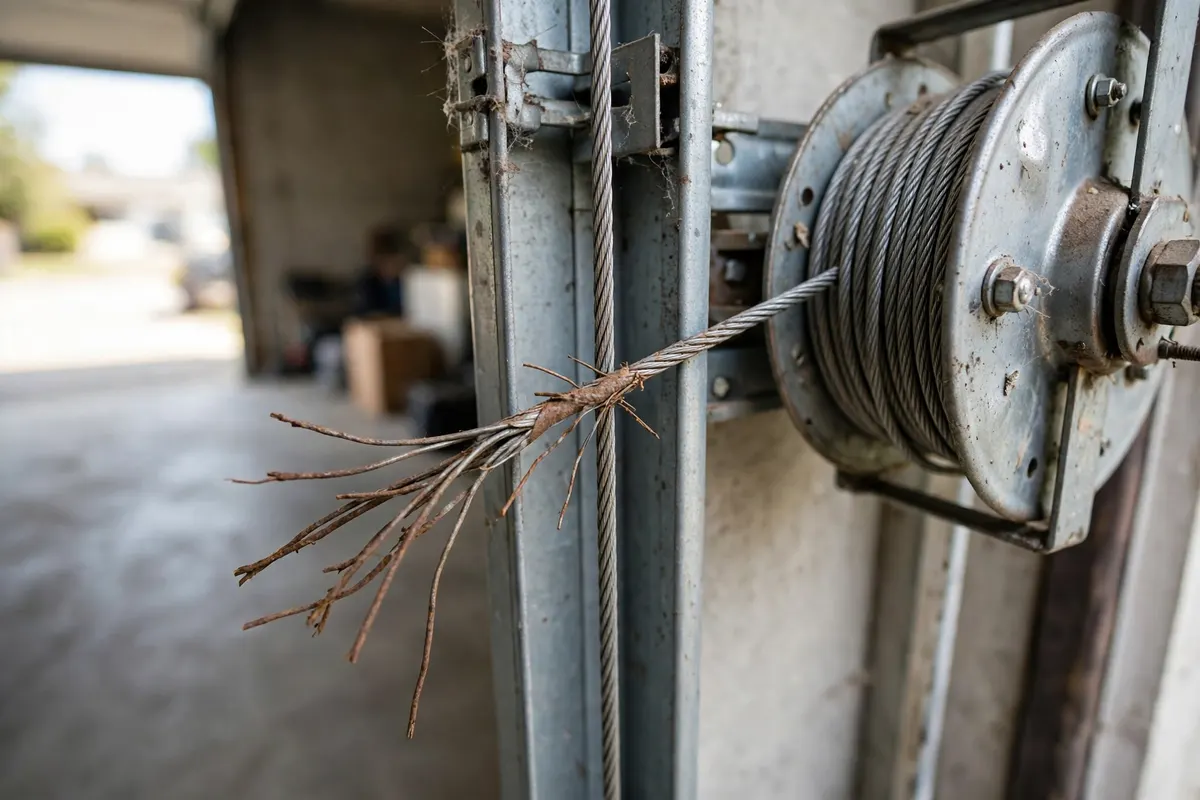
Lift cables carry the door’s weight on the drums, and they run under the same tension as the springs. A frayed cable can snap without warning, and a snapped cable can whip across the garage.
What cables do
Cables wind onto drums at each end of the torsion shaft, and they lift the door as the springs unwind. They carry the full weight of the door, every time it opens and closes.
- Cables wind onto drums and lift the door.
- They carry the door’s full weight, in tension.
- They fray slowly, strand by strand, until one snaps.
- A cable pair repair runs $150 to $300 (Garage Door Hub standard, 2026).
Signs a cable is failing
Look for fraying, rust, slack, or a cable that has come off its drum. A door that hangs crooked on one side often has a broken or slipped cable, not a broken spring.
- Frayed strands, rust, or a flattened cable.
- Slack in one cable and tension in the other.
- A cable off its drum, or hanging loose.
- A door that hangs crooked or drops on one side.
Never touch a cable under tension
Never undo a bottom bracket with the door down, and never touch a loose or broken cable. The bracket holds full spring tension, and a slipped wrench can cause serious injury in a second.
- Never undo a bottom bracket with the door down.
- Never pull on a loose or frayed cable.
- Never try to rewind a cable onto its drum.
- Call a pro, and say cable — it changes the job and the risk.
5. What a pro does that you cannot
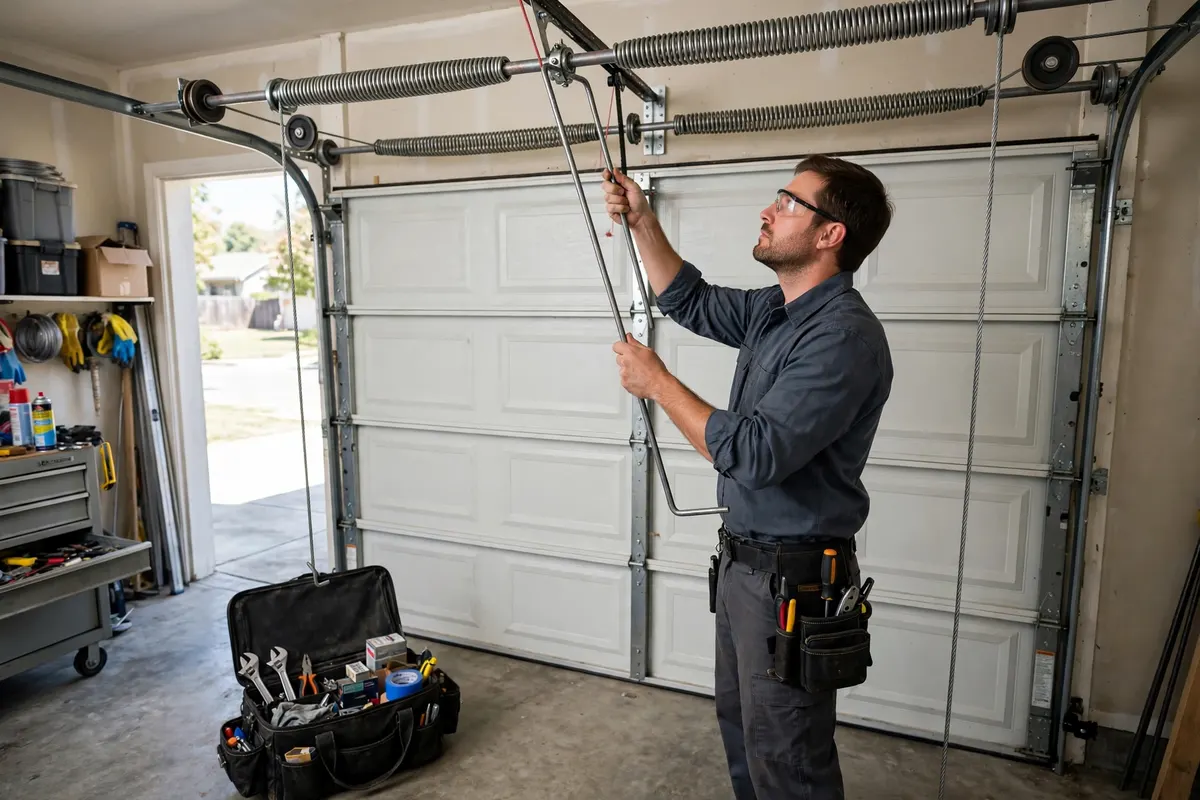
A professional technician brings three things a homeowner cannot: the right tools, the training to use them, and insurance if something goes wrong. That is why spring and cable work is pro-only, not a skill gap.
The tools
A pro brings winding bars made for the job, a torque wrench, and safety gear designed for spring work. A screwdriver or a socket extension looks like a winding bar, but it is not built for that torque, and it slips.
- Winding bars, sized to the spring cone.
- A torque wrench, for the set screws and the shaft.
- Safety glasses and gloves, as standard kit.
- The right spring, matched by size, wire and turns.
The training
A pro knows how much tension is in the spring, how to release it in a controlled way, and how to spot a spring that is about to fail. They do this job every day, and they have seen what goes wrong.
- They release tension before touching any hardware.
- They match spring size, wire and turns to your door.
- They test balance and auto-reverse after the job.
- They know when a second spring is about to fail too.
The insurance and the warranty
A pro carries liability cover, so a failure on the job is their risk, not yours. They also warranty parts and labor in writing, so a spring that fails early is replaced, not argued over.
- Liability cover: if something goes wrong, they are responsible.
- Written warranty on parts and labor.
- Springs are replaced in pairs — one old, one new, is a false saving.
- A spring pair costs $200 to $350 installed (Fixr, Jan 2025).
Price the job with the Spring Calculator, and check the company with the how to choose a garage door repair company guide.

6. What you can safely do yourself
You can do a lot around a spring system — just not the spring itself. Looking, testing, cleaning and lubricating are safe DIY; winding, adjusting and replacing are not.
Safe: look, test, clean, lubricate
Look at the springs and cables every month for rust, fraying, or a gap in the coil. Run the balance test by hand, wipe the sensors, and lubricate the spring coils with silicone spray.
- Look for rust, fraying, or a gap in the coil — look only.
- Run the balance test: the door should hold halfway open.
- Lubricate spring coils with silicone spray, twice a year.
- Wipe the sensors and tighten loose hinge bolts.
Never: wind, adjust, replace, undo
Never wind or unwind a spring, never adjust its tension, never replace a spring or a cable, and never undo a bottom bracket. Each of those jobs holds the door’s full weight in tension, and each has killed or maimed a DIYer.
- Never wind, unwind, or adjust a spring.
- Never replace a spring or a cable yourself.
- Never undo a bottom bracket with the door down.
- Never use a screwdriver as a winding bar.
When to stop using the door
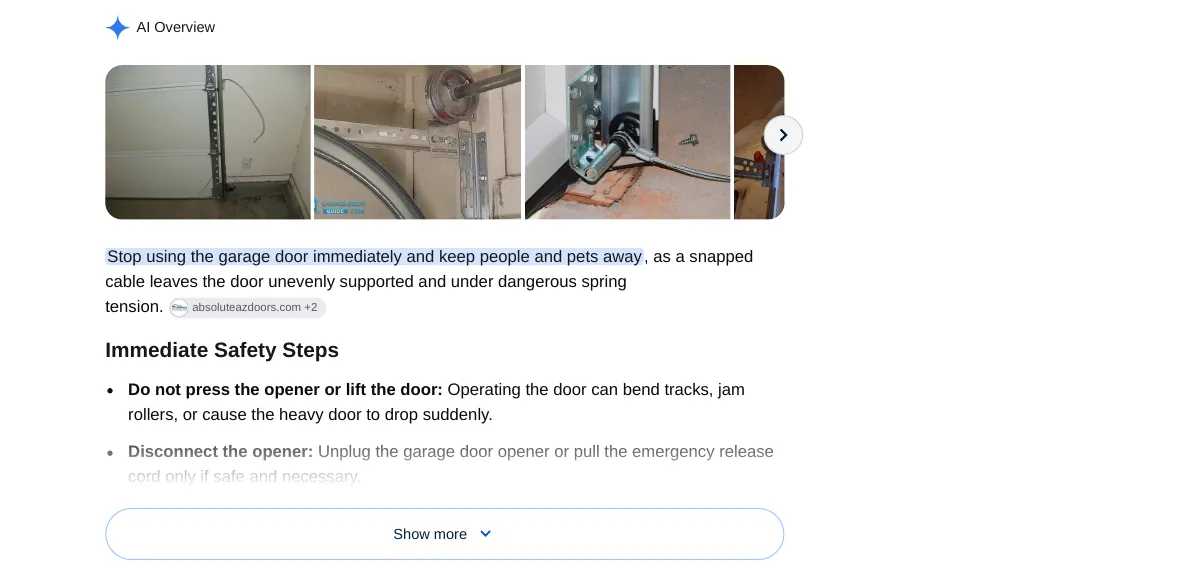
Stop using the door at once if a spring has snapped, if the door hangs crooked, if a cable is loose or frayed, or if the door drops fast or will not stay open. Disengage the opener and call a pro the same day.
- A snapped spring: stop, disengage, call a pro.
- A crooked door: stop, do not force it, call a pro.
- A loose or frayed cable: stop, do not touch it, call a pro.
- A door that drops fast: stop, step back, call a pro.

Watch: The red bolt warning — why springs and cables are pro-only
Door and Dock Solutions explains the stored energy in torsion springs and balancing cables in this short YouTube video, and why DIY attempts on them can cause serious injury.
- A torsion spring holds 100 to 200 pounds of force and releases it at once if it breaks or slips.
- Never wind, unwind, adjust or replace a spring, and never touch a cable under tension.
- Look for a gap in the spring coil, a crooked door or frayed cables — then stop using the door and call a pro.
Video: Door and Dock Solutions, YouTube. Checked 21 November 2026.
Garage Door Hub connects homeowners with trusted local garage door pros. Need a repair? Need a replacement? Start here. First, find out what it should cost. Then, price your exact job with our free calculator. Next, find a pro near you. Fast. No jargon. No guesswork. No surprise bills. Just clear prices, honest guides, and a local pro you can call today.
FAQ
Can a garage door spring kill you?
Yes. A torsion spring holds 100 to 200 pounds of force and releases it at once if it breaks or slips during a DIY attempt (EngineerFix, 2026). The energy in a typical two-car door spring is comparable to a car moving at 15 mph, focused into a small point.
What happens if a garage door spring breaks?
The door becomes very heavy, hangs crooked, drops fast, or will not stay open. You may hear a loud bang, like a gunshot, and see a gap in the spring coil. Stop using the door and call a pro — do not try to lift it.
Can I replace a garage door spring myself?
No. Winding a torsion spring needs proper winding bars, a torque wrench, and training, and a slip can break bones or blind an eye. Springs and cables are pro-only work, never a DIY repair. A spring pair costs $200 to $350 installed (Fixr, Jan 2025).
How do I know if my garage door cable is broken?
Look for frayed strands, rust, slack in one cable, or a cable off its drum — and a door that hangs crooked on one side. Do not touch a loose or broken cable, and do not undo a bottom bracket. Call a pro.
How long do garage door springs last?
About 10,000 cycles, which is 7 to 10 years at 4 cycles a day. High-cycle springs last 20,000 to 25,000 cycles. Replace springs in pairs, since both share the same age and wear.
Sources
- EngineerFix, 2026 — torsion spring force 100 to 200 pounds; doors weigh 150 to 400 pounds, double wood or insulated steel 250 to 500 pounds; spring and cable work is pro-only.
- The Unexplored Road, 2026 — a torsion spring holds about the same energy as a car moving at 15 mph; standard spring wound with roughly 30 to 40 turns; DIY injury patterns.
- ShunTool, 2026 — springs are the most dangerous component in a domestic garage; torsion springs are not a DIY adjustment; never undo a bottom bracket with the door down.
- Garage Door Hub, Repair #3, 2026 — broken spring signs and cost: single $140–$270, pair $200–$350 (Garage Door Hub standard).
- Angi, updated 30 Oct 2026 — spring $150–$350 per spring, average $250.
Last reviewed: 20 November 2026
Appendix — Related topics
You might have found this by these keywords — and if not, others might have: garage door spring danger, broken garage door spring, garage door cable broken, garage door spring replacement cost, garage door spring broke, garage door cable replacement cost, garage door spring safety, torsion spring danger, extension spring safety cable, garage door cable snapped, garage door spring repair near me, garage door spring warning signs.