

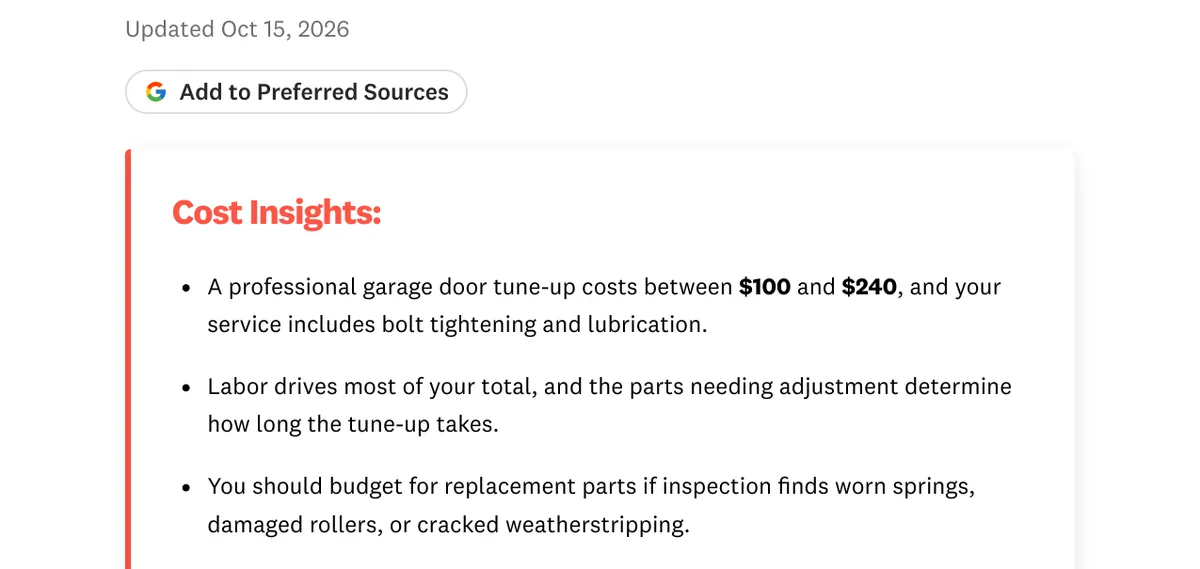
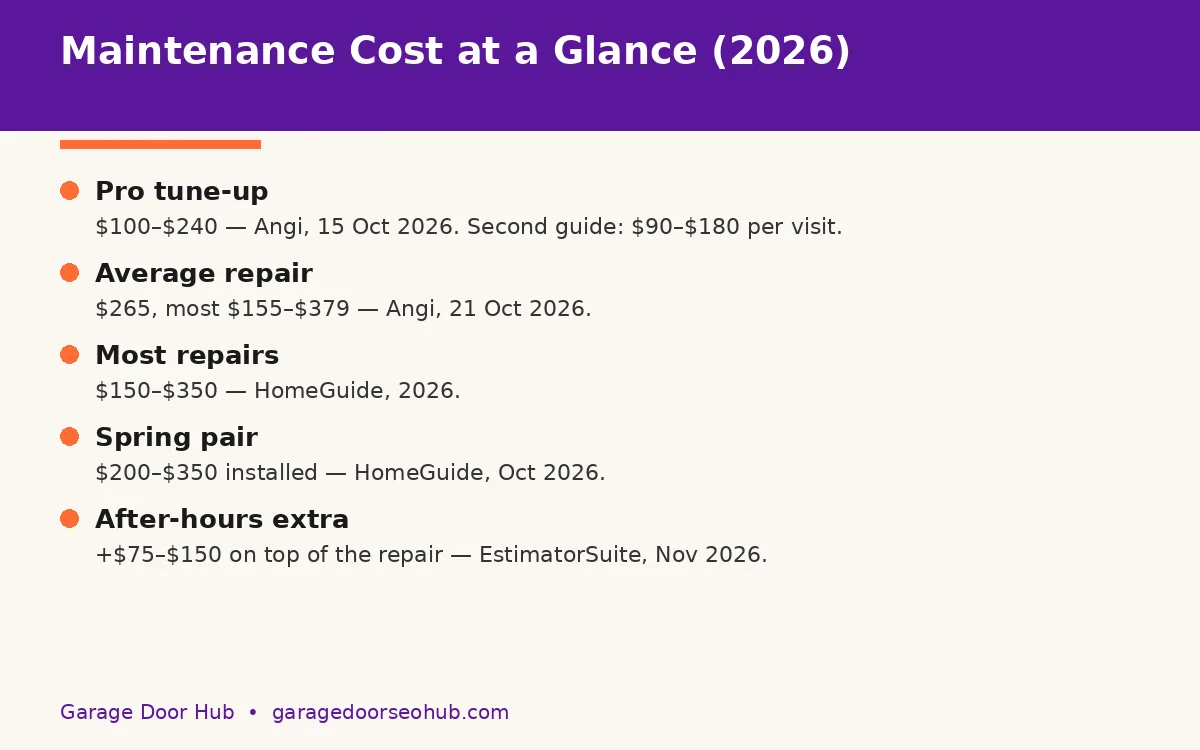
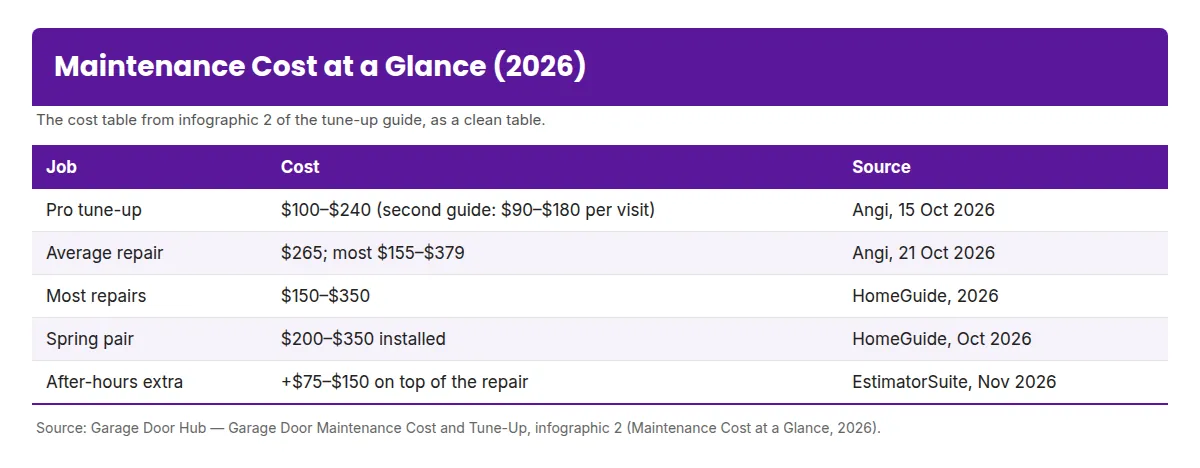
Angi’s 2026 tune-up guide puts a professional garage door tune-up at $100 to $240. That one visit covers lubrication, tightening, balance and safety tests.
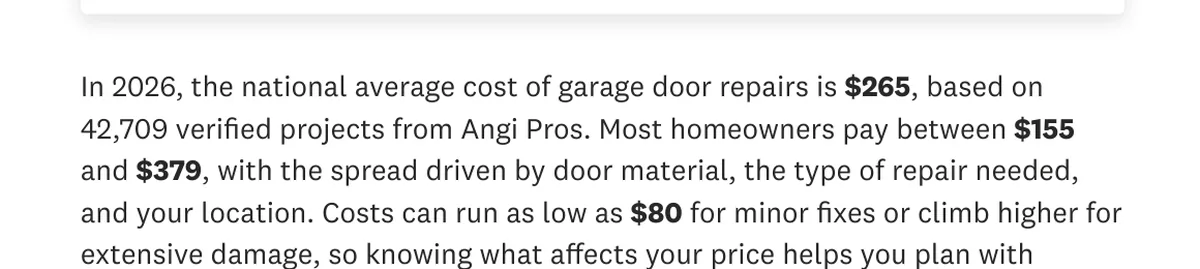
A tune-up is the cheapest visit a garage door ever gets. The next cheapest visit is a repair, and Angi puts the average repair at $265 (21 Oct 2026).
This guide breaks down the tune-up price, what is checked, how often to book, and what turns a tune-up into a repair bill.
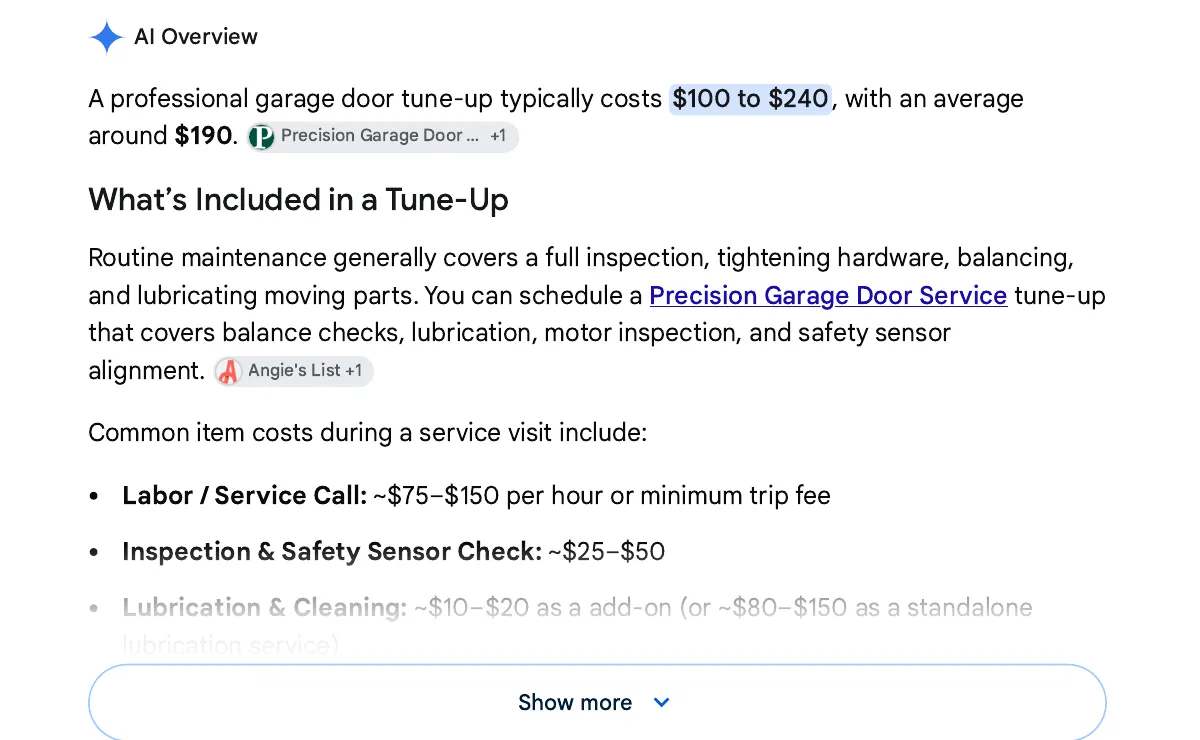
Garage door maintenance cost is $100 to $240 for a pro tune-up (Angi, 15 Oct 2026), or $90 to $180 per visit (GarageDoorLocator, 2026). The visit covers lubrication, hardware tightening, a balance test and safety checks. Book it once a year, and lubricate the door yourself every 6 months.
Garage Door Hub connects you with a trusted local pro. Get a clear price for your garage door repair or replacement first.
Price your job first with the free calculators below. They give you a number before you call anyone.
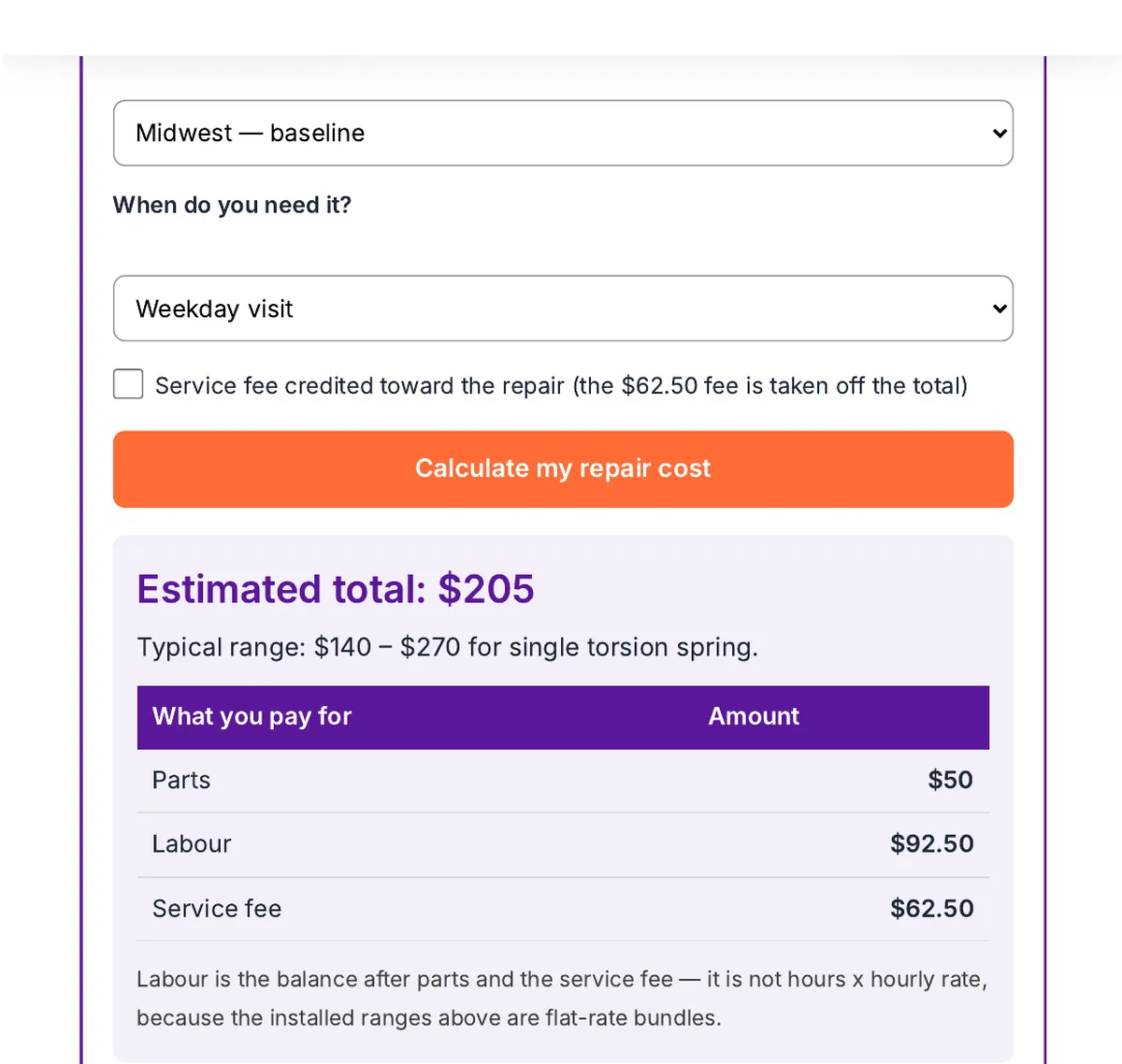
Repair Cost Calculator — price any repair the tune-up finds, before you agree to it.
Lifespan Calculator — see when springs, cables and rollers are due for replacement.
- Enter your door size and the part that failed.
- Note the price, then read the key takeaways and Section 1.
- Use the price in the guide to check any quote you get.
Key takeaways
- A pro tune-up costs $100 to $240 (Angi, 15 Oct 2026).
- The visit covers lubrication, tightening, balance and safety tests.
- Book a tune-up once a year; heavy-use doors may need two visits.
- Parts are extra — a tune-up does not include a spring replacement.
- A $29 tune-up that triples on site is a scam sign, not a bargain.
Table of Contents
-
1. What a tune-up costs in 2026
-
2. What a tune-up includes
-
3. Basic service vs a full tune-up
-
4. How often to book a tune-up
-
5. DIY cost vs pro cost
-
6. Reading a quote, and spotting a scam
-
7. When a tune-up is not enough
- Watch: The noisy-door checks a tune-up covers
- FAQ
1. What a tune-up costs in 2026
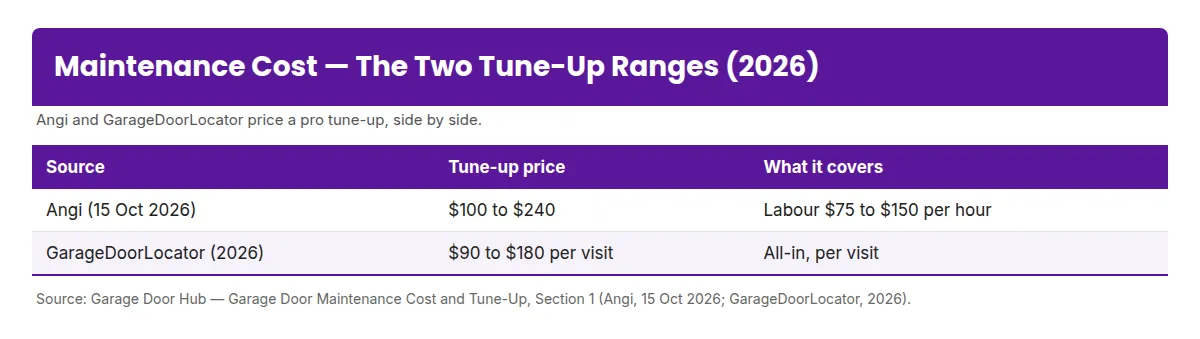
Two national guides price a tune-up, and they agree closely. Angi puts it at $100 to $240, updated 15 Oct 2026, and GarageDoorLocator puts it at $90 to $180 per visit in 2026.
The two ranges, side by side
The ranges overlap, so either one is a fair guide. The difference is what each guide counts as a tune-up, and where the home sits.

- Angi (15 Oct 2026): $100 to $240, labor $75 to $150 per hour.
- GarageDoorLocator (2026): $90 to $180 per visit, all-in.
- A single door costs less than a double door with two springs.
- City prices run higher than small-town prices.
- A second door on the same visit usually costs less than the first.
What moves the price up or down
Labor is the main cost driver, and a skilled pro finishes the work fast. Location, door size and door condition move the price the rest of the way.
- Heavy use: a door opened 8 or more times a day wears faster.
- Old doors need more tightening, cleaning and adjustment.
- Wood and glass doors cost more to service than light steel.
- A door that has never been serviced takes longer to check.
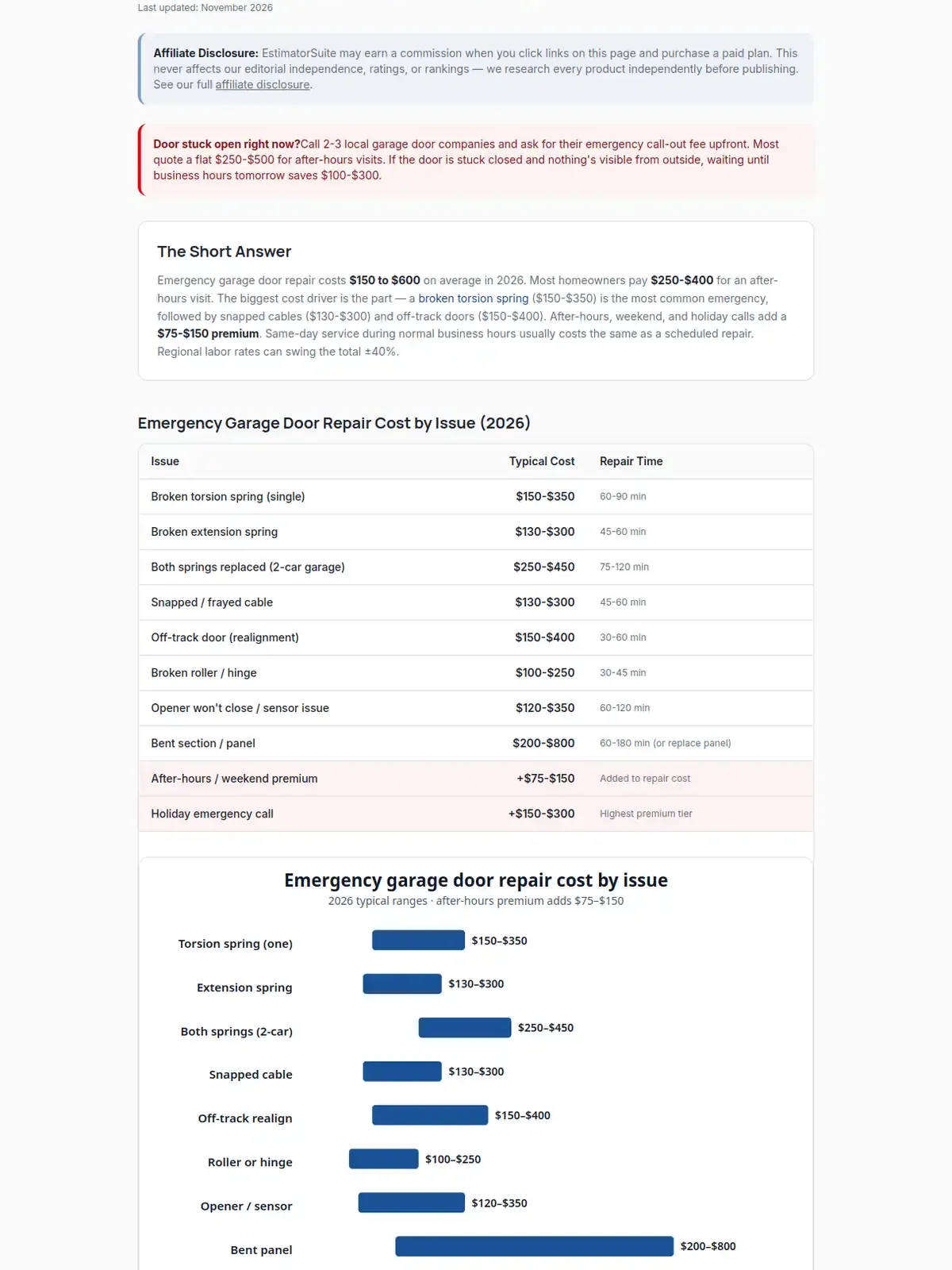
- After-hours visits add $75 to $150 (EstimatorSuite, Nov 2026).
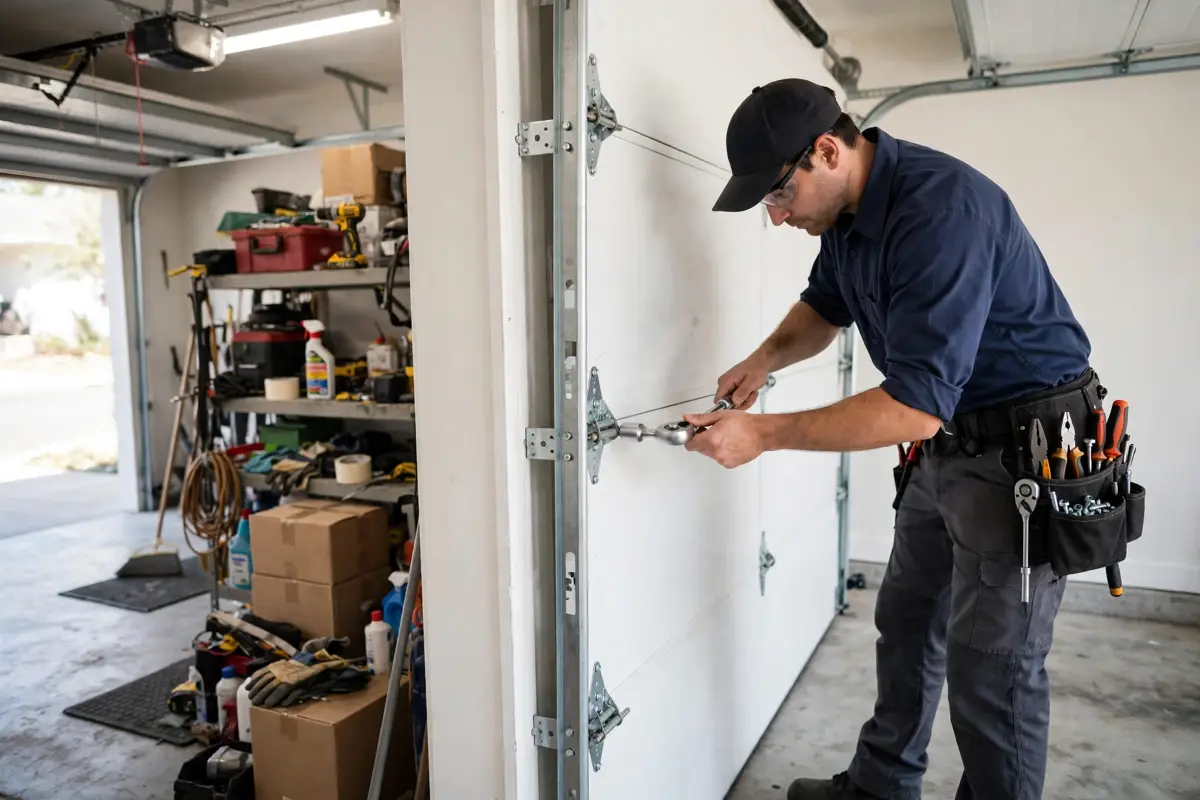
2. What a tune-up includes
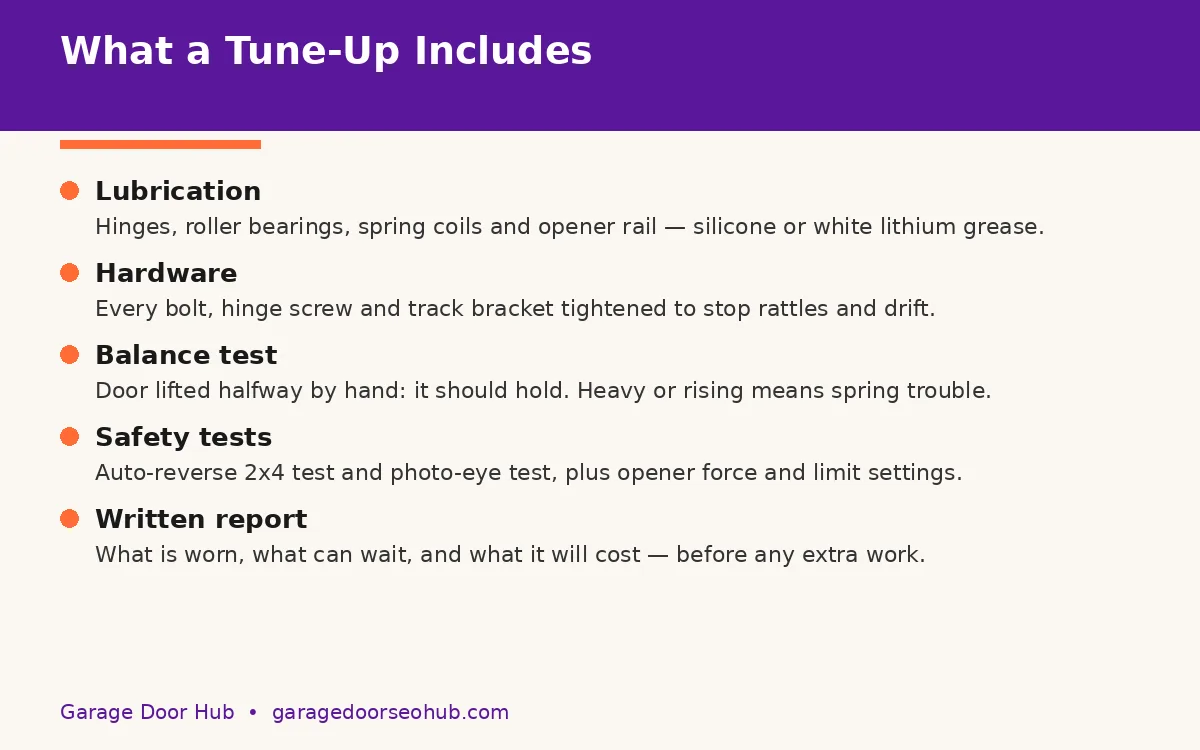
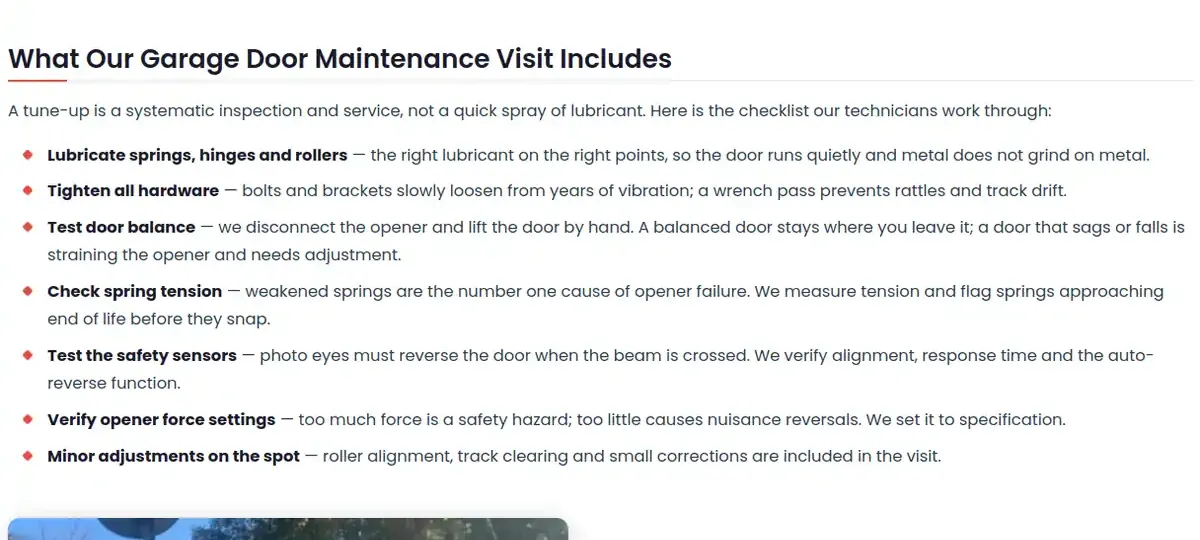
A tune-up is a systematic inspection and service, not a quick spray of lubricant. The tech works through a checklist, and every item on it has a job.
Lubrication and hardware
Lubrication and tightening are the bulk of the visit. They keep the door quiet, and they stop vibration from loosening the track over time.
- Silicone spray or white lithium grease on hinges, rollers and springs.
- Chain or screw-drive rails get grease; belt drives do not.
- Every bolt, hinge screw and track bracket gets tightened.
- Tracks get cleaned with a rag and left dry, never greased.
- The bottom seal and weatherstripping get checked for gaps.
Balance, springs and cables
The balance and spring check is the part only a pro should do. It finds the failures that a spray can cannot fix.
- The door is lifted by hand to halfway, and it should hold.
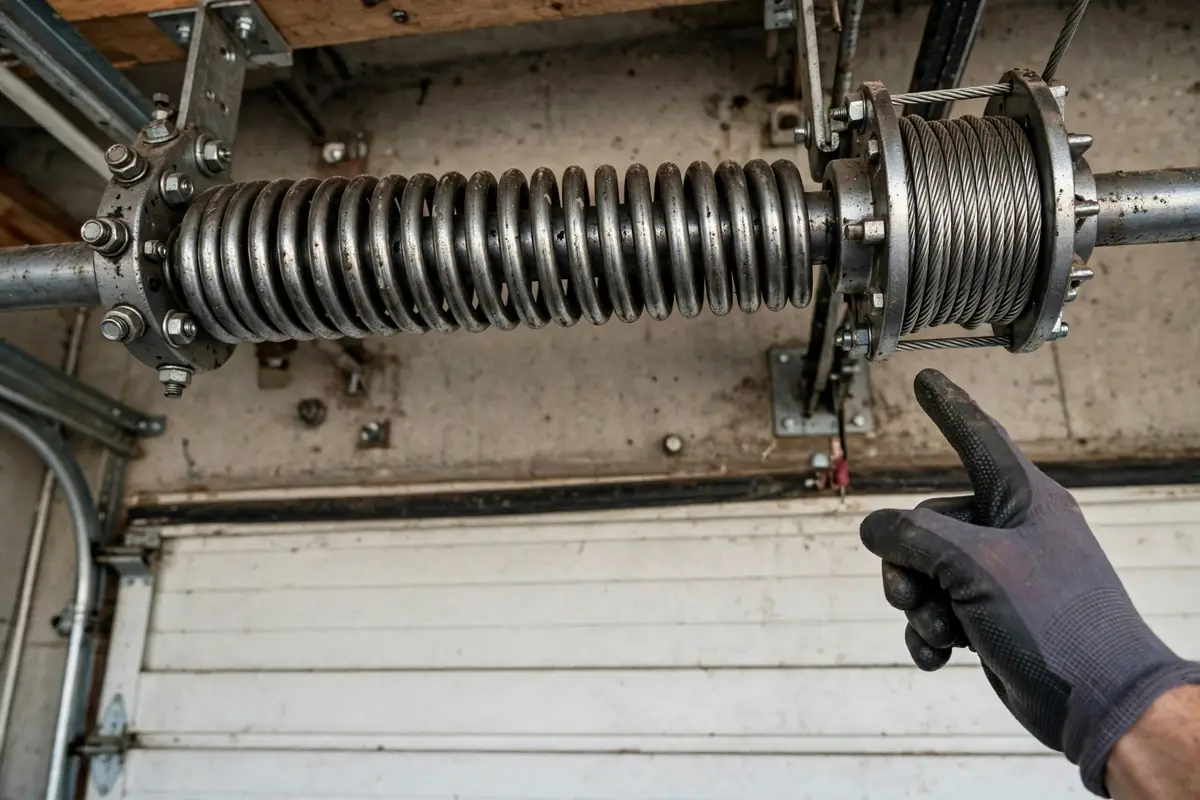
- Springs get checked for gaps, rust and lost tension.
- Cables get checked for fraying, slack and drum seating.
- Drums and bearings get a close look for wear.
- A spring near the end of its life gets flagged, not replaced on the spot.
Safety tests and the opener
Safety tests close the visit. They prove the door will stop and reverse when it should, and that the opener settings are right.
- Auto-reverse test with a 2×4 laid flat under the door.
- Photo-eye test: the door must reverse when the beam breaks.
- Opener force and limit settings get checked and set.
- Remote batteries and the battery backup get tested.
- The tech leaves a written note on what is worn and what can wait.
3. Basic service vs a full tune-up
Not every visit is a tune-up. A basic service, a tune-up and a repair are three different jobs, and they cost three different amounts.
Basic service: what it is
A basic service is lubrication and a look-over. It suits a young door that runs well, and it costs the least of the three visits.
- Lubrication of hinges, rollers and spring coils.
- A quick visual check of springs, cables and rollers.
- Sensor lenses wiped, and the door run through one cycle.
- No balance test, no force setting check, no written report.
- Best for doors under 5 years old with no symptoms.
Full tune-up: what it adds
A full tune-up adds the balance test, the safety tests and the written report. It is the visit this guide prices at $100 to $240.
- Everything in a basic service, plus the balance test.
- Spring tension measured, not just looked at.
- Safety systems tested to the standard, not glanced at.
- Opener force and limits set to the maker’s spec.
- A written report you can keep for the next visit.
4. How often to book a tune-up
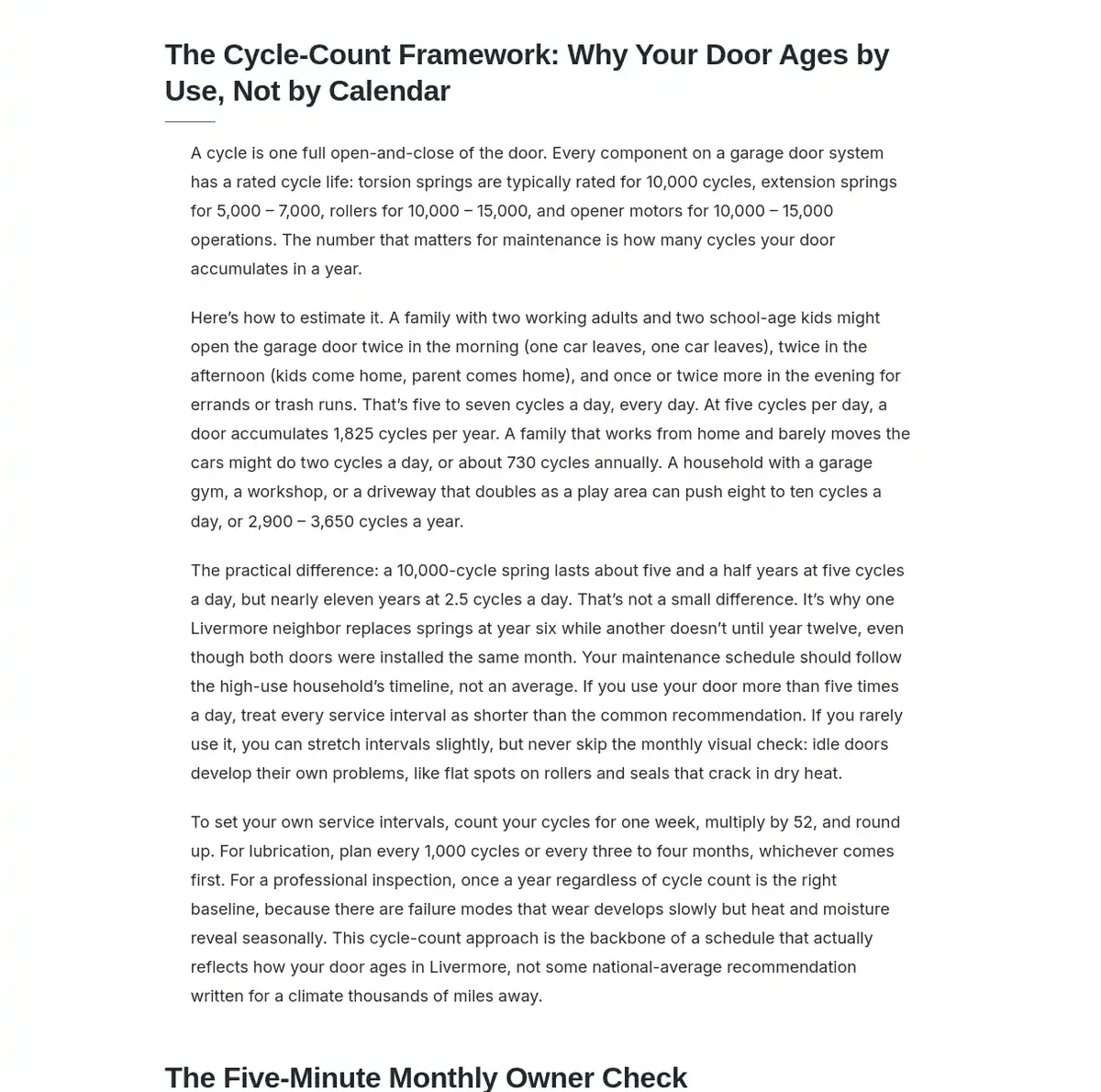
Once a year is the standard schedule for a typical family door. The right interval depends on how often the door cycles, not just on the calendar.
Once a year is the baseline
One visit a year is enough for a typical door in most homes. It matches the periodic inspection guidance from DASMA, the makers’ association.
- Book in spring or fall, before the hard season arrives.
- The visit takes about an hour for a standard two-car door.
- Spring catches winter damage; fall prepares for the cold.
- Lubricate yourself every 6 months between pro visits.
- Keep the receipt and the report for your maintenance log.
When twice a year pays
Heavy-use doors age by cycles, not by years. A door opened 8 to 10 times a day reaches wear thresholds twice as fast as one opened 3 times a day.
- Work-from-home homes, teens with cars, and garage-as-front-door homes.
- Coastal homes: salt air rusts rollers, springs and cables faster.
- Doors over 10 years old, or with a history of repairs.
- Lubricate every 3 to 4 months on a heavy-use door.
- A second visit costs less than one emergency repair.
5. DIY cost vs pro cost
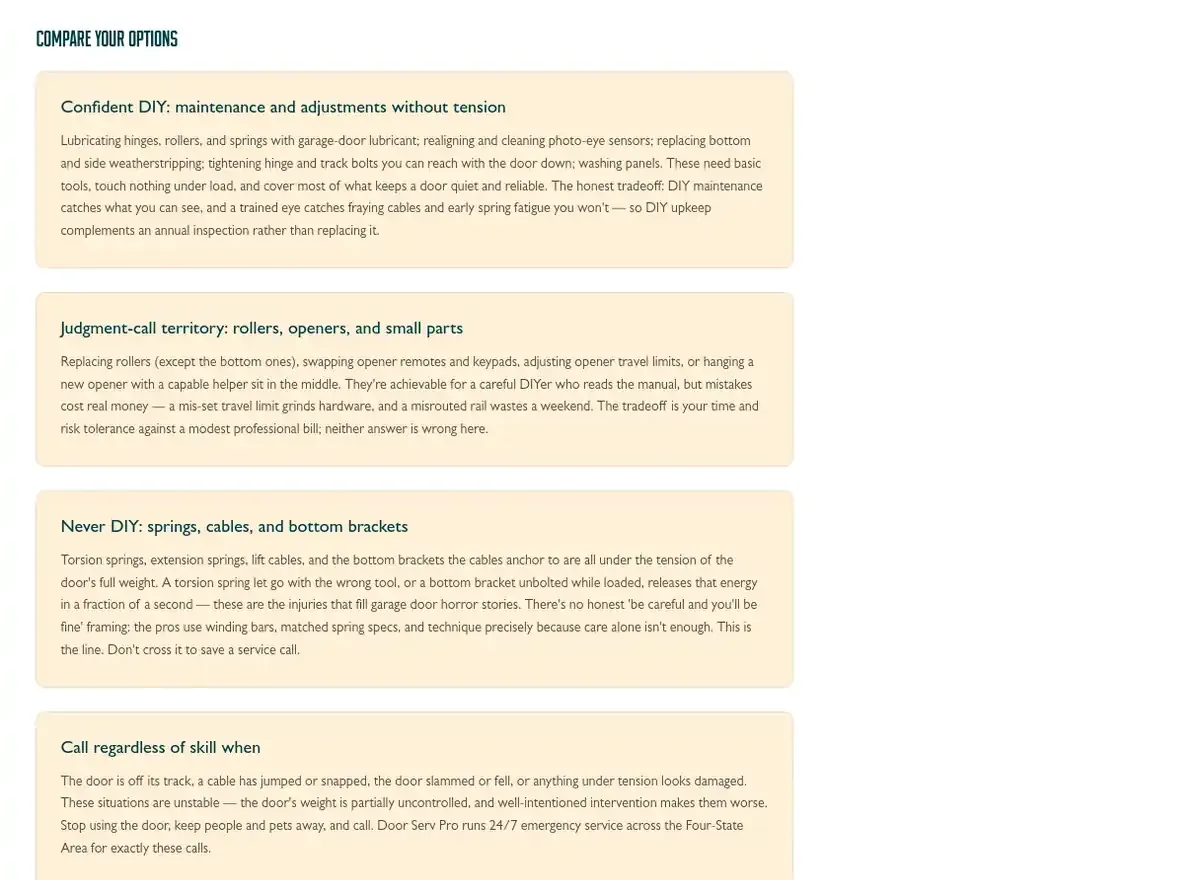
DIY maintenance costs about $10 to $15 in supplies, and it saves roughly $80 to $100 a year. It does not replace the annual pro visit, and it should not try to.
What DIY maintenance costs
One can of silicone spray and one can of white lithium grease cover every door in the house, and they last for years.
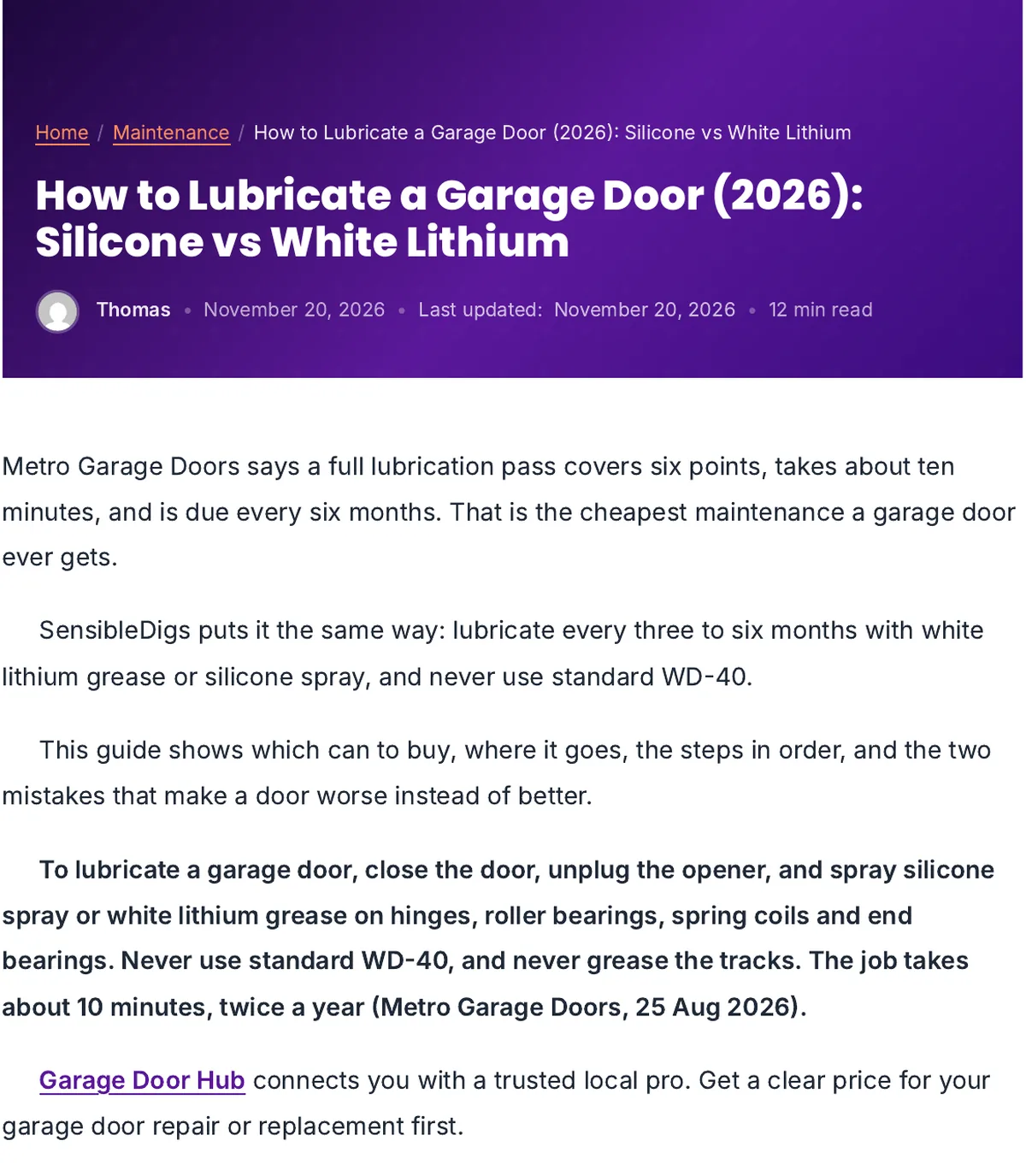
- Silicone spray: about $10 to $15 a can, one can lasts years.
- White lithium grease: about the same, for metal-on-metal points.
- Rags, a ladder and a socket set are the only other tools.
- Time: about 10 minutes per door, twice a year.
- Full steps are in the how to lubricate a garage door guide.
What DIY cannot replace
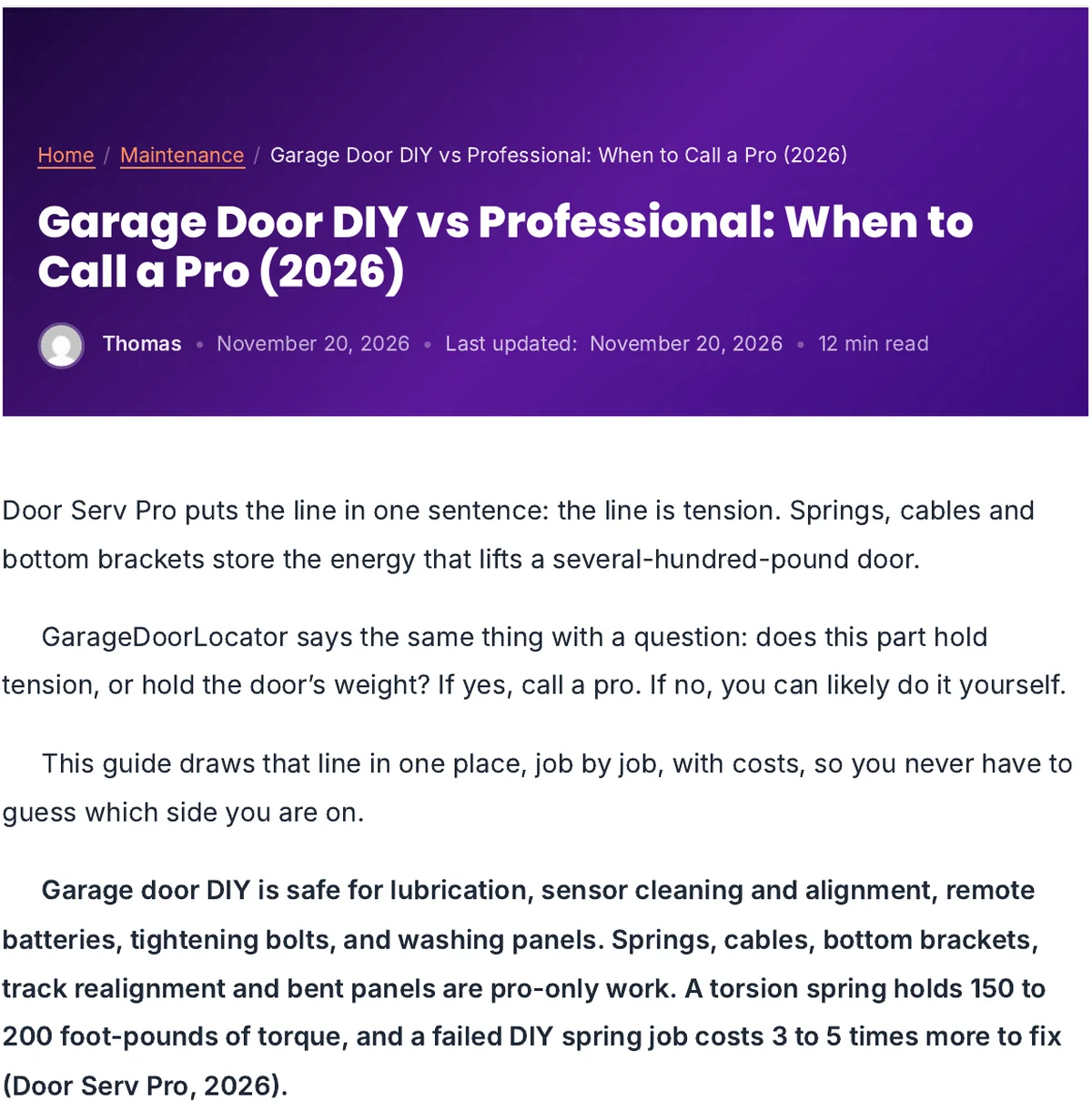
DIY catches what you can see, and a trained eye catches fraying cables and early spring fatigue you will not. That is the gap the pro visit fills.
- DIY cannot measure spring tension or test balance properly.
- DIY cannot spot a cable strand standing proud inside the drum.
- DIY cannot set opener force and limits to the maker’s spec.
- A failed DIY spring job costs 3 to 5 times more to fix.
- For the full line, see the garage door DIY vs professional guide.
6. Reading a quote, and spotting a scam
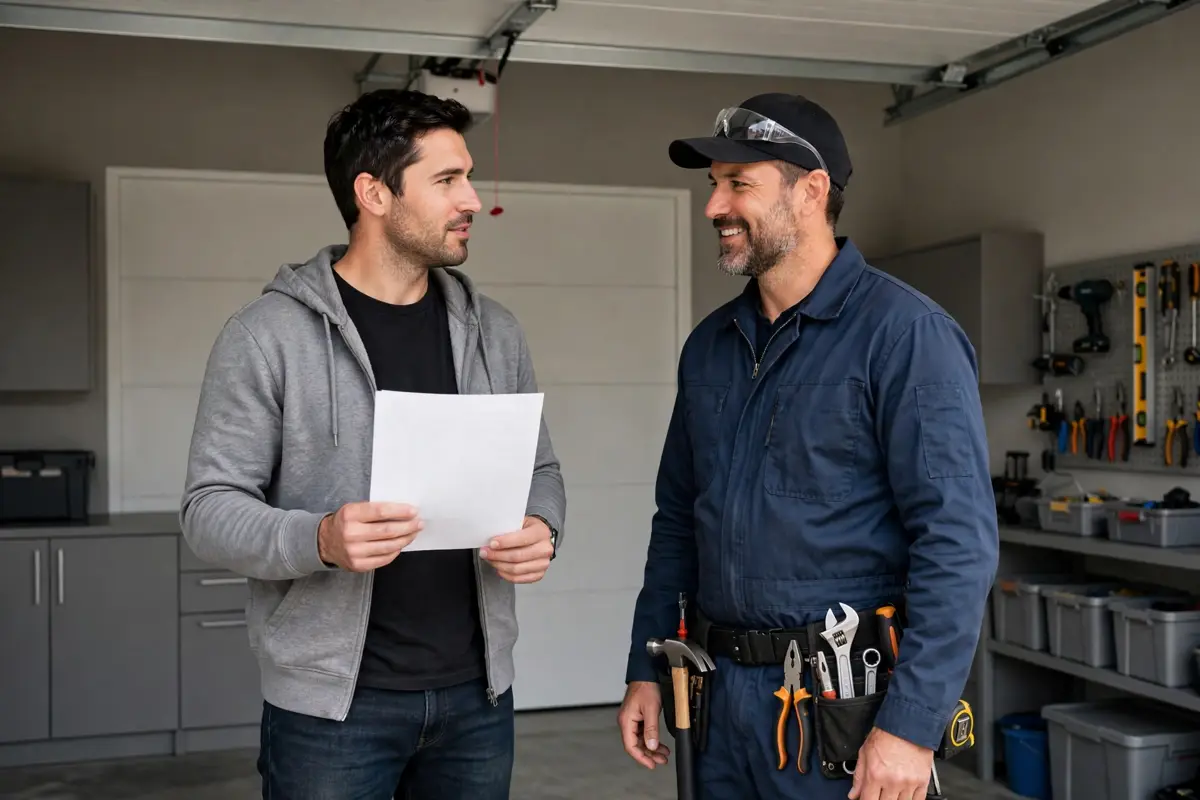
A tune-up quote should list what is checked, not just a price. A vague quote that triples on site is the oldest garage door scam there is.
What a good quote looks like
A good quote names the work, the price, and what costs extra. Get it in writing before the tech starts, and keep it with your log.
- The visit scope: lubrication, tightening, balance, safety tests.
- The price, and whether parts are extra.
- Which parts, and at what price, if any are needed.
- A written report after the visit, not just a verbal all-clear.
- Price any extra repair first with the Repair Cost Calculator.
Scam signs to walk away from
A $29 tune-up ad is a bait price, and it is the most common scam sign in this trade. The real price appears only after the tech is in your garage.
- A $29 or $19 tune-up that becomes $300 on site.
- A vague phone quote that triples once the tech arrives.
- A claim that the whole door needs replacing for one spring.
- Cash-only payment, or no written warranty.
- Pressure to decide now, with no time to check the price.
7. When a tune-up is not enough
A tune-up maintains a healthy door. It does not fix a failing part, and it should never be sold as a fix for one.
Signs you need a repair instead
Book a repair, not a tune-up, when the door shows a symptom. A tune-up on a broken spring wastes the visit fee and the tech’s time.
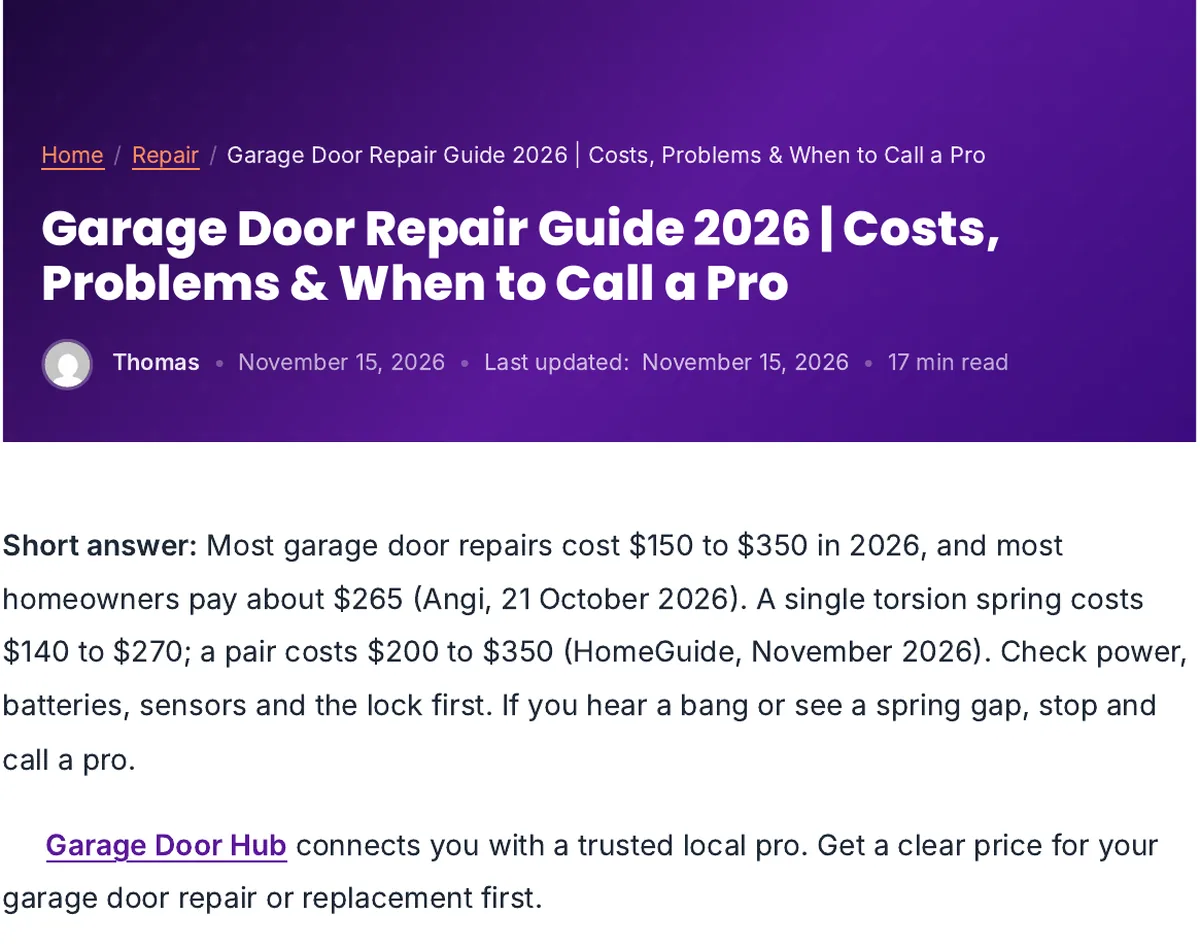
- A loud bang, a coil gap, or a door that feels enormous.
- A cable that is frayed, slack, or off its drum.
- A door that hangs crooked, drops fast, or will not stay up.
- Rollers that grind after lubrication are worn, not dry.
- For the full repair guide, see the garage door repair guide.
Plan the big jobs on your schedule
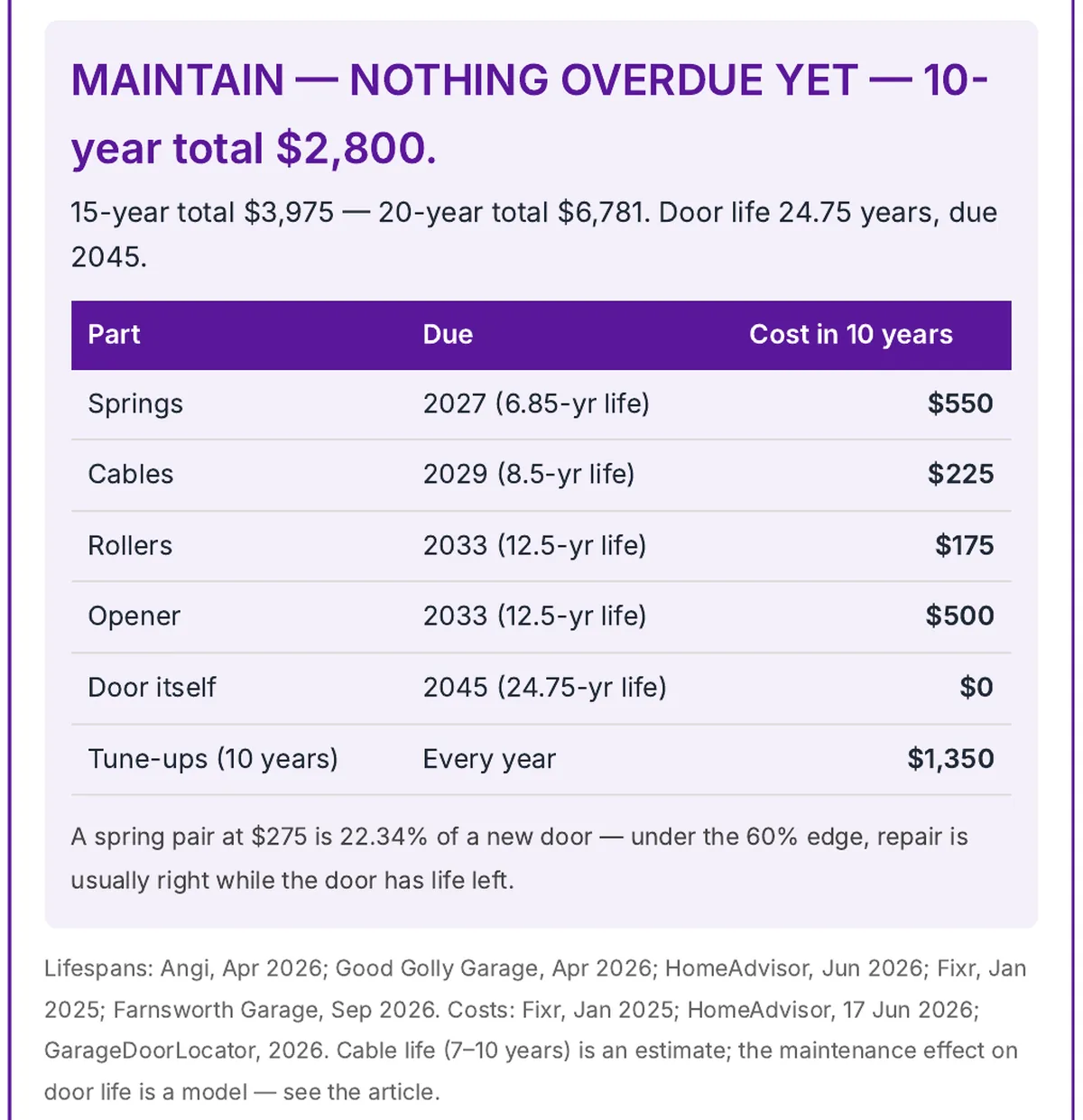
The tune-up report is a plan, not just a receipt. Use it to replace worn parts on your schedule, before they fail on a cold night.
- Springs over 7 years old deserve a replacement plan.
- A spring pair costs $200 to $350 installed (HomeGuide, Oct 2026).
- Rollers and cables have their own clocks; note them in your log.
- Two repairs in one year often mean a part is failing.
- For the whole schedule, see the garage door maintenance complete guide.
Watch: The noisy-door checks a tune-up covers
Ramón Delgado walks through the noisy-door checks — safety tests, lubrication and the parts you never touch — in this YouTube video. It shows the work a tune-up visit covers, and when to call a pro instead.
- A pro tune-up costs $100 to $240, and covers lubrication, tightening, a balance test and safety checks.
- Book it once a year, and lubricate the door yourself every 6 months.
- A $29 tune-up is not a bargain — read the quote, and walk away from pressure and vague pricing.
Video: Ramón Delgado, YouTube. Checked 21 November 2026.
Garage Door Hub connects homeowners with trusted local garage door pros. Need a repair? Need a replacement? Start here. First, find out what it should cost. Then, price your exact job with our free calculator. Next, find a pro near you. Fast. No jargon. No guesswork. No surprise bills. Just clear prices, honest guides, and a local pro you can call today.
FAQ
How much does a garage door tune-up cost?
A pro tune-up costs $100 to $240 (Angi, 15 Oct 2026). A second guide puts it at $90 to $180 per visit (GarageDoorLocator, 2026).
What does a garage door tune-up include?
Lubrication, hardware tightening, a balance test, spring and cable checks, safety tests, and opener force and limit settings, plus a written report.
How often should I get a garage door tune-up?
Once a year for a typical door. Heavy-use doors, coastal homes and doors over 10 years old may need two visits a year.
Is a $29 garage door tune-up a good deal?
No. A $29 tune-up is a bait price that often triples on site. A real tune-up costs $100 to $240, with the scope in writing first.
Does a tune-up include spring replacement?
No. A tune-up inspects springs and flags wear, but replacement is a separate repair. A spring pair costs $200 to $350 installed (HomeGuide, Oct 2026).
Sources
- Angi, updated 15 Oct 2026 — tune-up $100–$240, labor $75–$150 per hour.
- Angi, 21 Oct 2026 — repair average $265, most $155–$379.
- GarageDoorLocator, 2026 — tune-up $90–$180 per visit; safe DIY list.
- HomeGuide, Oct 2026 — spring pair $200–$350 installed.
- EstimatorSuite, Nov 2026 — after-hours premium +$75–$150.
- EM Garage Doors, 2026 — annual tune-up visit, about an hour, DASMA guidance.
- Garage Door Repair Livermore, 2026 — lubrication every 1,000 cycles or 3–4 months; pro inspection once a year.
- Door Serv Pro, 2026 — tension is the dividing line; failed DIY costs 3–5 times more.
Last reviewed: 20 November 2026
Appendix — Related topics
You might have found this by these keywords — and if not, others might have:
garage door maintenance cost, garage door tune-up cost, garage door tune-up near me, how much does a garage door tune-up cost, garage door maintenance, garage door tune-up includes, garage door service cost, annual garage door maintenance cost, garage door tune-up checklist, garage door repair cost