

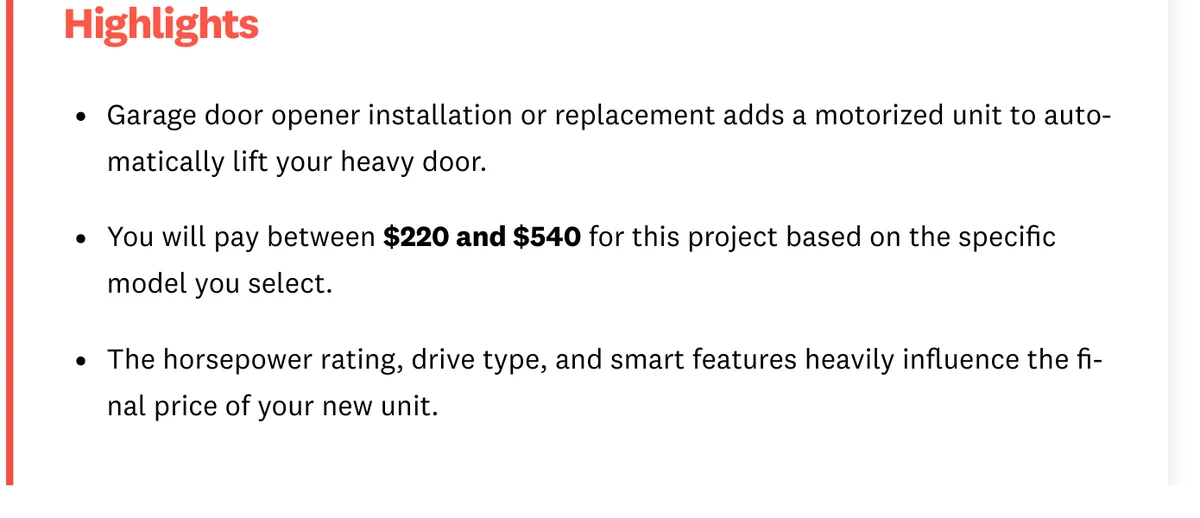
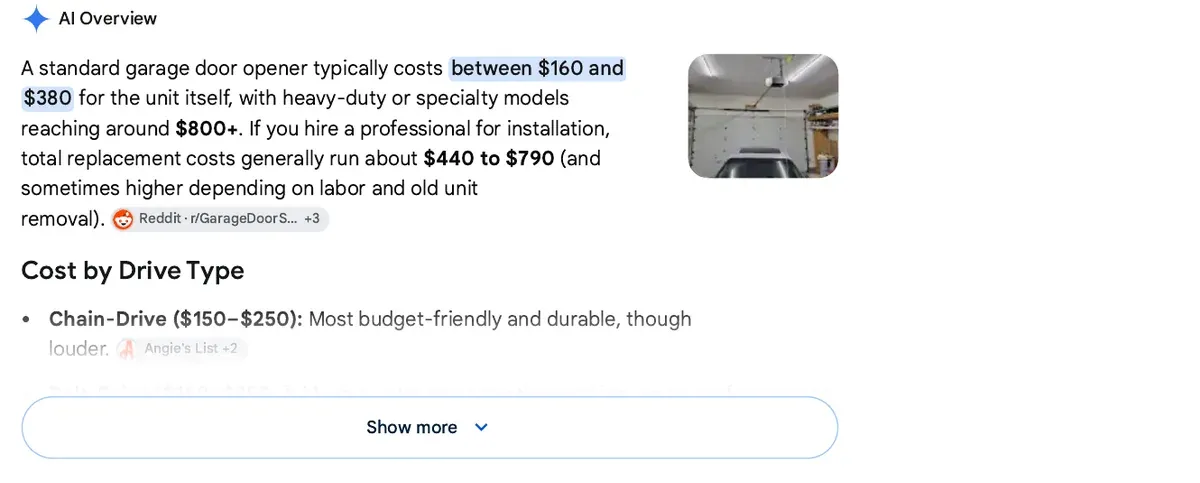
Angi puts the average opener install at $380, with most jobs at $220 to $540. That is the unit plus fitting, not the unit alone.
Today’s Homeowner lists chain units at $130 to $200 and belt units at $170 to $350.
This guide covers every opener type, the right size, smart control, and repair costs.
A garage door opener lifts your door by rail or wall mount, and the right one fits your door weight, noise needs, and budget. Most homes need a 1/2 HP belt drive for a single door or 3/4 HP for a double door. Installed cost averages $380, with most jobs at $220 to $540 (Angi, May 21, 2026). Price it.
Garage Door Hub connects you with a trusted local pro. Need a repair? Need a replacement? Start here. First, find out what it should cost.
Price your opener before you shop.
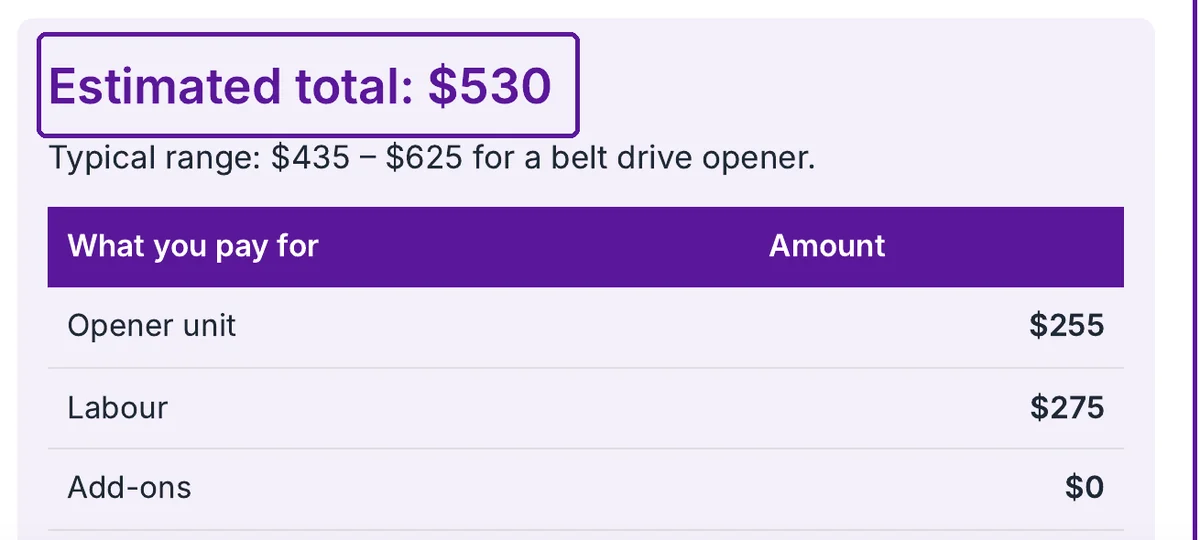
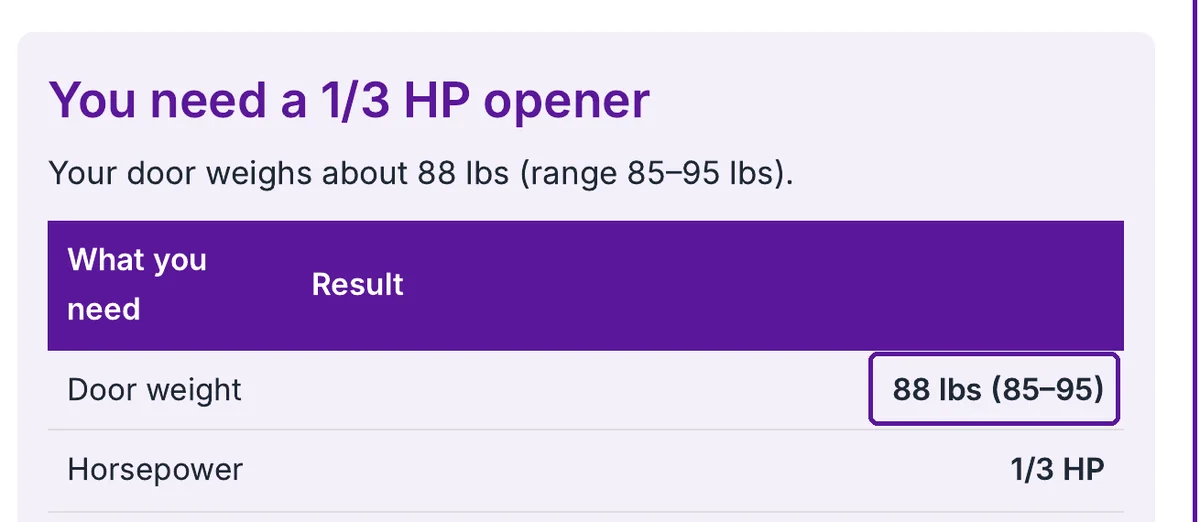
Opener Cost defaults to $530 fitted. Opener Size defaults to an 88 lb door at 1/3 HP.
Open the Opener Cost Calculator — then open the Opener Size Calculator. Keep both answers open. You will use them in every section below.
Download the 1-page printable chart (PDF) — the HP chart and drive picker from this guide, free to print.
- Enter door size and weight in the Size Calculator first.
- Note the HP answer, then price it in the Cost Calculator.
- Compare it with the Angi range in Section 6.
- Size by door weight, not door size. Weight decides horsepower.
- Belt drive is quietest. Chain drive costs least. Wall-mount frees the ceiling.
- Most openers last 10 to 15 years. A board or motor failure on an old unit means replace.
- Installed cost averages $380 (Angi, May 21, 2026). Price it first.
- 1. How a Garage Door Opener Works
- 2. Garage Door Opener Drive Types: Chain, Belt, Screw, Jackshaft, and DC
- 3. What Size Garage Door Opener Do You Need?
- 4. Smart Openers and myQ
- 5. When Your Opener Breaks: Repair at a Glance
- 6. Remotes, Keypads, and Install vs Replace
- Video: Garage Door Openers: The Complete Guide (Coming Soon)
- FAQ
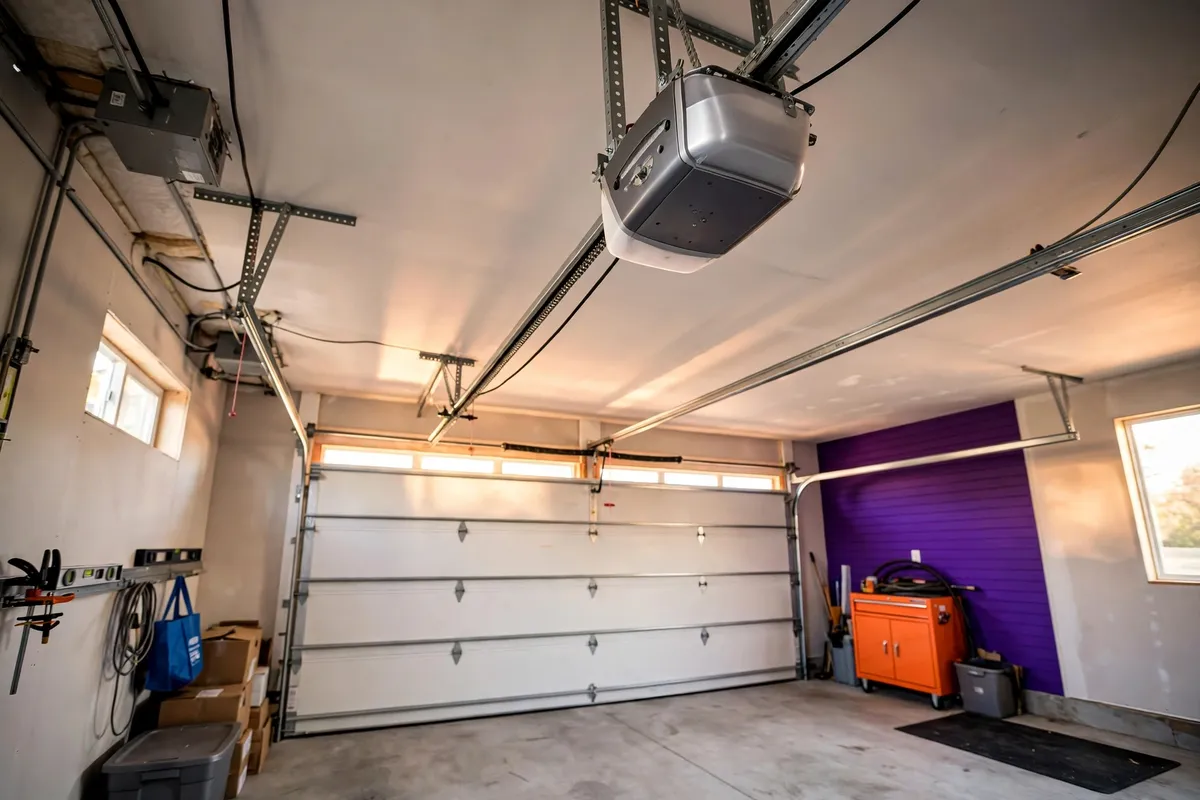
- Motor head: holds the motor, board, and light.
- Rail: runs from the motor head to the door.
- Trolley: rides the rail and links motor to door.
- AC motors run at one speed, so the door starts with a jerk.
- DC motors start soft and stop soft, so the door moves smooth and quiet.
- DC motors allow battery backup, so the door works in a power cut.
- DC motors are rated in HPc or newtons. Compare lift weight, not the label.
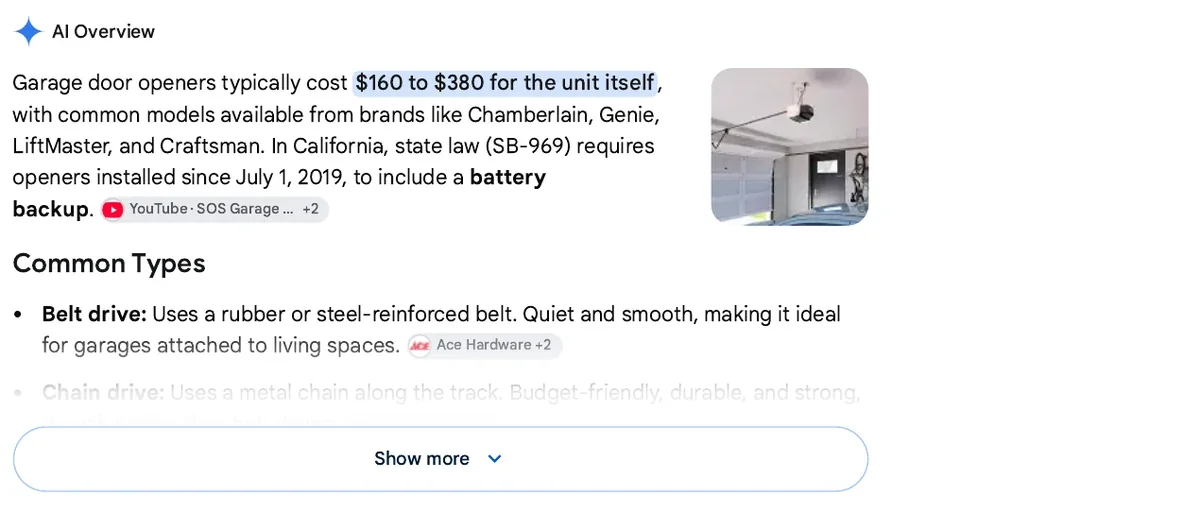
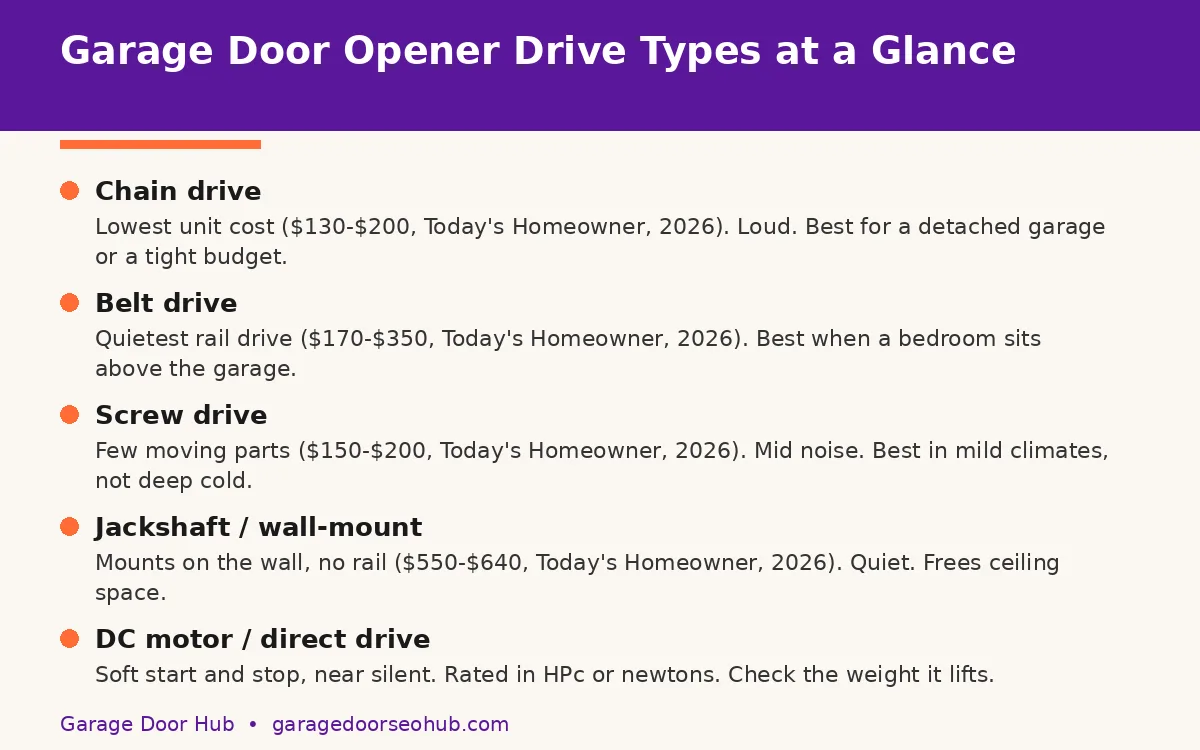
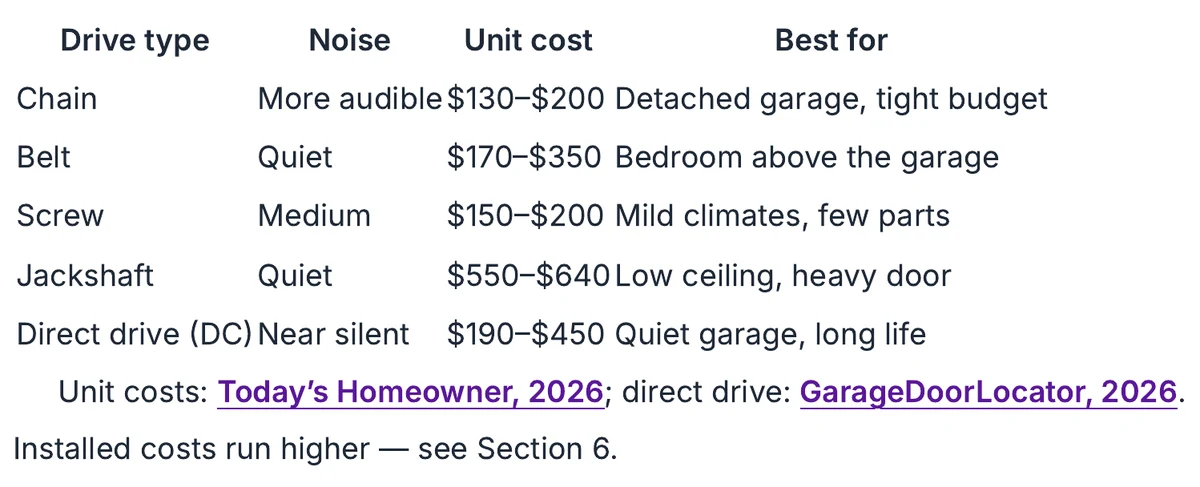
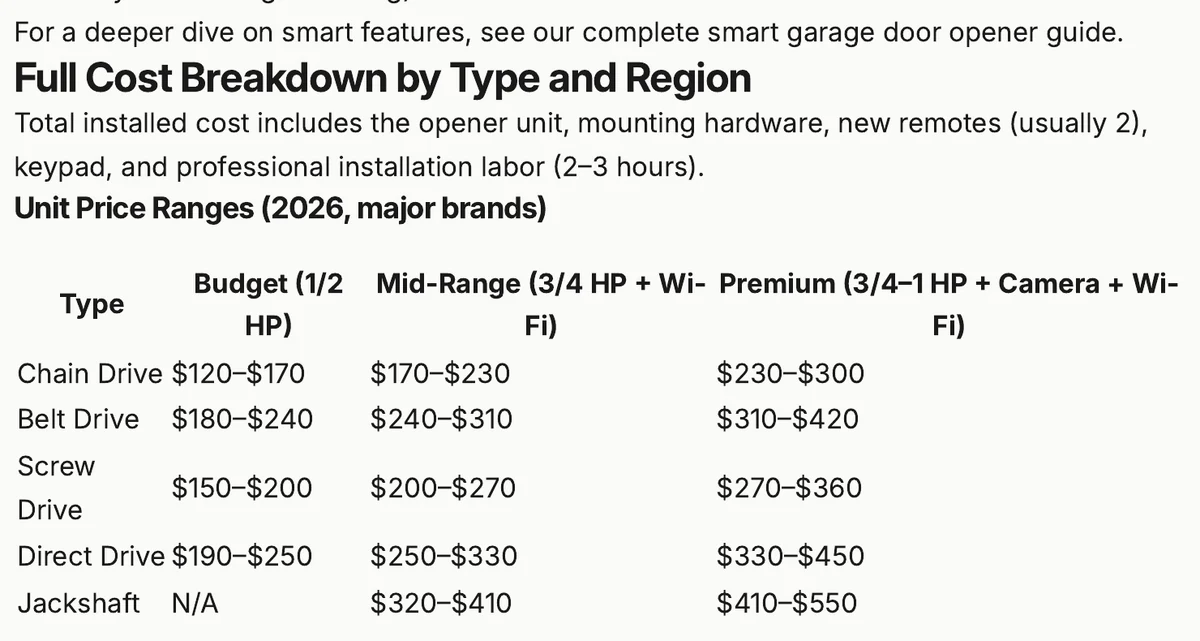
- Chain units cost $130 to $200 (Today’s Homeowner, 2026), the lowest price.
- The chain is strong, so it suits heavy doors and daily use.
- It is more audible than a belt drive (Garage Reference, 2026), with a rattle you can hear through the house.
- Pick chain for a detached garage.
- Belt units cost $170 to $350 (Today’s Homeowner, 2026), about $50 more.
- The belt needs no oil, so upkeep is less.
- It runs at 60 to 65 decibels, near normal talk (HomeMathLab, 2026).
- Pick belt for an attached garage or a garage under a bedroom.
- Screw units cost $150 to $200 (Today’s Homeowner, 2026).
- Fewer parts mean fewer things to wear out.
- It runs faster than chain or belt, about 10 to 12 inches per second (DesigningIdea, 2026).
- Pick screw for a mild climate, not for a cold garage.
- Jackshaft units cost $550 to $640 (Today’s Homeowner, 2026), the dearest type.
- No rail means no headroom lost, so the ceiling stays free for storage.
- Pick jackshaft for a low ceiling or a heavy wood door.
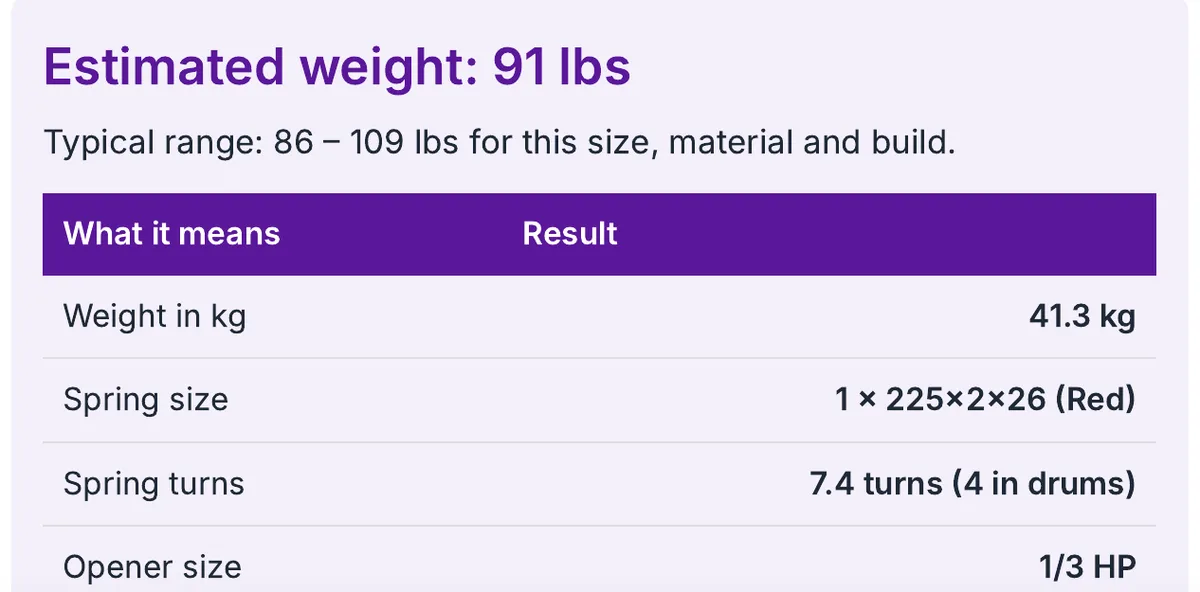
- A 9×7 single steel door weighs 91 lb by the Weight Calculator (range 86 to 109 lb): 1/2 HP is right.
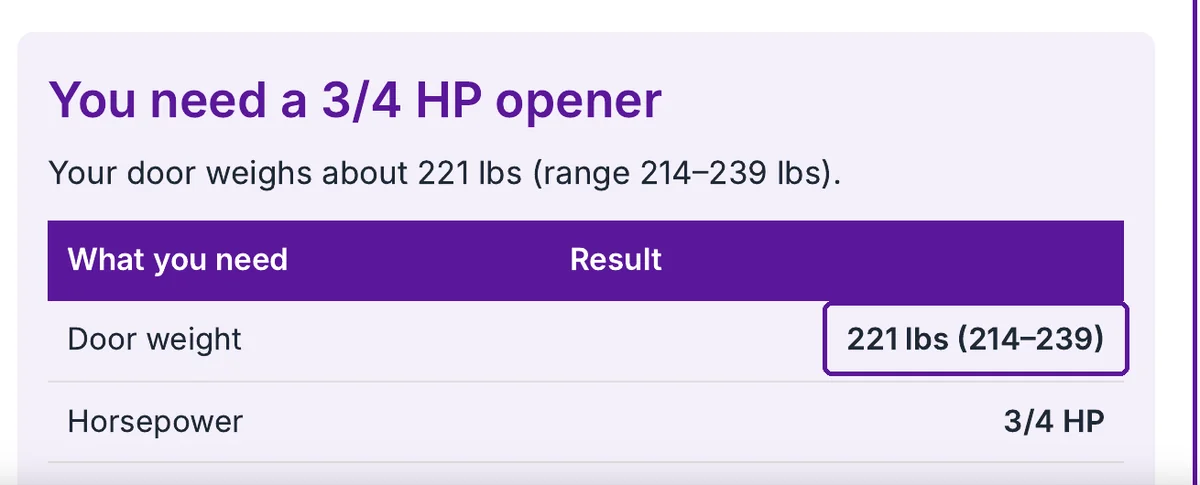
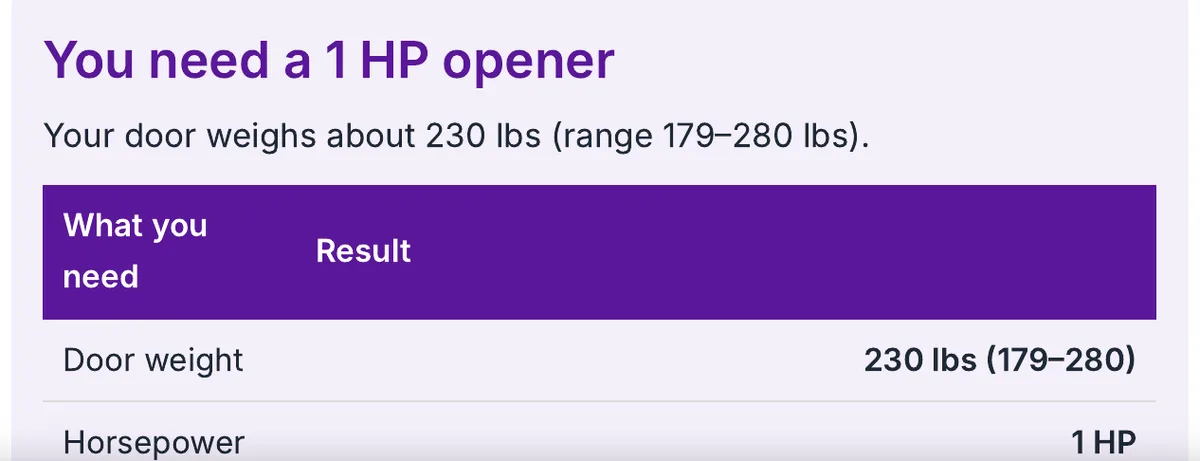
- The Opener Size Calculator puts a 16×7 double insulated door at 221 lb, so 3/4 HP is right.
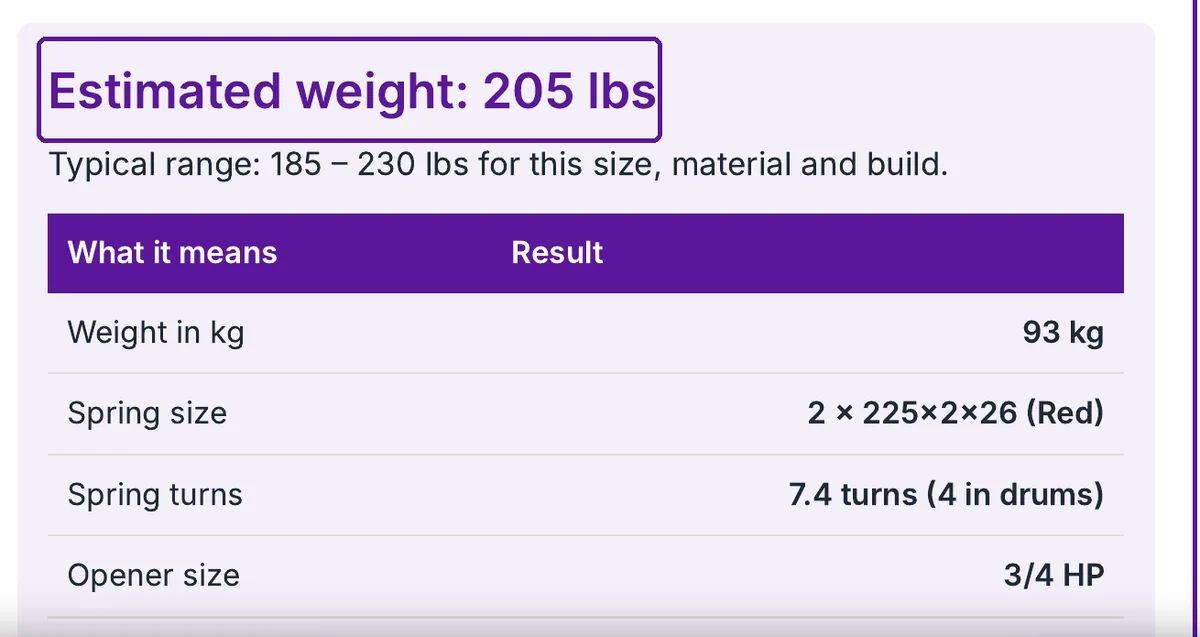
- The Weight Calculator gives 205 lb for triple-layer polyurethane, range 185 to 230 lb, and 180 lb for double-layer polystyrene, range 166 to 207 lb.
- All three weights sit in the 150 to 250 lb band, so all three need 3/4 HP.
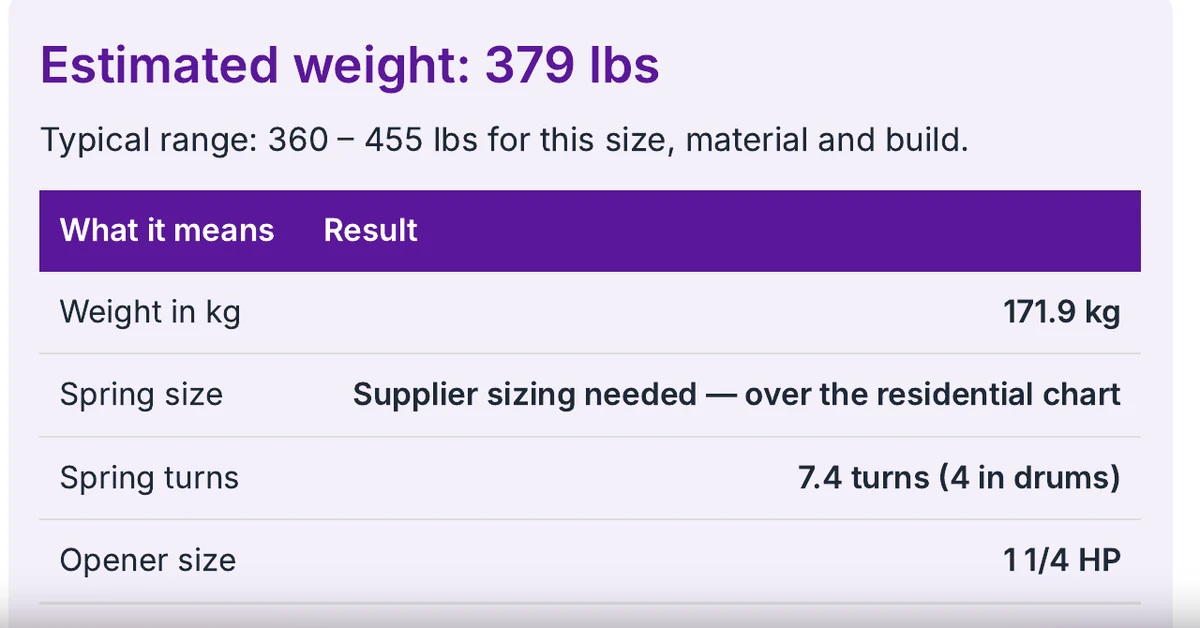
- A 16×7 solid wood door weighs 379 lb by the Weight Calculator (range 360 to 455 lb), or 230 lb by the Opener Size Calculator (range 179 to 280 lb).
- The two tools assume different builds. Size for 1 1/4 HP to cover both.
- Size up if you open the door 8 or more times a day.
- Size up if you plan to insulate the door later, since insulation adds weight.
- Size up for a door over 10 years old, since old springs add work.
- Never size down to save money.
- Open and close the door from the myQ app, from anywhere with signal.
- See if the door is open or closed, in real time, on your phone.
- Get an alert when the door opens or stays open too long.
- Download the myQ app and make an account with your email.
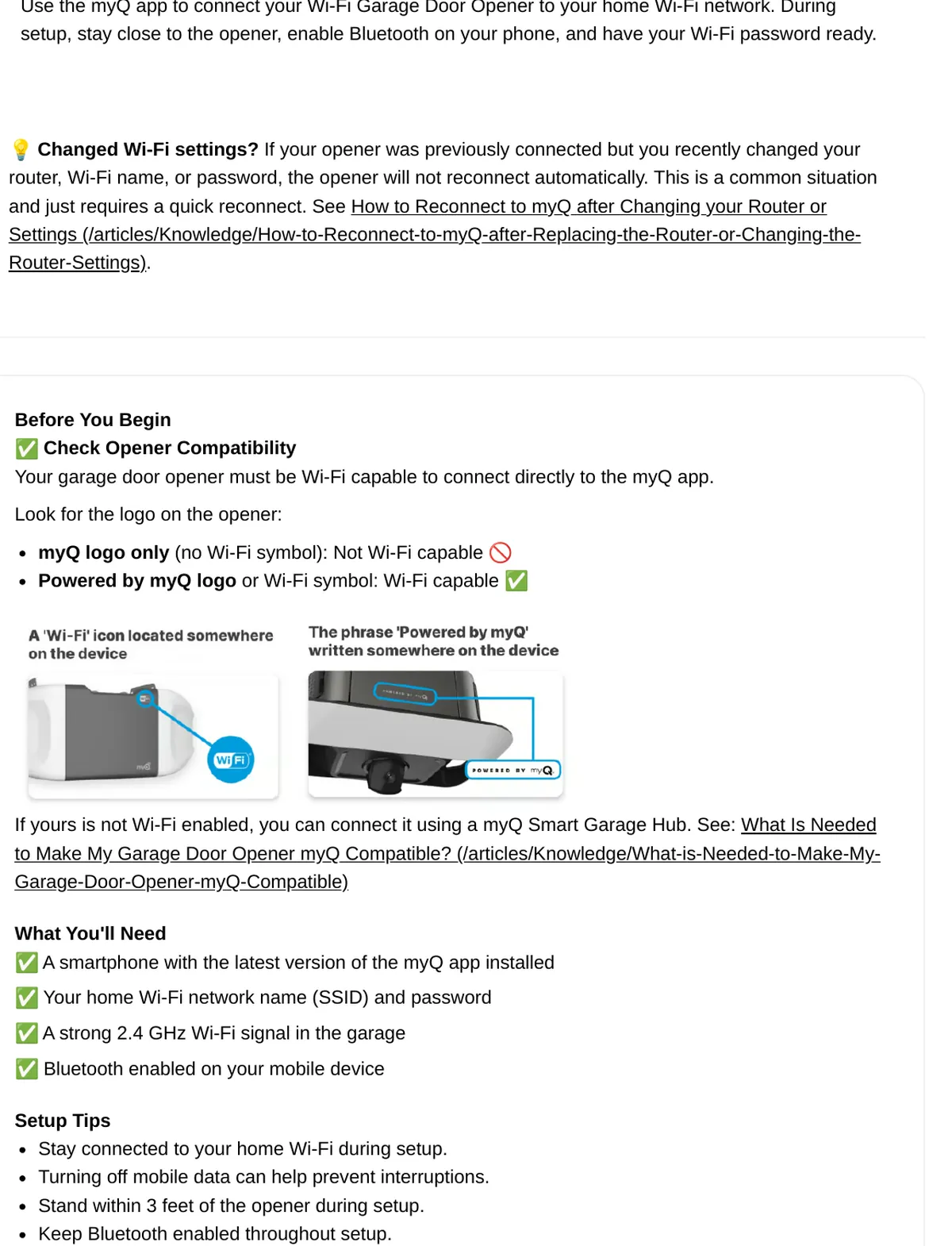
- Check the opener is Wi-Fi ready: look for a Wi-Fi mark on the motor head.
- Stand within 3 feet of the opener, and turn on Bluetooth on your phone.
- Tap Add Device, pick Garage Door Opener, then pick the motor spot.
- Pick your 2.4 GHz Wi-Fi network and type the password with care.
- Test the door from the app, then test it again from outside the house.
- Use 2.4 GHz Wi-Fi. myQ will not join a 5 GHz network.
- Keep Bluetooth on through setup.
- If the opener has a myQ mark but no Wi-Fi mark, it needs a Smart Garage Hub.
- Check the garage Wi-Fi first.
- Restart the router, then wait two minutes before you test the app again.
- Re-pair the opener if you changed the Wi-Fi name.
- Move the router closer, or add a Wi-Fi extender.
- A motor that runs while the door stays still means a stripped gear, at $100 to $300.
- A motor that hums but will not start means a dead capacitor, a cheap fix.
- For the full cost guide, see garage door opener repair cost.
- Chamberlain: blink counts give the fault code, and myQ is built into most new units. See Chamberlain garage door opener repair.
- LiftMaster: pro-grade units with myQ, and the same blink-code system as Chamberlain. See LiftMaster garage door opener repair.
- Genie: Intellicode rolling code and Safe-T-Beam sensors, with a Program button, not a Learn button. See Genie garage door opener repair.
- Balance decides life most: a door that holds halfway spares the motor.
- Worn springs kill openers, since the motor lifts the springs’ weight.
- If the safety reverse fails, call a pro at once.
- Check the lock button on the wall control first. Lock mode turns remotes off on purpose.
- Walk closer with the remote. If it works up close, the battery is weak or the range is short.
- Swap the battery. Most remotes take a CR2032 coin cell, and keypads often take a 9V or CR2032.
- Re-pair the remote: press Learn on the motor head, then the remote button within 30 seconds.
- Test the keypad PIN again, one try at a time, since too many wrong tries lock it out.
- LED lights on the opener can cut remote range. Swap them for opener-safe bulbs.
- A keypad with no lights means a dead battery or corroded contacts.
- For the full fix flow, see garage door remote not working.
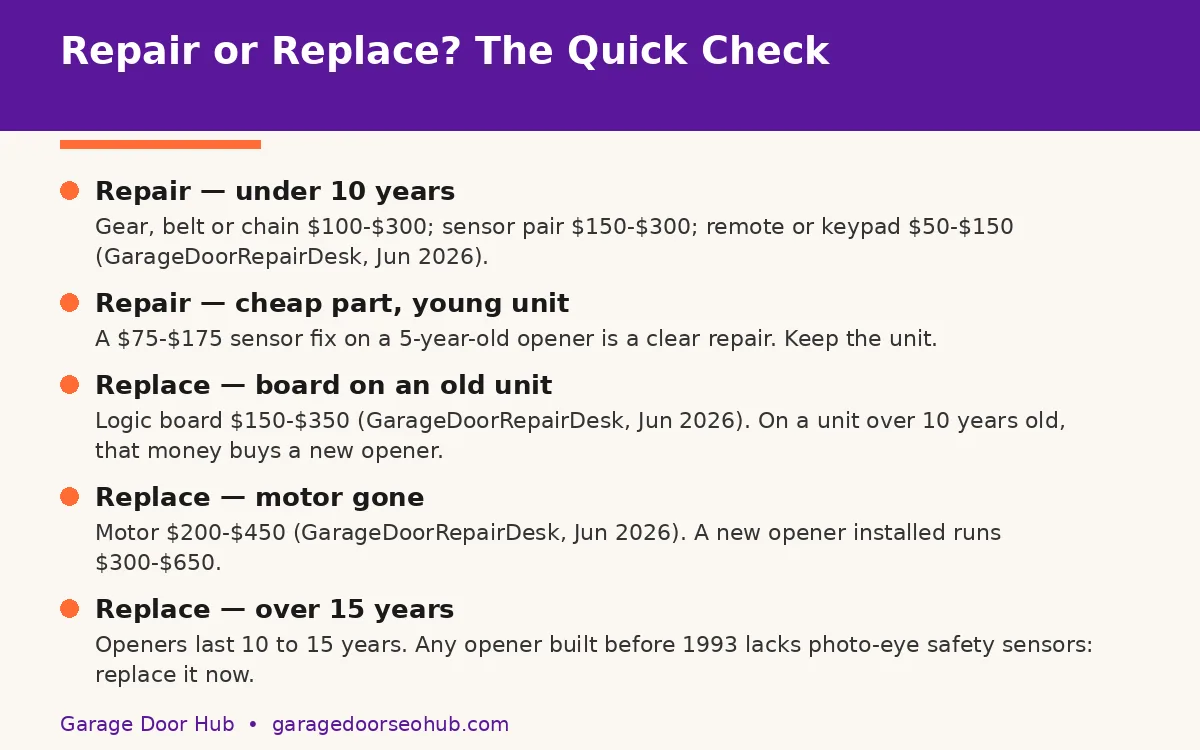
- Repair when the unit is under 10 years old and the part is cheap.
- Replace when the board or motor fails on a unit over 10 years old.
- Replace any opener built before 1993, since it lacks photo-eye safety sensors.
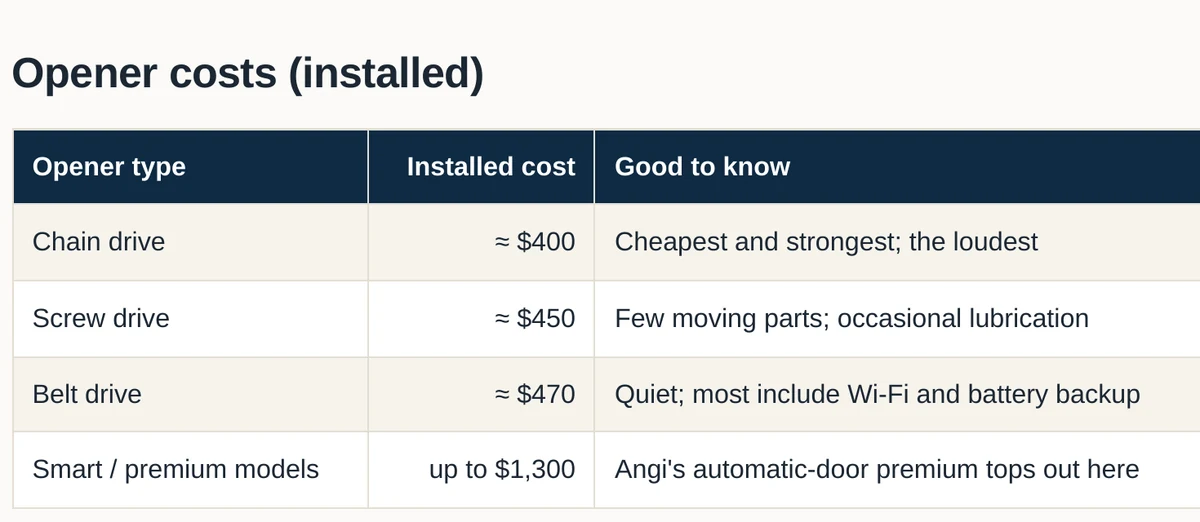
- Chain installed runs about $400, and belt about $470 (HomePriceFacts, November 2026).
- Labor runs $65 to $85 per hour, 2 to 6 hours (Angi, July 2026).
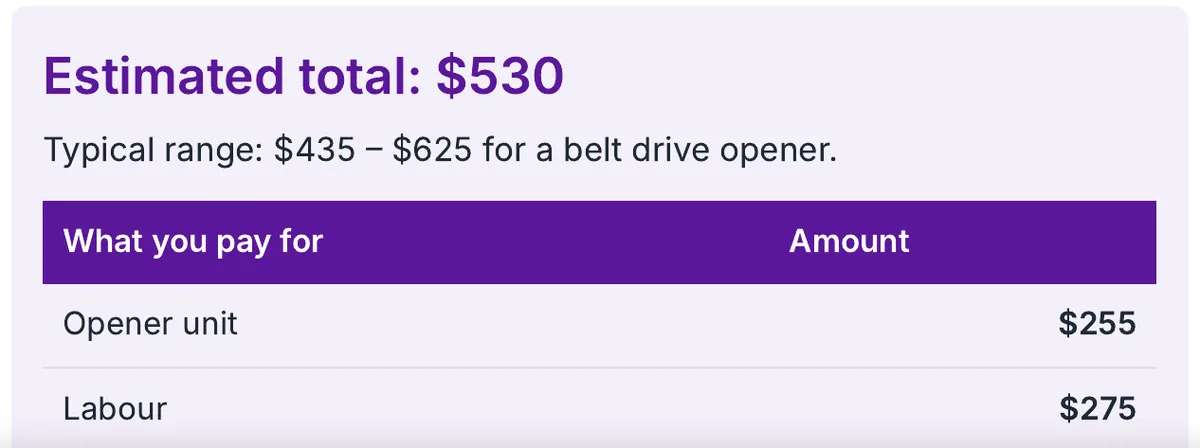
- The Opener Cost Calculator prices a belt-drive opener at $530 fitted, range $435 to $625.
- Angi — install average $380, range $220–$540, 21 May 2026. Checked 21 Nov 2026.
- Angi — pro install labor $65–$85 per hour, 2 to 6 hours, July 2026.
- Garage Reference — chain drives run louder than belt drives, 2026.
- Today’s Homeowner — opener types, 2026: chain $130–$200, belt $170–$350, screw $150–$200, jackshaft $550–$640.
- GarageDoorRepairDesk — opener repair cost by part, June 2026. Checked 20 Nov 2026.
- Appliance Analysts — 1/2 HP lifts about 300 lbs, 3/4 HP about 600 lbs. Checked 20 Nov 2026.
- GarageTransformed — HP chart, single vs double door. Checked 20 Nov 2026.
- Rax Doors — HP guide by door weight. Checked 20 Nov 2026.
- Chamberlain Group support — myQ Wi-Fi setup, 2.4 GHz required, Bluetooth, stand within 3 feet.
- EngineerFix — opener lifespan 10–15 years. Checked 20 Nov 2026.
- House Digest — opener lifespan 10–15 years, belt 15–20 years. Checked 20 Nov 2026.
- GarageDoorLocator — opener types and installed costs, 2026. Checked 20 Nov 2026.
- HomeMathLab — noise by drive type, 2026: belt 60–65 dB, chain 70–75 dB, direct drive 55–60 dB.
- DesigningIdea — screw drive speed 10–12 inches per second, 2026.
- HomePriceFacts — chain installed about $400, belt about $470, November 2026.
- LMS Garage Doors — 10 light blinks means a sensor fault on Chamberlain openers. Checked 20 Nov 2026.
- Garage Door Hub calculators — Opener Cost 1538 ($530 default), Opener Size 3824 (88 lb / 1/3 HP default). Live 15 Nov 2026.
Key takeaways
Table of Contents
1. How a Garage Door Opener Works
An opener does not lift your door alone. The springs do most of the lifting.
The parts that lift your door
Four parts do the work: the motor head, the rail, the trolley, and the safety sensors.
Example: A homeowner heard the motor run, but the door did not move. The trolley had slipped off the rail.
AC motors vs DC motors
Older openers use AC motors, and newer ones use DC motors.
2. Garage Door Opener Drive Types: Chain, Belt, Screw, Jackshaft, and DC
Drive type decides noise, cost, and upkeep. Pick it after horsepower.
| Drive type | Noise | Unit cost | Best for |
|---|---|---|---|
| Chain | More audible | $130–$200 | Detached garage, tight budget |
| Belt | Quiet | $170–$350 | Bedroom above the garage |
| Screw | Medium | $150–$200 | Mild climates, few parts |
| Jackshaft | Quiet | $550–$640 | Low ceiling, heavy door |
| Direct drive (DC) | Near silent | $190–$450 | Quiet garage, long life |
Unit costs: Today’s Homeowner, 2026; direct drive: GarageDoorLocator, 2026. Installed costs run higher — see Section 6.

Chain drive
A chain drive pulls the trolley with a metal chain, like a bicycle chain. It is the oldest design, and it is still the cheapest to buy.
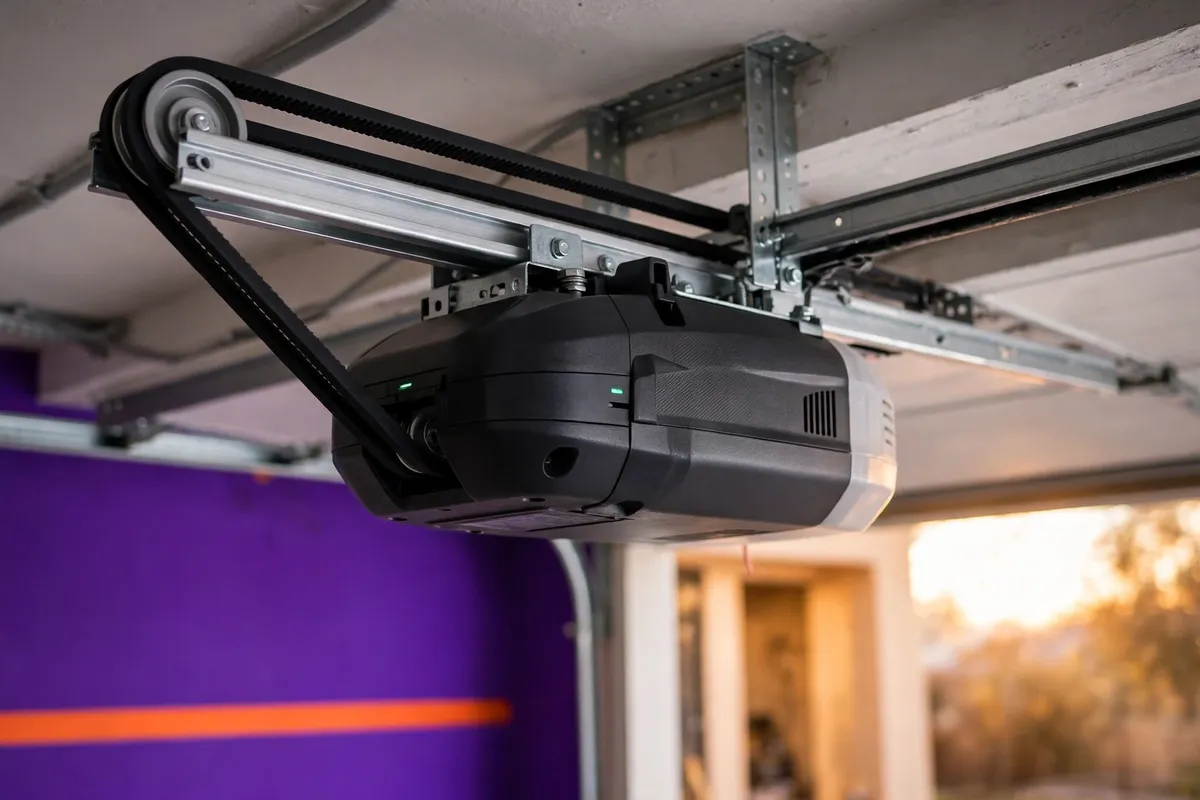
Belt drive
A belt drive works like a chain drive, but a steel-lined rubber belt replaces the chain. The belt kills the rattle, so the opener runs quiet.
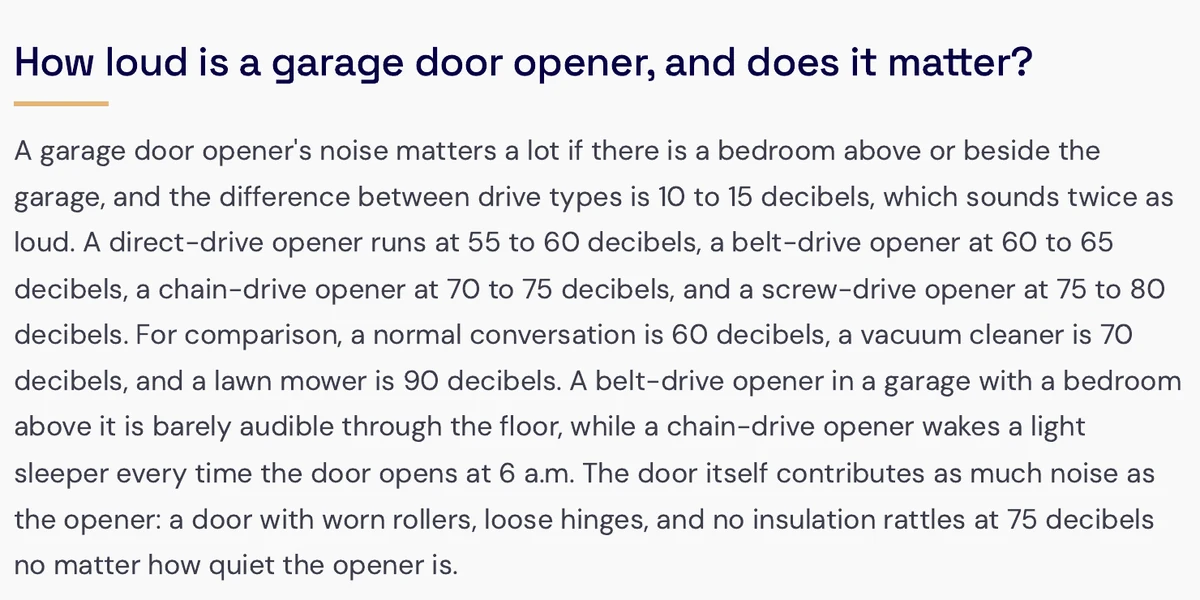
Example: A home with a bedroom above the garage swapped chain for belt. The morning door no longer woke the kids.
Screw drive
A screw drive turns a long threaded steel rod, and the trolley rides the thread.
Jackshaft and direct drive
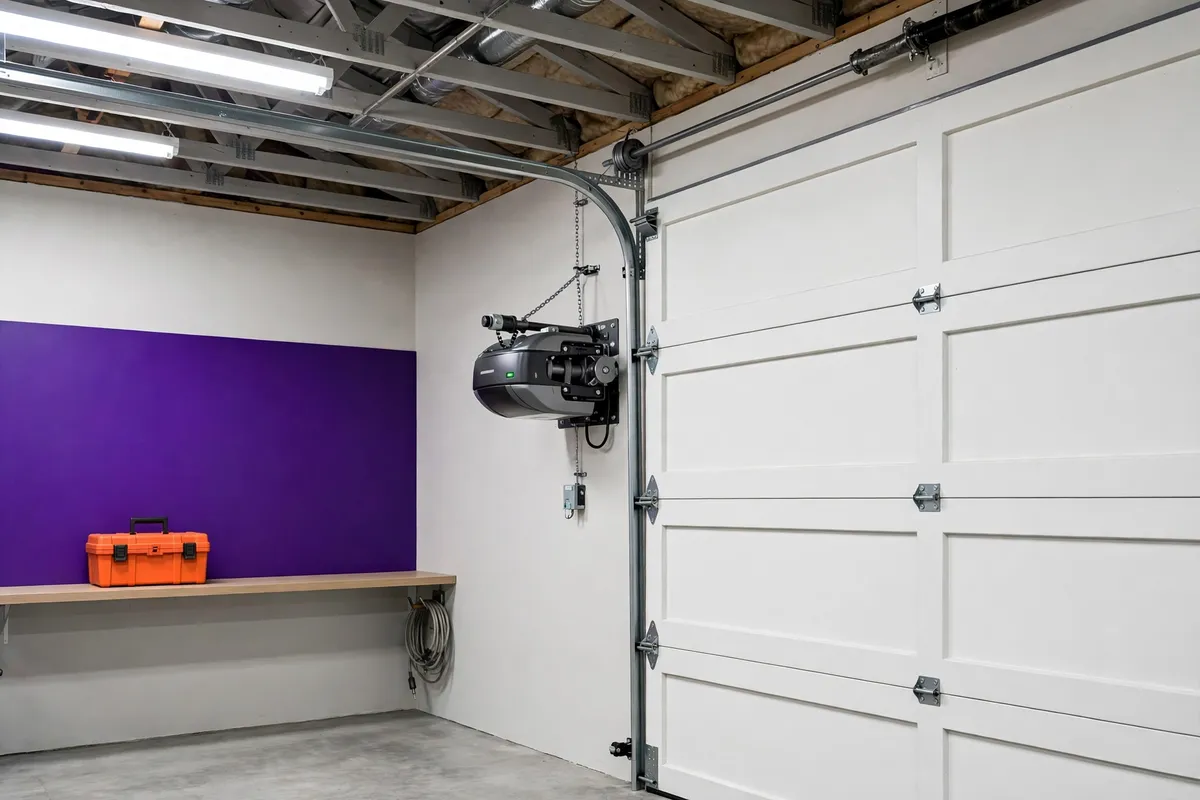
A jackshaft opener mounts on the wall and turns the torsion shaft direct. A direct-drive opener has one moving part: the motor itself rides the rail.
For the full face-off, see belt vs chain garage door opener.
3. What Size Garage Door Opener Do You Need?
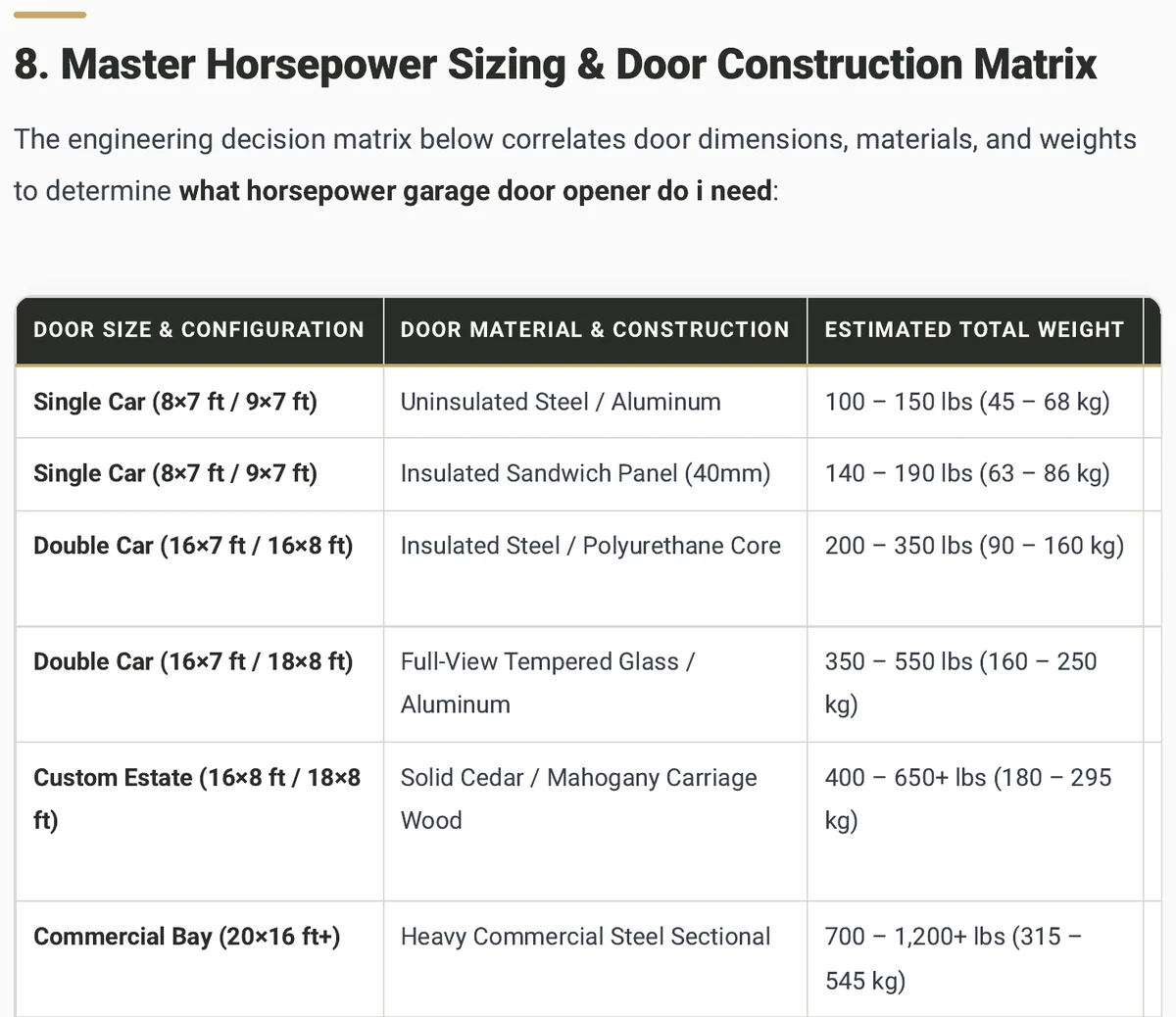
Size by door weight, not door size. Two doors can share a size and need a different opener.
Horsepower by door weight
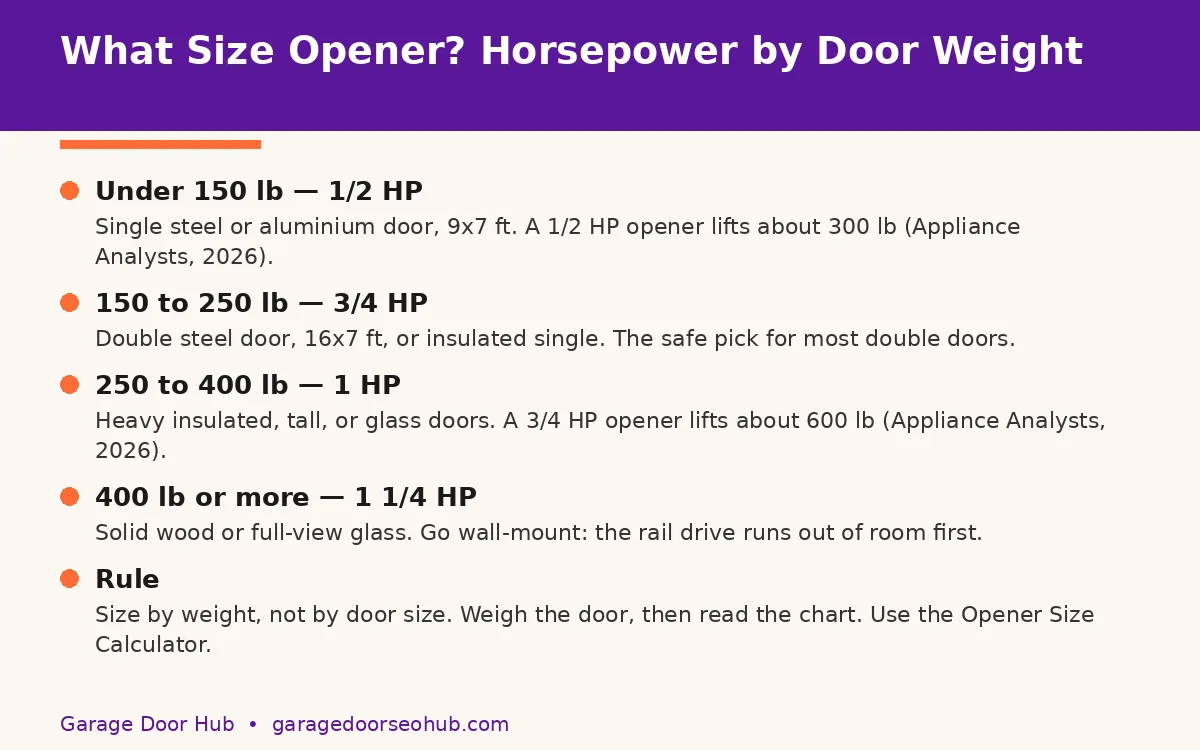
Find your door weight on the left, then read the HP on the right.
| Door weight | Door type | Opener size |
|---|---|---|
| Under 150 lb | Single steel, 9×7 ft | 1/2 HP |
| 150–250 lb | Double steel, 16×7 ft | 3/4 HP |
| 250–400 lb | Insulated, tall, or glass | 1 HP |
| 400 lb or more | Solid wood, full-view glass | 1 1/4 HP, wall-mount |
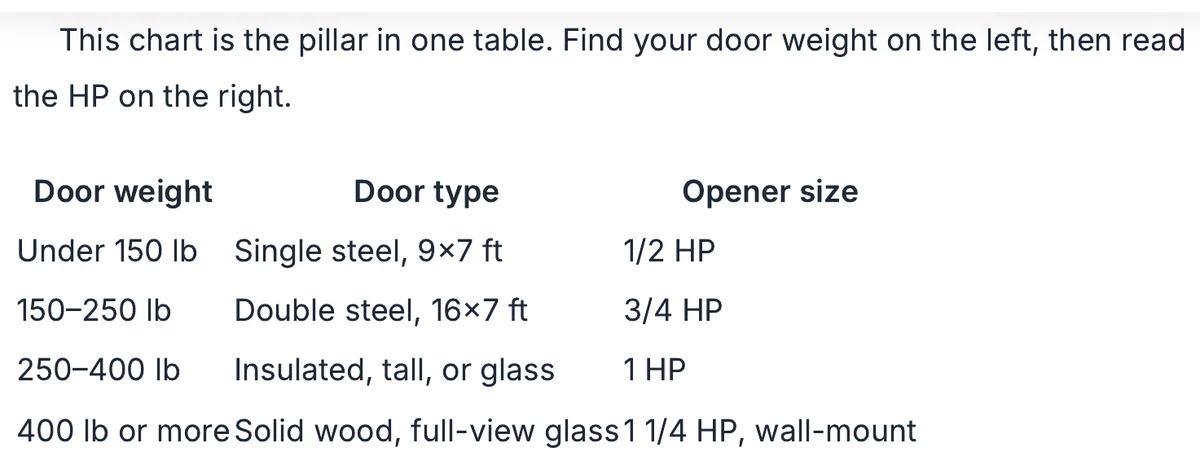
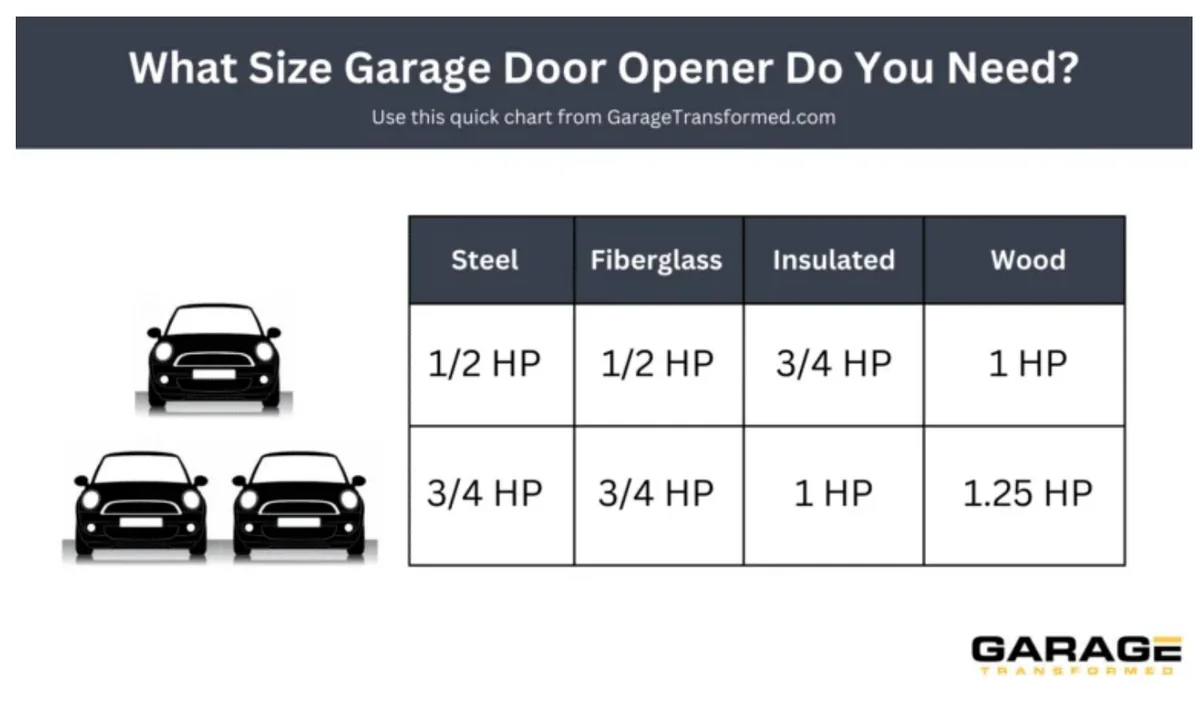
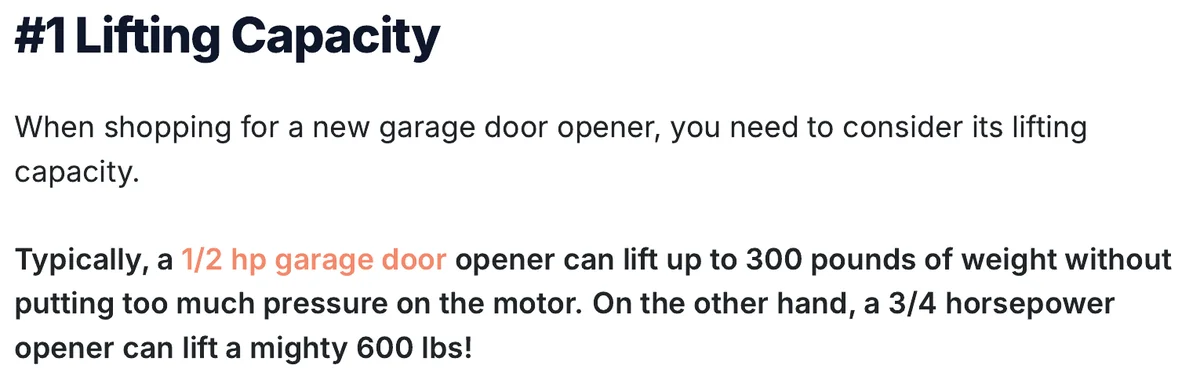
Sources: GarageTransformed and Rax Doors, 2026; lift figures: Appliance Analysts, 2026. A 1/2 HP opener lifts about 300 lb, and a 3/4 HP opener lifts about 600 lb.
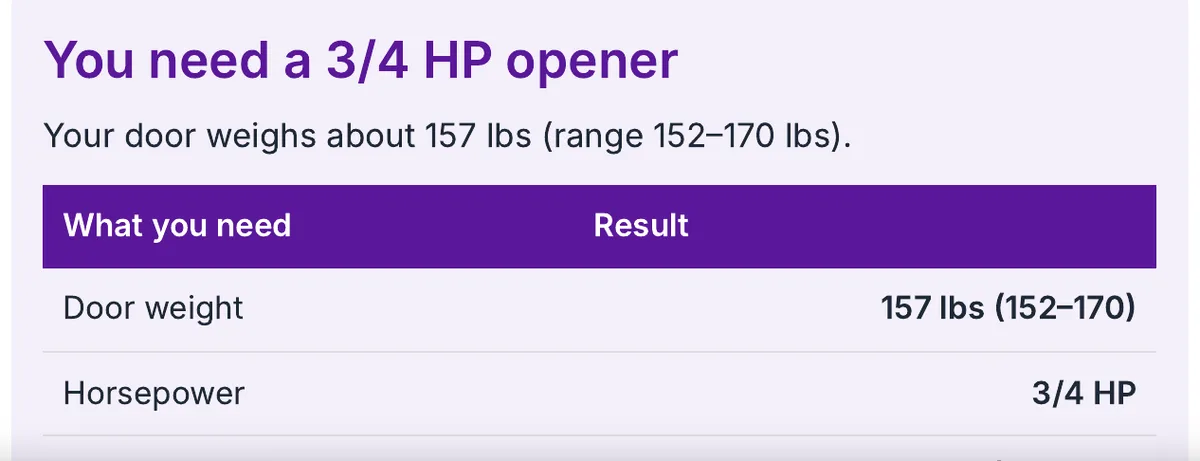
Example: Two 16×7 ft doors looked the same from the street. One was light steel at 157 lb, the other tall and insulated at 320 lb. The first needs 3/4 HP, and the second needs 1 HP.
When to size up
Size up when the door is heavy, tall, old, or used a lot. An undersized opener runs hot and wears out early.
For the full sizing guide, see what size garage door opener do I need.
4. Smart Openers and myQ
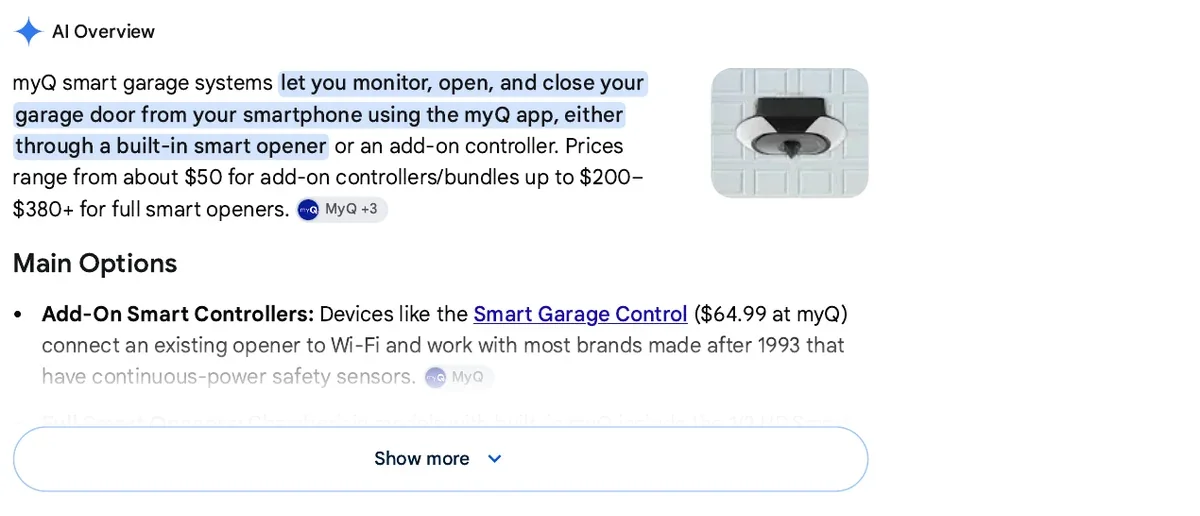
A smart opener adds Wi-Fi, so your phone opens the door and tells you when it is open. myQ is Chamberlain Group’s system.
What myQ does
myQ links your opener to your phone through home Wi-Fi. You can open the door from work, check it at night, and get an alert if it stays open.
Set up myQ in six steps
Set up myQ with the app, not with the wall control. Have your Wi-Fi password ready, and stand near the opener while you pair it.
Source: Chamberlain Group support, 2026. myQ needs a 2.4 GHz Wi-Fi signal.
When myQ drops off Wi-Fi
myQ drops most often after a router change, a power cut, or a weak garage signal. The door still works from the wall control, so the fault is the link, not the opener.
Example: A myQ opener went offline after a new router arrived. The Wi-Fi name had changed. Re-pairing it to the new name fixed it in five minutes.
For the full smart guide, see myQ garage door opener.
5. When Your Opener Breaks: Repair at a Glance
Most opener faults are small: a sensor, a gear, or a battery.
What each repair costs
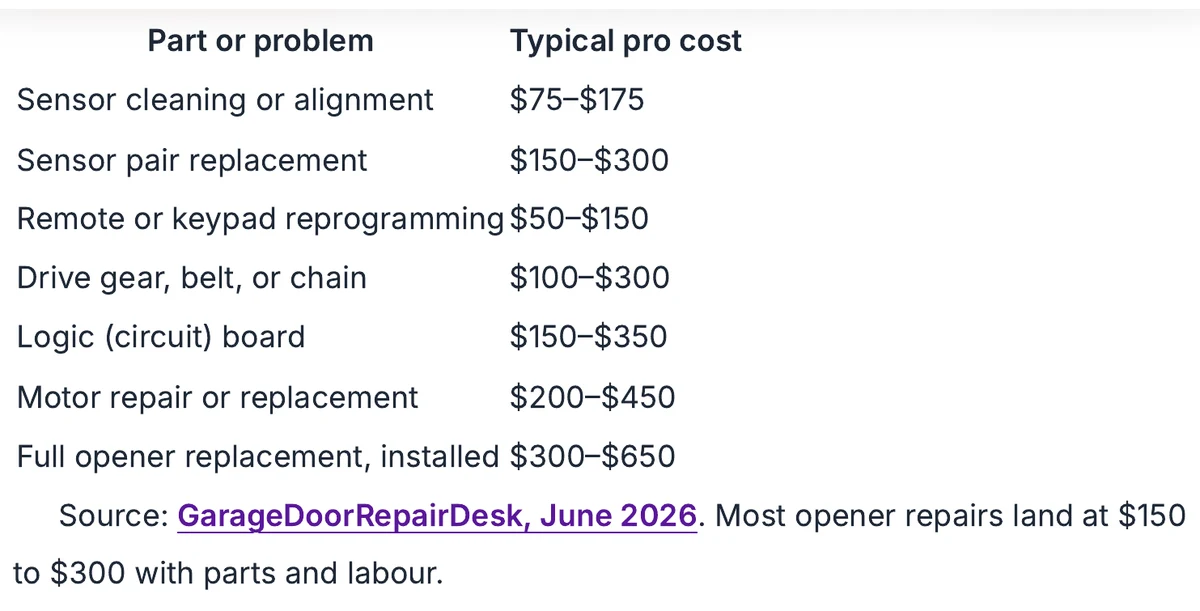
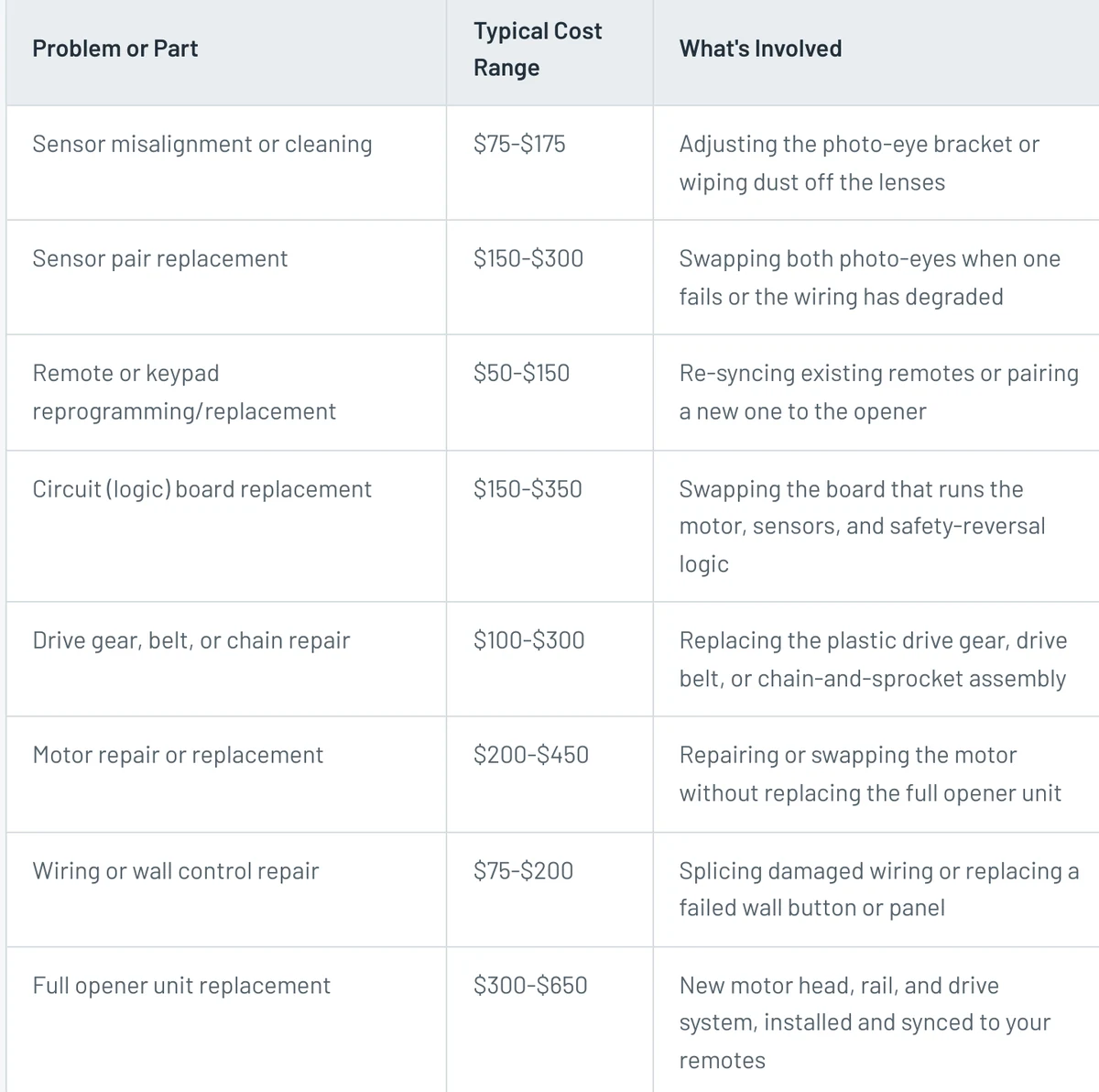
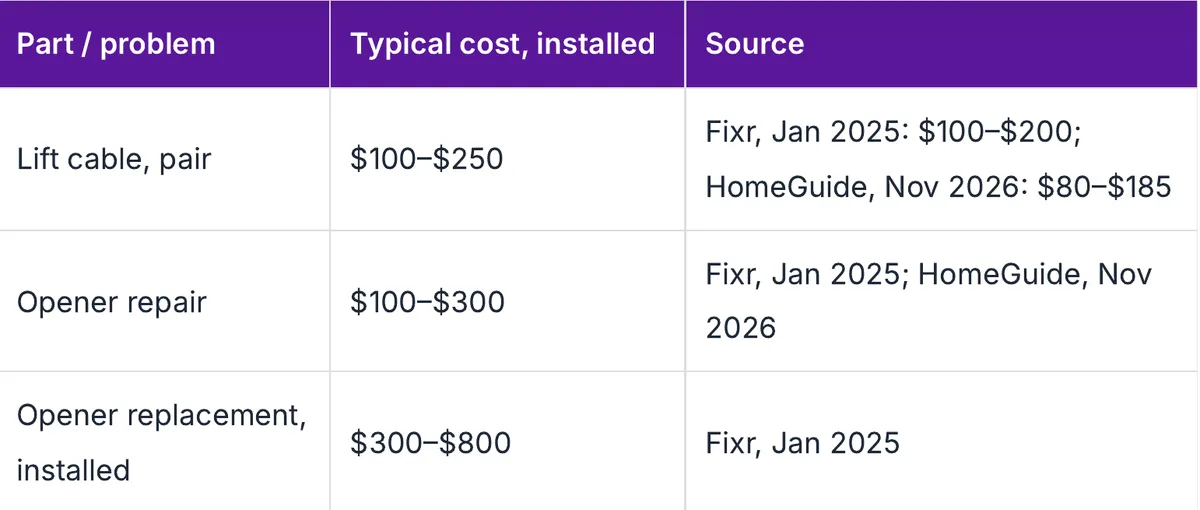
Repair cost follows the part that failed. The table below gives the pro price for each common fix, with parts and labor in one number.
| Part or problem | Typical pro cost |
|---|---|
| Sensor cleaning or alignment | $75–$175 |
| Sensor pair replacement | $150–$300 |
| Remote or keypad reprogramming | $50–$150 |
| Drive gear, belt, or chain | $100–$300 |
| Logic (circuit) board | $150–$350 |
| Motor repair or replacement | $200–$450 |
| Full opener replacement, installed | $300–$650 |
Source: GarageDoorRepairDesk, June 2026. Most opener repairs land at $150 to $300 with parts and labor.
Example: An opener hummed but the door did not move. The capacitor had died, and the fix cost far less than a new opener.
Chamberlain, LiftMaster, and Genie
The three big brands share most faults, but their codes and buttons differ. Chamberlain and LiftMaster are one firm, so they share parts and myQ. Genie runs its own system.
How long an opener lasts
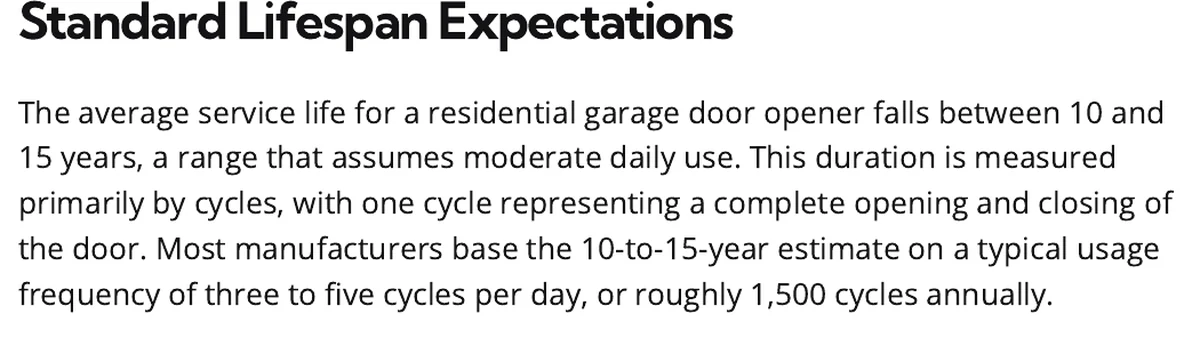
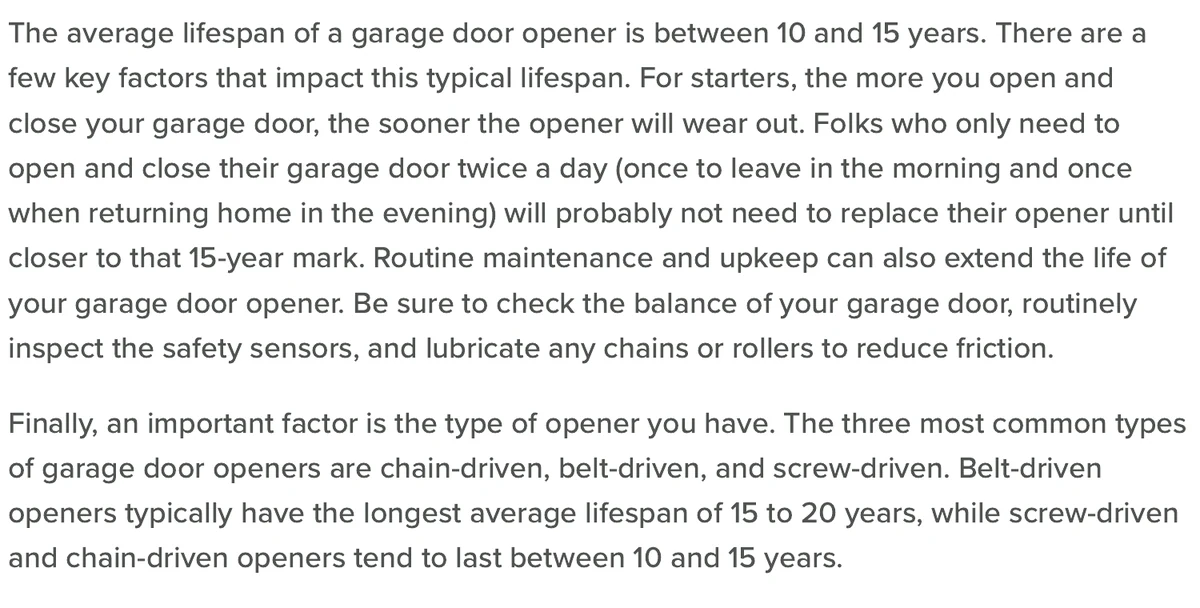
A home opener lasts 10 to 15 years with fair use. Belt drives can reach 15 to 20 years, while chain and screw drives sit at 10 to 15 years.
Sources: EngineerFix and House Digest, 2026. Any opener built before 1993 lacks photo-eye safety sensors and should be replaced now.
For the wider repair picture, see the garage door repair guide and its opener cost table.
6. Remotes, Keypads, and Install vs Replace
The remote and keypad fail more often than the opener itself. Most of those faults cost nothing, so check them first.
Remote or keypad not working
If the wall button works but the remote does not, the opener is fine.
Example: Every remote in a house died on the same day. The wall control lock had been bumped on, and a two-second hold fixed them all.
For the sensor side of the same fault, see garage door sensors, remote, and keypad troubleshooting.
Install vs replace: the 50% rule
Use the 50% rule: if the repair costs more than half a new opener, replace it. A new opener brings a warranty, quieter drive, and modern safety.
For the full install guide, see garage door opener installation cost.
What a new opener costs installed
A new opener installed averages $380, with most jobs at $220 to $540 (Angi, May 21, 2026).
If the door itself is worn, noisy, or bent, price the door too. See noisy garage door causes and fixes, and the new doors guide if a new door is the smarter spend. Find a pro at Garage Door Hub once you know your price.
Video: Garage Door Openers: The Complete Guide (Coming Soon)
A 60 to 120 second video for this guide is coming soon. It will cover drive types, sizing by weight, myQ setup, repair costs, and install vs replace.
Garage Door Hub connects homeowners with trusted local garage door pros. Need a repair? Need a replacement? Start here. First, find out what it should cost. Then, price your exact job with our free calculator. Next, find a pro near you. Fast. No jargon. No guesswork. No surprise bills. Just clear prices, honest guides, and a local pro you can call today.
FAQ
Can I use a garage door opener without power?
Only if it has battery backup. A DC opener with a charged backup battery opens the door a few times in a power cut. An AC opener with no backup will not move, so use the red release cord.
How much does it cost to replace just the remote?
Reprogramming or a new remote runs $50 to $150 (GarageDoorRepairDesk, June 2026). Try a fresh CR2032 battery first, since a dead battery is the most common cause.
Why does my garage door opener light blink 10 times?
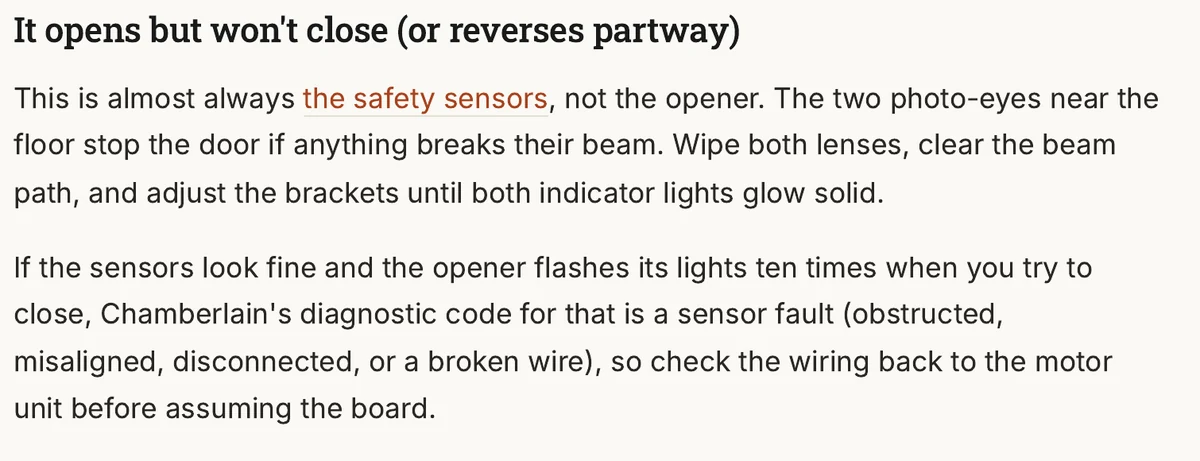
Ten blinks means a sensor fault on Chamberlain and LiftMaster openers. Check that both sensor eyes are clean, lined up, and lit, and look for a cut wire.
Is a jackshaft opener worth the extra cost?
Yes, if your ceiling is low, your door is heavy wood, or you want the ceiling free. If none of those apply, a belt drive gives you the same quiet run for far less.
Can I install a garage door opener myself?
A handy homeowner can fit a rail opener, but a pro install takes 2 to 6 hours (Angi, July 2026). The rail must be level, the sensors must line up, and the safety reverse test must pass.
Sources